What Is PCSL? Divisions, 2-Gun Rules, Membership Cost & PPS Scoring (2026)
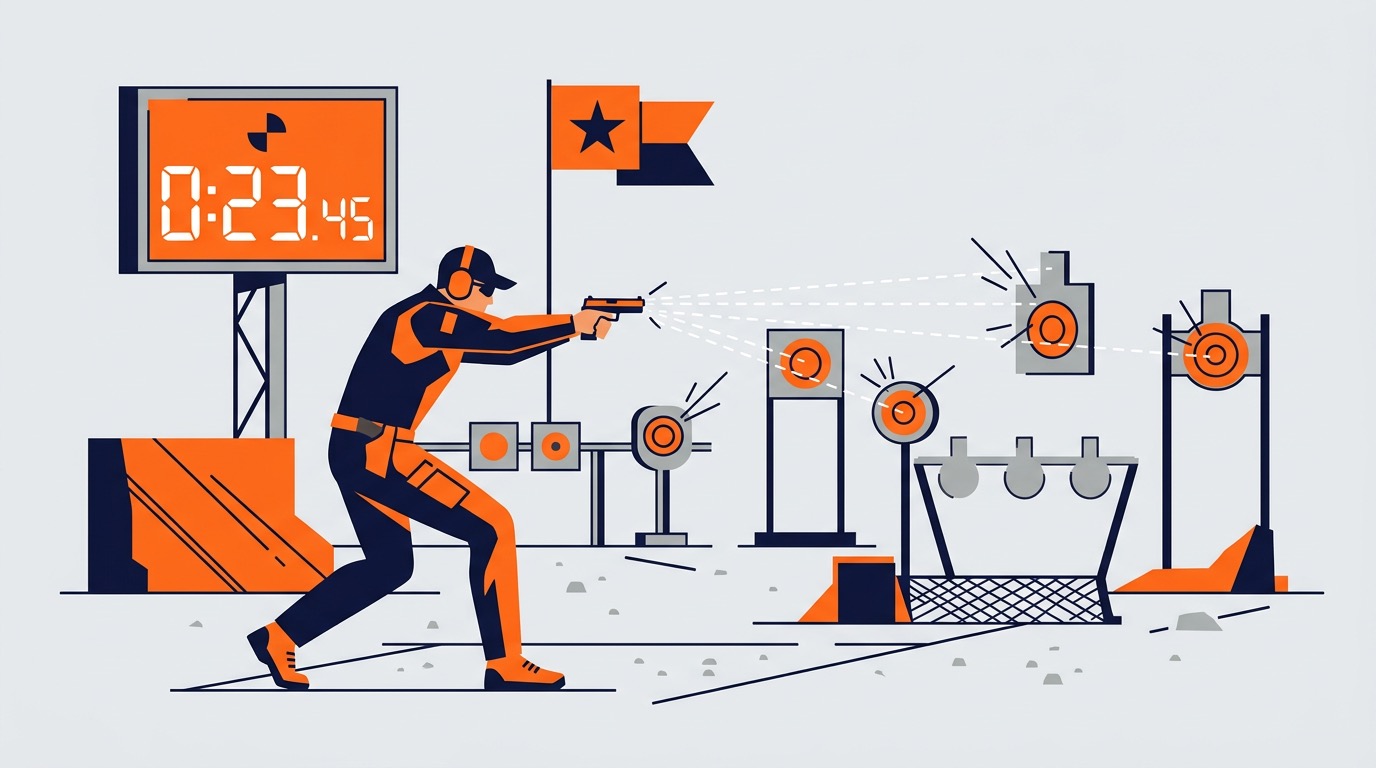
🎯 In a hurry? Here’s the one thing to know. PCSL scores you on PPS (Points Per Second) = total points ÷ time — which means half your score is literally the clock. A more expensive pistol won’t raise your PPS, but shaving fractions of a second off your draw, transitions, and reloads will — and the only way to measure that is a shot timer. The most useful one is free: the AirsoftShotTimer app records your splits and par times from your phone, so you can train at home with airsoft or dry fire before you ever spend $130+ on hardware.
📌 Updated for the 2026-05-05 rulebook. PCSL changed its division structure twice this year: Actual Carry Pistol was replaced by Defensive Practical and Defensive Competition in February, and Practical Irons was removed entirely in May. Nearly every PCSL explainer online — including the April 2023 rulebook PDF that still ranks in search — describes a lineup that no longer exists. The divisions section below is written against the current rulebook.
What Is PCSL?
If you’ve been paying attention to the competitive shooting world over the past few years, you’ve probably heard people buzzing about PCSL — the Practical Competition Shooting League. Founded in 2021 by champion shooter Max Leograndis, PCSL has quickly carved out a reputation as one of the most exciting and accessible practical shooting sports in North America. Their tagline says it all: “The Future of Competition Shooting.”
So what makes PCSL different from the other organizations you already know? In short, PCSL takes the best elements of USPSA, IDPA, and 3-Gun and blends them into a streamlined, modern format. It was designed from scratch for today’s shooter — someone who wants challenging, fair competition without drowning in a 200-page rulebook or dealing with organizational politics.
When I first walked into a PCSL match, what struck me immediately was the vibe. It felt less like a formal sanctioned event and more like a group of skilled shooters who genuinely wanted to push each other. The stages were creative, the rules were intuitive, and I didn’t need a law degree to understand the scoring. If you’ve ever been frustrated by the complexity of other organizations, PCSL might be exactly what you’re looking for.
💡 New to practical shooting entirely? Start with our Complete Guide to Practical Shooting for a broad overview before diving into PCSL specifics.
Why PCSL Is Growing So Fast
There are a lot of shooting sports organizations out there, so why is PCSL gaining traction faster than almost anything else? A few reasons stand out.
Open-Source Ruleset
This is the big one. PCSL’s ruleset is completely open-source. Any club, range, or group of shooters can adopt the PCSL rules, modify them for their local needs, and run matches — no approval from a national board required. There’s no bureaucracy standing between you and a match. If your local club wants to host a PCSL event this Saturday, they just… do it. (Clubs can now optionally affiliate with PCSL for a flat $300 per year to get official scoring uploads and shooter tracking — more on that below — but nobody has to.)
Compare that to organizations where you need sanctioning, insurance arrangements, and annual club dues before you can even think about posting a match. The open-source model removes friction, and that’s why you’re seeing PCSL pop up in places where other sports haven’t been able to get a foothold.
Simplified, Modern Rules
PCSL was written in 2021, not in the 1970s. The rules reflect how people actually shoot today. There are no legacy provisions that exist because “that’s how we’ve always done it.” Everything is designed to be intuitive — if something makes sense on the range, it probably aligns with the PCSL rulebook.

Focus on 2-Gun
While PCSL offers pistol-only and rifle-only formats, their flagship is the PCSL 2-Gun match — pistol and rifle on the same stage. This combines the best parts of 3-Gun competition without requiring a shotgun (which many shooters find to be the most expensive and least practical firearm to maintain for competition). If you already own a pistol and a rifle, you’re ready for PCSL 2-Gun.
Membership Is Optional — What PCSL Costs in 2026
Want to shoot a PCSL match? Just show up, register, and compete. You still don’t need a membership card to shoot — matches remain open to everyone, and that hasn’t changed.
What has changed is that PCSL now offers optional paid tiers, rolled out as the league matured. An individual standard membership runs $100 per year, and there’s a $1,000 one-time lifetime membership (sold as “Founding membership” through 2025, with some extra perks for early supporters). On the club side, ranges can affiliate for a flat $300 per year with no per-shooter activity fees — and starting in 2026, affiliated clubs get access to a club dashboard that uploads match scores automatically so their shooters’ results are tracked by the league.
So why pay if matches are open? Membership is how the league funds itself without gatekeeping the sport, and it’s the path to having your results officially tracked as PCSL builds out shooter classification. If you’re just trying your first match, save the $100 — spend it on ammo. If you’re hooked after three matches and want your scores to count toward something, that’s when membership starts making sense.
PCSL Scoring System: Points Per Second (PPS)
Understanding the scoring system is crucial before you step onto the line. PCSL uses a Points Per Second (PPS) system that will feel familiar if you’ve shot USPSA or IPSC, but with an important simplification.
How PPS Works
The formula is straightforward:
PPS = Total Points Earned / Time (in seconds)
You engage all the targets on a stage, and your total points are divided by the time it took you to complete the stage. Higher PPS means better performance. This is essentially the same concept as USPSA’s Hit Factor, but PCSL calls it PPS to keep the language clean and consistent.
There Is No Major/Minor — But There Is Still a Power Factor Floor
Here’s where PCSL diverges from USPSA in a meaningful way: there is no major/minor scoring distinction. A 9mm shooter and a .45 ACP shooter earn exactly the same points for hitting the same zone, so nobody is pushed toward hot, expensive, harder-to-control loads just to buy a point per hit.
What gets repeated wrongly on club pages and forums, though, is that PCSL therefore has “no power factor at all.” Read the division tables and you’ll find that isn’t true. Practical, Defensive Practical, Defensive Competition and PCC all carry a minimum power factor of 125. Only Competition division waives the floor entirely. The distinction matters if you load your own ammunition light for recoil: a 115-grain bullet at 1,020 fps makes 117 PF and will fail chrono in Practical, while the identical load is perfectly legal in Competition. Every division also caps bullet velocity at 1,600 fps and accepts calibers from 9x19mm up to .45 ACP.
There’s a deeper takeaway here that new shooters often miss: because the denominator in PPS is time, half of your score lives on the timer. Two shooters with identical hits will place differently if one draws a third of a second faster or reloads half a second quicker. That’s exactly why serious competitors train with a shot timer — without measuring time, you simply can’t see where you’re bleeding it. You don’t need a $130 CED 7000 to start; the free AirsoftShotTimer app will log your splits and par times until you’re regularly on a live-fire range.
Point Values on PCSL Targets
Here’s where PCSL gets really interesting — the point values written into Section 11.3 of the rulebook:
- T-Zone (“Tango”, the older K-Zone behaves identically): a single hit counts as two separate Alpha hits — 10 points
- A-Zone (“Alpha”): 5 points
- C-Zone (“Charlie”): 3 points
- D-Zone (“Delta”): 1 point
- Miss (“Mike”): minus 10 points, and you are assigned one miss for every hit you are short of the required count
- No-shoot: minus 10 points per hit, capped at two penalties on a paper or static-steel penalty target and one on falling steel
- Procedural: minus 10 points per occurrence
Two of those deserve a second look, because they are the numbers most often reported wrongly online. A miss is not zero — it is a ten-point subtraction, so dropping one round off a target swings you 15 points relative to an Alpha. And steel counts for 5 points, the same as an Alpha, with paper needing two hits and steel one unless the written stage brief says otherwise. Your stage points can be dragged down by penalties but never below zero.
The T-Zone is the game-changer on the upside. That 10-point hit is worth twice an A-zone, which means precision shooters who can consistently find it have a massive scoring advantage — even if they’re slightly slower.
Worked through end to end, a stage with 24 required paper hits and 3 steel hits is worth 135 points (27 × 5). Shoot 20 Alphas, 3 Charlies, 1 Delta and 3 steel and you have banked 125 points; do it in 37.00 seconds and your Hit Factor is 3.3784. If the division winner shot 4.5961, you earned 73.5053% of the stage, which becomes 99.2326 match points. Notice what the arithmetic is telling you: shaving two seconds off that run is worth more than converting two Charlies into Alphas.

The T-Zone Target (and Why the K-Zone Is Now Legacy)
If there’s one thing that defines PCSL as a sport, it’s that small, high-value box in the middle of the target. What has changed — and what almost every write-up online still gets wrong — is what it’s called and which targets are actually legal.
The Four Targets, and Which One You’ll See
Chapter 10 of the rulebook recognises four paper targets: the PCSL Practical Target, the Mini Practical Target, the Competition Target, and the K-Zone Target. All of them carry the same four scoring zones — T, A, C and D, separated by perforated lines — and each is two-sided by design: the brown side is always the handgun target, the white side is always the rifle target. In a 2-Gun or Pistol Caliber 2-Gun match that rule has a practical consequence people trip over on their first stage — your PCC replaces your rifle, not your handgun, so you engage white paper with it and brown paper with your pistol.
The K-Zone target is the one that has been quietly retired. It was the standard PCSL target until 2025; under the current rulebook it survives only as legacy inventory, usable at Level 1 matches and never on classifier stages, and it may not be used at Level 2 events or higher. Where it does appear, the K-Zone (“Kilo”) functions identically to the T-Zone (“Tango”). So if a club flyer still says “K-Zone,” nothing changes about how you shoot it — but if you are chasing a PCR classification, the stage that counts will be shot on a T-Zone target.
One more compatibility rule worth knowing before you show up: K-Zone targets may not be mixed with Practical targets in the same match, but they may be used alongside full-size Competition targets.
What Is the T-Zone?
The T-Zone is a small, high-value scoring area located in the center of the PCSL target. Think of it as a bullseye within the A-zone. Worth two Alpha hits — the full 10 points — it’s the highest-value zone on the target and the one that separates good shooters from great ones.
The PCSL target is also more compact than standard USPSA or IDPA targets. The overall silhouette is smaller, and the scoring zones are tighter. This means the skills that worked for you on a generous USPSA target may not translate directly — you need to be more precise.
Why the T-Zone Matters
The T-Zone fundamentally changes your shooting strategy. In USPSA, many competitive shooters train to hammer fast A-zone hits and move on. The difference between an A-zone and a C-zone is only 1-2 points, so speed almost always wins over precision.
In PCSL, the math is different. The gap between a T-Zone hit (10 points) and an A-zone hit (5 points) is enormous. If you’re facing a stage with 12 targets and you nail all T-Zones versus all A-zones, that’s a 60-point difference — easily enough to change your stage placement even if the T-Zone shooter was a full second slower.
This rewards the shooter who can balance speed and accuracy at a higher level. You can’t just spray and pray your way through a PCSL match. Every shot has to count, especially those aimed at the T-Zone.
Training for the T-Zone
If you’re coming from USPSA or IDPA, you’ll want to tighten up your accuracy standards. Here’s a practical approach:
- Start at 7 yards and shoot groups at a 3-inch circle (approximately T-Zone size)
- Use a shot timer to track your split times while maintaining T-Zone accuracy
- Gradually increase distance to 10, 15, and 20 yards
- Practice transitioning between targets while keeping your point of aim tight
💡 Our AirsoftShotTimer app is perfect for T-Zone accuracy drills. Set par times and track your splits as you work on tightening your groups. Check out our Shot Timer Training Guide for structured drill programs.
PCSL Divisions Explained (2026 Rulebook)
Before anything else, here is the answer to the question that sends most people in circles: a PCSL match does not have one fixed division list. Ask in a Facebook group and one club will tell you flatly that “PCSL only has two divisions, Practical and Competition,” while the registration page at the range down the road offers five. Both are right, because they’re describing different match types.
A PCSL Pistol match (“1-Gun” on many club flyers) runs the divisions in Appendix A of the rulebook. A PCSL 2-Gun match — the flagship format — only ever has Competition and Practical, because in 2-Gun a division is simply a pairing of an Appendix A handgun with an Appendix B rifle. That’s the whole mystery: five divisions on the pistol side, two on the 2-Gun side.
The list below reflects the rulebook revision published 2026-05-05, which is worth stating plainly because the division structure changed twice this year and most of what you’ll find online — including the April 2023 PDF that still ranks well in search — describes a lineup that no longer exists.
Competition (COMP) — the Open Class
This is the open-class equivalent, and the rulebook expresses it mostly by what it doesn’t restrict. Calibers run from 9x19mm to .45 ACP with a 1,600 fps velocity ceiling, there is no minimum power factor, there is no maximum magazine length, and you may have 30 rounds loaded at the start signal. Compensators, ports, frame-mounted optics, whatever you like — the rulebook lists no other restrictions on the handgun beyond it actually being a handgun.
If you own a tricked-out 2011 with a comp and a frame-mounted dot, this is where you belong. It’s also, quietly, where a lot of shooters end up after loading soft 9mm: with no power-factor floor, Competition is the only division where a 117 PF load is legal.
Practical (PRAC) — Where Most Shooters Live
Practical is the division PCSL is really built around, and it’s the one that absorbed the old Practical Optics. Slide-mounted red dots are simply allowed here — which is precisely why a separate optics division stopped being necessary. What Practical does restrict is the race-gun end of the spectrum: compensators and porting are not allowed, and frame-mounted optics are not allowed. Gas pedals carry no restriction, and flashlights, lasers and magwells are all permitted.
The numbers that catch people out are the ammunition ones. Practical requires a minimum power factor of 125 and caps you at 20 rounds loaded at the start signal — not 21+1, and not “whatever your magazine holds.” If you’re coming from USPSA Carry Optics and thinking in terms of 141.25mm magazines stuffed to 23, you will be downloading two rounds every stage.
Practical is where a Carry Optics or Production gun lands with no parts changes at all, which is the main reason PCSL grew so fast: your existing USPSA pistol is already division-legal.
Defensive Practical (DP) and Defensive Competition (DC) — the Concealment Pair
These two replaced Actual Carry Pistol in February 2026, and they are far more precisely defined than ACP ever was. Both must be shot from concealment, and both are bounded by weight and barrel length rather than by a vague “what you actually carry” standard.
Defensive Practical caps the pistol at 34.0 oz with an empty magazine and a 4.52-inch barrel measured breech to muzzle; if the gun is ported or compensated those limits tighten to 29.0 oz and 4.02 inches. You get 15 rounds at the start signal and need PF 125. Defensive Competition is the roomier sibling: 50.0 oz / 5.42 inches, or 45.0 oz / 5.02 inches if ported or compensated, with 20 rounds at the start signal. Both allow gas pedals up to 3/8 inch (0.375") of added width — measured deployed in DP, stowed in DC — and magwells up to 1.625 inches wide.
Concealment itself has a definition worth reading before you buy a cover garment. Your equipment must not be directly visible from any direction, including through mesh fabric, while you stand normally with your arms raised parallel to the ground. Everything — holstered gun, holster, magazines, pouches — must sit within 3.375 inches of the inner edge of your belt. IWB carriers have no positioning restriction, but OWB holsters may only be worn on the strong side between 2 and 4 o’clock (or 8 and 10 o’clock for left-handed shooters), with the strong-side hip bone marking 2 o’clock. If you’ve read our competition holster rules guide, you’ll recognise how much stricter this is than what USPSA now permits.
Pistol Caliber Carbine (PCC)
PCC is a core division of a Pistol match, which surprises people — the rulebook groups it in Appendix A rather than with the rifles. Same 9x19mm-to-.45 ACP window, same 1,600 fps ceiling, PF 125 minimum. Coupled side-by-side magazines are prohibited, and tripods, bipods, bags and similar support devices are not allowed.
What Happened to Practical Irons, ACP and Coachable Shooter
If you read an older guide to PCSL — or an older version of this one — you’ll have seen divisions that the current rulebook simply no longer contains. Two revisions did the pruning.
The 2026-02-06 revision removed Actual Carry Pistol, added Defensive Practical and Defensive Competition in its place, added the Concealment section that those two divisions depend on, renamed Revolver Open, and closed a loophole by ruling that brakes on the ends of suppressors are no longer permitted in Practical.
The 2026-05-05 revision then moved every division out of Chapter 3 and into Appendices A through D, reformatted them as tables, and removed Practical Irons, TenRoundIrons and Revo entirely. It also renamed “Carbine” to “Rifle” throughout, except where PCCs are concerned — which is why you’ll now see “PCSL Rifle” where older documents said “Carbine.”
There is no Practical Irons division to enter in 2026. Iron-sight shooters compete in Practical against optics; the rulebook made a deliberate choice not to protect them with a separate category. Coachable Shooter, meanwhile, was never a rulebook division at all. It belongs to the third tier the rulebook calls Unrecognized/Custom Divisions — categories a match director may invent at their leisure, usable only at affiliated Level 1 matches or unaffiliated ones, and never tracked by the PCR system. Plenty of clubs still run it, and it’s still a great way to shoot your first match; just don’t expect it to exist on the entry form everywhere, or to feed your classification.
Core, Recognized and Custom — Why the Distinction Matters
The rulebook sorts divisions into three tiers, and which tier yours sits in determines whether you can shoot it at a big match. Core divisions must always be available at any affiliated PCSL match and are always tracked by the PCR system. Recognized divisions — currently Rimfire Rifle (RFR) and Rimfire Pistol (RFP) on the pistol side — are available at Level 1 and 2 events at the match director’s discretion, will not be available at Level 3 or 4 events without a specific exemption, and may or may not be tracked. Unrecognized/Custom divisions are never tracked at all.
There’s one more category that matters if you live somewhere with magazine restrictions: ban-state divisions. PCSL recognises lower-capacity versions of every core and recognized division — Competition-10, Practical-10 and so on — for matches shot in a state or region with capacity laws. These are treated as separate recognized divisions and are not scored against their standard-capacity counterparts, either at the match or in the PCR system. If you shoot in California, New York or Massachusetts, that’s the line to look for on the registration page.

💡 Want to learn more about pistol optics before choosing between Competition and Practical? Check out our Complete Pistol Red Dot Sight Guide.
DA/SA and SAO Handling Rules
If you shoot a CZ Shadow, a Beretta 92 or a 1911-pattern gun, the rule you need is Section 2.6.2. A handgun is in a safe condition when it is unloaded, or — for SAO or DA/SA guns — when the manual safety is applied or the hammer is decocked. Either satisfies the rule; you do not have to do both. Striker-fired and Safe Action pistols count as safe as they are, and where such a gun also carries an external manual safety, that safety does not need to be applied. A gun whose manual safety is broken or disabled to the point that the trigger can still be pulled is prohibited outright under Section 2.7.2.
That’s a meaningfully looser standard than the decocking rituals you may be used to in USPSA or IDPA — but the looser wording is exactly why it’s worth reading once rather than assuming.
PCSL Match Types
Chapter 3 of the rulebook defines six match types: PCSL Pistol, PCSL Rifle, PCSL 2-Gun, PCSL Pistol Caliber 2-Gun, PCSL Shotgun and PCSL 3-Gun. The first four are what you’ll actually find on a local calendar; Shotgun and 3-Gun exist in the rulebook with their own division appendices but are far rarer on the ground. Which match type you enter determines which division list applies to you, so it’s worth knowing the difference before you register.
PCSL Pistol
The purest format — handgun only. Stages are designed around pistol engagement distances and challenges. If you’re new to PCSL, starting with a pistol match is the easiest way to learn the rules and scoring without worrying about rifle transitions.
PCSL 2-Gun
This is PCSL’s flagship format and what most people think of when they hear “PCSL.” Stages incorporate both pistol and rifle, requiring you to transition between platforms during a single stage. You might start with rifle on distant targets, transition to pistol for close work, then go back to rifle — all while the clock is running.
2-Gun is where PCSL really shines. It combines the excitement of multi-gun competition with a simpler equipment list than 3-Gun. No shotgun means one less gun to buy, maintain, and reload. The 2025 PCSL 2-Gun National Championship highlighted just how far this format has come in a short time.
The 2-Gun rules you actually need to know before your first match are fewer than you’d think. Both guns score the same PPS system — there’s no separate rifle scoring to learn. When a stage has you switch platforms, the gun you’re leaving behind must be abandoned safely exactly as the stage briefing describes, typically placed in a designated dump barrel or bin with the safety on; dropping a gun anywhere else, or letting the muzzle sweep past the 180, ends your day immediately. Stage briefings tell you which targets are rifle-only or pistol-only and where each gun starts (in hand, staged on a table, or slung). Listen to the walk-through, ask your squad, and the rules take care of themselves.
Rifle setup for PCSL 2-Gun doesn’t need to be exotic either. The overwhelming majority of shooters run an AR-pattern rifle in 5.56 with either a red dot or a 1-x LPVO — engagement distances at most local matches live between roughly 5 and 200 yards, so a properly zeroed optic matters far more than a premium barrel. Bring three or four rifle magazines, confirm your zero before match day, and think about how you’ll carry spare pistol and rifle mags on the same belt. That last detail trips up more first-timers than any rule in the book.
What will catch out a build you assembled for another sport are the four rules buried in Appendix B.1.2, which govern Practical rifles. Optics are unrestricted and suppressors are allowed, but:
- You start with 30 rounds, full stop. Magazines that hold more — drums included — are legal provided they are only loaded to 30 at the start of the stage.
- Muzzle brakes are prohibited unless the brake exists to adapt a suppressor and the suppressor stays attached. A blast-mitigation device like a SureFire Warden or Griffin Blast Shield is fine as long as it stays attached to the brake and sends all gas forward of the muzzle.
- Lightened or reduced-mass bolt carrier groups are prohibited. The assembled BCG must weigh no less than 0.2 oz under the OEM mass for the platform, and for an AR-15 the rulebook fixes OEM at 11.0 oz. This is the single rule most likely to make an otherwise sensible competition build illegal, because low-mass carriers are a popular way to soften recoil impulse.
- Magwells up to 2.000 inches of outer width are allowed; coupled side-by-side magazines are not.
Support gear is also match-type dependent in a way that’s easy to get wrong: bipods and bags are only allowed in Competition division, and only at PCSL Rifle or 3-Gun matches — never in a 2-Gun match. Tripods are never allowed outside 3-Gun Open. In Competition division rifles, PCCs are permitted as the rifle; in Practical they are not.
PCSL Pistol Caliber 2-Gun
A variation where a PCC is required as the rifle in every division, which is great if you already own one and want to shoot multi-gun without a second caliber on your reloading bench. Three details separate it from ordinary 2-Gun. Rifle paper and steel stay white, but rifle steel may be placed as close as 7 yards — a distance you’d never see with a 5.56 rifle. Your division is determined by your handgun only, so the PCC doesn’t push you up a class. And in Pistol Caliber 2-Gun Practical division specifically, the PCC gets its own allowance of 30 rounds loaded at the start signal, rather than the 20 your handgun is held to.
PCSL Rifle
Rifle-only stages that test precision and speed with a long gun. These matches typically feature longer engagement distances and more complex positional shooting requirements — and they’re the format where Competition-division shooters may finally deploy bipods and bags, which are prohibited in 2-Gun.

PCSL vs USPSA vs IDPA: Key Differences
If you’re coming from another shooting sport, you’re probably wondering how PCSL stacks up. Rather than burying you in comparison tables, let me walk through the practical differences that matter most on match day.
Scoring Philosophy
USPSA uses Hit Factor with major and minor power factor distinctions. IDPA uses a time-plus system where penalties add seconds to your raw time. PCSL uses PPS with no major/minor distinction — everyone scores the same regardless of caliber, though most divisions still hold you to a 125 power factor floor. This makes PCSL scoring the simplest of the three to understand and the fairest across equipment levels.
Target Design
USPSA targets are relatively generous, especially in the A-zone. IDPA targets have a smaller down-zero area. PCSL’s T-Zone target is the most demanding of all three — the high-value zone is compact, and the scoring gaps between zones are large. If you can consistently nail T-Zones, you’re a genuinely accurate shooter.
Organization Structure
USPSA requires membership ($65/year) and operates through affiliated clubs. IDPA also requires membership and club affiliation. PCSL flips the model: the rules are open-source, any club can run a match, and membership ($100/year) is optional — you only pay if you want your scores officially tracked by the league. Nothing stands between a new shooter and their first match, and that’s probably the single biggest reason for PCSL’s rapid growth.
| Feature | PCSL | USPSA | IDPA |
|---|---|---|---|
| Membership Required | No (optional $100/yr) | Yes | Yes |
| Scoring System | PPS, no major/minor (PF 125 floor in most divisions) | Hit Factor (major/minor) | Time-Plus |
| Unique Target | T-Zone (10 pts) | A-Zone (5 pts) | Down Zero |
| Multi-Gun Focus | 2-Gun (flagship) | Limited | Not available |
| Rules Access | Open-source | Members only | Members only |

Multi-Gun Integration
USPSA offers multi-gun but it’s separate from their core pistol program. IDPA doesn’t have a multi-gun format. PCSL was built with 2-Gun as a central pillar, which means stage design and rules are optimized for multi-gun from the ground up. For a deeper comparison of shooting sports, check out our IDPA vs USPSA Guide.
Coming From USPSA? What Transfers, and What Doesn’t
If you’ve been shooting USPSA for a few years, “PCSL vs USPSA” is almost never really a question about which sport is better. It’s a question about whether the last three years of your life come with you — the gear you saved up for, the classification you grinded for, the muscle memory you built one Wednesday-night dry fire session at a time. So let’s answer that directly, because most comparisons skip it entirely.
Your equipment transfers almost completely, though the destination has changed since the 2026 rulebook revisions. The belt, the holster, the mag pouches, the 9mm you already own — all of it works. A Carry Optics gun slots straight into Practical, which now allows slide-mounted dots directly; the old Practical Optics division no longer exists as a separate entry. An Open 2011 with a compensator and a frame-mounted dot goes to Competition. A Production-legal iron-sighted pistol also lands in Practical — Practical Irons was removed in May 2026, so iron sights and red dots now compete in the same division. Your actual carry gun goes to Defensive Practical or Defensive Competition depending on its weight and barrel length, since ACP was retired in February 2026. PCC stays PCC.
The two things worth checking before you show up are both numbers. Practical caps you at 20 rounds loaded at the start signal, not 21+1 and not whatever the magazine holds, so a 140mm Limited stick isn’t automatically legal just because it was legal last weekend. And Practical enforces a minimum power factor of 125, so if you’ve been loading soft for Carry Optics, chrono your ammunition before match day or plan to shoot Competition, which has no floor at all.
Your classification does not transfer. You arrive unrated, and that surprises people more than it should. PCSL built its own system from scratch — the PCSL Competitor Rating, or PCR — and rather than copying the percentage-of-a-high-hit-factor model, it works more like a chess or video-game Elo rating. The bands run from D class at 0–799 through C at 800–1199, B at 1200–1499, A at 1500–1699, M at 1700–1899, and Grand Master at 1900 and up. Your first four of the six classifier stages set your starting number, and after that the classifiers stop mattering.
That last part is the genuinely interesting difference, and it’s the one most USPSA shooters light up about when they hear it. In USPSA you shoot a six-stage local match and typically only one or two of those stages count toward your classification, because only designated classifier stages are standardized down to the inch. Everything else you shoot that day — the stage you actually planned well, the reload you finally nailed under pressure — is invisible to your card. Under PCR, every stage at an affiliated match feeds your rating. Your whole match counts, not the two stages someone else picked out for you.
To stop that from becoming a “GM factory” at whichever local club happens to have the softest field, each stage carries a weight based on match level. A level-one local match counts at a plain 1x. A level-two sectional or state match counts triple. A level-three regional counts five times, and Nationals counts ten. Grand Master is also expected to carry an additional performance requirement at level three or above, which means you cannot quietly farm the title at your home range. Ratings update quarterly on January 1, April 1, July 1, and October 1 rather than USPSA’s weekly refresh, and they decay if you stop competing — a design choice aimed squarely at the shooter whose instructor bio still says M class from six years ago. The GM line stays pinned near the 95th percentile, and there’s no theoretical ceiling above it, so the top of the sport can keep climbing without dragging the definition of GM along with it.
On the stage itself, the honest answer from shooters who run both is that PCSL pistol feels close to USPSA pistol with a few rules filed off. Freestyle stage planning is still the heart of it, shoot-throughs are more common than you’d expect coming from IDPA, and nobody is chasing major power factor because there is no major/minor split — though Practical does still hold you to a 125 floor. The adjustment most people mention is movement: PCSL stage design leans harder on running with a holstered gun between positions, so active retention and a holster you actually trust matter more than they did when you were shooting three-position boxes. And because PPS divides your points by your time, every split, draw, and transition number you’ve been tracking in USPSA means exactly the same thing here. The stopwatch is the one language both sports share.
One practical caveat before you go chasing a rating: PCSL began collecting classification data from affiliated clubs in 2025, with 2-Gun eligible first and Rifle and Pistol following. If you only shoot local pistol matches, your PCR may simply not exist yet. It’s also worth asking your match director whether the club is actually affiliated — affiliation is a flat $300 per year for the club with no per-shooter activity fee, so plenty of ranges run PCSL stages informally without their results feeding the system at all. If you care about the number, ask before the buzzer, not after.
Equipment You Need for Your First PCSL Match
One of the best things about PCSL is the low barrier to entry. Here’s what you actually need.
Essential Gear
- Pistol: Any reliable semi-automatic handgun. Glock 17, Glock 19, SIG P320, CZ P-09, S&W M&P — whatever you own and shoot well. If you want handgun recommendations, check our pistol guides.
- Holster: A strong-side OWB holster that covers the trigger guard. For ACP division, your concealment holster works. See our Competition Holster Guide for options.
- Magazine Pouches: At least 2-3 magazine pouches. Our competition belt setup: where each item goes covers setup options.
- Belt: A sturdy gun belt. Inner/outer belt systems are popular for competition.
- Magazines: At least 3-4 magazines for your pistol.
- Ammunition: Bring more than you think you’ll need. 150 rounds of pistol ammo for a typical match is safe. Budget 200 if you want a cushion.
- Eye and Ear Protection: Mandatory at every match. See our Shooting Protection Gear Guide.
For 2-Gun Matches (Additional)
- Rifle: An AR-15 or similar semi-automatic rifle in .223/5.56 is the standard choice.
- Rifle Magazines: At least 3-4 magazines, loaded per stage briefing.
- Rifle Ammunition: 100-150 rounds depending on the match.
- Sling: A quality two-point sling for rifle retention during transitions.
What You Do NOT Need
- A race gun or custom 2011
- A competition-specific holster (your duty or carry holster is fine)
- Membership in any organization
- Prior match experience (many clubs run a Coachable Shooter division for exactly this)

How to Find and Enter a PCSL Match
Getting into your first PCSL match is straightforward.
Search PractiScore
The easiest way to find PCSL matches near you is through PractiScore — the same platform used for USPSA and IDPA matches. Go to practiscore.com, search for “PCSL” in your area, and browse upcoming matches. Most PCSL matches allow online registration through PractiScore, so you can sign up and pay in advance.
Check Social Media
PCSL has an active presence on social media, particularly Instagram and YouTube. Search for #PCSL or follow Leograndis and PCSL-affiliated match directors. Many local matches are announced through social media or club Facebook groups before they hit PractiScore.
Talk to Your Local Range
If there’s no PCSL match in your area yet, talk to your local range or shooting club. Since the rules are open-source, any club can start hosting PCSL matches with minimal setup. All they need is the rulebook, some PCSL targets, and a timer. You might be the person who brings PCSL to your community.
What to Expect at Your First Match
Arrive early — at least 30 minutes before the scheduled start time. Bring all your gear, check in at registration, and attend the safety briefing. If your club runs a Coachable Shooter division, introduce yourself to the match director and they’ll pair you with an experienced coach; if it doesn’t, say it’s your first match anyway and ask to be squadded accordingly.
Most matches run a squad format where you rotate through stages as a group. Watch other shooters before it’s your turn, ask questions, and don’t stress about your score. Everyone was new once.
Shot Timer Training for PCSL
A shot timer is your single most important training tool for PCSL. The sport rewards the optimal balance of speed and accuracy, and you can’t find that balance without measuring both.
Essential Drills
T-Zone Precision Drill Set up a single target at 7 yards. Draw and fire 2 rounds, aiming for a 3-inch circle (simulating the T-Zone). Your goal is to keep both hits inside the circle. Start with a 3-second par time and work down to 2 seconds. Track your progress with a shot timer app.
Bill Drill Modified for PCSL From the holster, draw and fire 6 rounds on a single target at 7 yards. In standard USPSA training you’d aim for the A-zone, but for PCSL, push yourself to keep all 6 in the T-Zone. This builds the accuracy discipline that PCSL demands.
Transition Drill Set up 3-4 targets spaced 3-5 feet apart at 10 yards. Engage each with 2 rounds, focusing on smooth transitions while maintaining T-Zone accuracy. Use a par time to add pressure and track improvement over sessions.
2-Gun Transition Drill If you’re preparing for PCSL 2-Gun, practice transitioning from rifle to pistol. Start with rifle at low ready, engage 2 targets, safely sling the rifle, draw your pistol, and engage 2 more targets. Time the entire sequence and work on making the transition smooth and safe.
💡 Download AirsoftShotTimer to run all of these drills at home or at the range. The app tracks your splits, records par times, and helps you measure improvement over weeks of training. It’s the easiest way to prepare for your first PCSL match. Learn more in our how to use a shot timer.
Target Times for Beginners
Here are some benchmarks to work toward as a new PCSL shooter:
- Draw to first shot: Under 2.0 seconds (from concealment, under 2.5 seconds)
- Split times: 0.25-0.35 seconds between shots while maintaining T-Zone accuracy
- Reload: Under 2.5 seconds (slide lock reload)
- Target transitions: 0.30-0.50 seconds between targets at 10 yards
- Rifle-to-pistol transition: Under 4.0 seconds
Don’t chase these numbers right away. Focus on accuracy first, then gradually increase speed. As the old saying goes: you can’t miss fast enough to win. For a comprehensive training approach, check our Shooting Training Plan Guide.

Common Beginner Mistakes
After watching dozens of new shooters at PCSL matches, these are the mistakes I see most often.
Ignoring the T-Zone
New shooters often treat PCSL targets like USPSA targets — blasting for the A-zone and moving on. Remember, a T-Zone hit is worth double an A-zone hit. Take the extra fraction of a second to aim for the T-Zone. The math will reward you.
Going Too Fast
Speed kills — your score, that is. New shooters get caught up in the excitement and try to match the pace of experienced competitors. You’ll end up with C and D zone hits that destroy your PPS. Slow down, get your hits, and let the speed come naturally. Read our Shooting Mental Game Guide for more on managing match pressure.
Not Practicing Reloads
Magazine changes should be automatic. If you’re fumbling with reloads on match day, you’re losing seconds that no amount of fast shooting can recover. Practice your reloads until they’re muscle memory. Our Magazine Reload Guide covers all the techniques.
Skipping the Walk-Through
PCSL allows stage walk-throughs before you shoot. Use every second of that time. Plan your movement, identify target positions, decide where you’ll reload, and visualize your run. Experienced shooters win matches during the walk-through, not during the run.
Neglecting the Draw
Your draw sets the tone for the entire stage. A fumbled draw costs you a full second or more and shakes your confidence for the rest of the run. Practice your draw stroke with a timer until it’s consistent and smooth.
Forgetting Safety Fundamentals
This should go without saying, but match pressure can make even experienced shooters do dumb things. Know the safety rules cold. Breaking the 180-degree rule, sweeping yourself during a reload, or failing to keep your finger off the trigger during movement will get you disqualified — and could get you or someone else hurt.
Frequently Asked Questions
What does PCSL stand for?
PCSL stands for Practical Competition Shooting League, founded in 2021 by champion shooter Max Leograndis. It’s a practical shooting sport that scores on PPS (Points Per Second = points ÷ time), uses an open-source rulebook anyone can adopt, and is best known for its flagship 2-Gun format combining pistol and rifle on the same stage.
Do I need to be a member of any organization to shoot PCSL?
No. Matches are open to everyone — you can show up, register, and compete without joining anything. PCSL does now offer an optional membership, but it’s for shooters who want their scores officially tracked by the league, not a requirement to play. This open-door model remains one of PCSL’s biggest advantages over USPSA and IDPA, which both require membership.
How much does PCSL membership cost?
A standard individual membership is $100 per year, and a one-time $1,000 lifetime membership is also available (early supporters through 2025 got it as “Founding membership” with extra perks). Clubs can affiliate for a flat $300 per year with no per-shooter fees, which from 2026 includes a club dashboard for automatic score uploads. Remember: you can shoot matches without paying any of this.
What’s the difference between the Practical and Competition divisions?
Competition is the race-gun division — compensators, ports, frame-mounted optics, no power factor floor, and 30 rounds loaded at the start signal. Practical bans compensators, porting and frame-mounted optics, requires PF 125, and holds you to 20 rounds at the start signal. Slide-mounted red dots are allowed in Practical, which is why the old Practical Optics division was folded in and no longer appears on the 2026 entry form. Most new shooters with a modern optics-ready 9mm land naturally in Practical.
What caliber should I shoot for PCSL?
Since there’s no major/minor split, 9mm is the clear choice. It’s affordable, low-recoil, and gives you the highest magazine capacity, and there’s no scoring advantage to shooting anything bigger. Every division accepts 9x19mm through .45 ACP with a 1,600 fps velocity ceiling. Just remember that Practical, Defensive Practical, Defensive Competition and PCC all require a minimum power factor of 125 — a very light 9mm handload can fail chrono even though the caliber is legal.
Can I shoot PCSL with my concealed carry gun?
Absolutely — but the division you want is no longer called ACP. Actual Carry Pistol was removed in the February 2026 rulebook revision and replaced by Defensive Practical (DP) and Defensive Competition (DC). Both are shot from concealment. DP caps the gun at 34.0 oz and a 4.52-inch barrel (29.0 oz / 4.02 inches if ported or compensated) with 15 rounds at the start signal; DC allows 50.0 oz and 5.42 inches (45.0 oz / 5.02 inches ported) with 20 rounds. A Glock 19 or SIG P365 lands comfortably in DP; a full-size duty gun with a light will usually be a DC entry.
How is PCSL different from 3-Gun?
PCSL 2-Gun uses only pistol and rifle — no shotgun required. This cuts your equipment costs significantly and simplifies logistics. The stages are designed around two-gun transitions rather than three. For a full breakdown of 3-Gun, see our 3-Gun Competition Guide.
Does my USPSA classification transfer to PCSL?
No. PCSL runs its own system, the PCSL Competitor Rating (PCR), and you start unrated no matter what your USPSA card says. Your first four of six classifier stages set your initial PCR, and from there every stage you shoot at an affiliated match adjusts it. A USPSA GM will get to a high PCR quickly, but the letter itself doesn’t carry over.
What is a good PCR rating in PCSL?
The PCR bands are D at 0–799, C at 800–1199, B at 1200–1499, A at 1500–1699, M at 1700–1899, and Grand Master at 1900 and above. Grand Master is pinned near the 95th percentile of the field rather than to a fixed high score, and there’s no ceiling above it — so the number keeps meaning the same thing as the sport gets faster. Ratings update quarterly and decay if you stop competing.
Which PCSL division does my USPSA gun fit in?
Under the 2026-05-05 rulebook: Carry Optics goes to Practical (which now allows slide dots), Open goes to Competition, and a Production-legal iron-sighted pistol also goes to Practical — Practical Irons was removed in May 2026. Your concealed carry gun goes to Defensive Practical or Defensive Competition depending on weight and barrel length, and PCC stays PCC. The thing to verify is capacity: Practical allows 20 rounds at the start signal, not 21+1, so check your longest magazines before match day rather than at the safety table.
I’ve never shot a match before. Where do I start?
Sign up for a PCSL Pistol match and, if the club offers it, enter in Coachable Shooter — a custom division many match directors run for first-timers, where an experienced shooter walks the stage with you. It isn’t in the rulebook and it won’t feed your PCR, so it may not appear on every entry form; if it isn’t there, just tell the match director it’s your first match and ask to be squadded with people who can help. Bring your pistol, holster, magazines, ammo, eye and ear protection, and a willingness to learn. That’s literally all you need.
Are there PCSL national championships?
Yes. PCSL held its 2025 PCSL 2-Gun National Championship, and the sport continues to grow with more regional and national events each year. Check PractiScore and PCSL social media channels for upcoming major matches.
What are the PCSL rulebooks for 2026?
There is one general rulebook, and it lives online. PCSL migrated from a PDF-only format to a web-plus-PDF rulebook in February 2025; the current revision is dated 2026-05-05 and is published as an interactive rulebook with a changelog. Two revisions landed in 2026: 2026-02-06 (Actual Carry Pistol removed, Defensive Practical and Defensive Competition added, a Concealment section added, brakes on the ends of suppressors banned in Practical) and 2026-05-05 (divisions moved from Chapter 3 into Appendices A–D, Practical Irons / TenRoundIrons / Revo removed, “Carbine” renamed to “Rifle”). If a guide or club page you’re reading still describes ACP or Practical Irons, it predates both.
How many divisions does PCSL have — two, five, or six?
It depends on the match type, which is why you’ll see contradictory answers. A PCSL Pistol (1-Gun) match offers five core divisions: Competition, Practical, PCC, Defensive Practical and Defensive Competition, plus recognized Rimfire Pistol and Rimfire Rifle at the match director’s discretion. A PCSL 2-Gun match offers exactly two — Competition and Practical — because a 2-Gun division is a handgun/rifle pairing rather than a separate list. Neither club is wrong; they’re describing different formats.
What is the PCSL Defensive Practical division?
Defensive Practical (DP) is one of the two concealment divisions that replaced ACP in February 2026. Your pistol must weigh no more than 34.0 oz empty with a barrel no longer than 4.52 inches (or 29.0 oz / 4.02 inches if ported or compensated), you start with 15 rounds, you need PF 125, and the whole rig must be concealed — not directly visible from any direction, including through mesh, while you stand with your arms raised parallel to the ground, with everything within 3.375 inches of the inner edge of your belt. OWB holsters are restricted to the strong side between 2 and 4 o’clock.
Can I shoot PCSL in a magazine-capacity ban state?
Yes. PCSL recognises lower-capacity versions of every core and recognized division for matches shot where capacity laws apply — you’ll see them written as Competition-10, Practical-10 and so on. They count as separate recognized divisions, so you’re scored against other ban-state competitors rather than against standard-capacity shooters, both at the match and in the PCR system.
Do I need a shot timer to train for PCSL?
You don’t need to buy hardware to start. Because PCSL scores on PPS (points ÷ time), timing is central to training — but a free phone app is plenty to begin with. The AirsoftShotTimer app detects your shots and logs split and par times, which is all you need for dry fire and airsoft practice. Once you’re shooting live fire weekly in a noisy bay with other competitors, that’s when a dedicated hardware timer (CED 7000, PACT) earns its keep — see our best shot timer buying guide for how to choose.
How can I practice PCSL at home without a range?
Most of PCSL’s time-sensitive skills — the draw, transitions, and reloads — can be trained at home with dry fire or airsoft. Set the AirsoftShotTimer app to a random start beep, draw from the holster, aim, and press the trigger; the app records your reaction time. Run it with a GBB or AEG airsoft pistol and you get realistic recoil feedback too. Fifteen minutes of timed dry fire a night beats a single 200-round range trip on the weekend. See our dry fire training guide and how to use a shot timer for structured routines.
Take Your First Step
PCSL is proof that competitive shooting doesn’t have to be complicated, expensive, or exclusive. With its open-source rules, intuitive scoring, and welcoming community, there’s never been a better time to get into practical shooting competition.
Whether you start with a PCSL Pistol match alongside a coach or jump straight into 2-Gun with your own gear, the experience will make you a better, faster, and more confident shooter. And with the AirsoftShotTimer app in your pocket for dry fire and live fire training, you’ve got everything you need to show up prepared.
Find a match on PractiScore, load up your magazines, and see what you’re made of.
Related Articles
- Complete Guide to Practical Shooting — Overview of all practical shooting disciplines
- Your First USPSA Match — What to bring to your first match and how not to get DQ’d
- IDPA Beginner Pistol Guide — Getting started with IDPA
- IDPA vs USPSA Guide — Comparing the two major organizations
- IDPA scoring, penalty seconds and power factor — Points down, PE/FP/FTDR values and the PF chart
- IDPA Divisions Guide — Understanding IDPA division structure
- 3-Gun Competition Guide — Multi-gun competition overview
- IPSC Training Guide — International practical shooting
- Shot Timer App Guide — Train smarter with AirsoftShotTimer
- how to use a shot timer — How to read splits, par times, and draw times
- Best Shot Timer 2026 — Free app vs hardware timers compared
- Dry Fire Training at Home — Build speed without a range
- Pistol Draw Guide — Master your draw stroke
- which pistol drill to shoot — Structured drill programs
- Competition Holster Guide — Choosing the right holster
- competition belt setup: where each item goes — Setting up your competition belt
- Shooting Safety Rules Guide — Fundamental safety principles
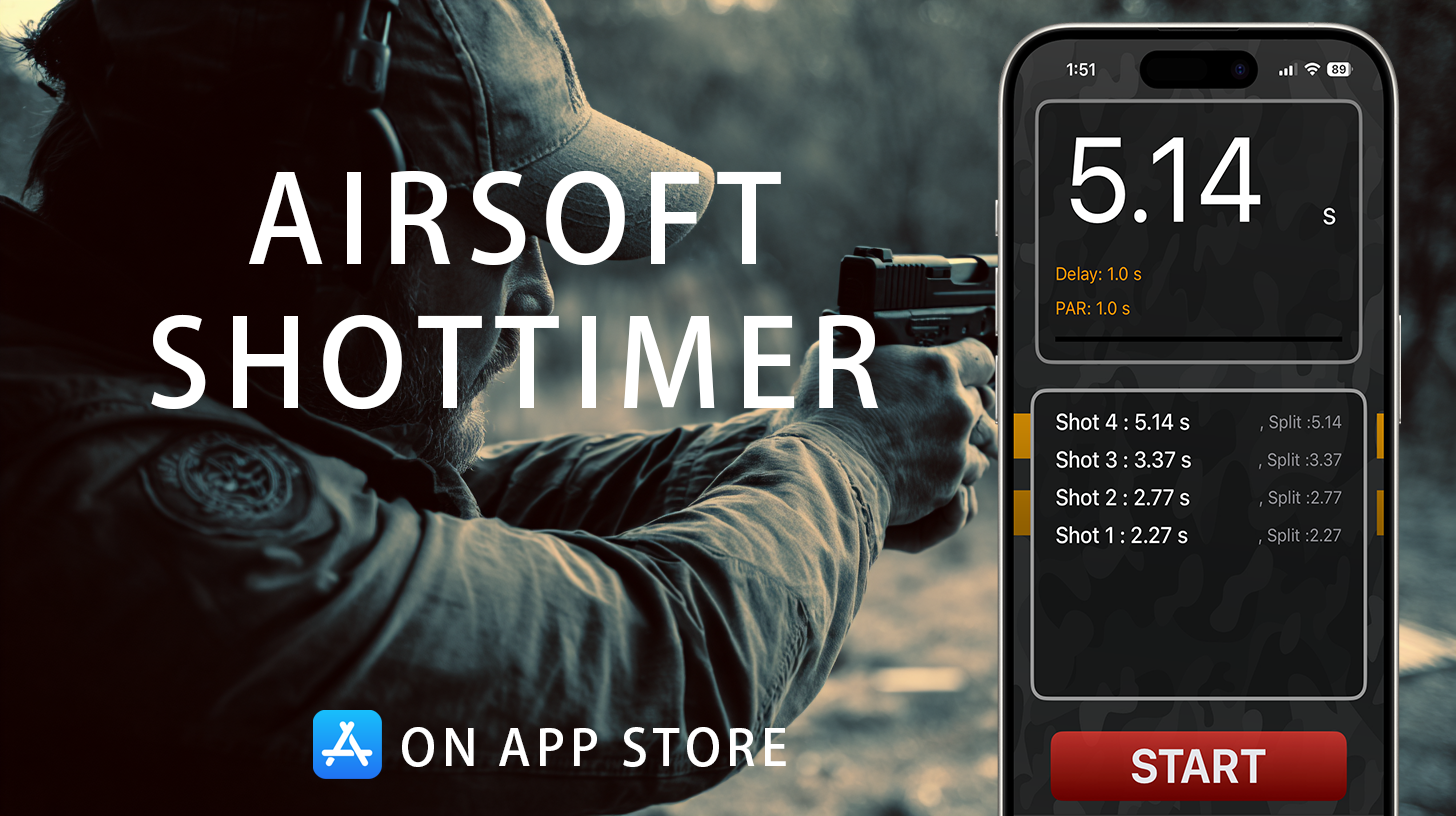
Put a Shot Timer in Your Pocket
Airsoft Shot Timer is a free shot timer app tuned for airsoft and Action Air — it picks up BB gun shots, tracks your split times, and saves you the cost of a $150+ hardware timer for IPSC/IDPA practice.

- PCSL
- PCSL Shooting
- Practical Competition Shooting League
- Practical Shooting
- Competition Shooting
- PPS Scoring
- K-Zone Target
- T-Zone Target
- PCSL Divisions
- PCSL Core Divisions
- PCSL 1-Gun
- PCSL 2-Gun
- PCSL 2-Gun Rules
- PCSL Pistol
- PCSL Rifle Divisions
- PCSL Membership
- PCSL Rifle Setup
- What Is PCSL
- Shot Timer
- PCSL vs USPSA
- PCSL Classification
- PCR Rating
- PCSL Competitor Rating
- Practical Irons
- Defensive Practical
- Defensive Competition
- PCSL PCC
- PCSL 2026 Rulebook
- Ban State Divisions
- Pistol Caliber 2-Gun
- USPSA Alternative
- Shooting Match
- Free Shot Timer App
- Dry Fire Training
- Draw Speed