Blake Drill Guide: Setup, Par Times by Level & How to Fix Slow Transitions
The Blake Drill in 60 seconds (BLUF)
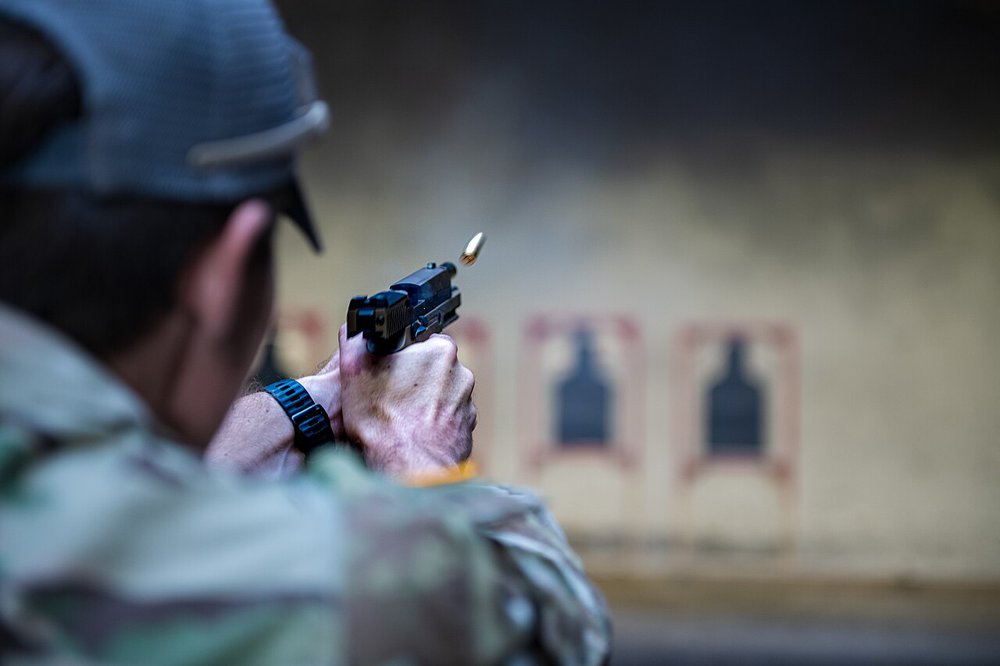
- The course of fire: Three targets side by side, one yard apart, at seven yards. On the beep, draw and fire two rounds on each target — six rounds total. Left-to-right or right-to-left, your choice.
- The goal: 2.0 seconds with all hits in the A-zone. That is the same number as the Bill Drill, which is the whole point: the only thing that changed is that you now have to move the gun twice.
- What it really measures: Six shots means one draw, three same-target splits, and two transitions. The two transitions are the only part that is different from a Bill Drill.
- The test nobody tells you about: Shoot a Bill Drill and a Blake Drill back to back. Blake time minus Bill time, divided by two, is how much slower each transition is than a normal split. That one subtraction tells you whether to train transitions or something else.
- Realistic par times: Around 4 seconds for a new shooter, 3 seconds for a solid club shooter, 2.5 for a strong competitor, 2.0 for the people the drill was named after.
- Train it anywhere: It dry-fires and runs on an airsoft pistol unusually well, because a transition is mostly an eye skill, not a recoil skill. A free Airsoft Shot Timer app gives you the beep, the par buzzer, and every split.
Almost every shooter who has spent a season with a timer can tell you their Bill Drill time. Ask the same people for their Blake Drill time and you usually get a pause, then something like “I don’t really shoot that one.” That gap is the reason this drill exists. You can get very fast at putting six rounds into one box and still lose a surprising amount of time on a match stage, because real stages almost never give you one box. They give you three targets in an array, and the clock keeps running while your gun travels between them.
The Blake Drill takes the Bill Drill you already know, changes exactly one thing, and leaves the goal time alone. That makes it the cleanest transition test there is. If your Blake time is barely slower than your Bill time, your transitions are fine and your time is going somewhere else. If it’s half a second slower, you just found the half second.
What Is the Blake Drill?
The drill takes its name from Blake Miguez, a USPSA Grand Master who made GM as a teenager, won a junior world title, and later shot on History’s Top Shot. Among competitors he was known for exactly the skill this drill isolates: very fast target transitions and the ability to drive a gun hard across an array. It spread widely through Ben Stoeger’s drill books and his live-fire drill library, which is where most people first read the procedure.
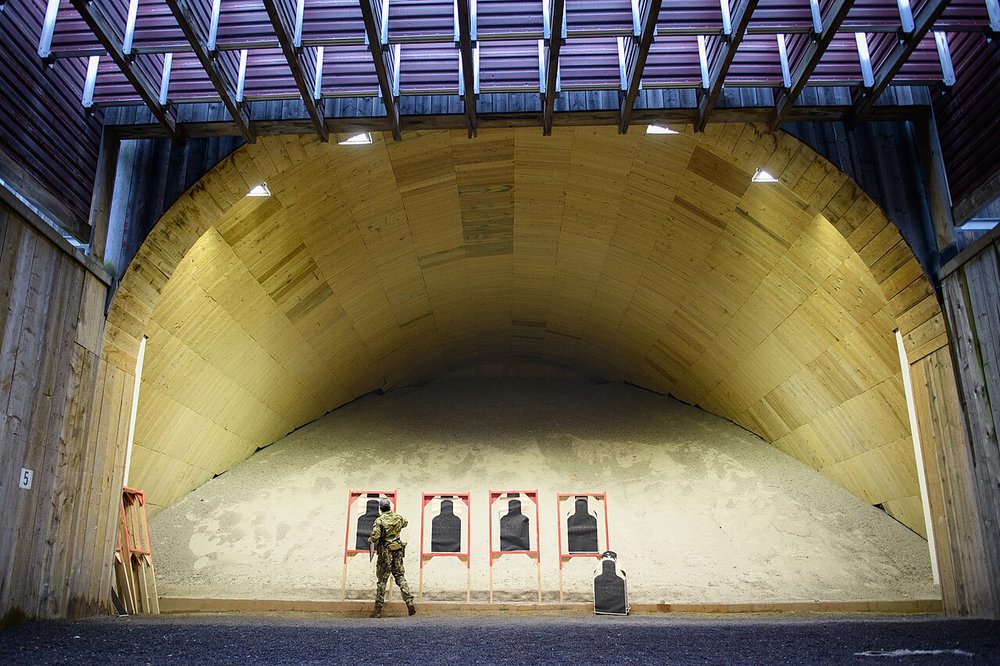
The course of fire is short enough to memorize. Set three IPSC or USPSA targets side by side with roughly one yard between them and stand at seven yards. Start with the pistol holstered and your hands relaxed. On the beep, draw and fire two rounds on the first target, two on the second, and two on the third. Direction doesn’t matter, and it’s worth alternating so you don’t only ever practice swinging one way. Six rounds, all A-zone hits, as fast as you can keep them there.
The goal is 2.0 seconds, identical to the Bill Drill’s classic standard. Stoeger frames it as a one-second draw followed by five shots in the remaining second. Hitting that means your transitions have to be almost as fast as your splits, which is a much bigger ask than it sounds.
One honesty note before the numbers: you will find a few pages online describing a “Blake Drill” with two targets, one round per target, or movement between positions. Those are useful exercises, but they aren’t the standard drill, and their times don’t compare to anyone else’s. If you want a number you can benchmark, shoot three targets, one yard, seven yards, two rounds each.
What Six Shots Actually Contain
Here is the part that makes the Blake Drill so useful with a timer. If you shoot the targets in order (T1, T1, T2, T2, T3, T3), your six shots break down into exactly four kinds of time:
- Shot 1 is your draw, measured from the beep.
- Shots 2, 4 and 6 are ordinary splits, the time between two shots on the same target.
- Shots 3 and 5 are your transitions, the time from the last shot on one target to the first shot on the next.
So the whole drill is one equation: Blake time = draw + 3 splits + 2 transitions. A Bill Drill is the same equation with no transitions at all: draw + 5 splits. Everything this page says about par times and diagnosis falls out of those two lines.
The practical consequence is that a timer that shows individual splits turns the Blake Drill into a diagnostic report, not just a single number. On a shot list in the Airsoft Shot Timer app, the third and fifth split are your transitions. Read them against the second, fourth and sixth, and you can see at a glance whether your gun is getting lost between targets or whether you’re simply slow everywhere.
Blake Drill Par Times: A Budget for Every Level
Most charts give you a single goal time and stop. That’s not very helpful if you’re currently shooting 3.6 seconds, because “get to 2.0” doesn’t tell you which part of the 1.6 seconds to go find. A better way to think about par times is as a budget: decide what draw, split and transition you can realistically shoot at your level, add them up, and you have a par that you can actually train to.
The table below is our worked budget for four levels. The draw, split and transition figures are illustrative targets, not official standards, but every row adds up exactly, and the elite row matches the numbers top shooters describe for the drill.
| Level | Draw | Split (×3) | Transition (×2) | Blake par |
|---|---|---|---|---|
| New shooter | 2.00 | 0.30 | 0.55 | 4.00 s |
| Solid club shooter | 1.50 | 0.25 | 0.375 | 3.00 s |
| Strong competitor | 1.25 | 0.22 | 0.295 | 2.50 s |
| Drill standard | 1.00 | 0.18 | 0.23 | 2.00 s |
A real data point shows how this plays out. One competitor who posted his Blake Drill runs at seven yards reported draws a little under 1.10, splits of about 0.19 to 0.22, and transitions averaging around 0.25. Plug those into the equation and you get 1.10 + 3 × 0.205 + 2 × 0.25 = 2.215 seconds, which is exactly where his runs landed (2.18 best, about 2.25 average). His own conclusion was that he needed quicker transitions to make 2.0. The budget says something more interesting: his transitions were only about 0.045 slower than his splits, already close to the drill-standard row. Even a Bill Drill at his draw and splits would come out at 1.10 + 5 × 0.205 = 2.125, over the goal with no transitions at all. The missing tenths were in the draw and the splits, and that’s the kind of thing you only see when you break the time apart.
Notice what the table says about the gap between levels, too. Going from 3.0 to 2.5 needs about a quarter-second off the draw, three hundredths off every split, and eight hundredths off every transition. You can’t get there by trying harder at one thing. That’s why the next section matters.
The Blake-Minus-Bill Test: How Much Do Your Transitions Cost?
This is the single most useful thing you can do with the Blake Drill, and it takes two runs. In the same session, with the same gun and the same holster, shoot a Bill Drill on one target and then a Blake Drill on three. Do it three or four times each and use your average for both.
Because a Bill Drill is draw + 5 splits and a Blake Drill is draw + 3 splits + 2 transitions, the draw cancels out when you subtract one from the other. What’s left is:
Blake − Bill = 2 × (transition − split)
In plain English: take your Blake time, subtract your Bill time, and divide by two. The answer is how much slower each of your transitions is than one of your splits. Call it your transition tax. It’s a number you cannot get from either drill alone, and it’s the cleanest measurement of transition skill you can take on a seven-yard line.
Here’s a worked example. Say your Bill Drill averages 2.40 seconds and your splits read about 0.25 on the timer. Your Blake Drill averages 2.80. The difference is 0.40, so each transition costs you 0.20 seconds more than a split, which puts your actual transitions at roughly 0.45. On a match stage with, say, eight target-to-target moves, that’s 1.6 seconds you’re paying just for moving the gun, before you’ve taken a single step.
How to read your number is a judgment call, but this is the rule of thumb we use. If your tax is under about 0.05 seconds per transition (a Blake Drill within a tenth of your Bill Drill), your transitions are genuinely good and your time is in your draw or your splits, so go work on those. Between about 0.05 and 0.20, you’re in the normal range for club competitors and transitions are worth regular practice. Above 0.20, transitions are your single biggest leak, and you will gain more from a month of Blake Drills than from anything else you could do.
The beauty of the test is that it removes the excuse. Plenty of shooters assume they’re slow because of their draw when the timer says otherwise. Two runs and a subtraction settle it.
How to Shoot Fast Transitions
The coaching that comes up again and again from top shooters on this drill boils down to a small number of habits. None of them are about effort. In fact, the most common thing that slows a transition down is trying too hard to make it fast.
Your eyes go first. The gun follows your eyes, not the other way around. The moment the last shot on a target breaks, your eyes should already be snapping to a specific spot on the next one, ideally the exact center of the A-zone, not “the next target” in general. Grandmaster Mark Smith describes the whole skill as “leave sooner, shoot sooner”: you leave sooner by moving your eyes before the gun, and you shoot sooner because your eyes are already there when the sight arrives. Stoeger puts the grip side of it simply: with a consistent grip, the gun aims wherever you look.
Stop the gun on the target, don’t sweep through it. A classic Blake Drill mistake is to keep the gun moving across the array and fire as it passes each target. It feels fast. It produces bad hits, especially on the center target, which is the one you’re always passing through. The gun needs to arrive, settle for an instant, and then leave.
Don’t overswing. When people drive the gun hard, it tends to shoot past the target and come back, and every bit of that extra travel is time. Smith’s standard is strict: if your sights or dot cross the vertical center line of the target as you come in, you pushed too hard, even if the shot still lands in the A-zone. A shorter path is a faster path.
Don’t stay in the gun during the transition. Many shooters, especially on red dots, keep looking at the dot as it travels, because they’ve found it and don’t want to lose it. Then they arrive at the next target still looking at the glass instead of the target. Look at the target and trust that the dot will show up where you’re looking. That trust is built in dry fire, rep after rep.
Slowing down is not the fix. When the hits go bad, the instinct is to back off the pace. Stoeger’s advice runs the other way: mistakes are expected in this drill, and it exists to build an aggressive transition. Push the pace until you’re just past comfortable, look at where the misses went, and fix the cause (usually stopping late or overswinging) while staying at that speed.
Training Plan: Par-Time Ladder, Variations and a Weekly Routine
The most effective way to train the Blake Drill is with a descending par-time ladder. Set the par buzzer well above your current time, run a few reps, then lower it. A common pattern from competitors is to start around 5 seconds, then 4, then 3, then 2.5, then 2. Your job on each par is to finish right on the buzzer with good hits, not to beat it by as much as possible. When you can’t keep your hits at a given par, that’s your working level, and you stay there until you can.
Once the basic drill gets comfortable, a few variations change the emphasis without losing the comparability of the original:
- Reverse direction. Run it right-to-left as often as left-to-right. Most people are noticeably slower swinging one way.
- Start at low ready. Take the draw out completely. Now your time is just three splits and two transitions, and the transition tax becomes very visible. Subtract roughly your normal draw from your Blake par to get a low-ready par.
- Widen the spacing. Moving the targets two or three yards apart lengthens every transition and teaches you to accelerate and decelerate the gun rather than just flick it.
- Push the distance, a little. Ten yards is a good second distance. Stoeger’s advice is not to take the standard version much past fifteen yards, because with targets only a yard apart the drill stops being about transitions and starts being a precision test.
A simple weekly routine for a busy shooter looks like this. In live fire, start every session with one cold Blake Drill and log it, then run a Bill Drill and a Blake Drill back to back to update your transition tax, then spend the rest of your transition block on the par ladder. At home, two or three short dry-fire sessions a week on the same three-target setup, with a par time, do most of the real work. For more drills to pair with this one, our pistol drill selector suggests combinations by skill gap and round count, and the Bill Drill time standards guide covers the other half of the test in depth.
Dry Fire and Airsoft: Why This Drill Transfers So Well
Some drills lose most of their value when you take away live recoil. The Blake Drill is the opposite. Transitions are a visual and movement skill, and the hard part, getting your eyes to the next spot and stopping the gun there without overswinging, is exactly the same with or without a bang.
In dry fire, tape three small targets on a wall a few feet apart, scaled so they subtend about the same width as the real setup at seven yards. You won’t get true splits, because you can’t run a trigger six times in a row on most pistols, so change the drill slightly: draw, press once on each target, or simply bring the sights to each target, see an acceptable sight picture, and look away to the next one without pressing. That second version is how Stoeger’s team demonstrates it, and it’s surprisingly revealing. On close, easy targets the gun should only “dip” onto the target before leaving. On harder ones it should show a visible stop. Set a par time and run it with a timer that beeps a random start and a par buzzer, and you have a complete transition session in fifteen minutes.
With an airsoft gas blowback pistol, you can run the drill almost exactly as written on paper targets at five to seven yards, which makes it one of the best live-feedback drills for anyone who trains between range days or shoots IPSC Action Air. The recoil is lighter, so your splits will be faster than with a 9mm, and that’s worth knowing before you compare numbers: an airsoft Blake Drill should be compared to an airsoft Bill Drill shot the same day, not to your live-fire times. The transition tax test works perfectly here, because the subtraction cancels the platform difference out.
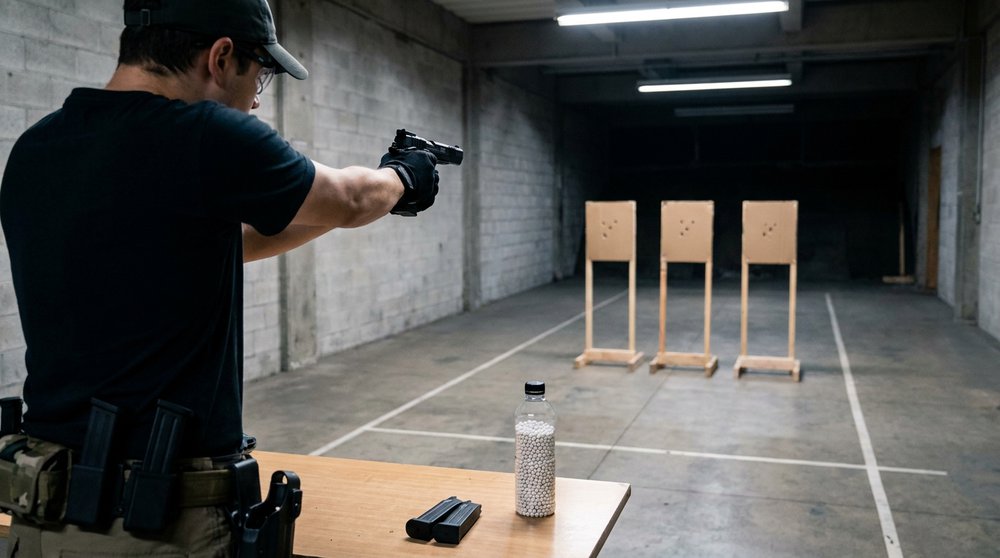
For timing, the Airsoft Shot Timer app is built for this situation: its shot detection is tuned for the quieter, sharper report of GBB pistols, it shows every split so you can pick out shots 3 and 5 as your transitions, and it keeps your runs so you can track your transition tax week over week. It’s free, which makes it easy to keep on the phone in your range bag for the days you’re shooting airsoft at home and live fire on the weekend.
Common Mistakes on the Blake Drill
The first and most common is shooting it as a speed test of the draw. People rip the draw, get a great first shot, and then the gun wanders across the array. The draw is about half the drill’s time budget at the elite level, but it’s the half you already train in the Bill Drill. If your Blake Drill isn’t telling you anything about your transitions, you’re not reading the splits.
The second is chasing the time with bad hits. A 1.9-second run with two C-zone hits on the center target is not a passed Blake Drill. As with the Bill Drill, the honest number is the fastest time at which every hit is still an A. If you want to put a value on that trade-off, our hit factor calculator will show you how quickly a couple of Charlies erase the time you gained.
The third is only ever going one direction, and the fourth is changing the setup between sessions. If your targets are a yard apart on Monday and a yard and a half on Thursday, your times aren’t comparable, and the whole value of the drill as a measurement disappears. Measure the spacing once, mark the stand positions, and keep it fixed.
Frequently Asked Questions
What is the Blake Drill?
The Blake Drill is a pistol transition drill named after USPSA Grand Master Blake Miguez. You set three targets one yard apart at seven yards, then draw and fire two rounds on each target, six rounds total. It uses the same six rounds and the same 2.0-second goal as the Bill Drill, but spreads the shots across three targets so that two of the five splits become transitions.
What is a good Blake Drill time?
The classic goal is 2.0 seconds with all A-zone hits from the holster. Realistically, around 4 seconds is a reasonable starting point for a new shooter, 3 seconds is solid for a club competitor, and 2.5 seconds is a strong time. The more useful benchmark is your own Bill Drill: if your Blake Drill is within about a tenth of a second of it, your transitions are excellent.
How is the Blake Drill different from the Bill Drill?
Both are six rounds from the holster at seven yards with a 2.0-second goal. The Bill Drill puts all six on one target, so after the draw every shot is a split. The Blake Drill puts two on each of three targets, so after the draw you have three splits and two transitions. Shooting both back to back and subtracting tells you how much each transition costs you.
Can you do the Blake Drill in dry fire?
Yes, and it’s one of the best drills for it, because transitions are mostly an eye and movement skill. Set up three small targets at home, draw, and either press once on each target or bring the sights to each target and look away to the next. Run it against a par time on a shot timer and lower the par as you get cleaner.
How far apart are the targets in the Blake Drill?
The standard spacing is about one yard (roughly one meter) between targets, at a distance of seven yards. Keep the spacing the same every time you shoot it, otherwise your times won’t be comparable from session to session.
The Takeaway
The Blake Drill is the cheapest piece of self-knowledge in pistol shooting. Six rounds and a subtraction tell you whether your transitions are costing you two hundredths or two tenths, and once you know that, you know where your next month of practice should go. Shoot a Bill and a Blake back to back this week, write down the difference, and put the three-target setup on your dry-fire wall. Then let a free shot timer app keep score while you push the par down a tenth at a time.
Image credits: cover and multiple-target range — U.S. Army photos by Thomas Mort (1, 2), public domain, via Wikimedia Commons, resized. Indoor range — Noah Wulf, “Man with Glock 30 at Shooting Range”, CC BY-SA 4.0, via Wikimedia Commons, resized. Airsoft training photo — AI-generated illustration.


Put a Shot Timer in Your Pocket
Airsoft Shot Timer is a free shot timer app tuned for airsoft and Action Air — it picks up BB gun shots, tracks your split times, and saves you the cost of a $150+ hardware timer for IPSC/IDPA practice.


- Blake Drill
- Blake Drill Par Time
- Target Transitions
- Transition Drill
- Pistol Drills
- Shooting Drills
- Bill Drill
- Shot Timer
- Split Times
- Par Time
- USPSA
- IPSC
- Practical Shooting
- Dry Fire
- Airsoft
- GBB Pistol
- Ben Stoeger
- Blake Miguez