Army Pistol Qualification (M17): Course of Fire & Scores
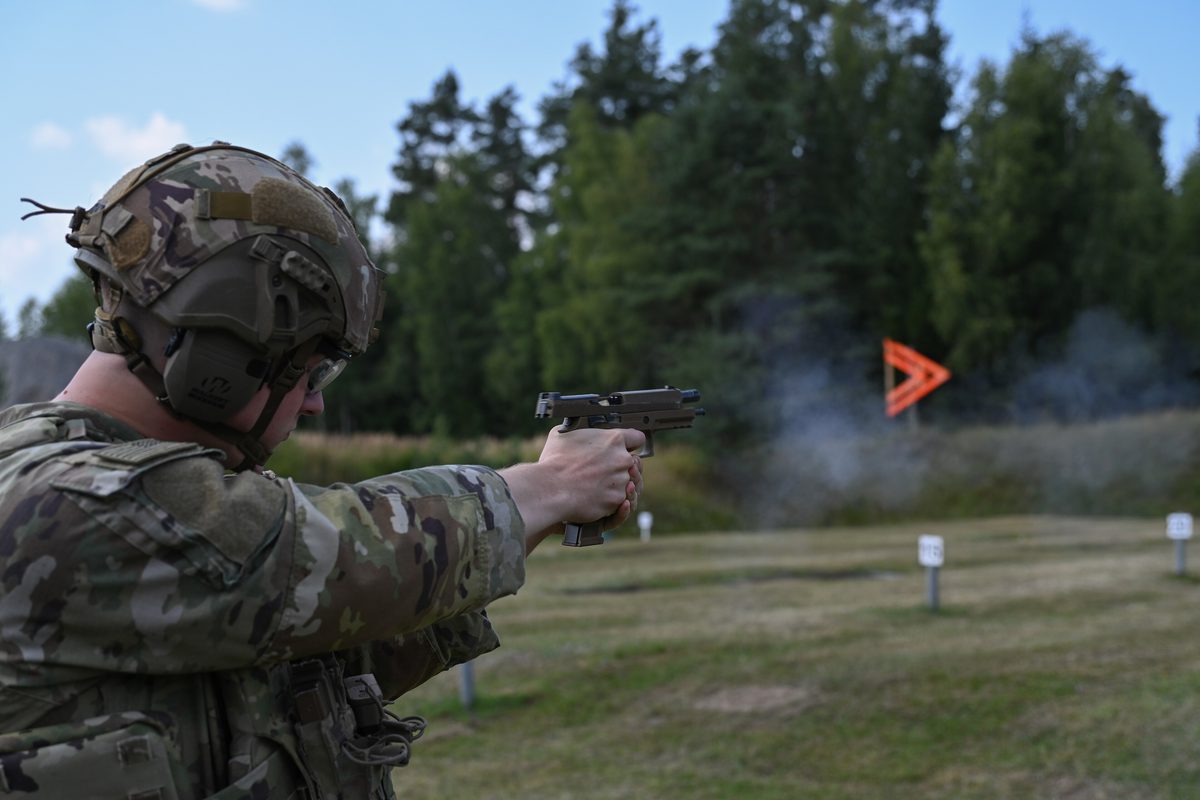
The Army pistol qualification in 60 seconds (BLUF)
- The course: The current Army pistol qual (M17, M18 or M9) is Table VI in TC 3-20.40: 30 rounds at 30 pop-up targets, from 7 to 31 meters, in three phases of 10 targets: standing, kneeling, and walking. One round per target, one 10-round magazine per phase.
- The clock: Single targets stay up 5 seconds, double targets 8 seconds, with 2 seconds between exposures and a 10-second break between phases for a reload and a position change. The whole run is about 3 minutes 16 seconds.
- Scores: 21 hits qualifies (Marksman), 24 is Sharpshooter, 27 is Expert. That means you can drop 9, 6 or 3 targets.
- What decides the badge: 16 of the 30 targets are at 16.5 meters or farther. Expert means hitting at least 13 of those 16, and there are no spare rounds to make up a miss.
- Train it anywhere: Every exposure is a par time. A free shot timer app with repeating par beeps can play the whole pop-up rhythm while you dry fire or shoot an airsoft M17.
If you searched “army pistol qualification,” you probably want three things: what the course of fire actually is, what score you need, and how to not embarrass yourself on range day. The short version: the M17 qual is 30 shots at 30 automated pop-up targets, scored as hits, with 21 to pass and 27 for Expert. It is far more of an accuracy test than a speed test. You get about four and a half seconds per round, more than three times what the FBI qualification gives you, but the targets go out to 31 meters and every round has exactly one target to hit.
That’s why the usual advice (“it’s easy, just take your time”) is only half right. Close targets are easy. The far half of the course is where badges are won and lost, and it’s also the part you can rehearse at home with a timer. Below is the full sequence from the official manual, the scoring math for each badge, and a practice plan that works with dry fire or an airsoft pistol.
What Is the Army Pistol Qualification?
The Army pistol qualification is the annual handgun standard every Soldier issued a pistol must pass, and it’s valid for 12 months. The current version is Pistol Table VI, Qualification, published in TC 3-20.40, Training and Qualification, Individual Weapons (July 2019, with Change 1 from November 2019). As of October 2026, Army Publishing still lists that edition as the active one, with no later change. It covers the M17, the compact M18, and the older M9, and it’s scored on DA Form 7814, the pistol scorecard. The old DA Form 88 belongs to the previous course.
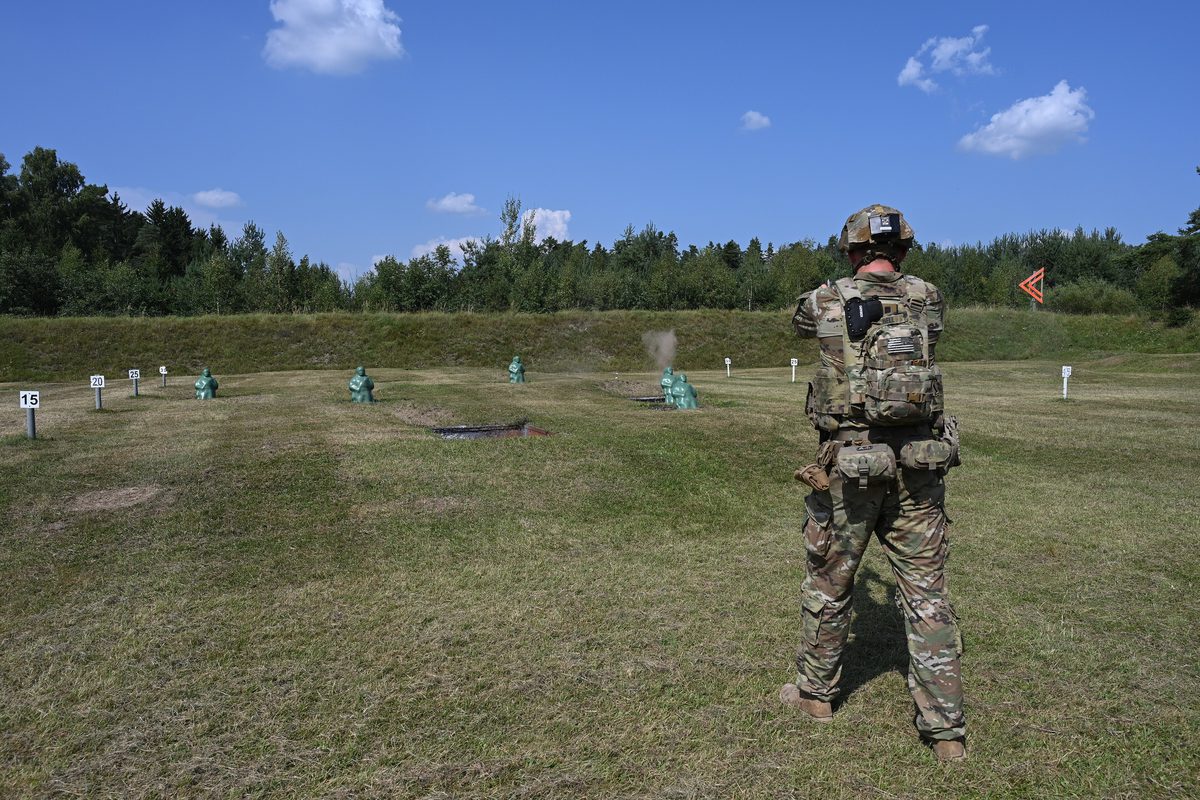
The range is a Combat Pistol Qualification Course (CPQC): an automated range with fixed lanes of pop-up targets between 7 and 31 meters, a short walking path, and a tower that runs the whole sequence and records hits. You don’t see your score target by target the way you would on paper. A target comes up, you either hit it before it goes down or you don’t, and the system counts.
The targets are E-type kneeling silhouettes (the plastic silhouette most Soldiers know from rifle ranges) or a 3-D kneeling mannequin, at the installation’s choice. The manual specifically rules out F-type and G-2 prone targets for this table, so you are always shooting at a kneeling torso-and-head shape, never a small head-only target.
You start standing at your firing point with the pistol holstered, and every engagement is fired from the ready. In practice that means the gun stays out between targets, held at the ready while you wait for the next one to rise.
The Course of Fire, Phase by Phase
Table VI is 23 firing tasks that present 30 targets, split into three phases of exactly 10 targets each. Every phase uses one magazine loaded with exactly 10 rounds, carried in your magazine pouch. Staging magazines on the ground or a bench isn’t allowed. Because each phase uses exactly one round per target, the magazine runs dry on the last target of the phase, and the 10-second break that follows is when you do your emergency reload and move to the next position.
| Phase | Position | Targets | Distances (meters) | Exposures | Phase clock |
|---|---|---|---|---|---|
| 1 (tasks 1-9) | Standing unsupported | 10 | 7, 12.5, 23, 31, 10, 16.5, 27, 7, then 10 + 12.5 together | 8 singles at 5 s, 1 double at 8 s | 64 s |
| 2 (tasks 10-17) | Kneeling | 10 | 23, 31, 16.5, 27, 7 + 10, 12.5, 23, 16.5 + 12.5 | 6 singles at 5 s, 2 doubles at 8 s | 60 s |
| 3 (tasks 18-23) | Walking a 10 m path | 10 | 7 + 7 (left and right), 10 + 12.5, 16.5 + 23, 23 + 27, then 27, 31 | 4 doubles at 8 s, 2 singles at 5 s | 52 s |
The phase clock is the exposures plus the 2-second gaps between them. Standing is 8 × 5 + 8 = 48 seconds of exposure plus eight 2-second gaps, so 64. Kneeling is 6 × 5 + 2 × 8 = 46 plus seven gaps, so 60. Walking is 4 × 8 + 2 × 5 = 42 plus five gaps, so 52. Add the two 10-second transitions and the whole qualification is 196 seconds, about three and a quarter minutes from the first target to the last.
Look at how the order is built. The standing phase jumps around on purpose: 7 meters, then 12.5, then 23, then 31, then back to 10. You never get two targets in a row at the same distance, so you can’t settle into one sight picture. The kneeling phase opens with the two farthest targets of the phase back to back (23 and 31 meters), right after you’ve reloaded and dropped to one knee. The walking phase saves two single long targets (27 and 31 meters) for the very end, when you’ve been walking and shooting for 40-odd seconds.
The Scoring Math: How Many Targets Can You Drop?
Scoring is simply hits out of 30. The rating bands from TC 3-20.40 Table 1-13 are:
- Expert: 27 to 30 hits, so you can miss 3
- Sharpshooter: 24 to 26, so you can miss 6
- Marksman: 21 to 23, so you can miss 9
- Unqualified: 20 or fewer
The qualifying standard is written as 70 percent of presented targets, which is 21 of 30.
Now sort the 30 targets by distance. There are 5 at 7 meters, 4 at 10, 5 at 12.5, 4 at 16.5, 5 at 23, 4 at 27, and 3 at 31. That splits the course almost in half: 14 targets at 12.5 meters or closer and 16 targets at 16.5 meters or farther.
Run the badge requirements against that split. Suppose you clean all 14 close targets, which most people who practice at all can do. To qualify you still need 7 of the 16 far targets. For Sharpshooter you need 10 of 16. For Expert you need 13 of 16, which means you can miss at most three targets past 15 meters across the whole course, standing, kneeling and walking combined. Drop even one close target and the far-target requirement goes up by one.
This is the real shape of the test. Marksman is mostly a check that you can hit close targets and survive the far ones. Expert is a check that you can hit a kneeling silhouette at 23 to 31 meters, with a pistol, on a clock, nearly every time. A target at 31 meters looks 31 ÷ 7 = 4.4 times smaller than the same target at 7 meters, and the same small error in your sight alignment or trigger press is 4.4 times bigger on the target.
There is one more rule that makes the first attempt matter. A Soldier who refires within the retraining window (the manual says 45 days in Table 1-13 and 44 days in paragraph 1-74) can only be awarded Marksman, whatever they score. If you want Expert, you have to shoot it on the first try.
Where Soldiers Actually Drop Targets
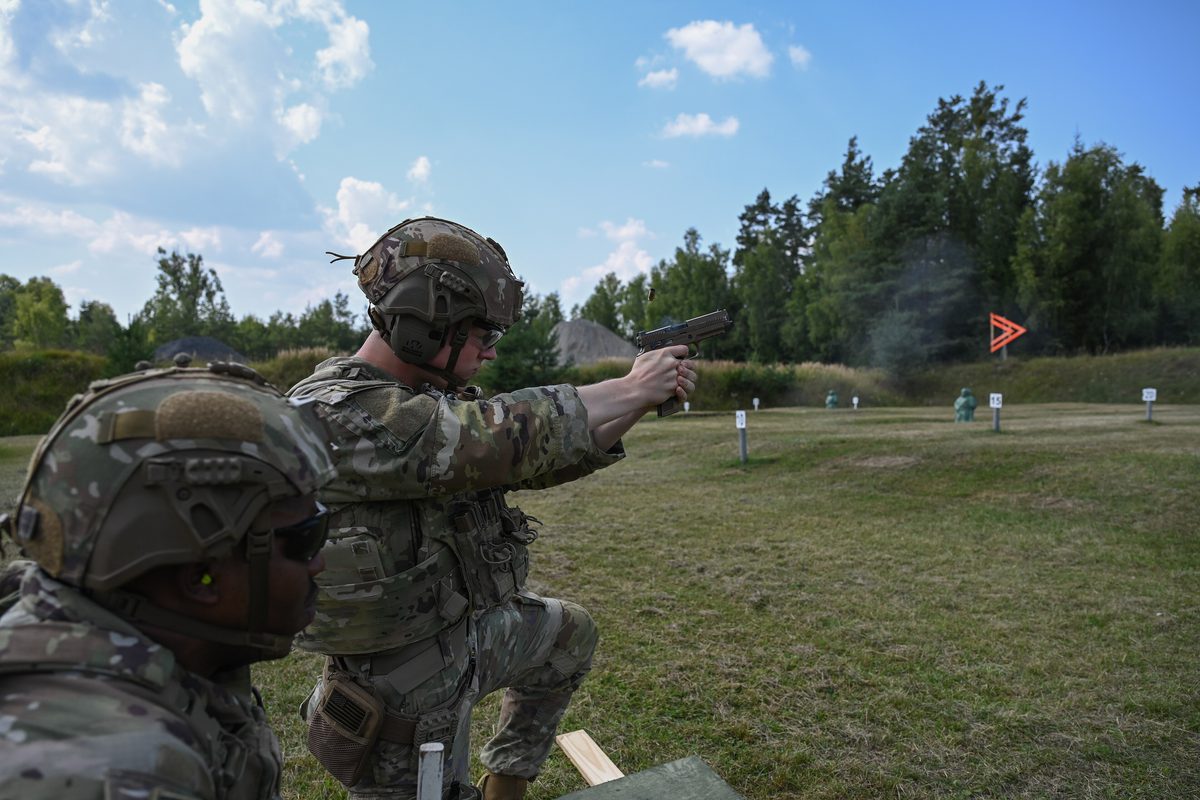
The time per round looks generous: 136 seconds of exposure for 30 rounds is about 4.5 seconds per round. Compare that with the FBI pistol qualification, which gives you 63 seconds for 50 rounds, or 1.26 seconds per round. The Army course gives you more than three times as long per shot. But that average hides three places where the clock gets tight.
The long singles from the ready. A 31-meter target gets the same 5 seconds as a 7-meter target. If you take a second to see it rise and bring the gun up, you have about four seconds to get a sight picture good enough for 31 meters and press without disturbing it. That’s plenty if your trigger press is clean, and not nearly enough if you’re chasing the dot or the front sight around the target hoping for a good moment. The three 31-meter targets come once in each phase, so you get exactly one chance per position.
The doubles. Two targets in 8 seconds is 4 seconds per round, less than a single target gets, and you have to find the second target and transition to it. The widest one is the first engagement of the walking phase: 7 meters left and 7 meters right at the same time, while you’re stepping off. The kneeling double of 16.5 and 12.5 meters is the tightest at distance.
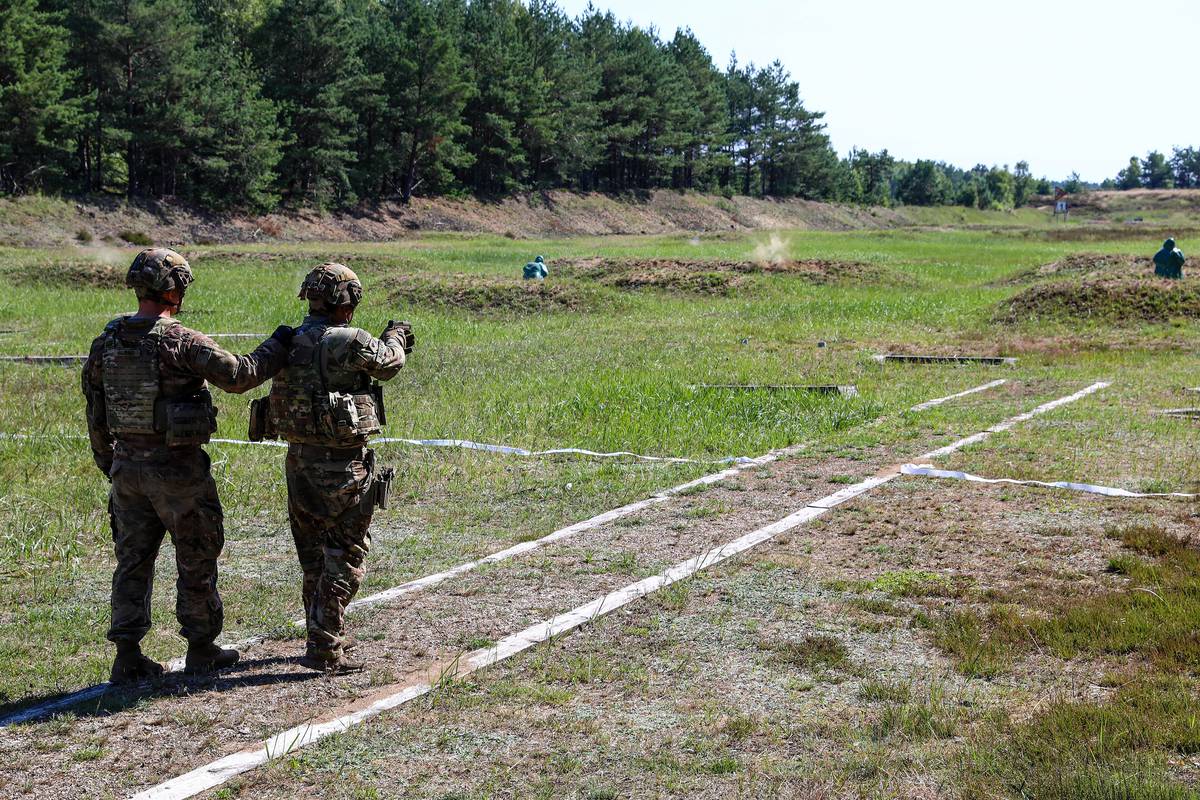
The walking phase. This is the phase with the least time per round (42 seconds of exposure for 10 rounds, 4.2 seconds each) and it’s the only one where you shoot while moving. The path is only 10 meters long and the phase lasts about 52 seconds, so if you spread the walk evenly, you’re covering roughly 20 centimeters a second: a slow, deliberate step every few seconds, not a walk across a parking lot. Soldiers who walk at a normal pace either run out of path or end up shooting with their feet in motion and the sights bouncing. In one helmet-cam video of this phase, the range safety’s only coaching is “good, slow walk” and “slow down.”
Two other details catch people. First, one round per target means no makeup shots. If you fire twice at a target, you’ve stolen the round for a later target, and you’ll be standing in front of a raised target with an empty magazine. Second, the emergency reload and position change share one 10-second window. A 3-second reload plus a 2-second move to kneeling leaves you five seconds of slack, which is fine, until you fumble the magazine out of the pouch. The first kneeling target is at 23 meters and the next one is at 31, so arriving late and rushed is expensive.
Old vs. New: What Changed From the 40-Round CPQC
If you qualified with the M9 before 2019, or you’re reading an older range handout, you’ll see a different course. The old Combat Pistol Qualification Course in FM 3-23.35 gave you 40 rounds for 30 targets across seven tables (four standing tables, an advancing table, plus CBRN and night tables), with three required magazine changes. Single targets were up for 3 seconds and multiple targets for 5 seconds on the standing tables, and Expert was 26 to 30, Sharpshooter 21 to 25, Marksman 16 to 20.
So the new course is stricter on scoring (21 to qualify instead of 16) but more generous on time (5 and 8 seconds instead of 3 and 5), and it took away the ten spare rounds that used to let you re-engage a target you missed.
There is a wrinkle worth knowing about. In the current manual, paragraph D-69 still says single targets are exposed for 3 seconds and doubles for 5, while the actual engagement tables (D-45 to D-47) list 5 and 8. The tables are what ranges program, but the mismatch is a good excuse for a training rule: practice to 3 and 5 seconds, qualify at 5 and 8. If you can make your hits on the old timing, the real course feels slow.
How to Train for It With a Shot Timer
The qualification is really two skills on a clock: a fast, clean presentation from the ready to a good sight picture, and a trigger press that doesn’t move the gun at 25 to 31 meters. A shot timer lets you train both against the real exposure times instead of guessing.
Start with the 5-second single. From the ready, on the beep, one shot at your longest practical distance. Set the par to 5.0 seconds and note where in the window your shot breaks. If your shot breaks at 1.5 seconds and misses, you’re rushing, not short on time. Work it down: when you can hit reliably with the shot breaking around 3 seconds, you’ve built the margin the long targets need.
Then the 8-second double. Two targets spread a few meters apart, one shot each, par 8.0. The transition is the skill here: eyes to the second target first, gun follows. Practice both directions, because the course gives you left-right pairs and near-far pairs.
Then rehearse the rhythm. This is where the timer app earns its keep. The Airsoft Shot Timer app (iOS and Android) lets you set several par beeps in one run and put them on repeat. Set par beeps at 5.0 and 7.0 seconds and turn on repeat: the 5-second beep is “target down,” the 7-second beep is “next target up,” and the cycle loops for as long as you like. That’s the exact cadence of a run of single targets, 5 seconds up and 2 seconds of gap. For a run of doubles, use 8.0 and 10.0. Ten cycles of 5 and 7 is a full standing phase in about 70 seconds, close to the real 64.
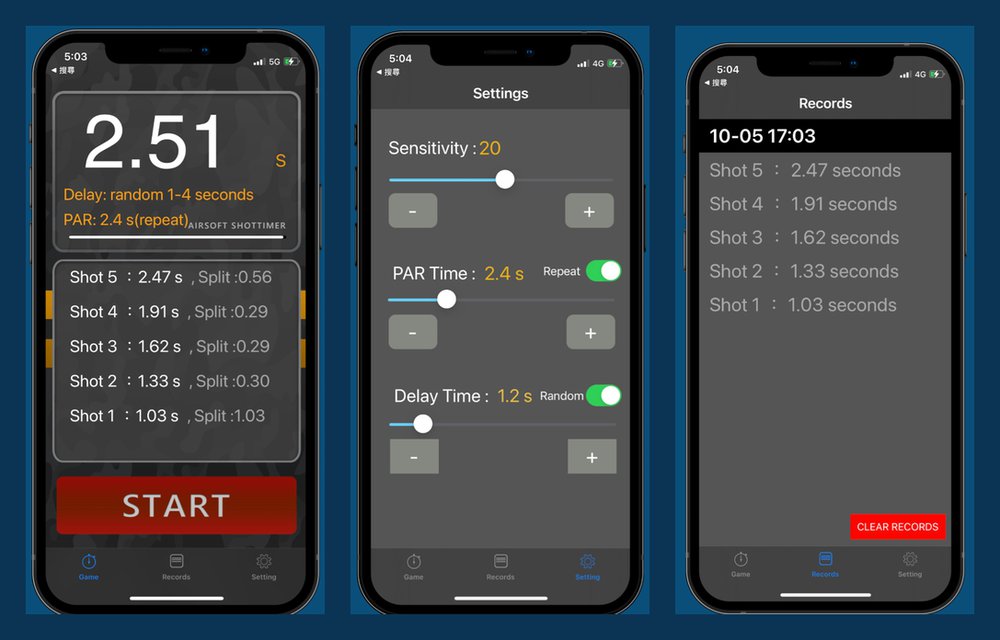
Add the reload and the kneel. Load a magazine with exactly the number of rounds you’ll fire, so the gun locks open on the last target. Then give yourself a single 10-second par: emergency reload, drop to kneeling, gun on target before the beep. Most people find out their real reload time this way, and it’s usually slower than they thought. Our magazine reload guide breaks the emergency reload into steps you can time separately.
For the kneeling phase itself, the shooting stance guide covers a stable kneeling position, and the shooting on the move guide covers the rolling heel-to-toe step that keeps the sights steady during the walking phase.
Practicing With Dry Fire or an Airsoft Pistol
Most of what this course tests is visual and mechanical: presenting from the ready, finding a small target, pressing without moving the sights, transitioning between two targets, reloading, kneeling and walking without losing the sight picture. All of that can be practiced in dry fire with the timer cadence above. Fifteen minutes of 5-and-7 repeats at reduced-size targets is more useful than a box of ammo fired at 7 meters with no clock. The dry fire training guide has the safety setup.
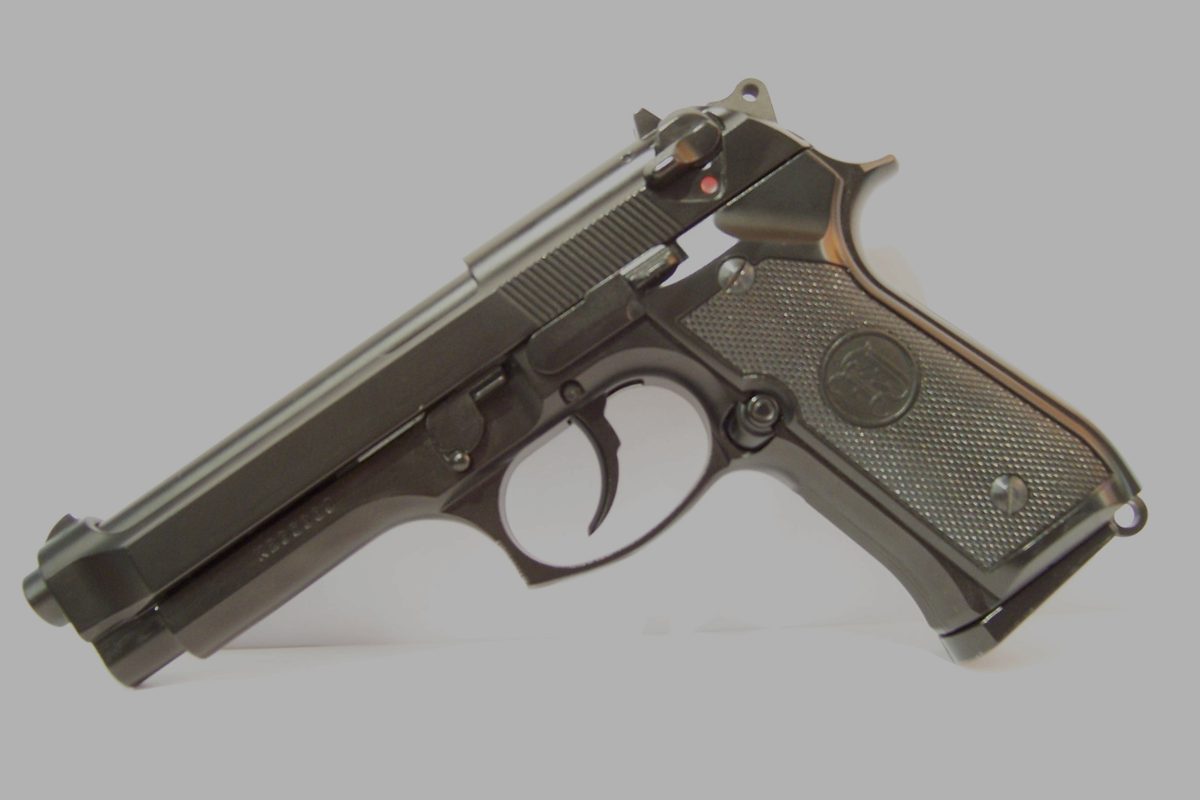
An airsoft gas blowback pistol gets you real hits, real reloads and a real slide lock. The M17 has a direct airsoft counterpart, and our ProForce M17 vs M18 airsoft comparison covers which one to pick. An M9-pattern GBB works just as well: the M9 was the Army’s sidearm before the M17 and is covered by the same qualification table. Load magazines with exactly 10 BBs so the reload happens where it does on the real course.
Distance is the problem: few GBB pistols group well enough for 31 meters, and most indoor spaces don’t have it anyway. The fix is to shrink the target instead of backing up. The target’s size should scale by practice distance ÷ real distance. If you practice at 7 meters, use targets at 70% of full size for the 10-meter targets, 56% for 12.5, 42% for 16.5, 30% for 23, 26% for 27 and 23% for 31. Print a sheet with silhouettes at those sizes, keep the real exposure times, and you’re solving the same sight-picture problem the course asks for. Remember that airsoft recoil is much lighter, so treat your airsoft hit rate on the small targets as a best case. For more on what carries over, see our guide to airsoft and firearms training crossover.
CBRN and Night Fire
If a unit doesn’t have an approved simulator, Soldiers also fire two short extra tables. The CBRN table is 7 targets with 7 rounds while wearing a protective mask, at 7 to 31 meters, with 10 seconds for single targets and 20 for the double. The standard is 5 of 7. Units with an EST or similar simulator run it in the simulator instead, and if the simulator stage is incomplete or failed, the Soldier’s rating is Unqualified regardless of the day-fire score. The night table is 5 targets with 5 rounds under night vision, at 7 to 16.5 meters. The manual itself gives two different passing numbers for this one (4 of 5 on one page, 3 of 5 on the revised page), so check your unit’s range SOP.
Marine Corps and Navy Pistol Quals: Not the Same Test
People searching for “marine corps pistol qualification” or “navy pistol qualification” often land on Army pages, and the courses are different enough that the Army numbers above don’t apply.
The Marine Corps runs its own Combat Pistol Program under the MCO 3574.2 series, and published descriptions of it use a points-based score rather than hits on 30 pop-ups, so a “21” or a “27” means nothing there. The Navy handgun course is set by the OPNAVINST 3591.1 series. Its qualification course is designed to be shot on a 15-yard range and includes close strings from the holster at 3 yards, such as drawing and firing 2 rounds in 4 seconds. That makes it closer in spirit to the FBI course than to the Army’s long pop-up lanes.
We weren’t able to confirm the full current course sheets and score bands for either service from the primary documents, so we’re not going to repeat the numbers that circulate online. If you’re preparing for one of those quals, get the current order from your range staff. The timer methods above still apply: every course is a list of strings with a par time.
Common Mistakes That Cost Targets
Practicing only at 7 meters. It feels productive because you hit everything. But the close targets are 14 of 30 and rarely the problem. Spend most of your practice on the 16 far targets, at real distance or on scaled targets.
Shooting twice at hard targets. On paper qualifications a second shot can save you. Here it costs you a later target. Commit to one good press per target.
Walking too fast. The walking path is 10 meters for about 52 seconds of shooting. Slow, short steps keep the sights steady; normal steps make you miss the long targets at the end.
Ignoring the reload. The emergency reload sits inside a 10-second window that also includes a position change, and the next targets are the farthest ones. Practice it with a timer until it’s boring.
Rushing the long shots because the target “might go down.” Five seconds is a long time for one shot. Use it. A shot that breaks at 3.5 seconds and hits is worth exactly the same as one that breaks at 1.2 seconds and hits, and far more than one that breaks at 1.2 and misses.
Frequently Asked Questions
How many rounds is the Army pistol qualification?
The current Army pistol qualification (Table VI in TC 3-20.40) is 30 rounds at 30 targets, with one round per target and one 10-round magazine for each of the three phases: standing, kneeling, and walking. The older pre-2019 course used 40 rounds for 30 targets.
What score do you need to pass the Army pistol qualification?
You need 21 hits out of 30 to qualify as Marksman. 24 to 26 hits is Sharpshooter and 27 to 30 is Expert. 20 or fewer is Unqualified. Refires inside the retraining window can only earn Marksman.
What are the distances on the Army M17 qualification?
Targets are at 7, 10, 12.5, 16.5, 23, 27 and 31 meters. Fourteen targets are at 12.5 meters or closer and sixteen are at 16.5 meters or farther, with three at the maximum 31 meters.
How long is each target exposed?
In the engagement tables, single targets are exposed for 5 seconds and double targets for 8 seconds, with a 2-second gap between exposures and a 10-second break at the end of each phase for a reload and position change. One paragraph of the manual still lists 3 and 5 seconds, so practicing to the shorter times gives you margin.
Is the Army pistol qualification hard?
Qualifying is not hard for someone who practices: you can miss 9 targets and still pass. Expert is a real test, because you can miss only 3, and in practice that means hitting at least 13 of the 16 targets at 16.5 to 31 meters, with no spare rounds.
Can you practice the Army pistol qualification with an airsoft pistol?
Yes. A gas blowback airsoft M17 or M18 lets you practice the presentation, transitions, emergency reload, kneeling and walking against the real exposure times. Use targets scaled down by practice distance divided by real distance (23% size at 7 meters for a 31-meter target) and a shot timer set to repeat 5- and 7-second beeps.
The Takeaway
The Army pistol qualification is 30 rounds, 30 targets, three positions and about three minutes. Passing is mostly about the close half; the badge you leave with is decided by the 16 targets past 15 meters and by whether your trigger press holds up at 31 meters on the first try. Train the 5-second single and the 8-second double against a timer, rehearse the reload-and-kneel inside 10 seconds, and walk the moving phase slower than feels natural. A free shot timer app with repeating par beeps is enough to start tonight in dry fire.
For another timed standard to compare against, the FBI pistol qualification guide covers the faster, closer 50-round course, and our pistol aiming guide covers the sight picture you’ll need for the far targets. If you’re curious about the gun itself, our SIG M17 vs M18 comparison explains how the issued pistols differ from the ones you can buy.
Course data: TC 3-20.40, Training and Qualification, Individual Weapons (30 July 2019, incl. Change 1, 4 November 2019), Table 1-13 and Appendix D (Tables D-42 to D-47, D-53 to D-67); old course: FM 3-23.35 Appendix A (incl. Change 3, 2008).
Image credits: cover, pop-up targets and kneeling position — U.S. Army photos by Pfc. Francisco Torres (1, 2, 3); walking phase — U.S. Army photo by Spc. Hedil Hernandez; Navy qualification — U.S. Navy photo by Pat Migliaccio; airsoft M9 — madhood, “KJW Beretta M9 GBB”; all public domain, via Wikimedia Commons, resized (airsoft photo cropped to 3:2).


Put a Shot Timer in Your Pocket
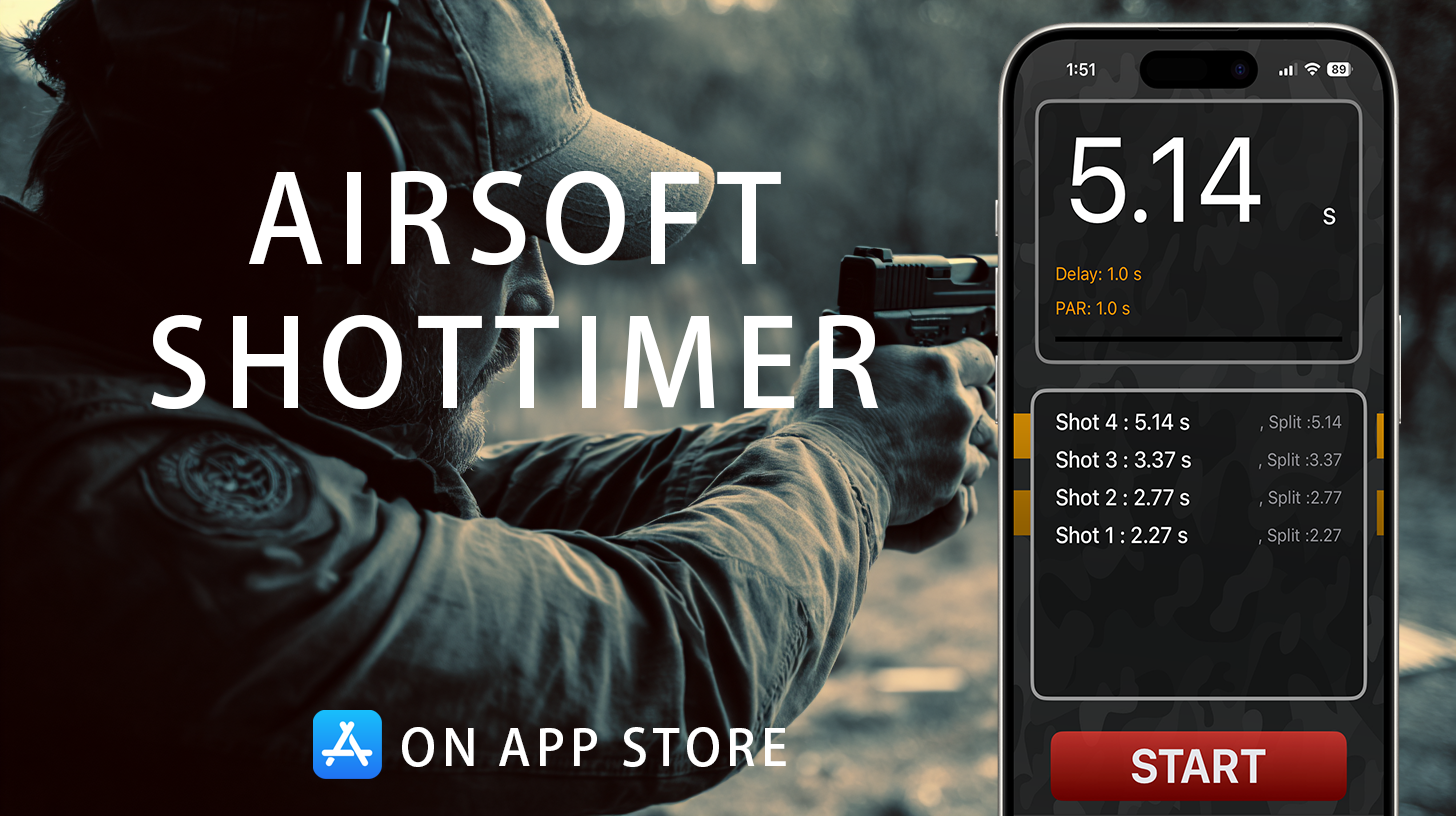
Airsoft Shot Timer is a free shot timer app tuned for airsoft and Action Air — it picks up BB gun shots, tracks your split times, and saves you the cost of a $150+ hardware timer for IPSC/IDPA practice.

- Army Pistol Qualification
- M17 Qualification
- Army M17 Qualification Standards
- Pistol Qual
- Table VI
- TC 3-20.40
- CPQC
- M17
- M18
- Marine Corps Pistol Qualification
- Navy Pistol Qualification
- Pistol Qualification
- Shot Timer
- Par Time
- Dry Fire
- Airsoft
- GBB Pistol