One-Handed Shooting: SHO/WHO Grip, Drills & Par Times
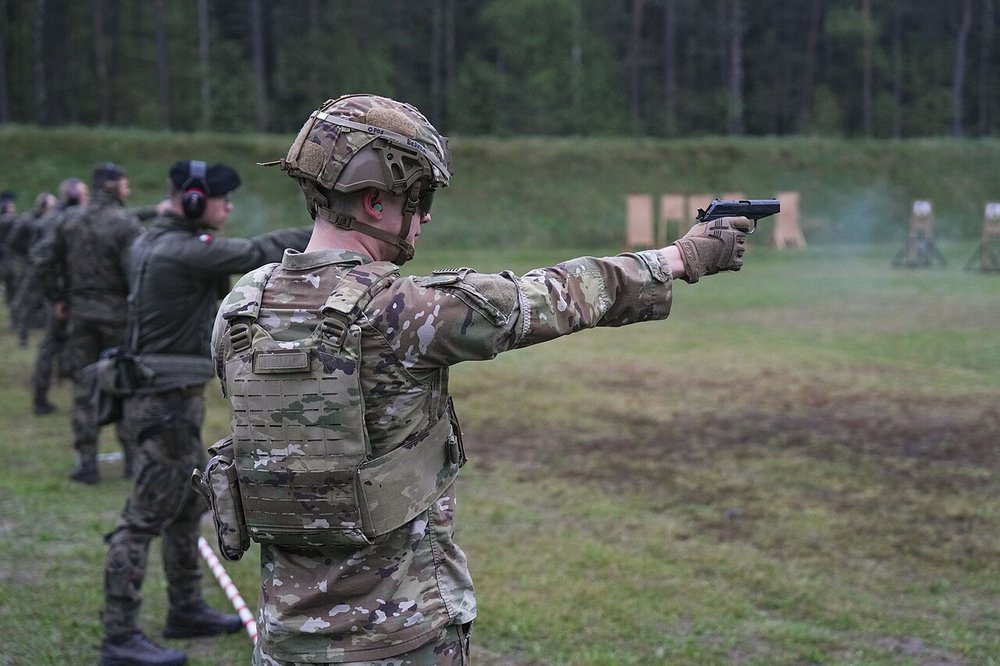
One-handed shooting in 60 seconds (BLUF)
- What it is: Firing a pistol with only your strong hand (SHO) or only your weak/support hand (WHO). It shows up in IPSC and USPSA stages, the IDPA 5x5 classifier, the FBI qualification and Dot Torture.
- The grip: Squeeze harder than you would two-handed (as hard as you can without shaking), drop the thumb so it pinches the frame, and keep the pressure front-to-back rather than curling your fingertips.
- The stance: For a quick string up close, keep your normal stance and just take the support hand away. When you have time or the target is far, blade slightly and lean into the gun. Tuck the free hand against your chest.
- Weak hand: A slight cant of the gun is fine; your dominant eye is now on the “wrong” side. Be very careful prepping the trigger with your weak hand.
- How much slower: A USPSA GM aims for about 70-80% of his two-handed performance strong hand and 50-60% weak hand. His real run hit those raw times, then lost the gain to penalties — the one-hand tax is paid in points, not seconds.
- Measure it: Shoot your two-handed time first, then set one-handed par times from it on a free shot timer app.
One-handed shooting means firing a pistol with a single hand: strong hand only (SHO), your dominant hand, or weak hand only (WHO), also called support hand only. Shooting with one hand works on the same principles as a two-handed grip — hold the gun still while you press the trigger, then let it return to the same spot — but you lose the hand that does most of the recoil control. So the technique changes: a firmer grip, a thumb that does part of the missing hand’s job, and a slower, more patient pace.
Almost everybody who shoots matches has a story about the strong hand / weak hand stage. You’re having a great day, you walk up to the next bay, read the briefing, and see “weak hand only.” The squad groans. Somebody says “this is going to be a disaster,” and for most of the people saying it, it is. Justin, a USPSA Grandmaster who runs the Justin Shoots YouTube channel, tells exactly that story: on pace to win a local match, he threw two misses on a weak/strong hand stage and decided he had to fix it. It turned out not to take much — just some dedicated time spent figuring out what the gun does in one hand.
This guide collects what that work looks like: the rules you’ll be held to, the grip and stance changes that actually help, real numbers on how much slower one-handed shooting is, and how to turn your own two-handed time into one-handed par times you can train against.
Where You’ll Be Tested on One-Handed Shooting
One-handed strings appear in nearly every standard and match format, which is why they’re worth practicing even if you never carry a gun. Here are the ones you’re most likely to meet:
- IPSC / USPSA stages: stage briefings can specify strong or weak hand only, and some whole stages are built around it. Justin mentions shooting an Area 5 match with an entire strong-hand-only stage and a nationals with an entire weak-hand-only stage.
- IDPA 5x5 classifier: string 2 is draw and fire five rounds strong hand only at ten yards. Our IDPA classifier guide covers all four strings and the times chart.
- FBI pistol qualification: the very first string at 3 yards is three rounds strong hand only, switch hands, three rounds support hand only — all in six seconds, from concealment. See the FBI qualification breakdown.
- Dot Torture: dot 5 is a draw to five rounds strong hand only, and dot 8 is five rounds weak hand only from low ready — the most hated dot on the sheet. The Dot Torture guide has the full sequence.
If you shoot IPSC, it pays to know the exact rule, because it’s narrower than many people think. (Action Air, the airsoft branch of IPSC, has its own rulebook, so check that edition if you shoot airsoft matches.) In the IPSC Handgun Rules (January 2024 edition), rule 10.2.8 says that once a course of fire stipulates strong or weak hand only, touching the handgun with the other hand costs one procedural penalty per occurrence — with exceptions for releasing an external safety (without scooping the gun), reloading, and clearing a malfunction. The penalty becomes one per shot fired if you use the other hand or arm to support the handgun or the shooting wrist, hand or arm, or to steady yourself on the ground, a barricade or a prop while firing. Rule 1.1.5.3 adds that once the single hand is specified, you must use it exclusively for the rest of the stage. And rule 8.2.4 says a course may never require you to draw from the holster with the weak hand — so weak-hand strings start from a table, or from a strong-hand draw followed by a hand switch. USPSA and IDPA have their own wording; read the stage briefing and ask at the walkthrough if anything is unclear.
The Strong Hand Only Grip: Squeeze Harder, Drop the Thumb
The short answer is to grip the gun harder than you would with two hands and use your thumb to replace a little of what the support hand normally does. Both of those go against what you’ve probably been taught about two-handed shooting, and that’s the point: the rules change when one hand is gone.
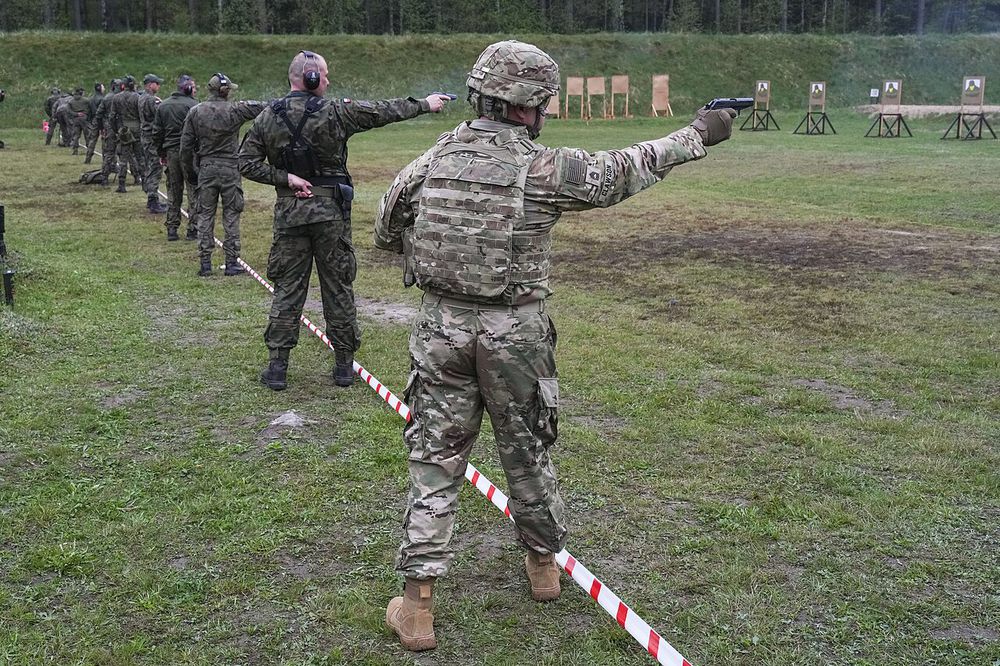
With two hands, most instructors want the firing hand fairly relaxed so the trigger finger can move quickly and independently, and they let the support hand do most of the clamping. USPSA champion Ben Stoeger describes his normal grip that way: connected to the gun so it stays glued in place, but as light as possible so the trigger finger is free. One-handed, he changes that. He increases pressure in the shooting hand — “not up to 100%, but a much firmer grip” — and the reason he gives is simple: you’re not pulling the trigger as fast one-handed anyway, so the usual cost of a tense hand (slower, sloppier trigger movement) mostly disappears.
Justin goes further and says one-handed you basically can’t squeeze too hard, as long as the gun doesn’t start to shake. That’s the real limit. If your grip makes the sights tremble, you’ve broken the one job a grip has: holding the gun still before and during the press. It is also why caffeine and adrenaline matter more one-handed. He describes watching shooters at three in the afternoon, wired on energy drinks, shaking like a leaf on a strong-hand string.
The other change is the thumb. Take the support hand away and there’s an open gap on the support side of the grip, and energy leaks out of it, which usually pushes the gun off to that side in recoil. Instead of flagging the thumb high, Justin drops it so it rests near the middle finger and pinches the frame. That thumb becomes a tiny version of the missing support hand: a bit more contact, a bit more friction and some side-to-side pressure that keeps the dot moving straight up and down instead of drifting sideways. He squeezes evenly with the bottom three fingers rather than loading the pinky, and keeps the main pressure front-to-back on the grip — “clamping, not curling” — so the fingertips don’t pull the gun off line.
It feels strange at first. The gun flops around in one hand more than you’re used to, and Stoeger’s point is that most of that is perception. Watch the spot you want the sights to come back to, and be a little more patient than feels natural while they get there. “Be patient” is the single idea both shooters keep coming back to.
Stance and the Free Hand: Square for Speed, Blade for Distance
Keep your normal stance when you need to shoot quickly, and blade slightly and lean into the gun when the target is far or you have time to set up. Stoeger frames it as a decision rather than a rule. If a stage calls for coming off the gun and immediately shooting one-handed, the fastest thing is to change nothing: stay squared up exactly as you were and simply take the support hand away. If the targets are further out or harder, he blades off slightly and leans into the gun, because the gun tracks better that way — it just takes time to get there.
That time is the catch. Justin, who likes the bladed position, points out that you usually go one-handed right off a draw or a reload, so you’d be moving your feet while doing something else. Any foot movement while the sights are up disturbs them, just like shooting on the move. So get the feet set before the gun comes up to your eyes, not while the dot is trying to settle. He also tends to drop the elbow a little when bladed, which gives a straighter line from hand to shoulder and helps the gun recoil straight up and down. Our stance guide covers the two-handed baseline this all starts from.
Then there’s the free hand. Leaving it dangling, or waving it out to the side in the old-movie detective pose, throws your balance off, especially if the stage has you moving. The better habit is to give it a job: pull it in tight against your chest. That creates a rigid structure and gets the arm out of the way. Just don’t let it creep onto the shooting arm. Under the IPSC rule above, using the other hand or arm to support the shooting wrist, hand or arm while firing costs a procedural for every shot, so a hand on the chest is fine and a hand bracing your forearm is not.
Weak Hand Only: Cant a Little and Respect the Trigger
Your weak hand uses the same grip principles, but two things are different: the dominant eye is now on the far side of the gun, and the hand has much less experience pressing a trigger. Both need a small adjustment.
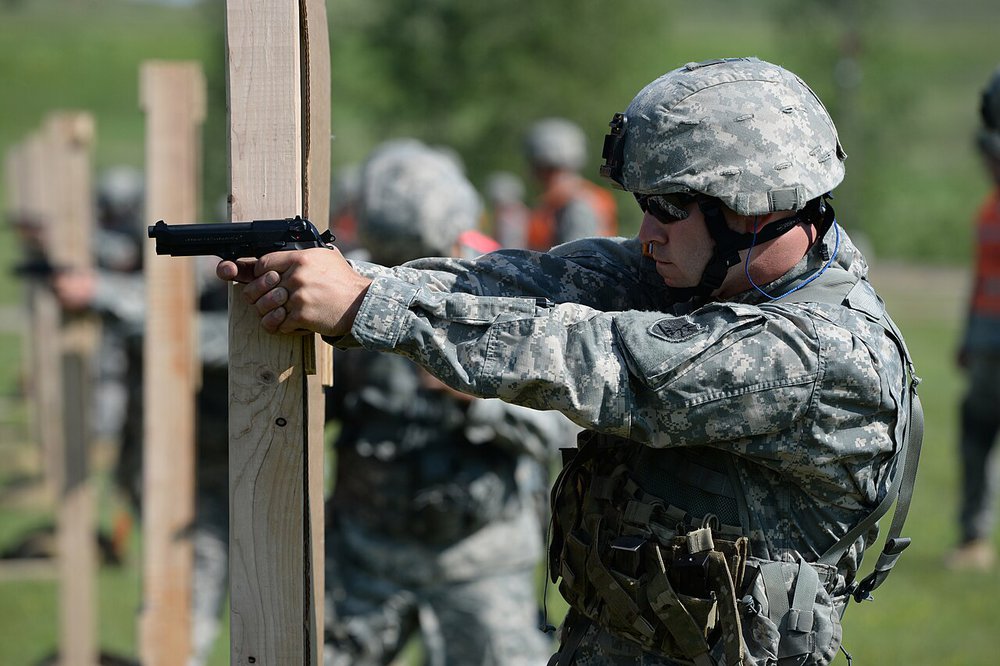
For the eye problem you have two options. You can bring the gun across toward your dominant eye, which bends the wrist and arm out of line, or you can keep a straight line from shoulder to hand and cant the gun slightly so the sights reach your eye. Justin generally hates canting — a canted gun recoils diagonally, and you’re used to watching the sights move straight up and down — but weak hand only he cants “just a smidgen,” because bending the arm causes worse left-right drift. His advice is to accept a little diagonal recoil, and to stay focused on the target rather than staring at the dot and pushing into the gun.
The trigger is the second issue, and it’s a safety point as much as a performance one. Prepping the trigger — taking up the slack before the sights settle — is normal two-handed. With the weak hand, a lot of shooters, Justin included, have prepped a hair too far and fired a shot before they meant to. Treat the weak-hand trigger like a new skill. A useful dry-fire test is “trigger control at speed”: aim at a target with your finger touching the front of the trigger guard, and on the beep press the trigger as fast as you can while watching whether the sights move. Do it strong hand, then weak hand. Our trigger control guide has more drills built on the same idea.
How Much Slower Is One-Handed Shooting? Real Numbers
Expect strong-hand-only to run at roughly 70-80% of your two-handed performance and weak-hand-only at about 50-60%. Those are the targets Justin sets for himself, and he tested them on camera against a drill with a published standard, so we can check his numbers.
The drill is the Billy Drill Standards from USPSA Grandmaster Billy Barton of SpecTrain Performance: a Bill drill — six rounds from the draw — at 7, 15 and 25 yards, with the three raw times added together. It’s scored “time plus”: +0.5 seconds for each C, +1 for each D and +5 for each miss. In Barton’s class, the two-handed passing standard is under 10 seconds, which Justin calls master-class shooting. He says he can shoot it two-handed in about 9.5 seconds on demand.
His strong-hand-only run was 2.43, 4.03 and 4.90 at 7, 15 and 25 yards, a raw total of 11.36 seconds. Six C hits added 3.00, for a final 14.36. His weak-hand-only run was 3.87, 5.36 and 6.82, a raw total of 16.05; one D and four C added 3.00 for a final 19.05.
Now compare that against his 9.5-second freestyle time, defining performance as two-handed time divided by one-handed time:
- Strong hand, raw time: 9.5 ÷ 11.36 = 84% — better than his 70-80% target.
- Strong hand, with penalties: 9.5 ÷ 14.36 = 66% — below target.
- Weak hand, raw time: 9.5 ÷ 16.05 = 59% — inside his 50-60% target.
- Weak hand, with penalties: 9.5 ÷ 19.05 = 50% — the bottom of it.
That’s the useful surprise. His one-handed speed was already where he wanted it. What he lost was points: three seconds of penalties in each run, which is more than the gap between his raw time and his goal. Strong hand only, his raw time was well inside the 70-80% band and penalties alone pushed him below it. In other words, most people don’t need to shoot one-handed faster; they need to stop throwing C and D hits while doing it. That matches what he said on the 25-yard string, where “any slight movement” turned into bad hits. His own benchmarks for the drill are sub-15 to sub-18 seconds strong hand only as a solid level and sub-23 weak hand only, with sub-10 and sub-15 as the dream.
Set Your One-Handed Par Times From Your Two-Handed Time
Don’t copy anyone else’s one-handed par times. Measure your own two-handed time on a drill, then divide it by 0.75 for strong hand only and by 0.55 for weak hand only — the middle of the 70-80% and 50-60% bands above. The table does the math for a six-round Bill drill at 7 yards:
| Your two-handed Bill drill (7 yd) | Strong hand only par (÷ 0.75) | Weak hand only par (÷ 0.55) |
|---|---|---|
| 2.00 s | 2.67 s | 3.64 s |
| 2.50 s | 3.33 s | 4.55 s |
| 3.00 s | 4.00 s | 5.45 s |
| 3.50 s | 4.67 s | 6.36 s |
| 4.00 s | 5.33 s | 7.27 s |
These pars are for clean runs. Given the lesson above, a run that beats the par with a C or D in it doesn’t count — score it time plus (+0.5 per C, +1 per D) and count it only if the total still beats the par. When you can do that three runs in a row, move to the next row up. The same method works for any drill: shoot the two-handed version first, then divide.
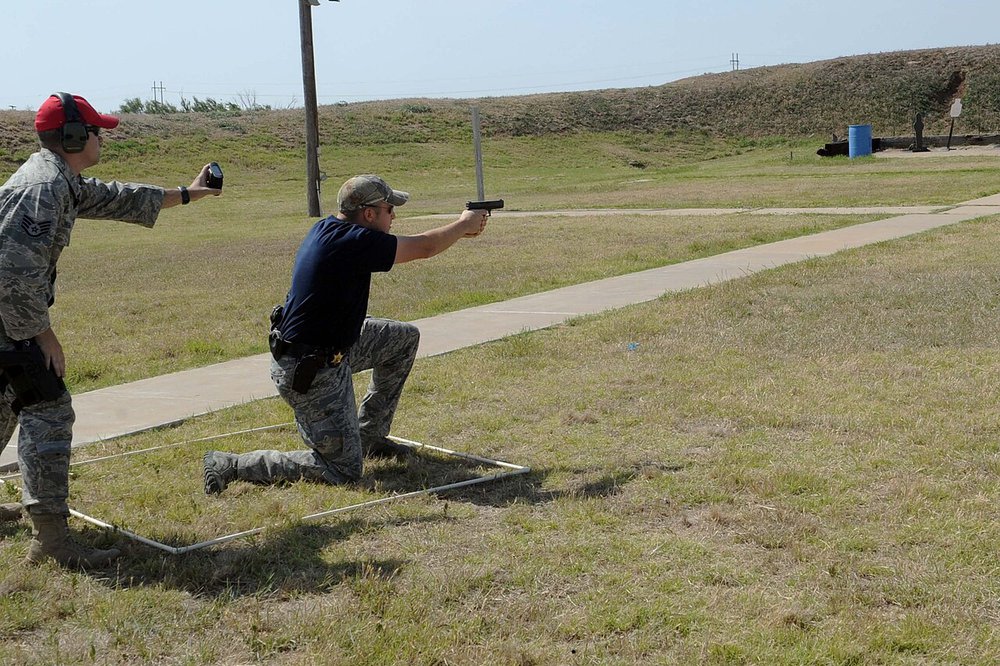
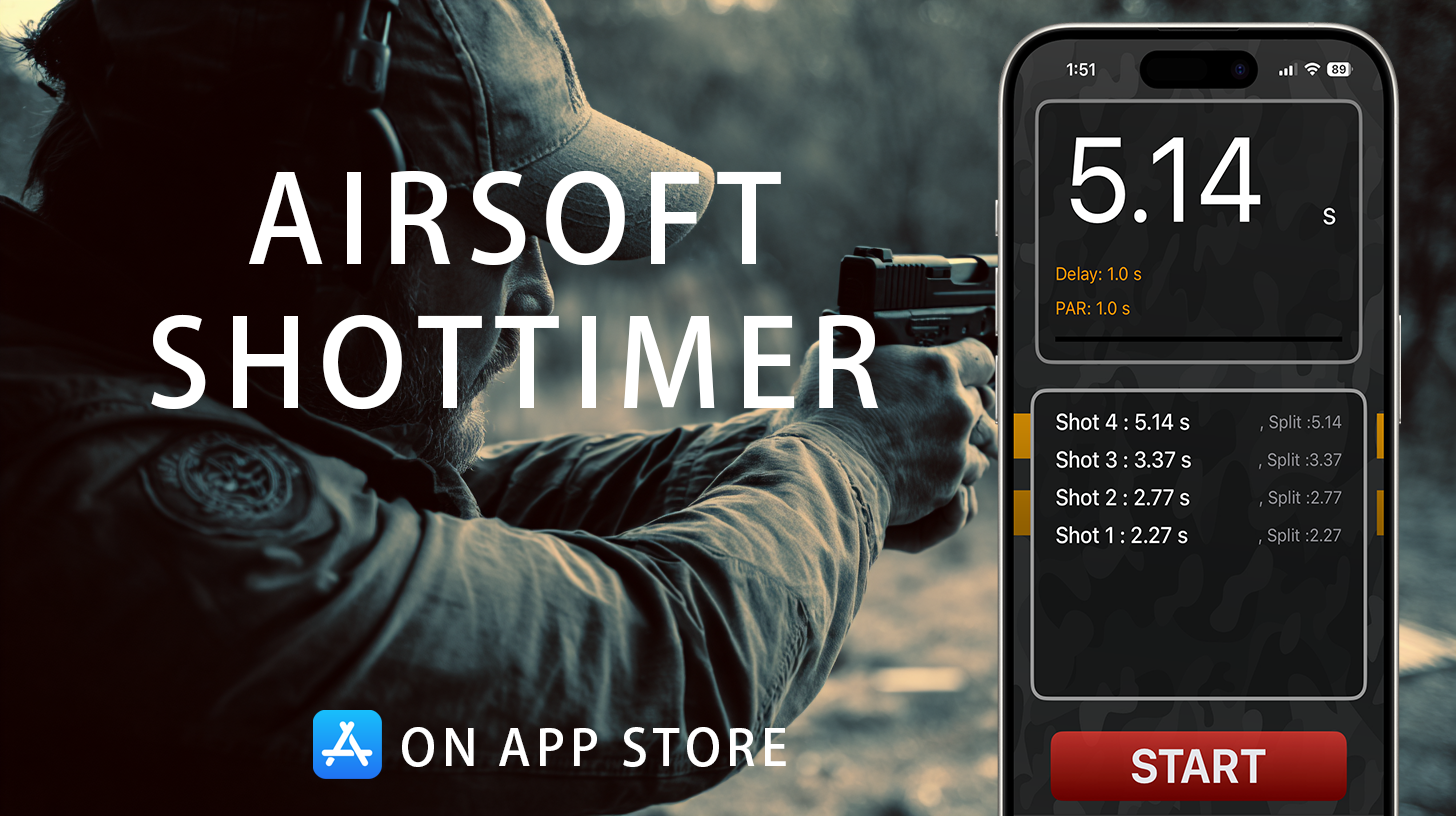
This is where a timer earns its place. In the Airsoft Shot Timer app you can set the par to your number from the table, turn on a random start delay so you can’t anticipate the beep, and read every split afterward. The splits tell you where the time goes: a long first shot means the draw or the switch to one hand, while splits that jump around in the middle usually mean the gun isn’t returning to the same spot. You can also stack more than one par beep, which is handy for the FBI string below.
One-Handed Shooting Drills That Work
Start with groups, then doubles, then timed strings. That order gets you accuracy first, because, as the numbers above show, points are where most one-handed runs fall apart.
Slow groups at 10-15 yards. Justin calls this the drill he should have mentioned first: shoot slow groups with each hand and see how still you can hold the gun while pressing the trigger. Adding speed to a one-handed grip that can’t hold a group is the hard way round.
Doubles at 7 yards, as a diagnostic. Shoot pairs and watch where the second shot goes. You want shots stringing vertically. Shots pulled to one side usually mean you pushed into the gun or changed pressure between shots. Strong hand only at 7 yards, he says you should be able to shoot pairs about as fast as you can and still hold roughly a fist-sized, 5-6 inch group. Weak hand only, he slows down until he can actually confirm the sights on both shots. Don’t do these forever — once you know what your gun does, move on to longer strings.
FBI string 1 as a time budget. Three strong hand, switch, three weak hand in six seconds at 3 yards. Break it into parts: a 1.5-second draw to the first strong-hand shot, two strong-hand splits at 0.35 (0.70), a 1.2-second hand switch to the first weak-hand shot, and two weak-hand splits at 0.50 (1.00) add up to 4.40 seconds, leaving 1.60 to spare. The switch is the step people rarely practice, and it’s where the time goes. Instructor Will Workman shot this string in 5.27 seconds during a 100/100 run, after fumbling his shirt on the draw. Set a second par beep at your switch target to train it.
Billy drill standards. Once groups and doubles are under control, run the drill above for a single score you can track month to month.
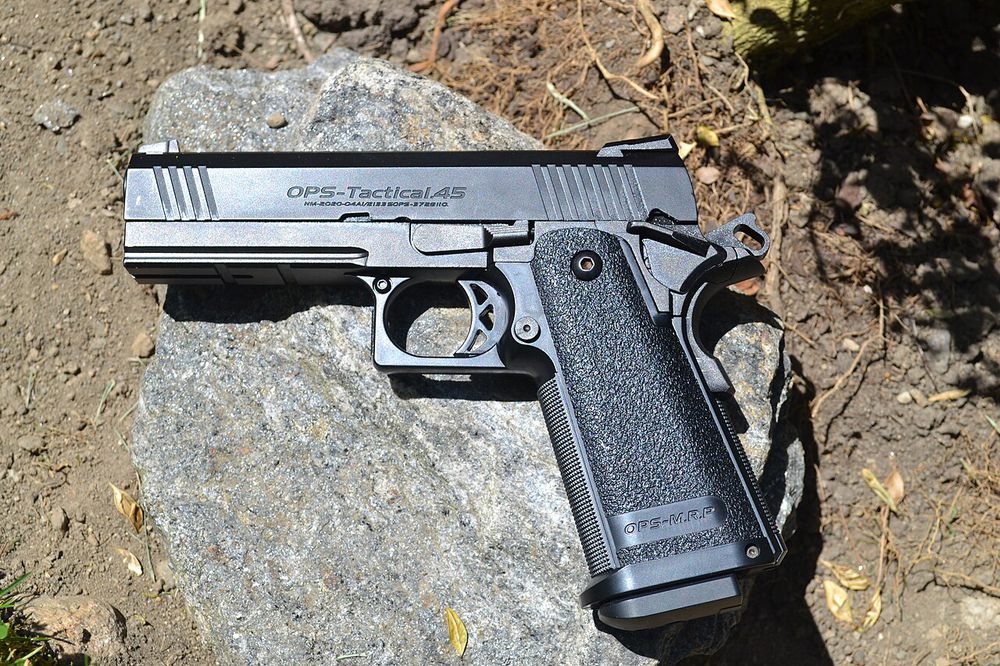
Dry fire and airsoft. Most of the grip work can be done dry: build the one-hand grip, press the trigger and watch the sights, then do the trigger-control-at-speed test for each hand. Our dry fire guide covers setting up a safe space. A gas blowback (GBB) airsoft pistol is also a good tool for this skill. Its recoil is far lighter than a 9mm, so it won’t teach you full recoil control, but it will clearly show the errors that come from the hand itself — pushing the shot, changing pressure, jerking the trigger with the weak hand — and you can shoot strong- and weak-hand strings at home at 5 meters. In airsoft games, switching to the weak hand also lets you shoot around the left side of cover while exposing less of your body, so the practice pays off there too. If you’re choosing a gas pistol, see our Tokyo Marui Glock GBB guide.
Frequently Asked Questions
How do you shoot a pistol with one hand?
Grip the pistol high on the backstrap and squeeze harder than you would two-handed, without squeezing so hard the gun shakes. Drop your thumb so it pinches the frame, keep pressure front-to-back, and pull your free hand in against your chest. Shoot at a slightly slower, more patient pace, and if you have time, blade your body slightly and lean into the gun.
How much slower is shooting with one hand?
As a working target, strong-hand-only shooting runs at about 70-80% of your two-handed performance and weak-hand-only at about 50-60%. In one USPSA Grandmaster’s Bill drill test, his raw one-handed times met those targets, but penalties for C and D hits pulled his final scores down to about 66% strong hand and 50% weak hand.
Should you cant the gun when shooting one-handed?
Strong hand only, most shooters keep the gun upright so recoil stays straight up and down. Weak hand only, a slight cant is common, because your dominant eye is on the other side and canting lets you keep the arm straight instead of bending it across your body.
What do you do with your free hand when shooting one-handed?
Pull it in tight against your chest. That keeps you balanced and gets the arm out of the way. Don’t let it touch the gun or support your shooting arm — in IPSC, using the other hand or arm to support the shooting wrist, hand or arm while firing costs a procedural penalty for every shot.
Do you have to draw with your weak hand in IPSC?
No. Under IPSC rule 8.2.4, a course of fire must never require a competitor to draw from the holster with the weak hand. Weak-hand-only strings start with the gun on a table or other surface, or after a strong-hand draw followed by switching hands.
The Takeaway
One-handed shooting isn’t a different skill; it’s your normal grip with the support hand removed, and it needs only a few changes: squeeze harder, put the thumb to work, give the free hand a job, cant slightly with the weak hand and be patient while the sights come back. The real numbers say most shooters already shoot one-handed fast enough — they lose the time in penalties. So measure your two-handed time, set one-handed pars from it, and only count clean runs. A free shot timer app is all you need to start.
Image credits: cover and strong-hand photo — Sgt. Jacob Suess, U.S. Army (public domain, second photo); weak hand — Senior Master Sgt. David H. Lipp, U.S. Air National Guard (public domain); shot timer — Senior Airman Leandra Stepp, U.S. Air Force (public domain); airsoft pistol — Dwt110, CC BY 3.0. Photos illustrate one-handed shooting in general; they are not from the drills described above.


Put a Shot Timer in Your Pocket
Airsoft Shot Timer is a free shot timer app tuned for airsoft and Action Air — it picks up BB gun shots, tracks your split times, and saves you the cost of a $150+ hardware timer for IPSC/IDPA practice.

- One-Handed Shooting
- Strong Hand Only
- Weak Hand Only
- SHO WHO
- Shooting With One Hand
- One Handed Pistol Shooting
- Pistol Grip
- Pistol Training
- Shooting Drills
- IPSC Rules
- USPSA
- IDPA 5x5
- FBI Qualification
- Dot Torture
- Bill Drill
- Shot Timer
- Par Time
- Airsoft
- GBB Pistol
- Dry Fire