Free Hit Factor Calculator (USPSA & IPSC) — Major/Minor + Time to Beat
Type in your hits, your penalties and your time. The hit factor appears as you type. It runs in your browser, there’s nothing to sign up for, and it also answers the question the other calculators skip: at the pace you just shot, is a make-up shot worth taking?
Action Air and most divisions score Minor.
The hard part is the time, not the math. The free Airsoft Shot Timer app uses your phone's mic to catch every BB gun shot — its last-shot time is the number you type in above.

The 30-second version
- Hit factor = (points − penalties) ÷ time. Time is to two decimals, the hit factor to four.
- Paper scores A 5 / C 3 / D 1 in Minor, A 5 / C 4 / D 2 in Major. Steel is 5 points either way.
- Each miss, no-shoot hit and procedural is −10. So a miss costs you 15 compared with an Alpha: 5 you didn’t earn plus 10 taken away.
- A stage can’t go below zero. If your penalties outweigh your points, the stage scores 0.
- What you need is the time. The calculator does the division. The time comes from a timer, and that’s what a shot timer app is for.
How hit factor is calculated
Hit factor is points per second. You add up what your hits are worth, take off the penalties, and divide by the time from the start beep to your last shot. That’s how USPSA’s Comstock and Virginia Count methods score a stage (rule 9.2.2.1), and it’s how IPSC, PCSL and Action Air do it too.
A worked example. A Minor shooter runs El Presidente: 12 rounds on three targets. The result is 8 Alphas, 3 Charlies and 1 Delta in 7.50 seconds. That’s 40 + 9 + 1 = 50 points, and 50 ÷ 7.50 = 6.6667. Same run, but one Charlie becomes a miss: 40 + 6 + 1 = 47, minus 10 for the miss, is 37. Divide by 7.50 and you get 4.9333. One bad shot took 26% off the hit factor. That ratio is why experienced shooters will slow down a little on the shot they’re unsure of.
There’s a faster way to count than adding up every hole. Instructors call it points down: start from the maximum (5 × the number of required hits) and only count what you lost. An Alpha is 0 down. In Minor, a Charlie is 2 down and a Delta 4 down. A miss is 15 down. On a six-shot Bill Drill with one Charlie, you don’t add 5 + 5 + 5 + 5 + 5 + 3. You say “30, two down, 28.” Once you think in points down you can score a drill in your head before you’ve walked up to the target.
Scoring values the calculator uses
These come straight from the USPSA rulebook (2026-09 edition). The IPSC Handgun rules use the same zone values and the same −10 penalties. Action Air scores paper like Minor.
| What happened | Minor | Major | Rule |
|---|---|---|---|
| A-zone hit | 5 | 5 | App. B1 |
| C-zone hit | 3 | 4 | App. B1 |
| D-zone hit | 1 | 2 | App. B1 |
| Steel (popper or plate down) | 5 | 5 | App. B3 |
| Miss, no-shoot hit, procedural | −10 each | −10 each | 9.4.4, 9.4.2, 10.1.2 |
Two details catch people out. First, the penalties are written as “twice the value of the maximum scoring hit”, and since an Alpha is 5, that works out to −10. Second, rule 9.5.6 sets the minimum score for a course of fire at zero. A stage where you earned 20 points and collected 30 in penalties scores 0, not −10. The calculator does both for you, and it rounds your time to two decimals the way the official time is recorded.
Is a make-up shot worth it? The math in one line
This is the part most hit factor calculators leave out. Any extra half-second also lowers your hit factor, so a make-up shot only helps if the points it buys arrive faster than your current rate. The break-even is exact, not a rule of thumb:
A make-up shot pays off if it takes less than (points gained ÷ your hit factor) seconds.
Turning a miss into an Alpha gains 15 points (you get 5 and avoid the −10). Upgrading a Minor Charlie to an Alpha gains 2, and a Major Charlie gains only 1. At typical hit factors, that works out to:
- HF 4: a make-up for a miss is worth up to 3.75 s; a Minor C → A is worth 0.50 s; a Major C → A is worth 0.25 s
- HF 6: 2.50 s for a miss; 0.33 s Minor; 0.17 s Major
- HF 8: 1.88 s for a miss; 0.25 s Minor; 0.13 s Major
- HF 10: 1.50 s for a miss; 0.20 s Minor; 0.10 s Major
- HF 12: 1.25 s for a miss; 0.17 s Minor; 0.08 s Major
Two things stand out. Picking up a miss is almost always worth it. Even on a fast Bill Drill-type stage, you’d need to spend well over a second to lose on it. Chasing Alphas over Charlies is the opposite. On a quick stage in Major, a tenth of a second spent refining the sight picture costs more than the extra point is worth. That’s the honest maths behind “Major shooters can shoot faster”, and it’s why the calculator prints both numbers under your result.
From hit factor to stage points and percentage
At a match, your hit factor isn’t your final stage score. The shooter with the highest hit factor in your division gets the stage’s full points. Everyone else gets a share in proportion. If the stage is worth 60 points, the winner shoots 8.0 and you shoot 6.0, you get 6.0 ÷ 8.0 × 60 = 45.0000 stage points. That’s rule 9.2.2.1, and 9.2.5 has stage points calculated to four decimal places. Put the winner’s hit factor in the calculator’s optional box and it shows your percentage straight away.
Classifiers work the same way, except you’re compared with a fixed benchmark called the High Hit Factor (HHF) instead of the day’s winner. Type the classifier’s HHF into the same box and you get your percentage and the class it roughly lines up with (GM 95%+, M 85%, A 75%, B 60%, C 40%). A single classifier doesn’t set your class, though. For how classifiers combine, and a full hit-factor-to-class chart for any HHF, see the USPSA classifier guide.
Using hit factor in training (where the clock comes in)
The second optional box is the one that changes how you practise. Type the hit factor you want, and the calculator tells you the time those same points need. Say your clean El Presidente is 60 points and you want an 8.0. You need 7.50 seconds. That’s a par time, and you can put it straight into the online par timer or the app and train against it until you make it 8 out of 10 times.
Scoring your drills as hit factor also shows you what a drill actually rewards. A Bill Drill packs 30 points into about two seconds, so time dominates. Here’s an instructor’s classic class question with the numbers worked out. One shooter goes all Alphas in 2.01 s, just over the “sub-2 clean” standard. The other shoots 1.99 s but drops one Charlie. Pass/fail says both failed. Hit factor ranks them: 30 ÷ 2.01 = 14.93 against 28 ÷ 1.99 = 14.07, so the slower, clean run wins. Now set the same six shots across three spread-out positions 15 yards from the target. The run takes ten seconds, the hit factor drops to around 3, and suddenly each dropped point matters far more than each tenth of a second.
None of this works if your times are guesses. The free Airsoft Shot Timer app listens through your phone’s microphone, picks up each BB gun shot, and records the first shot, every split and the last shot. That last-shot time is the number the calculator needs. It’s built to hear quiet GBB pistols, which most hardware timers struggle with. That makes it practical for Action Air and backyard airsoft drills, and it works with live fire too.
FAQ
How do you calculate hit factor?
Add up your points (A 5, C 3 or 4, D 1 or 2, steel 5), subtract 10 for every miss, no-shoot hit and procedural, then divide by your time in seconds. Example: 50 points in 7.50 seconds is a 6.6667 hit factor. If the penalties are bigger than the points, the stage scores zero.
What is a good hit factor?
It depends entirely on the stage. A 5 can be an excellent run on a long field course with movement and a poor one on a close stand-and-shoot. Judge a hit factor against the stage winner’s or the classifier’s HHF. Your percentage of that number is what means something.
Is a miss −10 or −15?
The penalty is −10. But compared with an Alpha you’re 15 points worse off, because you also missed out on the 5 points the hit would have earned. That’s why points-down counting treats a miss as 15 down.
Does Major or Minor change the hit factor?
Only through Charlies and Deltas. Alphas and steel are 5 points either way, and the penalties are the same. A Major shooter with the same hits and the same time gets a higher hit factor whenever they have C or D hits. That’s also why Major and Minor divisions have different classifier HHFs.
Can a hit factor be negative?
No. USPSA rule 9.5.6 makes zero the minimum score for a course of fire or string. If you earn 20 points and take 30 in penalties, the stage scores 0 and your hit factor is 0.0000.
Sources: USPSA Competition Rules, 2026-09 online edition (rules.uspsa.org): 9.2.2.1, 9.2.5, 9.4.2, 9.4.4, 9.5.6, 10.1.2, Appendix B1 and B3. The Bill Drill comparison follows an example from Gateway Defense’s “Understanding Hit Factor Scoring” video; the numbers here are recalculated.
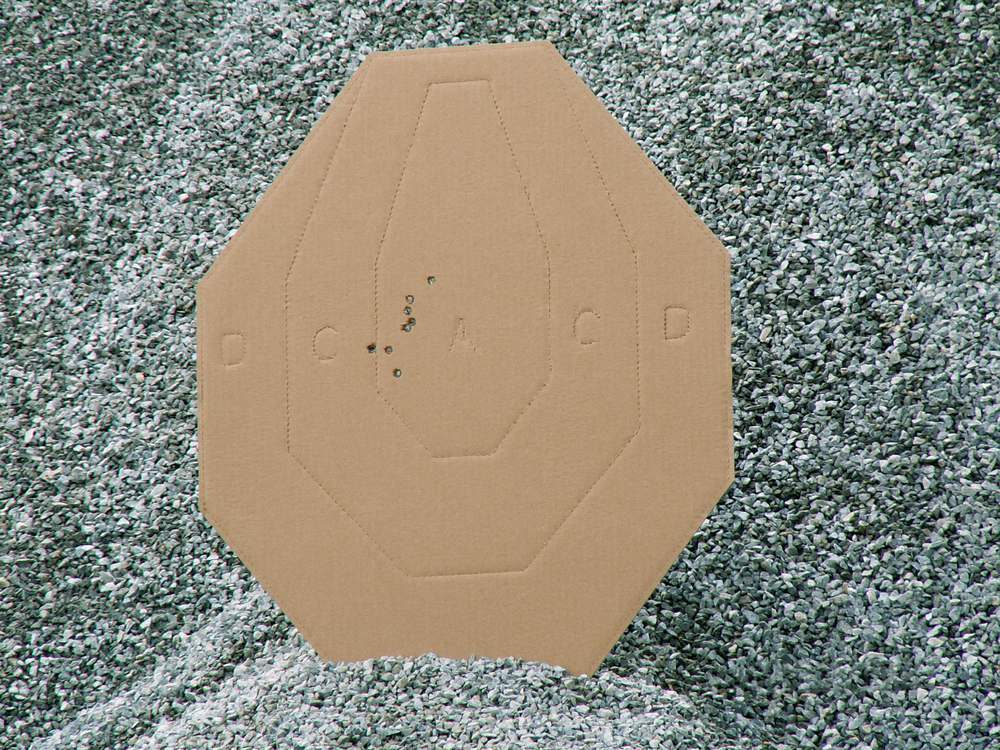
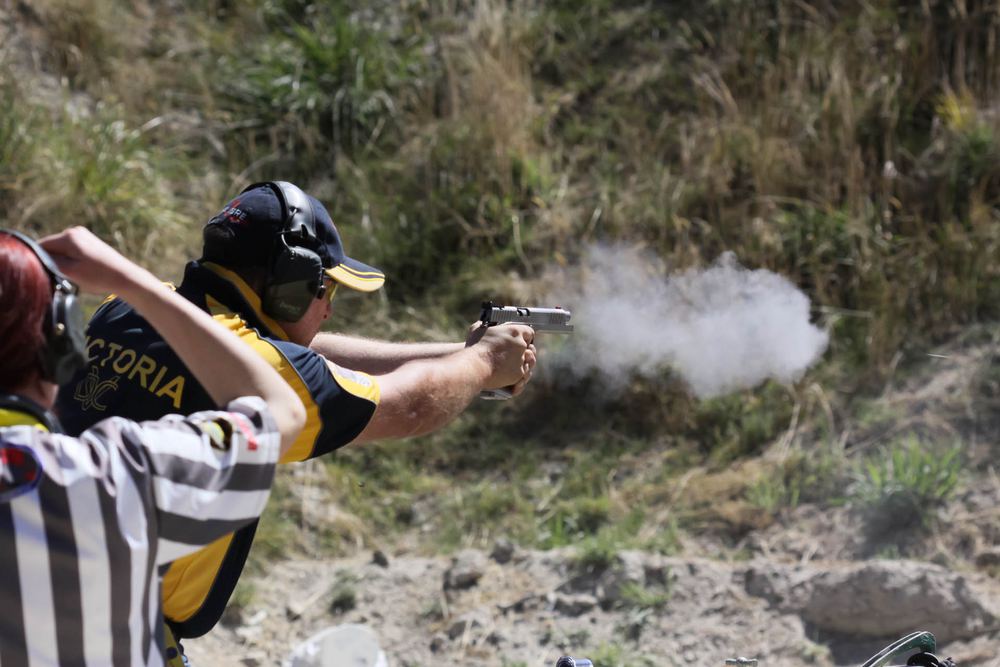
Image credits: cover — Rude, “IPSC target”, public domain, via Wikimedia Commons, resized. Stage photo — A. Taverner, “Gun powder smoke at the 2013 IPSC Australasian Handgun Championship”, CC BY 2.0, via Wikimedia Commons / Flickr, resized.


Put a Shot Timer in Your Pocket
Airsoft Shot Timer is a free shot timer app tuned for airsoft and Action Air — it picks up BB gun shots, tracks your split times, and saves you the cost of a $150+ hardware timer for IPSC/IDPA practice.
- Hit Factor Calculator
- Hit Factor
- USPSA Hit Factor Calculator
- IPSC Hit Factor Calculator
- How to Calculate Hit Factor
- Hit Factor Scoring
- Comstock Scoring
- Major Power Factor
- Minor Power Factor
- Uspsa Scoring
- IPSC Scoring
- Action Air
- Shot Timer
- Practical Shooting
- Dry Fire
- Bill Drill