Best Shot Timer 2026: 12 Shooting Timers Tested, From a $32 Amazon Buy to the $330 Flagship
Quick Picks: The Best Shot Timer for Every Budget (2026)
Short on time? Here are the 2026 picks at a glance, then the full reasoning below.
- Best overall (live fire): CED 7000 Gen-2 — $139.95, the IPSC/IDPA default, rechargeable and pocket-sized.
- Most reliable basics (no app needed): PACT Club Timer III — $124.95, the beep cuts through double ear-pro and the menus never get in your way.
- Best for USPSA and data tracking: Competition Electronics ProTimer BT — $149.95, Bluetooth logging to your phone.
- Best value / best all-round shooting timer: SG Timer GO — $164.99, the SG Timer 2’s brain and app ecosystem in a pocket-sized body half the price, now in the three-button, water-resistant version released in September 2026.
- Best premium for noisy indoor ranges: SG Timer 2 — $329.99, accurate enough to even pick up airsoft and suppressed shots.
- Best for rain and outdoor matches: Double-Alpha EDGE — $249.95, the only timer here with a published IP65 rating and a second display on the top edge.
- Best budget Bluetooth timer (USPSA / PractiScore): AMG Lab Commander — around $160-189, syncs to PractiScore over Bluetooth; the full AMG review and setup guide covers it properly.
- Best dedicated dry-fire timer: AMG Lab Sidekick BLE — around $65, tuned for the faint trigger “click”.
- Loudest buzzer on a firing line: Kestrel KST1000 — around $300-319, weatherproof and drop-tested, but read the section below before you spend that.
- Cheapest thing that beeps: ZOHAN and the other $30-40 Amazon units — genuinely usable for solo dry fire, genuinely a liability anywhere else.
- Not on a live-fire range yet? Hardware is the wrong first purchase — start with a phone and revisit this list later (app comparison here).
The short version: if you already compete or shoot live fire weekly, a CED 7000 Gen-2 or PACT Club Timer III is the safe first buy — and if you can stretch another $25-40, the SG Timer GO is the one most people end up happiest with. Below is what each one actually feels like to run on a bay, and where each one starts to annoy you.
The 2026 Shot Timer Comparison Table (Real Dealer Prices)
Before the write-ups, here is the whole category on one screen. Every price below is what a stocking US dealer was actually charging in September 2026, not a manufacturer’s list price or a number copied from a 2024 article:
| Timer | Price | Buzzer | Weather | Battery | Phone app |
|---|---|---|---|---|---|
| ZOHAN and similar | $32-40 | fixed, modest | none | AAA | no |
| AMG Lab Sidekick BLE | $65 | quiet, dry-fire tuned | none | coin cell | Bluetooth only |
| PACT Club Timer III | $124.95 | very loud, no backlight | none | 9V | no |
| CED 7000 Gen-2 | $139.95 | loud | none | rechargeable | no |
| Competition Electronics ProTimer | $137.95 | adjustable + headset jack | none | 9V, 20+ h | no |
| Competition Electronics ProTimer BT | $149.95 | adjustable | none | 9V | Bluetooth logging |
| SG Timer GO (2026 redesign) | $164.99-189.99 | 99 dB | water-resistant, no IP number | rechargeable, 1,000 mAh | full Drills app, settings also on-device |
| AMG Lab Commander | $160-189 | loud | none | rechargeable | PractiScore sync |
| Double-Alpha EDGE | $249.95 | up to 125 dB, floor above 100 dB | IP65 sealed | 2× CR123A, 25-50 h | firmware/basic only |
| Kestrel KST1000 | $300-319 | loudest on a line | weatherproof | AA | minimal |
| SG Timer 2 | $329.99 | 60 dB to painful | water and dust resistant | rechargeable, months | full Drills ecosystem |
One line in that table is worth more than the rest of it put together: the buzzer floor. Everyone shops for the loudest timer and nobody checks how quiet it goes. If you do most of your training in a flat at ten at night, a timer whose minimum is still over 100 dB is a timer you will stop using, and that single number is why the SG Timer 2 keeps showing up in living rooms as well as on bays.
One pricing trap to know before you click buy. Shooters Global’s own store folds VAT into the price depending on where you browse from: the same SG Timer GO showed up at $202.94 (including $37.95 VAT) on one regional view and at $164.99 on the US view, and the SG Timer 2 appears at $368.99 VAT-inclusive against $329.99 at US dealers. Before deciding the manufacturer is $40 dearer, check whether the number in front of you includes tax — then buy from whichever of the official store or a stocking dealer actually has the version you want on the shelf.
Why You Need a Dedicated Shot Timer
If you’ve ever practiced your draw, reloads, or follow-up shots at the range and thought “yeah, that felt faster,” you know how vague training without a timer can be. Shooting is a sport measured in hundredths of a second, and the gap between how fast you think you are and how fast you actually are is usually bigger than you’d expect.
I remember the first time I timed my draw-to-first-shot with a shot timer — 2.3 seconds. I’d been convinced I was somewhere around 1.5. That number was a wake-up call, but it also gave my training a clear direction. Watching that time drop from 2.3 to 2.0, then 1.8, then 1.5 over weeks of focused practice — that kind of measurable progress is something you simply cannot get by going off feel alone.
Whether you’re an IPSC competitor pushing stage times, an IDPA shooter working on defensive draws, a dry fire enthusiast training at home, or an airsoft player timing tactical movements, a quality shot timer is one of the best investments you can make in your shooting development. The question is: with options running from a $32 Amazon unit to a $330 flagship, which one should you buy?
Before You Spend Anything: Do You Actually Need Hardware?
Here’s the part most buyer guides quietly skip: a good chunk of the people reading a shot timer buying guide shouldn’t buy one yet. Every week I hear from someone who bought an entry-level timer, used it twice in the living room, and left it in a drawer.
The honest test is where you train, and two things separate a real timer from everything else — both of them physical. The first is buzzer volume. With electronic ear-pro clamped on your head, only a purpose-built buzzer cuts through, and a good one is audible from dozens of metres down the range. The second is detection in noise: on a bay with three other shooters going off beside you, the timer has to pick your shots out of theirs, and that is exactly where weak sensors fall apart — you finish a string and find it logged eleven shots for your six.
So buy hardware the moment you’re regularly on a live-fire range with shooters working next to you, or competing in IPSC/IDPA where the start signal has to be heard over ear-pro. If you’re not there yet — training dry fire at home, or shooting airsoft and Action Air — put the cash toward ammo, BBs or a decent belt instead, and come back when your training moves to a live bay. Timing on a phone is a separate comparison with its own trade-offs, and we keep it on its own page: the best shot timer app guide.
The Only Two Features You Actually Need (Everything Else Is Optional)
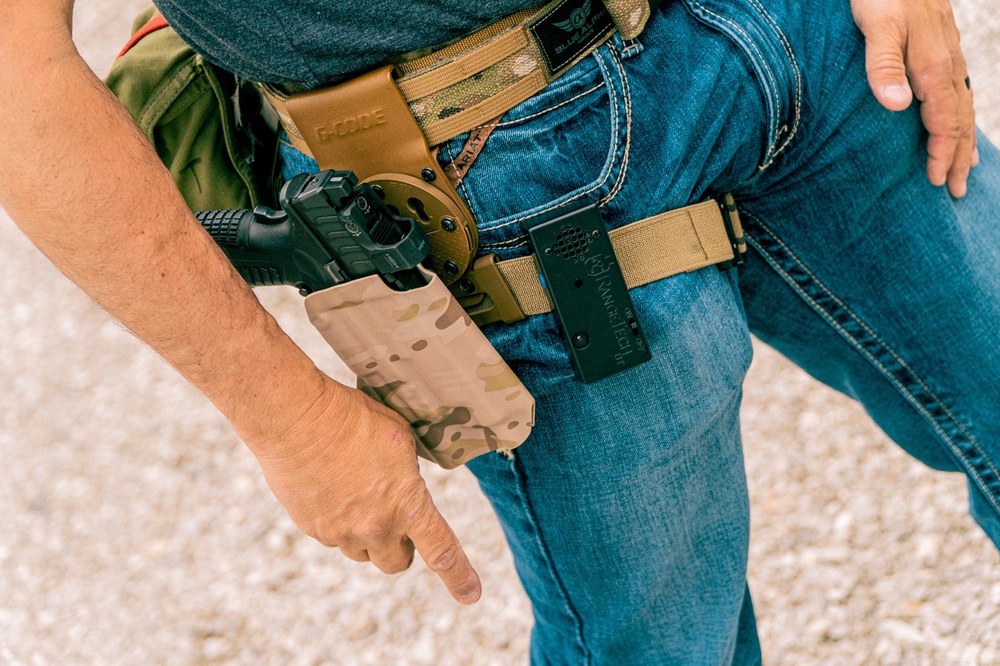
Spec sheets are where shot timer shopping goes to die. Every product page lists a dozen modes, and none of them tells you which ones you will ever touch. So it is worth listening to people who run timers for a living: in a 2025 shot timer discussion at Ben Stoeger Pro Shop, Joel Park and Hwansik Kim — both career USPSA competitors and instructors — cut the whole feature list down to two things.
The first is being able to switch the start signal between random delay and instant. Instant means the buzzer fires the moment you press the button, which is what a range officer needs. Random delay is what you need when you are training alone: press start, let your hands fall to your sides, breathe out, and let the beep surprise you. If your timer can only do one of the two, half your training is compromised — you will either be anticipating the beep or unable to run a stage for someone else.
The second is par time, and it matters far more in dry fire than most people realise. A dry fire trigger pull makes no noise a timer can register, so no timer on earth can tell you how fast your dry draw was. What it can do is give you a second buzzer at a deadline. Set a two-second par for a Bill Drill, then draw and press the trigger six times — if the buzzer lands after your sixth press, you made it; if it lands on your fourth, you failed, and you know it instantly without looking at a screen. That single trick is most of what a timer does at home, and it is why par time is not an advanced feature but the core one. (The same logic drives most of the drills in our dry fire training guide.)
Two more features sit just below those, and both are quietly worth paying for. One is adjustable buzzer volume — obvious the first time you dry fire in an apartment at 10pm with a partner or kids asleep down the hall. Timers without it get the low-tech treatment: shooters literally tape over the buzzer to muffle it. The other is an adjustable random-delay length. Many timers randomise between roughly one and four seconds, and at the short end you can barely get your hands down before the beep. Hwansik Kim sets his minimum to around 2.4 seconds specifically so he has time to settle into a proper start position first. It is a tiny setting that changes the quality of every rep you run.
Everything past that — Bluetooth, video overlay, PractiScore sync, cloud history — is genuinely useful, but it is a preference, not a requirement. Read the rest of this list with that hierarchy in mind and the price differences start making a lot more sense.
Twelve Shot Timers Reviewed: Every Shooting Timer Worth Buying in 2026
The shot timers worth serious consideration boil down to a handful of models, each with distinct positioning and trade-offs. Rather than dumping spec sheets, let me walk you through each one from a user’s perspective.
CED 7000 Gen-2: The Most Popular All-Rounder
The CED 7000 is probably the best-selling shot timer in the world. Walk into any IPSC or IDPA match and you’ll see them everywhere. The reason is straightforward — reasonable price, comprehensive features, and a remarkably compact form factor.
The first thing you notice picking up a CED 7000 is how small it is. At just 82 grams (2.9 oz), it’s lighter than most smartphones and practically disappears in a pocket. The interface is intuitive — a few buttons handle all the settings without needing to consult the manual. The display is crisp and readable even in direct sunlight.
The CED 7000 has several standout features. It’s the only rechargeable timer in its price range — USB charging means no scrambling for batteries mid-competition. It stores up to 999 shot records, more than enough for a full day of matches or training. It can also connect to the CED BigBoard display system, projecting timing results on a large screen for spectators during matches.
However, the CED 7000’s weakest point is its performance in noisy environments. During indoor range testing with multiple active shooters, its echo filtering proved inconsistent — roughly 82% correct shot isolation, meaning about 18% of the time it misjudges or misses shots. If you mainly train at a quiet outdoor range, this won’t matter. But if you frequently shoot at busy indoor ranges, it’s something to consider.
The model you want in 2026 is the Gen-2, and that matters more than it sounds. The Gen-2 is what Double-Alpha now stocks at $139.95, and it is the version competitors name when they write “CED7000 Gen 2” — if you find an older unit listed cheaper somewhere, check which generation you are actually buying. The other thing worth knowing is that the CED is quietly getting harder to find: Ben Stoeger Pro Shop, the biggest name in practical-shooting retail, currently lists CED accessories but no CED 7000 body at all. It is not discontinued, but it is no longer the timer that every dealer keeps on the shelf, and that is a change from two years ago.
At $139.95, the CED 7000 Gen-2 still offers the best value among mainstream options. If this is your first shot timer, it’s usually the safest entry point — just buy it from somewhere that has it in stock rather than waiting on a backorder.
PACT Club Timer III: The Reliable Workhorse
PACT is one of the oldest names in the shot timer game, and the Club Timer III is their flagship seller. If the CED 7000 is a nimble pocket knife, the PACT Club Timer III is a sturdy, dependable utility knife — no fancy features, but everything it does, it does solidly.
The Club Timer III’s most praised qualities are its buzzer volume and screen clarity. The buzzer is loud enough to hear clearly from across an outdoor range, even through double ear protection. The large-font display is easy to read in any lighting condition without squinting.
The operation logic is equally straightforward. Review mode lets you quickly scroll through each shot’s time and split data, and setting a Par Time takes just a few seconds. No confusing menu hierarchies — all common functions are one or two button presses away.
The Club Timer III’s downsides are its slightly larger size compared to the CED 7000 and its reliance on a 9V battery rather than rechargeable power. During busy competition seasons, you’ll find yourself swapping batteries regularly. It also lacks Bluetooth or app connectivity — all data stays on the timer itself, with no option to export to your phone for deeper analysis.
Priced at roughly $130, it sits right alongside the CED 7000. If you particularly value buzzer volume and rock-solid basic functionality, the Club Timer III is an excellent choice.
Competition Electronics Pro Timer BT: Feature-Rich Classic
Competition Electronics (CE) Pro Timer series enjoys strong name recognition in North American shooting circles. The latest BT version adds Bluetooth connectivity, finally bringing this classic timer into the modern era.
The Pro Timer BT offers the richest menu system among traditional timers. Beyond the standard Review, Par Time, and Start Delay options, it includes Comstock mode (commonly used in USPSA) and various customization settings. If you shoot USPSA, the Pro Timer BT’s feature set feels tailor-made for your needs.
The biggest BT version upgrade is Bluetooth connectivity. Through the PTLink app, you can view timing data on your phone in real-time, add notes and target photos to each shot string, and export complete training logs. For shooters who keep detailed training journals, this is incredibly practical — no more bringing pen and paper to the range to copy down numbers.
In terms of feel, the Pro Timer BT is slightly larger and heavier than the previous two options. It feels more like a piece of equipment than a pocket gadget. For Range Officers who clip the timer to their belt and run stages all day, the extra weight accumulates noticeably.
Priced at roughly $160-189, it’s a step up from the first two. If you need Bluetooth connectivity and rich feature options — especially for USPSA/IPSC competitors and match staff — the Pro Timer BT justifies the premium.
Competition Electronics Pocket Pro II: What the Pros Carry — and Why You Can’t Buy One
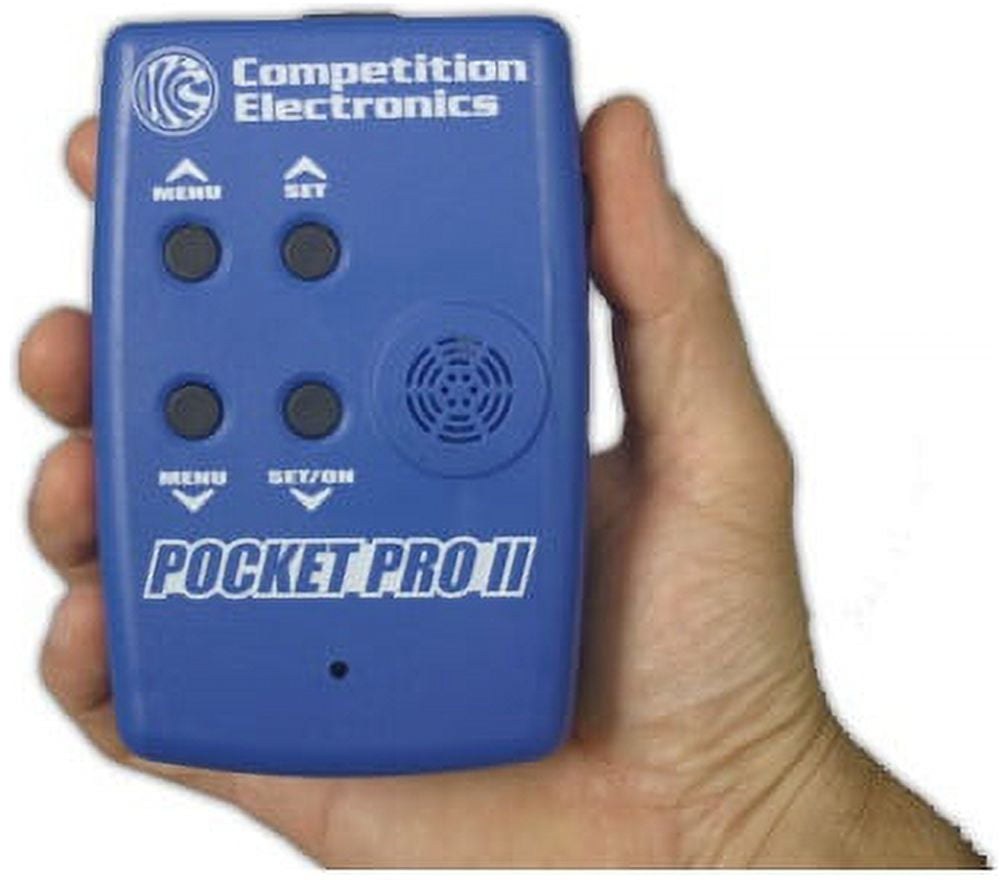
Here is the timer that almost never makes the top of a “best shot timer” list but keeps coming out of working shooters’ range bags. When Joel Park and Hwansik Kim were asked which timer to buy, the answer was blunt: if you stop watching here, buy the Pocket Pro II. Both named it their personal go-to, and both were still running the units they bought over a decade ago.
The appeal is not the feature count — it is that everything you need is one obvious button away. Four buttons walk the menu and a fifth fires the buzzer, the digits are large and unambiguous, and a first-time user can generally work it out on the firing line without a manual. That sounds like faint praise until you have watched someone fumble a menu tree while a squad waits behind them.
What it has that the $130 pair doesn’t is the two “nice to have” features from the section above, both of them: you can set the buzzer volume down for indoor or apartment dry fire, and you can lengthen the random start delay so you aren’t caught mid-fidget. It also has a backlight, which the PACT flatly does not — and if you shoot at an indoor range or anywhere with poor light, that alone can decide the purchase.
Durability is the other half of the pitch, and the anecdote that sticks with me is Joel Park’s: a Pocket Pro got so soaked in Minnesota rain during a class that water pooled inside and the screen went blank. He pulled the battery, left it open in his trunk overnight, put the battery back the next day, and it powered straight up. He still uses it. Whatever the Pocket Pro lacks in modern polish, it has an unusually good record of simply not dying.
And here is the update that changes the recommendation. The Pocket Pro II has been discontinued by Competition Electronics. Retailers that used to stock it now list it as no longer available, and the units still floating around dealer inventories and the used market are the last of them. Every buying guide still telling you to buy a Pocket Pro II — including, until this update, the section you just read — is sending you after a product that is out of production. If you find one new at a sensible price, it is still an excellent timer and the durability story above still holds. Just don’t go hunting for one.
Competition Electronics ProTimer: The Pocket Pro II’s Actual Replacement
Competition Electronics did not abandon the design; they iterated on it. The ProTimer, model CEI-4730, is sold explicitly as the Pocket Pro II’s successor — the company’s own description says they took the best parts of the Pocket Pro II and added to them — and at $137.95 it lands in almost exactly the same price bracket the Pocket Pro II occupied. If you were about to buy a Pocket Pro II, this is the timer to buy instead.
What you gain over the old unit is worth having. There is a 50-string memory with on-screen review, so you can scroll back through the day’s strings numbered and timestamped rather than trying to remember whether the good run was three strings ago. There is built-in hit factor scoring — points per second, calculated on the timer itself, which is the number that decides your finish in USPSA and normally requires either mental arithmetic or a phone. Par time now goes up to five programmable intervals rather than one, which is what you want for multi-beep drills. Sensitivity was pushed up far enough that it will register a finger snap, which matters more than it sounds when you are trying to get a timer to hear a light target load or an airsoft pistol.
Two small features are the ones I’d actually miss if I went back. The first is an 850mcd white start LED as an alternative to the buzzer — a visual start signal, which is the polite way to train in a shared space and the only way to train while someone else is asleep down the hall. The second is a 3.5mm headset jack with volume control, so you can route the beep into your own ears and no one else’s. Between those two, the ProTimer is quietly one of the better apartment dry-fire timers on this list despite having no app at all.
It still runs on a single 9V battery for 20-plus hours, it is still made in the USA, and it carries a two-year warranty with a half-price repair guarantee after that — which is the same “we expect this to outlive you” posture that made the Pocket Pro II a decade-long buy. What it does not have is Bluetooth or any data history beyond its own screen. If you want your training logged to a phone, step up to the ProTimer BT at $149.95 or across to the SG Timer GO.
SG Timer 2: The Tech Flagship
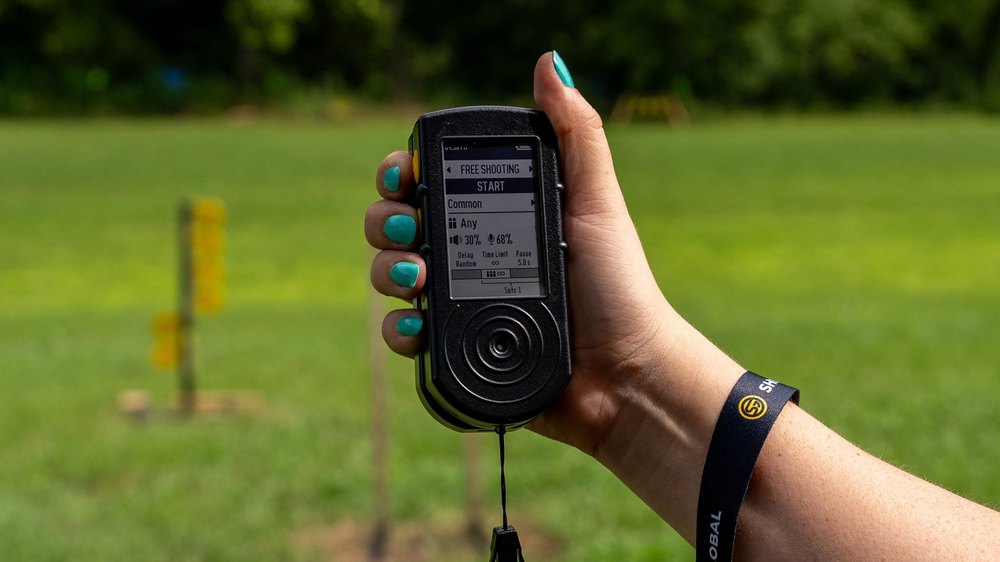
Shooters Global’s SG Timer 2 is currently the most advanced shot timer on the market, with a price to match. If the previous timers are “timers,” the SG Timer 2 is more like a “shooting training computer.”
The SG Timer 2’s most impressive feature is its acoustic detection technology. It uses a custom-engineered Acoustic Amplifier, making it the loudest shot timer ever made according to the manufacturer. More importantly, its smart sensing system can accurately isolate only your shots even at a busy indoor range — dramatically reducing false detections. It can even detect airsoft AEG guns, CO2 pistols, and suppressed firearms, a detection range that traditional timers simply can’t match.
The display is another highlight. The 172PPI high-resolution screen uses a bottom layer that reflects sunlight to create internal illumination, providing exceptional contrast that actually improves in bright outdoor conditions. A single charge lasts up to 30 days of use, essentially eliminating battery anxiety.
Paired with Shooters Global’s dedicated app, the SG Timer 2 becomes a complete training ecosystem. Bluetooth connectivity enables real-time data viewing on your phone, video sync capability, and long-term progress tracking. The video overlay feature is particularly useful — you can see timing markers directly on your training footage, making it clear exactly which shot took too long during review.
At roughly $330, it’s more than double the price of a CED 7000. That’s steep for casual shooters, but for serious competitors, coaches, and frequent match officials, the SG Timer 2’s detection accuracy and app integration deliver efficiency gains that justify the investment.
Kestrel KST1000: The Loudest Buzzer Money Can Buy — and Not Much Else
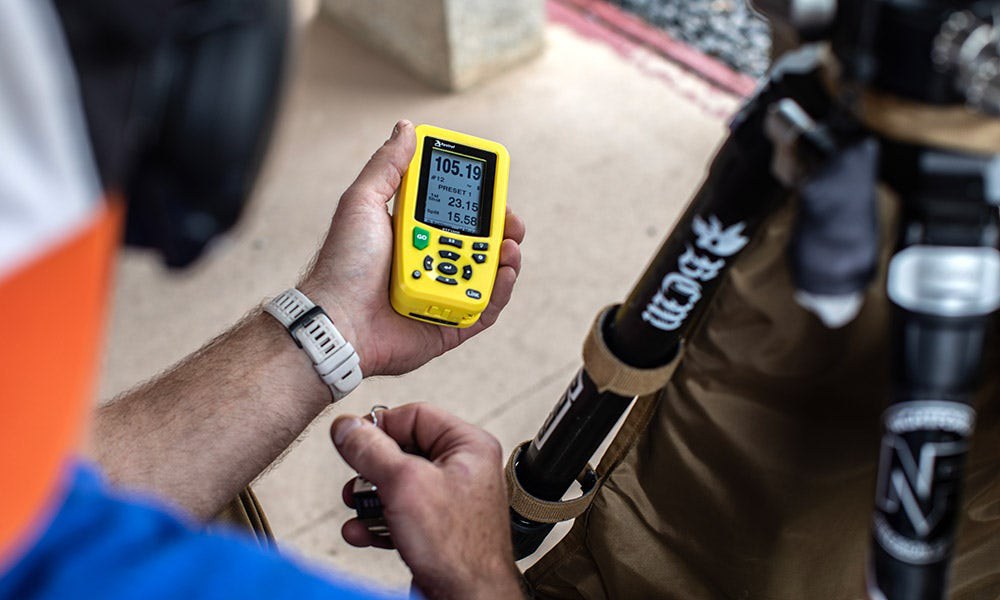
Nearly every other 2026 buying guide lists the Kestrel KST1000 near the top, usually with the phrase “the safe choice.” It costs around $300-319, it is waterproof and dust-proof, it is drop-tested, it carries a five-year warranty, it is made in the USA, it times up to 999 seconds for long outdoor stages, and it has Bluetooth. On paper it is the most rugged thing here, and reviewers who focus on build quality genuinely love it.
The honest version is more complicated, and it comes from the people who own one and still recommend something else. Joel Park and Hwansik Kim both keep a Kestrel — and both describe it, in almost the same words, as a $300 speaker. The buzzer is the loudest either of them has used, loud enough that an instructor standing at one end of a firing line can start a shooter at the far end who is wearing plugs and muffs. That is a real capability, and for a working instructor it is worth the money on its own.
For everything else, they reach for the Pocket Pro. Roughly a dozen buttons and a dense menu on a small screen make it slow to reconfigure between drills, and neither of them was willing to spend the learning curve when a five-button timer shows the same numbers instantly. Kim’s summary — great functions, but he isn’t spending range time driving them — is the most useful sentence in this whole roundup. Park also had a unit arrive dead, then couldn’t get a reply from customer service until he posted about it publicly, at which point a replacement shipped the next day. One person’s experience isn’t a pattern, but it belongs in a buying decision at this price.
There is a real buyer for this timer: the instructor, match official or precision-rifle shooter who needs a start signal that carries across a whole line in the rain, and who sets the thing up once. If that is not you, you are paying flagship money for a buzzer, and the $165 SG Timer GO below does more of what most shooters actually do. One practical note from testers who did get along with it: the factory sensitivity ships around 50%, and bumping it toward 80% resolves most complaints about missed shots — worth doing before you decide the unit is faulty.
SG Timer GO: The Best Bang-for-Buck Shooting Timer
If there’s one timer that quietly became the default recommendation over the past two years, it’s this one. The SG Timer GO is Shooters Global’s compact model — think of it as the SG Timer 2’s brain in a body barely bigger than a car key fob, at roughly $165 instead of $330.
Physically it’s tiny, and that matters more than the spec sheet suggests. Next to a PACT Club Timer III it looks like a toy, but there’s a real advantage to gear that doesn’t flap around on your belt while you’re moving through a stage. The current version — the redesign Shooters Global released in September 2026 — has three physical buttons and a large auto-backlit display. That backlight is a genuine differentiator: the PACT has no backlight at all, so in a dim indoor bay you’re squinting at your own numbers, while the GO senses the light level and switches its LED on for you.
The third button is the headline change, because it fixes the original GO’s one real complaint. The first-generation GO had only two buttons, so the deeper settings — par times, volume, sensitivity, presets — lived in the free Drills app, and changing a par time on the line meant pulling out your phone. On the new unit the primary shooting settings can be changed on the timer itself; the app is still where you build presets and review history, but it is no longer mandatory mid-session. That also settles most of the old PACT-versus-GO argument. Reviewers used to say the PACT was simpler out of the box, yet adjusting its microphone sensitivity means popping open the battery compartment and fiddling with a trim adjustment. The GO now wins on both counts.
What you get for the app dependency is the whole Shooters Global ecosystem at a mid-tier price. Your strings sync to your phone and stay there — months or even years of training history, rather than the single most recent string that a PACT overwrites the moment you shoot again. The Drills app will also film you and stamp your split times onto the footage, which is the single most useful review tool I know of for spotting which rep was slow rather than just knowing one of them was. There’s a range officer mode, a spy mode that syncs with other timers at matches, a dry-fire mode sensitive enough to catch striker clicks that the PACT flatly cannot hear, and Apple Watch control if you wear one.
At $164.99 it’s about $25-40 more than the entry-level pair, and for that you get Bluetooth, an app ecosystem, a backlit screen, dry-fire capability, and a two-year warranty. Unless you specifically want a no-app timer, it’s very hard to argue for spending $125 instead.
What changed in the September 2026 redesign? Shooters Global previewed the new GO at SHOT Show in January 2026 and released it on September 11, 2026. Forum threads call it the “SG GO II”, but the official name is still just SG Timer GO. Beyond the three buttons, the body is now tough polycarbonate and water-resistant (no IP number published), the acoustic chamber was redesigned with a wider pickup field for better shot detection, and the battery grew from 900 to 1,000 mAh, about 11% more. The price did not move: $164.99 direct with one mount, $174.99 with both the belt quick-release and the pocket clip, while stocking dealers list their bundles at $179.99-189.99. The buying advice has flipped since earlier this year — there is nothing left to wait for — but first-generation two-button units are still in the channel, so check that the listing says three buttons. If you find an old one discounted well below $140 and you don’t mind setting it up from your phone, it is still a very good timer.
While we’re on the ecosystem, two other Shooters Global announcements are worth knowing if you’re buying into it. The SG Pulse Pro rifle level is switching from its magnetic connector to USB-C in the first half of 2026, with a magnetic-to-USB-C adapter promised for existing owners. And the Drills app is getting Shotisize, an automated video analysis feature that finds the timer’s beep in your uploaded footage and overlays shot timestamps and splits without you scrubbing the timeline by hand. It is still in development, but it is the sort of thing that keeps this ecosystem worth paying a premium for.
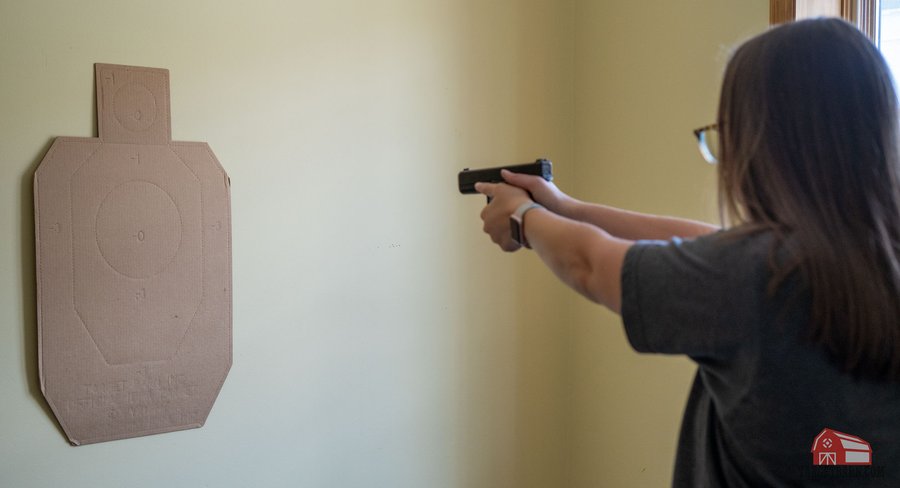
Double-Alpha EDGE: The One That Survives Rain
This is the newest timer in the category and the most interesting arrival in years. Double-Alpha Academy — the IPSC gear house whose name is on half the belts at a European match — released the EDGE at $249.95, deliberately positioned $80 under the SG Timer 2, and their marketing claim is simply that it is the best shot timer on the market. Worth taking seriously, and worth testing rather than believing.
Physically it is a lot of timer. The housing is fibre-reinforced polymer with a thick Gorilla Glass screen protector over a dual backlit display, and it measures 130 × 65 × 35 mm at 230 g — which is genuinely chunky next to a 82 g CED. The most common first reaction from people who pick one up is some version of “wow, that’s a big timer.” Whether that bothers you depends entirely on whether it lives on your belt during a stage or in your hand as a range officer.
The headline feature, and the reason it earns a spot on this list, is that second display on the top edge. If your timer is clipped to your belt, a top-facing readout means you glance down and read your time without unclipping anything — a small thing that turns out to matter a lot in practice. It is not perfect: it is a single line showing only the total time, and side lighting makes it read a bit like a pocket calculator. But nothing else at this price has it.
The other headline is durability, and this is the one dimension where the EDGE is genuinely alone. It carries a published IP65 rating — fully sealed against dust and usable in heavy rain. The SG Timer 2 is described by its maker as water and dust resistant but has never been given an official IP number, and nothing in the $125-165 bracket makes any weather claim at all. If you shoot outdoor matches in a climate that has weather, that rating is the argument.
Feature-wise it is deep where it counts. The buzzer runs up to 125 dB with adjustable tone frequency, par timing supports up to five programmable intervals across profiles, and the review matrix stores 30 strings of up to 250 shots each with splits. There is a rate-of-fire readout, a customisable range-officer walkthrough countdown, five user presets, an integrated flashlight that can also fire an optical start signal, and a microphone test screen that shows live signal levels and recommends a sensitivity setting — which is a genuinely clever answer to the indoor-range problem described further down this page. Over Bluetooth it drives DAA’s Target Activation Pods ($179.95 each, sold separately) and talks directly to the DAA ARC Chrono to display velocity and power factor.
Two things to weigh before you buy. The first is the battery: two CR123A cells, 25-50 hours, and no batteries in the box — CR123As are not what most people have in a drawer, and one reviewer only made it through a match because he happened to keep spares for a red-dot sight. The second is the buzzer floor. The EDGE’s minimum volume still sits above 100 dB. There is a flash-to-start option instead, but if your goal is training a reaction to a beep, a light defeats the purpose. For apartment dry fire, that alone rules it out — the SG Timer 2 goes down to roughly 60 dB and will even route the beep to a Bluetooth headset.
And then there’s the app, which is where the price gap explains itself. The EDGE’s companion app does firmware updates, basic control and a battery readout, and that’s about the end of it. So the honest verdict from head-to-head testing is this: on practical and basic function the two are a draw, on advanced function it isn’t close, and the EDGE lands slightly awkwardly between categories — more expensive than the timers that already do the basics beautifully, without quite enough software to justify premium money. Buy the EDGE if the top display, the IP65 rating or the DAA target-pod integration is the thing you specifically want. Otherwise either save $85 and buy a GO, or spend $80 more and buy the flagship.
AMG Lab Commander and Sidekick: Where They Land in This Lineup
Two AMG units earn a place on this list, at opposite ends of it. The Commander, around $160-189, is the cheapest honest route to Bluetooth match scoring; against the rest of this lineup that puts it behind the SG Timer GO on refinement, but ahead of everything else on price-per-feature. The Sidekick BLE, around $65, is the cheapest piece of hardware here worth owning — though it’s a dry-fire tool and nothing else, with a buzzer far too quiet to survive a live-fire bay, so it never really competes with the $130 pair for range duty.
That’s about as far as a roundup this size can usefully go on a brand this deep. Current prices and where units are actually in stock, Commander versus Sidekick in detail, the setup instructions that don’t come in the box, the PractiScore pairing sequence and the sensitivity numbers that actually work are all in the AMG shot timer review and instructions guide.
Related reading: Want the full dry fire methodology to run alongside whichever timer you pick? See our Dry Fire Training Guide.
The $30 Amazon Tier: ZOHAN and What You Actually Give Up
Every list above starts at $130, and the obvious question is what happens if you type “shot timer” into Amazon and buy the cheapest thing with good reviews. That is usually a ZOHAN, currently around $32-40, and it deserves an honest answer rather than being ignored — most roundups skip this tier entirely, which is exactly why buyers end up disappointed by it.
It is a real timer, not a toy. The current ZOHAN unit has a genuinely loud buzzer, a backlit screen, several shooting modes, par time, and enough sensitivity for dry fire practice — the feature list on paper covers both of the two things that actually matter. Reviewers who bought one alongside the established brands generally land in the same place: it isn’t refined enough to displace a PACT Club Timer III, but at a quarter of the price it is not a scam either, and for a solo shooter on a private range or a garage dry-fire setup it does the job.
What you give up is everything that shows up when conditions get hard. Build quality is the first thing — it is not as robust as a Pocket Pro or a PACT, so it will not survive being dropped on concrete or left in a hot truck the way those will. Sensitivity handling is the second and more important one. A cheap microphone with crude filtering has to choose between missing your quieter shots and logging the shooter in the next bay as yours, and there is no version of that tuning that works on a busy line. Support and firmware are the third: when something behaves oddly, there is nobody to call.
So the honest recommendation is narrow but real. If you shoot alone, mostly dry fire, and cannot justify $130 yet, a $32 timer that you actually use beats a $300 timer you keep deferring. The moment you start shooting next to other people — a club match, a busy indoor bay, any kind of squadded event — its shot detection becomes the weak link and you will end up buying twice. Buy it as a training aid, not as your competition timer.
Do Shot Timers Work at Indoor Ranges? (Where Cheap Timers Fall Apart)
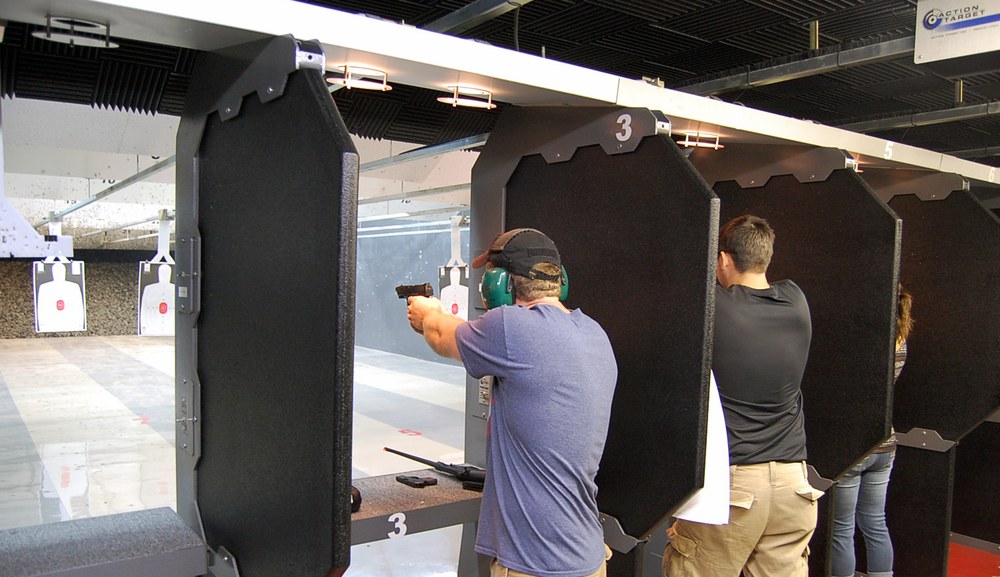
This deserves its own section because it is the single most common reason people are unhappy with a timer they already bought, and almost no buying guide addresses it directly.
An indoor bay is close to a worst case for acoustic shot detection. Concrete and steel bounce every shot back at the microphone as an echo a few milliseconds behind the original, which a timer can happily log as a second shot. Meanwhile the shooter two lanes over is producing a signal at your microphone that is often louder than your own quieter loads. Turn sensitivity down and the timer misses your shots; turn it up and it logs eleven shots for your six. If you have ever finished a string and found split times that make no physical sense, this is why — and it is not always your technique or your gun.
Three things separate timers that cope from timers that don’t. The first is adjustable sensitivity that you can actually reach: the SG Timer GO and SG Timer 2 expose it in the Drills app in two taps, while the PACT requires opening the battery compartment and turning a physical trim adjustment, and the cheapest units simply don’t offer it. The second is the quality of the echo filtering itself — this is the main thing your money buys at the top of the market, and it is why the SG Timer 2 is the standing recommendation for busy indoor lines despite its price. The third, which almost nobody mentions, is a backlight. Indoor bays are dim, and a PACT Club Timer III has no backlight at all, so you will be angling the screen toward the nearest light to read your own splits. The ProTimer, SG Timer GO, SG Timer 2 and the EDGE all have one — and the EDGE has two, counting the readout on its top edge.
If you train mostly indoors, the practical shortlist gets short fast: SG Timer GO at $164.99 if you want value, SG Timer 2 at $329.99 if the bay is genuinely busy and you are tired of bad data, and the ProTimer at $137.95 if you want no app and a screen you can read. Rifle bays and compensated pistols make everything worse still — if that describes your range, assume you need the top tier rather than hoping the entry level copes. And whatever you buy, the first thing to do is find the sensitivity setting and tune it on your own range rather than trusting the factory value.
Outdoor Matches, Rain and Cold: Which Timers Actually Survive It
Indoor ranges break cheap timers acoustically. Outdoor ranges break them physically, and almost nobody writes about it — which is odd, because in most of the world a club match is an outdoor match, and outdoor matches happen in whatever weather the calendar hands you.
Start with sealing, because it is the only spec here that is measurable. The Double-Alpha EDGE publishes an IP65 rating, which in plain terms means dust-tight and rated against a jet of water — usable in heavy rain, not usable underwater. Interestingly, the EDGE’s rear speaker grille looks alarmingly open when you inspect it, but the housing behind it is sealed and the rating is an official one, so the appearance is misleading. The SG Timer 2 has no published IP figure at all; Shooters Global describe it as water and dust resistant and say it handles heavy rain, and the redesigned SG Timer GO, on sale since September 2026, adds water resistance to the compact model for the first time, likewise without an IP number. The Kestrel KST1000 comes from a company that builds weather meters and is properly weatherproofed and drop-tested — which, along with the buzzer, is most of what your $300 buys. Everything under about $150, including the CED, PACT and ProTimer, makes no weather claim whatsoever. A 9V-battery timer in a plastic shell will usually survive light drizzle in your pocket and will not enjoy anything more than that.
Cold is the second problem, and it is the one that catches people out because it looks like a fault rather than physics. Batteries lose voltage in the cold, and battery gauges read that as depletion. One reviewer ran an EDGE for seven straight hours at a winter match and watched the meter fall to two or three bars — then watched it climb back the moment the timer warmed up indoors. The number on the screen was lying, but only temporarily. The practical lesson is not about that timer specifically: in winter, keep the unit inside a jacket between stages rather than clipped to an exposed belt, and do not diagnose a battery by what the gauge says at 2°C.
Battery chemistry is where the outdoor calculation genuinely differs from the indoor one. A rechargeable timer is more convenient nine months of the year — the SG Timer 2 needs charging about four times a year even under heavy range-officer use. But you cannot fix a flat rechargeable in the middle of a stage, whereas swappable cells go in during the walkthrough. If you run replaceable-cell timers, the discipline is simple: buy a CR123A or 9V charger, keep a charged set in the range bag, and remember that the EDGE ships with no batteries at all, so order cells with the timer rather than discovering the omission the night before a match.
So the outdoor shortlist, honestly: the EDGE if you want a published rating and a top display you can read without unclipping; the SG Timer 2 if the app ecosystem matters more than the certificate; the Kestrel if your job is starting shooters at the far end of a long line in bad weather. And if you are shooting club matches in a temperate summer with a $125 timer, you are almost certainly fine — just don’t leave it on the bay when the sky goes dark.
Choosing by Scenario: Which Shot Timer Fits You Best?
Now that you know each timer’s characteristics, let me help you choose based on your actual use case. Different training styles and competition types have very different demands.
For IPSC or IDPA competitors, the CED 7000 Gen-2 or ProTimer BT are the mainstream choices. The CED 7000 likely has the highest market share at IPSC events thanks to its compact size, rechargeable battery, and BigBoard display compatibility. The Pro Timer BT offers deeper functionality, particularly Comstock mode for USPSA matches. If you want PractiScore Bluetooth scoring without the SG Timer 2’s price tag, the AMG Lab Commander covers that middle ground at around $160-189 — being the official timer of USPSA is a big part of why it’s become such a common sight on USPSA and Steel Challenge squads. The SG Timer GO sits in the same bracket at $164.99 and is the better pick if you’d rather have the Drills app ecosystem and video overlay than PractiScore sync. And if budget allows, the SG Timer 2 provides the most reliable detection accuracy in noisy competition environments.
For primarily at-home dry fire trainers, the Sidekick BLE is the most direct hardware answer, and the $65 price tag buys more features than most people need. And if what you actually want is to see where the shot landed rather than just how fast it broke, that’s a different tool entirely — our laser training system guide covers the Mantis TitanX, SIRT and cartridge kits that add shot placement to your dry fire.
For airsoft players wanting to time magazine changes, draws, or tactical movements, the SG Timer 2’s wide detection range is a clear advantage — it can detect AEG and CO2 pistol sounds. Other traditional timers respond inconsistently to airsoft gunfire. That said, for most airsoft training, a phone app is honestly sufficient.
For shooting instructors or frequent Range Officers, the calculation is different from everyone else’s, because your timer’s job is to be heard rather than to log data. The Double-Alpha EDGE is worth a hard look for this job specifically: the top-edge display lets you read a time without taking the timer off your belt, the walkthrough countdown is a dedicated function, the flashlight helps when you are calling tight hits in poor light, and the IP65 sealing means a wet squad day is not a problem. Its one weakness — a buzzer that will not go quiet — simply does not apply when your whole purpose is volume. Beyond that, the Kestrel KST1000’s buzzer justifies its $300 — it will start a shooter at the far end of a line who is wearing plugs and muffs, which nothing cheaper reliably does. If you want one timer that does both jobs, the SG Timer 2 is the most worthwhile investment. Its detection accuracy, app integration, and build durability hold up best under high-frequency, long-term use. The Pro Timer BT is a solid runner-up — Bluetooth connectivity and logging features add real value to teaching workflows.
Picking Your First Shot Timer
If you’ve read this far and still can’t decide, here’s a simple decision framework.
Your budget and primary use case are the two factors that matter most. If your budget is around $125-140, the CED 7000 Gen-2 and PACT Club Timer III are both safe, reliable choices. The differences between them are honestly small — the CED 7000 Gen-2 is lighter and rechargeable; the Club Timer III is $15 cheaper with a louder buzzer and simpler operation, but has no backlight. Pick whichever advantage matters more to you, and check stock before you commit to the CED.
If you can stretch to $160-190, the Pro Timer BT’s Bluetooth features and rich menu system bring more structure to your training records. If you’re transitioning from an app to hardware and are used to viewing data on your phone, the Pro Timer BT offers the smoothest transition.
If you want the safest first purchase rather than the best-specified one, the ProTimer at $137.95 is hard to argue with — adjustable buzzer volume, a headset jack, an LED start signal, built-in hit factor scoring, a menu you can learn on the firing line, and the same made-in-USA lineage that kept Pocket Pro IIs working for over a decade. If budget isn’t a concern and you’re serious about your training, the SG Timer 2 is the current top of the line. But honestly, for most shooters just starting timed training, the $125-140 entry-level options deliver 90% of the core functionality. Buy one and start training — then consider upgrading once you have a clearer understanding of your needs. That’s far better than deliberating for weeks and not buying anything.
Ultimately, regardless of which timer you choose, what matters most is using it. A flagship timer collecting dust in a drawer is worth less than an entry-level timer that comes to every practice session. Build the habit of timing every training session, and the speed of your improvement will surprise you.
Frequently Asked Questions
What is the best shot timer in 2026?
For most live-fire shooters the best value in 2026 is the SG Timer GO at around $165 — Bluetooth, an app ecosystem with video overlay, a backlit screen and dry-fire sensitivity for barely more than the entry-level pair. The CED 7000 (around $130) remains the safe no-app choice and the IPSC/IDPA default, with a rechargeable battery and a pocket-sized body. If you want the most advanced detection for busy indoor ranges, the SG Timer 2 leads the pack. For at-home dry fire the AMG Lab Sidekick BLE (around $65) is hard to beat. Across the whole list, the $130 pair remains the answer for anyone who just wants a timer that works and never thinks about it again.
Do I need the manufacturer’s app with a hardware timer?
No, but on the Bluetooth models it’s where half the value lives. Shooters Global’s free Drills app pairs with the SG Timer GO and SG Timer 2 for video overlay and months of saved history; the AMG Lab Commander talks to PractiScore for match scoring; the Competition Electronics Pro Timer BT uses its own PTLink. The CED 7000 and PACT Club Timer III have no app at all and work fine standalone. That’s a different question from which standalone timer app to download — for that comparison, see our best shot timer app guide. The one thing no app can do is out-shout your ear protection on a live-fire range; that’s what a hardware buzzer is for.
Is the SG Timer GO worth it over a CED 7000 or PACT?
For most buyers, yes. The GO runs about $165 against roughly $130 for the older pair, and for that extra $35 you get Bluetooth, the Drills app ecosystem with video overlay and months of saved history, an auto-backlit screen, and a dry-fire mode sensitive enough to register striker clicks — none of which the CED or PACT offer. It’s also noticeably smaller on the belt. The case for the older timers comes down to two things: you want a timer with no app dependency whatsoever, or you specifically want the PACT’s famously loud buzzer. Both are legitimate reasons, but neither applies to most people.
What is the best budget shot timer?
Among full live-fire timers, the CED 7000 and PACT Club Timer III at around $130 are the value benchmarks — both are reliable, both are the default sight at club matches, and neither asks you to learn an app first. Stretch to $165 and the SG Timer GO becomes the better buy once Bluetooth and the Drills ecosystem are in the picture. If what you want is a dedicated dry-fire device rather than a range timer, the $65 AMG Lab Sidekick BLE is the cheapest hardware here worth owning.
What is the best shot timer for dry fire?
The AMG Lab Sidekick is the purpose-built answer — it’s tuned for the faint dry-fire “click” that confuses live-fire timers, and the AMG shot timer review and instructions guide covers its setup, sensitivity and the Commander comparison in full. Whichever unit you end up with, the drills matter more than the hardware: our dry fire training guide has the practice structure to run with it.
Will a shot timer work with airsoft?
Most hardware timers struggle with airsoft because GBB and AEG shots are far quieter than live fire, so they miss shots or false-trigger on field noise. Of everything on this list, the SG Timer 2 is the only unit with a detection range wide enough to handle airsoft reliably — and at $330 that’s a lot of money to solve a problem software solves better, so airsoft and Action Air players are better served by the app comparison than by anything in this roundup.
Are shot timers worth it?
If you train with any intention at all, yes — it’s the cheapest way to find out that the draw you thought took 1.5 seconds actually takes 2.3. A timer converts “that felt faster” into a number you can chase, and it’s the only piece of gear here that improves every drill you already do rather than adding a new one. The caveat from earlier in this guide still stands: if you’re not on a live-fire range regularly yet, a phone app gives you 90% of that benefit for free, and the app comparison is the better starting point.
How much does a good shot timer cost, and why are they so expensive?
A good one costs $130-165 in 2026; the floor is about $32 for an Amazon unit and the ceiling about $330 for the SG Timer 2. The reason a device that “just beeps and counts” costs more than a smartwatch is that the hard part isn’t the beep — it’s isolating your shots from echoes and from the shooter in the next bay, which takes a purpose-built microphone, real acoustic filtering, and per-unit testing across a low production volume. That engineering is exactly what you stop paying for below $50, and exactly what you notice the first time you use a cheap timer on a busy line.
What is the best shot timer for beginners?
The Competition Electronics ProTimer at $137.95, for one reason: you can operate it correctly on your first range trip without reading anything. Menu buttons you can learn on the firing line, large digits, an adjustable buzzer volume plus a headset jack so home dry fire doesn’t wake the house, and an LED start signal for when even that is too loud. It is the direct replacement for the now-discontinued Pocket Pro II, so old advice pointing at that model still applies here. The $139.95 CED 7000 Gen-2 is the other safe answer if you want the timer you’ll see most often at club matches. Skip the flagships until you know which features you actually miss.
Kestrel KST1000 or SG Timer 2 — which should I buy?
They cost roughly the same ($300-319 versus $330) and they are built for different people. The Kestrel is the more rugged object and has the louder buzzer, and it treats its app as an optional extra; the SG Timer 2 has the better detection in noise and puts the app at the centre of how you use it, with video overlay and long-term history. Buy the Kestrel if you run a firing line in bad weather and want a start signal that carries. Buy the SG Timer 2 if you want your training data to survive the drive home. If neither reason applies, the $165 SG Timer GO does most of what the SG Timer 2 does for half the money.
What is the most popular shot timer?
By sheer count at club matches, the CED 7000 — it’s been the IPSC and IDPA default for years and you’ll see them on more belts than anything else. The AMG Lab Commander has taken a large share of USPSA squads on the back of PractiScore sync, and the Shooters Global pair have been the fastest-growing name since 2024. Popular isn’t the same as best for you, though: the Competition Electronics line is under-represented at matches and over-represented in the bags of people who teach for a living, and Double-Alpha’s EDGE arrived in 2026 to chase the top of the market.
What is the best shot timer with Bluetooth or PractiScore?
For phone-synced scoring the standouts are the Shooters Global SG Timer 2 ($329.99) at the premium end, the AMG Lab Commander ($160-189) as the budget PractiScore option and the SG Timer GO ($164.99) as the do-everything middle pick; the Competition Electronics ProTimer BT ($149.95) syncs through its own PTLink app instead. The Double-Alpha EDGE ($249.95) also has Bluetooth, but its app is essentially a firmware updater — the radio is there mainly to drive DAA target pods and their chronograph, not to build you a training log. Between the two PractiScore-capable picks, the Commander is the cheaper way in and the AMG guide walks through the pairing sequence that catches out most first-time owners.
Double-Alpha EDGE or SG Timer 2 — which is the better premium timer?
On day-to-day handling and core timing function they are close enough to call a draw, so the decision comes down to three specifics. Buy the EDGE ($249.95) if you want a published IP65 weather rating, a second display on the top edge you can read without unclipping the timer, or control of DAA target activation pods and the ARC Chrono. Buy the SG Timer 2 ($329.99) if you want the software: profiles, downloadable drills, quick stages, hit-factor calculation, video overlay with split times, Apple Watch and Garmin control, and a buzzer that goes down to about 60 dB for home dry fire instead of the EDGE’s 100 dB-plus floor. Both were measured at roughly 130 dB at maximum, so loudness is not the tiebreaker. In short, the EDGE wins on hardware and the SG Timer 2 wins on ecosystem — and for most buyers the ecosystem is what they end up using every week.
Is the Competition Electronics Pocket Pro II still available?
No — the Pocket Pro II has been discontinued and retailers now list it as no longer available. Its official replacement is the Competition Electronics ProTimer (CEI-4730) at $137.95, which the company describes as built on the best parts of the Pocket Pro II design. The ProTimer adds a 50-string memory with on-screen review, built-in hit factor scoring, up to five par-time intervals, an 850mcd LED start signal and a 3.5mm headset jack. If you find a genuine new Pocket Pro II at a fair price it is still a fine timer, but do not go hunting for one — and be sceptical of any buying guide that still names it as a current pick.
What changed in the new SG Timer GO (2026)?
The redesigned SG Timer GO was released on September 11, 2026, after a SHOT Show preview in January. People call it the “SG GO II”, though the official name didn’t change. It has three physical buttons instead of two, so primary settings such as par time can be changed on the timer without the app; a water-resistant polycarbonate body (no official IP rating); a redesigned acoustic chamber with a wider pickup field for better shot detection; and a 1,000 mAh battery instead of 900 mAh. The price is unchanged at $164.99 direct, or $174.99 with both mounts. If you are buying now, make sure the listing is the three-button version — a discounted first-generation unit is only worth it if the saving is substantial.
What is the most weather-resistant shot timer?
The Double-Alpha EDGE is the only timer in this lineup with a published rating: IP65, meaning dust-tight and rated against water jets, so it is fine in heavy rain. The Kestrel KST1000 is properly weatherproofed and drop-tested, which is a large part of what its $300-319 buys. The SG Timer 2 is described by its maker as water and dust resistant but carries no official IP number, and the redesigned SG Timer GO released in September 2026 adds water resistance to the compact body for the first time. Everything under $150 — CED 7000 Gen-2, PACT Club Timer III, ProTimer, the $32 Amazon units — makes no weather claim at all, so treat those as pocket-in-a-drizzle timers rather than all-weather ones. Cold is a separate issue for every timer: battery gauges read low in freezing conditions and recover once the unit warms up, so keep it inside a jacket between stages.
Wrapping Up
A shot timer is one of the highest-ROI investments in shooting training. You don’t need to spend a fortune — a $130 timer can double your training efficiency. It transforms “I think I’m getting faster” into “my splits dropped from 0.35 to 0.28,” giving every practice session a clear target and trackable results.
Choose the shot timer that fits your needs, and start training with intention. Whether you’re working on IPSC rapid fire, IDPA tactical reloads, or airsoft gear manipulation, a shot timer will become your most valuable training partner.
Related Articles
- how to use a shot timer - Deep dive into shot timer training methods and techniques
- Shot Timer App Complete Guide - Turn your phone into a professional training system
- Dry Fire Training Guide - Professional shooting practice at home
- which pistol drill to shoot - Timer-based training drills and exercises
- Practical Shooting Guide - IPSC competitive shooting from beginner to advanced
- IDPA Divisions Guide - IDPA competition rules and division breakdowns
- Airsoft Loadout Guide - Optimize your gear setup with shot timer benchmarking
Put a Shot Timer in Your Pocket
Airsoft Shot Timer is a free shot timer app tuned for airsoft and Action Air — it picks up BB gun shots, tracks your split times, and saves you the cost of a $150+ hardware timer for IPSC/IDPA practice.

- Shot Timer
- Best Shot Timer
- Best Shot Timer 2026
- Best Shot Timers
- Budget Shot Timer
- Cheap Shot Timer
- Best Shooting Timer
- Shot Timer Reviews
- Shot Timer Comparison
- Best Shot Timer for Beginners
- Shot Timer for Indoor Range
- SG Timer GO
- SG Timer
- CED 7000
- PACT Club Timer
- Competition Electronics ProTimer
- Kestrel KST1000
- Double-Alpha EDGE
- PractiScore
- IPSC
- IDPA
- Training Guide