The F.A.S.T. Drill: Par Times, Scoring & the Coin Only 26 Shooters Have Won (2026)
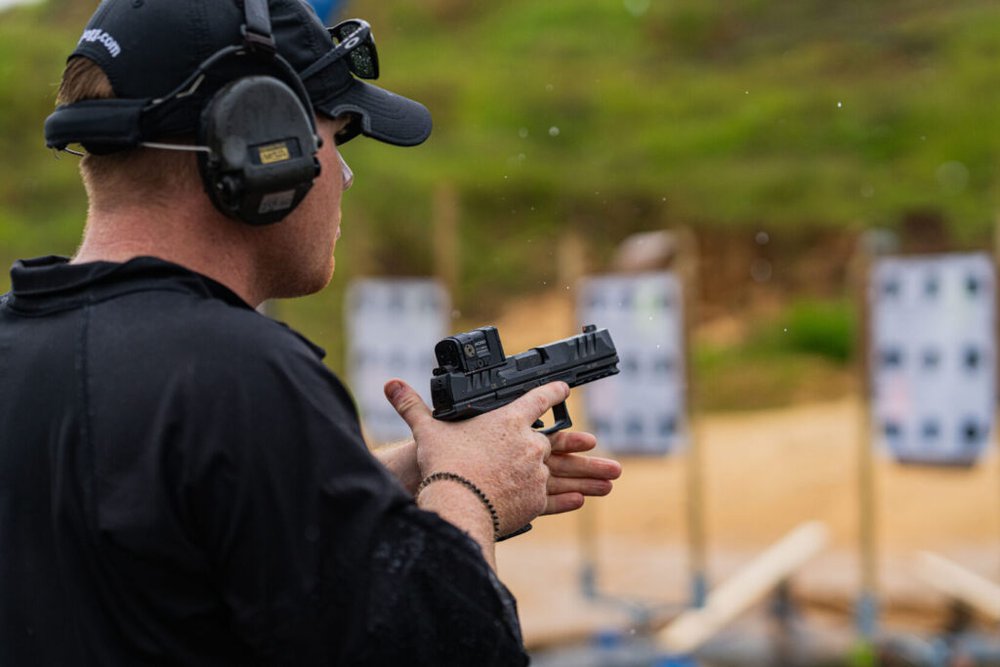
The F.A.S.T. Drill in 60 seconds (BLUF)
- What it is: Six rounds at 7 yards on one target — a 3×5 inch card in the head and an 8-inch circle in the body. Draw with exactly two rounds in the gun, fire two at the card, reload from slide lock, fire four at the circle.
- Why it hurts: The hardest shots come first and cold, then the gun runs dry on purpose. A slide-lock reload tears your grip apart, and you have to rebuild it while the clock runs.
- Ratings: 10+ seconds Novice · under 10 Intermediate · under 7 Advanced · under 5 Expert.
- Penalties are the whole game: every miss on the 3×5 card adds 2.00 seconds; every miss on the 8-inch circle adds 1.00 second. A 4.84-second run with two dropped body shots scores 7.34 — a Novice-to-Advanced fall from one bad grip.
- The coin: A clean sub-5.00 run, done in front of an authorized instructor, twice. Since 2007 exactly 26 people have earned one. There is also a “half pin” for a clean sub-7.00.
- Train it anywhere: Load two BBs in a GBB airsoft pistol and the slide locks back for real. With a free shot timer app you get the same draw, the same reload, and the same honest number — without burning 600 rounds finding out.
Most shooting drills flatter you. You pick the distance, you pick the pace, and you stop when the group looks good. The F.A.S.T. does the opposite: it hands you a small target, an empty gun, and a stopwatch, and then it tells everyone in earshot exactly where you actually are. Ernest Langdon — the man Todd Green authorized to carry on as arbiter of the F.A.S.T. Coin — puts it bluntly in his own classes: “It is a test specifically. It’s not something you practice.”
That one sentence is the thing most people get wrong about this drill, and it’s the reason so many shooters have a “personal best” they’ve never repeated. Six rounds, 7 yards, five seconds. The whole thing is over before you can talk yourself into anything.
What Is the F.A.S.T. Drill?
F.A.S.T. stands for Fundamentals, Accuracy, and Speed Test. It was designed by the late Todd Louis Green, the instructor behind pistol-training.com, who died in March 2016 after a decade-long fight with cancer. The test outlived him and is now shot in classes and on ranges all over the world, largely unchanged.
The course of fire is short enough to memorise in one read:
- Distance: 7 yards
- Target: a single silhouette with a 3×5 inch box in the head and an 8-inch circle in the body
- Start position: pistol holstered and concealed, or in a duty rig with all retention devices active; shooter facing downrange, relaxed, arms hanging at your sides
- Load: exactly two rounds in the gun — that’s the whole point
- On the beep: draw, fire two and only two rounds at the 3×5 box
- Slide locks back empty → perform a slide-lock (emergency) reload
- Fire four and only four rounds at the 8-inch circle
- Total: 6 rounds, one string, one number
Two shots, reload, four shots. It reads like nothing. It shoots like a tax audit.
The design is deliberately hostile in a way that most drills aren’t. Kyle Morgan, a former Delta Force operator, shot it cold on camera for EOTECH and summed up the architecture before he’d even fired: the first two shots demand a tight tolerance at a medium distance, then “four slide lock breaks your grip automatically”, and then you have to reacquire that grip and deliver four more hits while the tolerance opens up and your brain starts screaming go faster. Every phase actively sabotages the next one.
The Scoring: Why Raw Time Lies
This is where most write-ups stop and most shooters get fooled. The number your timer shows is not your score.
| Event | Adjustment |
|---|---|
| Miss on the 3×5 head box | +2.00 seconds per miss |
| Miss on the 8-inch body circle | +1.00 second per miss |
| Open-top holster without concealment | +0.50 seconds |
| Retention holster plus covered (flap) mag pouches | −0.50 seconds |
Look at what that penalty structure does. Dropping a single head shot costs you two full seconds — on a drill where the difference between Advanced and Expert is also two seconds. As Langdon tells his students: if you drop a head shot, that hurts really, really bad.
Kyle Morgan’s cold run is the perfect worked example. Raw time on the timer: 4.84 seconds — a coin-grade number on its face. But he’d thrown two of the four body shots after the reload, and he was shooting from a duty rig with retention and no concealment. Final score: 4.84 + 0.50 + 2.00 = 7.34 seconds. A run that felt like Expert scored below Advanced. His own reaction on camera — “a 7 second for me is extremely slow” — is the honest reckoning this test is built to force.
Practical takeaway: don’t chase the timer number. Score every single run properly, on paper, penalties included. A F.A.S.T. score you didn’t score isn’t a F.A.S.T. score.
The Ratings — and What Each Tier Actually Demands
| Rating | Score (penalties included) |
|---|---|
| Novice | 10.00 seconds or slower |
| Intermediate | under 10.00 seconds |
| Advanced | under 7.00 seconds |
| Expert | under 5.00 seconds |
Those brackets look evenly spaced. They aren’t. Going from Novice to Intermediate is mostly a matter of not fumbling the reload. Intermediate to Advanced is real skill. And Advanced to Expert is a different sport entirely — Langdon, a USPSA Grand Master and IDPA Distinguished Master with ten national titles, demonstrated a 5.16 on camera and immediately said “I was slow.” His deliberately-paced pin demo came in at 6.63. His own summary of the gap: “the difference between sub-five and sub-seven is huge.”
If you are shooting this for the first time, expect an Intermediate. If you’re a competent competition shooter, expect Advanced and be annoyed by it. Expert is not a plateau you arrive at — it’s a number you occasionally touch.
The F.A.S.T. Coin: 26 People in 17 Years
Todd Green attached an award to the test in 2007, and it is one of the hardest-won pieces of metal in the shooting world.
- The coin requires a clean run under 5.00 seconds — 4.99 or better — shot in front of an authorized instructor at a recognised class or event. Per Green’s standard it has to be done twice in a row; in Langdon’s classes the working procedure is that you must hit it on your first run, and then you get two more attempts to repeat it.
- The “half pin” (the hat pin) is the tier below: a clean sub-7.00, penalties included.
And the holster rules for a coin attempt are stricter than most people realise. Green specifically ruled that ALS and SERPA holsters do not count as retention rigs for coin purposes — a genuine retention rig needs a hood or a thumb break. Shoot it from an ALS and you carry the +0.50 penalty, which means you actually need a 4.49 on the clock. Going for a coin means either true concealment or a real retention holster. Nothing in between.
How hard is that in practice? The public list of coin holders runs from #01 Simon Golob in September 2007 through #25 and #26 in March 2024 — twenty-six people in seventeen years, and the founder himself holds #00. For context, thousands of shooters earn a USPSA Grand Master card or an IDPA Distinguished Master rating in that same span. If you want a benchmark that is genuinely rare, this is it.
The Target: A 3×5 Card and an 8-Inch Circle
You do not need to buy anything. pistol-training.com hosts the official F.A.S.T. target as a free download that prints on a standard home printer — which is exactly how the EOTECH crew set theirs up on camera.
If you’d rather improvise, the geometry is trivially easy to fake:
- Head box: an actual 3×5 inch index card, stapled or taped high on a silhouette.
- Body zone: an 8-inch circle — a paper plate is very close, or trace anything about 20 cm across.
- Put the card roughly where a head would be, the circle where the upper chest would be, and space them like a real silhouette. The vertical transition between the two zones is part of what the test measures, so don’t stack them too close together.
One scoring nuance worth knowing before you argue with your buddy on the range: a shot that breaks the line counts. In the EOTECH run, a shot that looked out was ruled a hit once they got close enough to see that the burn mark broke the border. Check your hits from arm’s length, not from behind the timer.
Where the Time Actually Goes
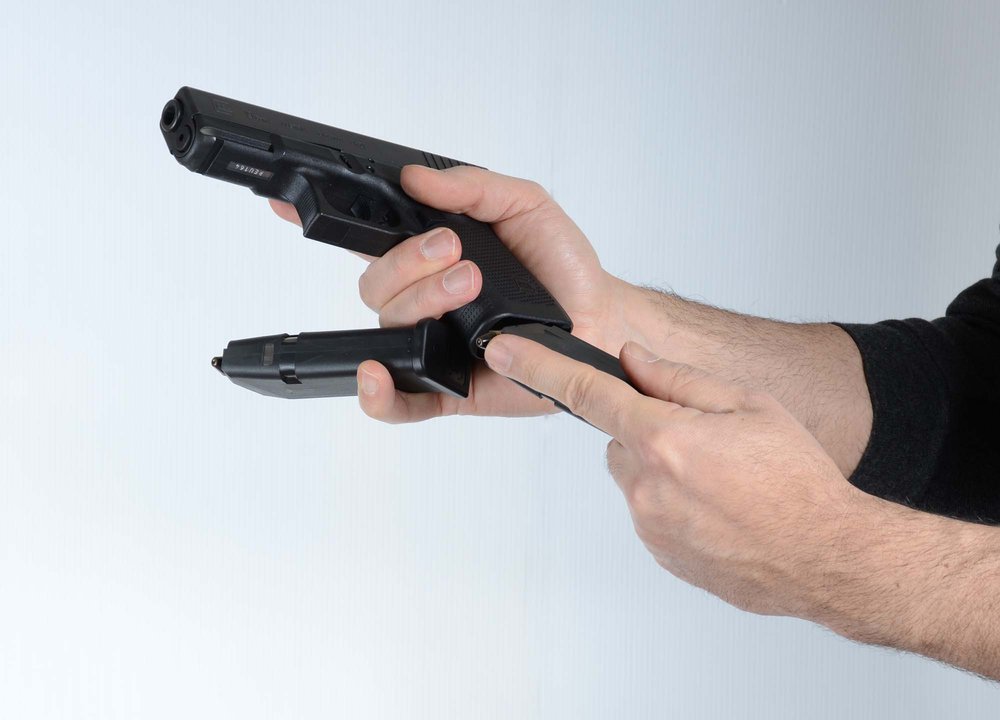
The F.A.S.T. is six rounds, but it is really four measurable skills stacked in a row — and a shot timer that records every split will tell you which one is costing you your rating. Here’s a realistic budget for a clean sub-5 run versus a clean sub-7:
| Segment | Sub-5 (coin pace) | Sub-7 (pin pace) |
|---|---|---|
| Beep → 1st head shot (draw) | ~1.50 s | ~1.80 s |
| Split between the two head shots | ~0.30 s | ~0.50 s |
| 2nd head shot → 1st body shot (the reload) | ~2.00 s | ~2.80 s |
| Three splits across the four body shots | ~0.28 s each | ~0.40 s each |
| Total | ≈ 4.6 s | ≈ 6.3 s |
Read that table again and notice the obvious: the reload is roughly 40% of your entire score. More time passes between your second and third shots than during the draw. This is why the F.A.S.T. is so often described as a reload test wearing a marksmanship costume — and why the highest-leverage thing you can do to improve is to go practise slide-lock reloads as a standalone skill until the movement is boring.
The second-biggest lever is the draw. If your beep-to-first-shot is 2.2 seconds, no amount of speed in the back half saves you; that’s draw stroke work, and it’s the part you can do at home for free.
The Three Mistakes That Blow Up Your Score
1. Shooting the last four rounds on a grip you never rebuilt. This is the classic F.A.S.T. failure and it is exactly what happened on that 4.84-second run. A slide-lock reload forces your support hand off the gun completely. If you slam the mag in, hit the slide release, and immediately start pressing the trigger, you’re firing four rounds on a half-formed grip — and the misses land in the back half of the string, where the penalties quietly eat two seconds. Fix: treat the last third of the reload as a grip rebuild, not a gun-loading task. The hand goes back on before the sights come up.
2. Staring at your hits mid-string. Both shooters in the EOTECH session got wrecked by this in different directions. One saw a marginal head shot, mentally slowed down, and shot the body string far more carefully than it needed. The other saw two good head shots, decided he had time in the bank, “turned the gas up,” and threw two. The lesson from the coaching afterwards is blunt: don’t validate your shots mid-run. Look at the target when the string is over. Your brain cannot score and shoot at the same time.
3. Confusing the tolerances. The two halves of this test want opposite things. The 3×5 card at 7 yards needs a genuinely focused sight picture; the 8-inch circle wants speed with an acceptable-hits mindset. Shooters who run both halves at the same pace fail one of them by definition. The skill the F.A.S.T. is actually measuring is changing gears on purpose — which is the same thing the Mozambique Drill tests in miniature, and the opposite of what the Bill Drill rewards.
“It’s a Test, Not a Drill” — So How Do You Train For It?
Langdon’s framing matters practically, not just philosophically. If you run the F.A.S.T. twenty times in an afternoon, you are no longer testing anything — you’re warmed up, you know exactly where the card is, and the number you write down is a lie you’ll tell yourself for a month.
A saner approach:
- Shoot it cold, once. First string of the day, no warm-up, first magazine out of the bag. That’s the score that means something. This is why EOTECH runs it as a cold “drill of the month” — the whole point is “to see if in fact you are ready or not.”
- Then train the components separately — draw stroke, slide-lock reloads, transitions from a small target to a big one, four-round strings on the circle at your true speed.
- Log the score, not the feeling. One clean number per session, penalties included. Over six weeks the trend line tells you far more than any single run.
- Re-test cold, weeks apart. If your cold F.A.S.T. drops half a second over two months, your training is working. If your warm score drops and your cold score doesn’t, you’ve just got better at the range, not better with a gun.
If you’d like a structured place to put those component sessions, our shooting training plan guide lays out how to build a weekly cycle around a small number of measured standards instead of random drills.
Running the F.A.S.T. at Home with Airsoft or Dry Fire
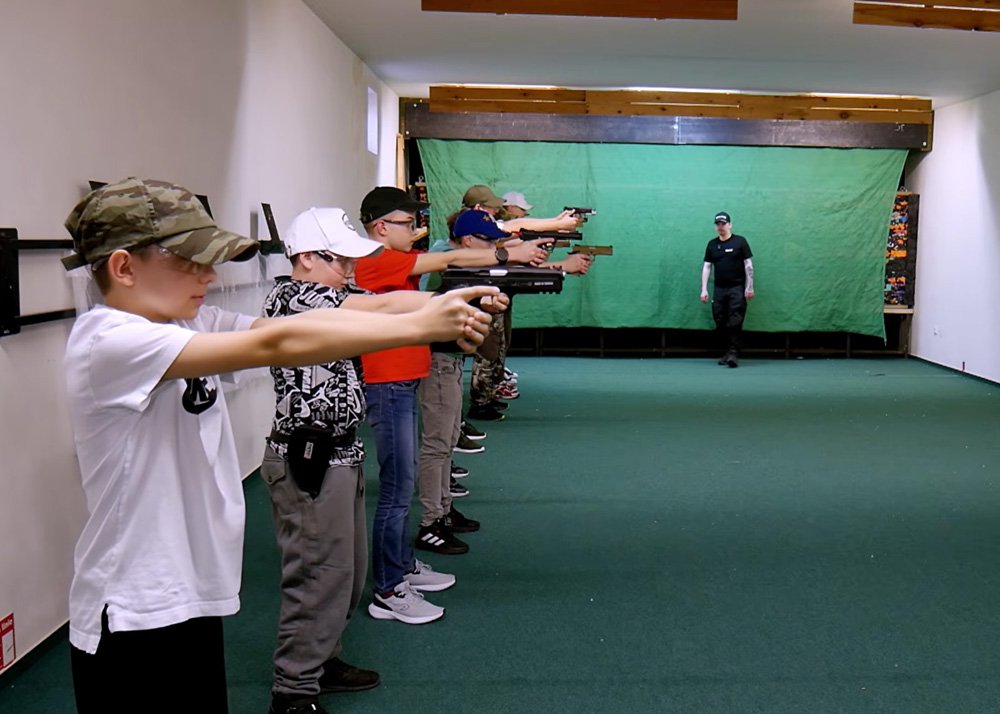
Here’s the part almost nobody covers, and it’s the reason this test is so friendly to airsoft and dry-fire training: the F.A.S.T. is a gun-handling test more than a ballistics test. Nothing about the draw, the reload, the grip rebuild, or the gear change requires a live round.
With a gas blowback (GBB) airsoft pistol — this is the closest analogue available, and it’s genuinely good:
- Load exactly two BBs into the magazine. A GBB pistol with a functioning slide stop will lock back on empty for real, which means you get an authentic slide-lock reload, not a simulated one. A Tokyo Marui Hi-CAPA or a TM Glock GBB does this all day.
- Keep the geometry honest. At 7 yards a decent GBB will hold the 3×5 card, so run it at full distance if your space allows. If you’re stuck with a 3–4 yard indoor lane, halve the target sizes as well as the distance — roughly a 1.5×2.5 inch card and a 4-inch circle — so the angular difficulty stays the same. Shrinking the distance without shrinking the target turns the hard shots into free ones.
- Recoil is lighter than a 9mm, so your splits will flatter you by a tenth or so. That’s fine — you’re training the sequence and the reload, and those transfer completely.
With pure dry fire, you lose the slide-lock but keep the two most expensive segments. Run it as: draw, two presses at the card, drop the mag, insert a fresh one, release the slide, four presses at the circle — with a par time set to your target rating. It won’t produce a scoreable F.A.S.T., but it will absolutely produce a faster one when you get to the range. Our dry fire training guide covers making those reps safe and structured.
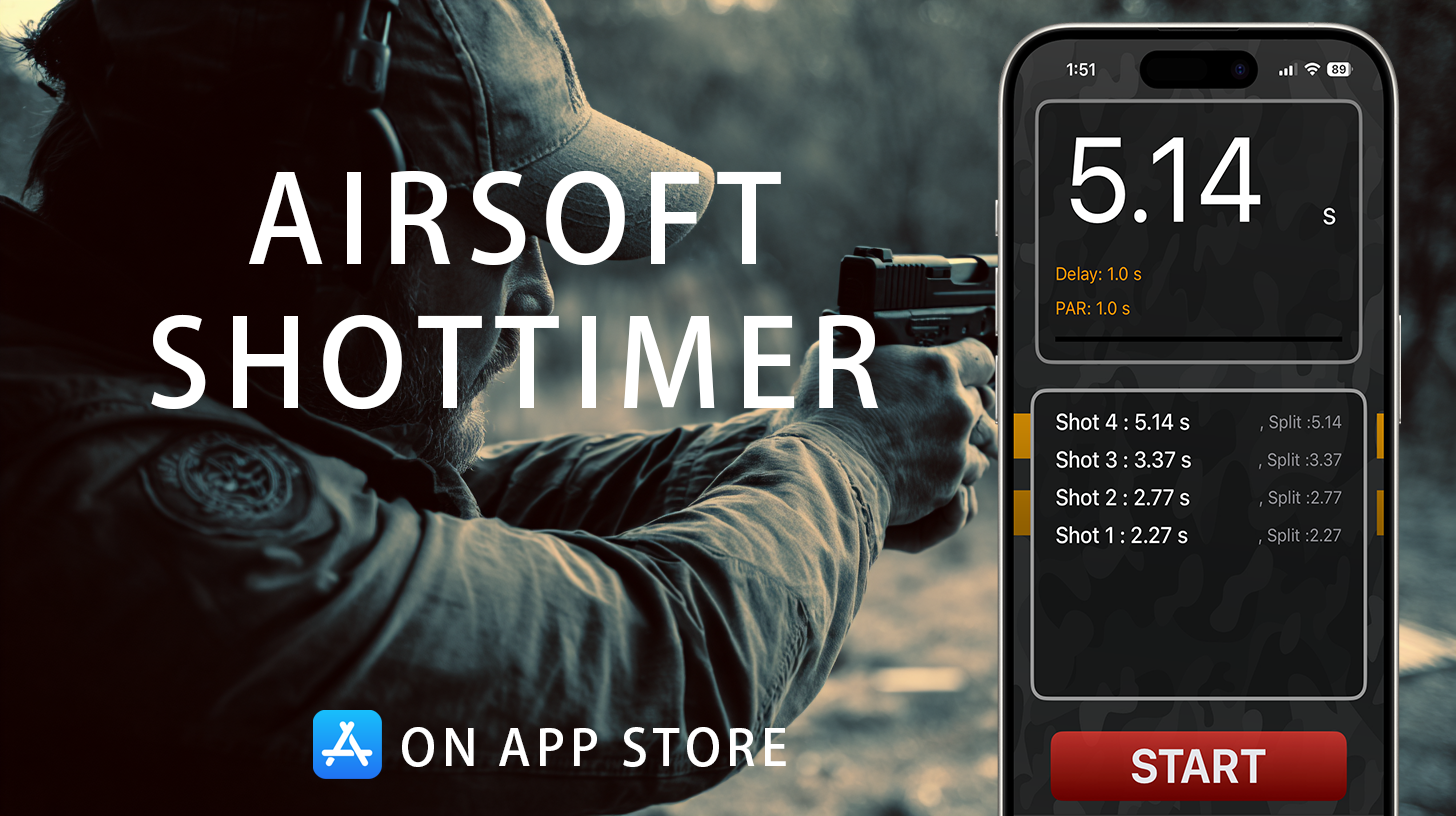
Either way you need a start signal and split times, which is the one piece of equipment this test genuinely can’t do without. The Airsoft Shot Timer app gives you the beep, records every split, and lets you set a par tone at 5.00 or 7.00 seconds so you find out during the run whether you’re on pace — for free, on the phone already in your pocket.
FAQ
What is the F.A.S.T. drill?
The F.A.S.T. (Fundamentals, Accuracy & Speed Test) is a six-round pistol test designed by Todd Louis Green. From 7 yards, starting concealed or from a duty rig with a pistol loaded with only two rounds, you draw and fire two rounds at a 3×5 inch head box, perform a slide-lock reload, and fire four rounds at an 8-inch body circle.
What is a good F.A.S.T. drill time?
Under 7.00 seconds with penalties included rates Advanced; under 5.00 seconds rates Expert. Under 10 seconds is Intermediate and 10 or slower is Novice. A first-time shooter typically lands in the Intermediate band; experienced competition shooters usually score Advanced.
How is the F.A.S.T. drill scored?
Take the raw time on the timer and add 2.00 seconds for every miss on the 3×5 card and 1.00 second for every miss on the 8-inch circle. Add 0.50 seconds if you used an open-top holster without concealment, or subtract 0.50 seconds for a retention holster with covered magazine pouches. The adjusted number is your score.
How do you win a F.A.S.T. Coin?
You must shoot a clean run under 5.00 seconds in front of an authorized instructor, from concealment or a true retention holster (hood or thumb break — ALS and SERPA don’t qualify), and repeat it: Green’s standard is two consecutive sub-5 clean runs. Only 26 shooters have earned one since 2007.
Where can I get the F.A.S.T. drill target?
pistol-training.com offers the official target as a free download that prints on a normal home printer. You can also build one in thirty seconds with a real 3×5 index card and an 8-inch circle (a paper plate works) taped onto any silhouette.
Who created the F.A.S.T. drill?
Todd Louis Green, the instructor behind pistol-training.com, created the test and the coin standard in 2007. Green died on 15 March 2016 after a decade-long battle with cancer; his friend Ernest Langdon was authorized to carry on as the arbiter of the F.A.S.T. Coin.
Can I shoot the F.A.S.T. drill with an airsoft pistol or in dry fire?
Yes, and it works unusually well. Load exactly two BBs into a gas blowback airsoft pistol and the slide will lock back on empty, giving you a genuine slide-lock reload. In pure dry fire you can still run the full sequence with a magazine change and a par time. Scale the target down proportionally if you have to shoot at less than 7 yards.
Why is the reload the hardest part of the F.A.S.T.?
Because it costs the most time and it damages the shots that follow. On a sub-5 run the reload segment alone is around two seconds — roughly 40% of the score — and a slide-lock reload forces your support hand completely off the gun, so the four body shots are fired on a grip you have to rebuild under time pressure. That’s where most missed body shots, and most 1-second penalties, come from.
Related Reading
- pistol drill selector — where the F.A.S.T. sits among the other benchmark standards
- Magazine Reload Guide — the slide-lock reload that decides 40% of your score
- Pistol Draw Guide — cutting time off the segment before your first shot
- The Bill Drill — the pure-speed benchmark at the opposite end of the spectrum
- Dot Torture Drill — the untimed accuracy test that fixes what the F.A.S.T. exposes
- Competition Holster Guide — retention, concealment, and why your rig changes your score
Put a Shot Timer in Your Pocket
Airsoft Shot Timer is a free shot timer app tuned for airsoft and Action Air — it picks up BB gun shots, tracks your split times, and saves you the cost of a $150+ hardware timer for IPSC/IDPA practice.

- FAST Drill
- F.A.S.T. Test
- Todd Green
- Ernest Langdon
- FAST Coin
- Shooting Drills
- Pistol Drills
- Par Times
- Shot Timer
- Slide Lock Reload
- Emergency Reload
- Draw From Concealment
- Dry Fire
- Airsoft
- Pistol Training
- Practical Shooting
- Printable Target
- 3x5 Card Drill
- Cold Drill
- Standards Test