Mozambique Drill: Par Times, Scoring & the Exact Third-Shot Window
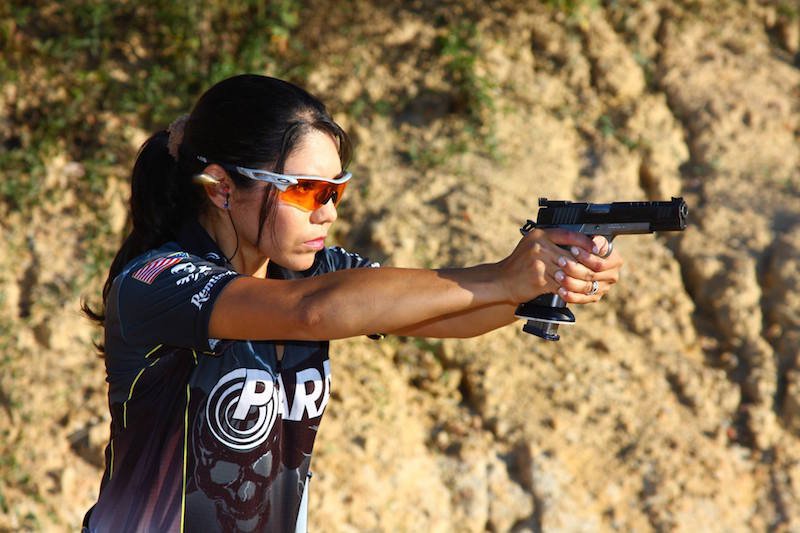
The Mozambique Drill in 60 seconds (BLUF)
- What it is: Draw and fire two rounds to the body, then one precise shot to the head, on a single target at seven yards. Also called the Failure Drill or Failure to Stop.
- Why it exists: It trains the moment your first response doesn’t work — two fast hits, no reaction, and now you need one slow, exact shot under pressure.
- What’s a good time? The classic par is 5 seconds from the holster at seven yards. Around 3 seconds you’re genuinely quick; world-class shooters have run it under one second up close.
- The hard part: The gear change. Your brain has to shift from “fast and loose” torso shots to a “small and exact” head shot mid-string — most people either rush the third shot and miss, or stall for half a second.
- Where exactly does shot three go? Not “the head” — the window between the eyebrows and the upper lip. Everywhere else on the skull is angled bone that can deflect a bullet.
- Three things almost nobody tells you: the 1974 shot that started it all landed in the neck, not the head; the LAPD renamed it the Failure Drill in 1980 over the name’s racial overtones; and most US police departments no longer teach the head shot at all.
- Train it anywhere: The 2+1 rhythm is a pattern skill. An airsoft pistol or a dry-fire rep against a par time on a free Airsoft Shot Timer app builds the same draw, cadence and transition without a single live round.
If you’ve seen John Wick clear a room — two quick shots to the chest, one to the head, next target — you’ve watched a Hollywood-polished Mozambique Drill. Keanu Reeves trained the pattern for the films, and Tom Cruise made an alley version of it famous in Collateral years earlier. But the drill wasn’t invented for the movies. It came out of a gunfight at an airport in 1974 — or at least out of a story about one, which turns out to be a distinction worth making — and it survives in competition warm-ups and training courses today because it tests something almost no other drill does: what you do when your first answer fails.
Most shooting drills reward one gear. The Bill Drill is pure speed — six fast shots into a big A-zone. A slow-fire group is pure precision. The Mozambique makes you shift gears mid-string: two shots as fast as you can hold the torso, then a deliberate, small-target head shot while your adrenaline is still screaming “go fast.” That gear change is where the drill is won or lost, and it’s why shooters who look brilliant on a Bill Drill can fall apart on the third shot of a Mozambique.
What Is the Mozambique Drill?
The course of fire is simple enough to describe in one sentence. Stand at seven yards from a single IPSC/IDPA-style silhouette, start holstered, and on the beep: draw, fire two rounds to the center of the torso, then transition up and fire one round into the head box — and specifically into the narrow window between the eyebrows and the upper lip, which we’ll come back to, because “the head” is not actually the target. Three rounds total. The standard par time is five seconds, and every part of the run is measurable on a shot timer: your draw, your split between the two body shots, and the transition time to the head shot.
The drill also answers to two other names you’ll hear at any range: the Failure Drill and the Failure to Stop drill. All three refer to the same 2+1 sequence, and the aliases explain the concept better than the geography does — the drill exists for the moment two solid torso hits fail to stop a threat, whether because of body armor, drugs, or sheer determination. When the fast answer fails, the precise answer has to be ready.
What makes it a permanent fixture in serious training programs is the same thing that makes it deceptively hard. The two body shots teach nothing new — any practical shooter can hammer a torso at seven yards. It’s the third shot that exposes you. The head box is roughly a quarter the size of the A-zone, your gun is recoiling, your eyes have to pick a new, smaller aiming point, and your trigger press has to slow down without your mind stalling. Rushing it throws the shot over the shoulder; overthinking it burns a full second. Finding your honest speed for that transition is the entire game.
The Real Story Behind the Name (And What’s Actually Verified)
The standard telling goes like this. During the Mozambican War of Independence, a Rhodesian soldier of fortune named Mike Rousseau was fighting on the Portuguese side. Around 1974, near the end of the war, Rousseau was moving through the Lourenço Marques airport — today’s Maputo International — when he rounded a corner and came face-to-face with a FRELIMO fighter armed with an AK-47, roughly ten paces away. Rousseau brought up his Browning Hi-Power, fired two rounds into the man’s chest on either side of the sternum, and the fighter kept coming. He raised his sights, fired once more, and the fight ended.
Here’s the part that gets left out of almost every retelling, and it’s the detail that changes how you should think about the drill. That third round didn’t hit the head box. By the fuller accounts, it struck the base of the neck and severed the spinal cord — an inch or two low of where the drill you practice tells you to aim. The shot that founded the most famous head-shot drill in shooting was, by the standard of that drill, a miss that happened to hit something that worked. There’s a lesson buried in there about what “good enough under pressure” really looks like, and it’s a more honest one than the clean version.
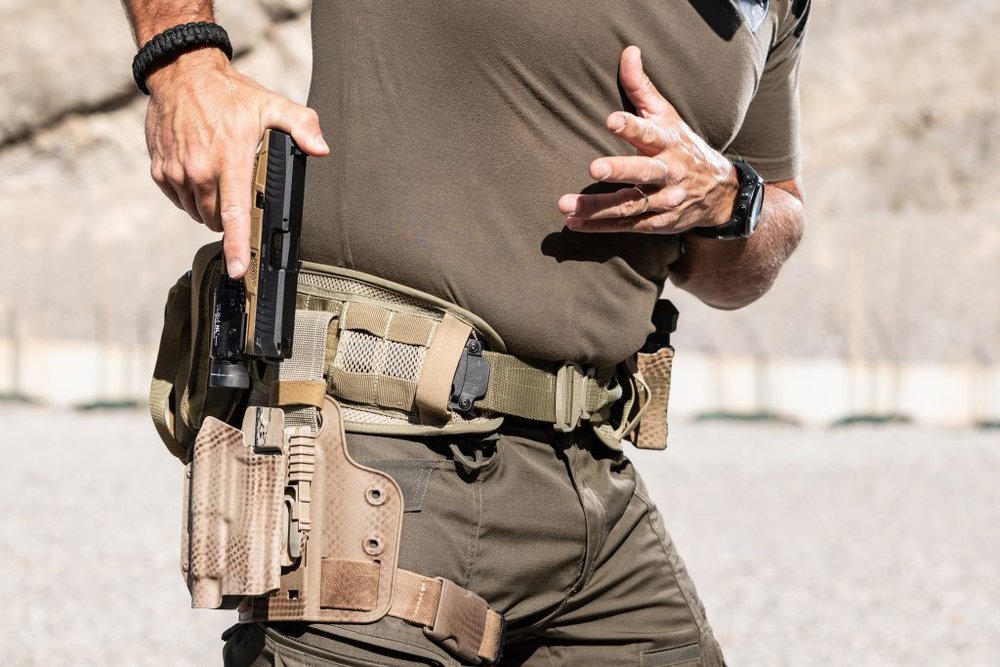
It’s also worth being straight about the evidence. This story is anecdotal, not documented. There is no incident report, no contemporaneous account, no independent confirmation — what exists is Rousseau telling the story to an acquaintance, and that acquaintance being famous. Wikipedia hedges it as “according to anecdotal history,” and if you spend ten minutes in the CCW forums you’ll find the same objection stated more bluntly: it’s hearsay from a mercenary to a colonel, retold for fifty years. That doesn’t make the drill less useful — the tactical logic stands entirely on its own — but it does mean you should quote the story with a shrug rather than a straight face, and you should be suspicious of anyone who recites the caliber, the range and the year with total confidence.
The acquaintance, of course, was Colonel Jeff Cooper — the Marine officer and instructor who founded Gunsite Academy and helped create IPSC. Cooper saw the tactical lesson immediately: two quick torso shots might not be enough, and a trained shooter needs a conditioned follow-up rather than a moment of shocked hesitation. He built the sequence into the Gunsite curriculum from the late 1970s and named it after the country where the shooting happened. If you enjoy this kind of history, Cooper is also the man behind the El Presidente drill, which he built a few years earlier while training a presidential protection detail.
The rename has a specific date and specific names too, which is more than the origin story can claim. In 1980, two LAPD SWAT officers — Larry Mudgett and John Helms — attended pistol training at Gunsite, and asked Cooper for permission to bring the technique back to the Los Angeles Police Department under a different name. Their concern was that calling it “the Mozambique” carried racial overtones that wouldn’t survive a department curriculum. Cooper agreed, and Failure Drill is what the LAPD taught. That’s why you’ll hear the same three shots called three different things depending on who trained the person talking: Mozambique on a competition range, Failure Drill in a police academy, Failure to Stop in a military manual.
How to Run the Mozambique Drill
Set one silhouette target at seven yards — an IPSC metric target, an IDPA target, or any silhouette with a defined head box works. Load at least three rounds, holster, and stand in your normal ready position. On the start signal, draw and put two shots into the center of the torso at your fast cadence, then drive the gun up to the head box, let the sights settle, and break one precise shot.
The classic execution cue comes from how the head box changes your acceptable sight picture. On the body shots, a practical shooter accepts a coarse sight picture — dot or front sight somewhere in the A-zone, press, press. On the head shot that tolerance collapses: you need the sights verified inside a box maybe four inches square, which means your eyes must arrive at the exact spot on the head before the gun does, and your trigger press has to be clean enough not to push the muzzle out of that little window. The rhythm of a good run isn’t three even beats — it’s “bang-bang……bang,” with the pause exactly as long as it takes you to see what you need to see, and no longer.
Score it honestly. Two A-zone body hits and a head shot outside the box is a failed run, no matter the time. In a defensive context that third shot only exists because precision suddenly became mandatory — so give yourself full credit only when all three rounds do their job. Then look at the timer: your draw, your body split, and your transition-to-head split. Those three numbers tell you exactly which piece to train next, the same way the draw-and-splits breakdown works in our Bill Drill guide.
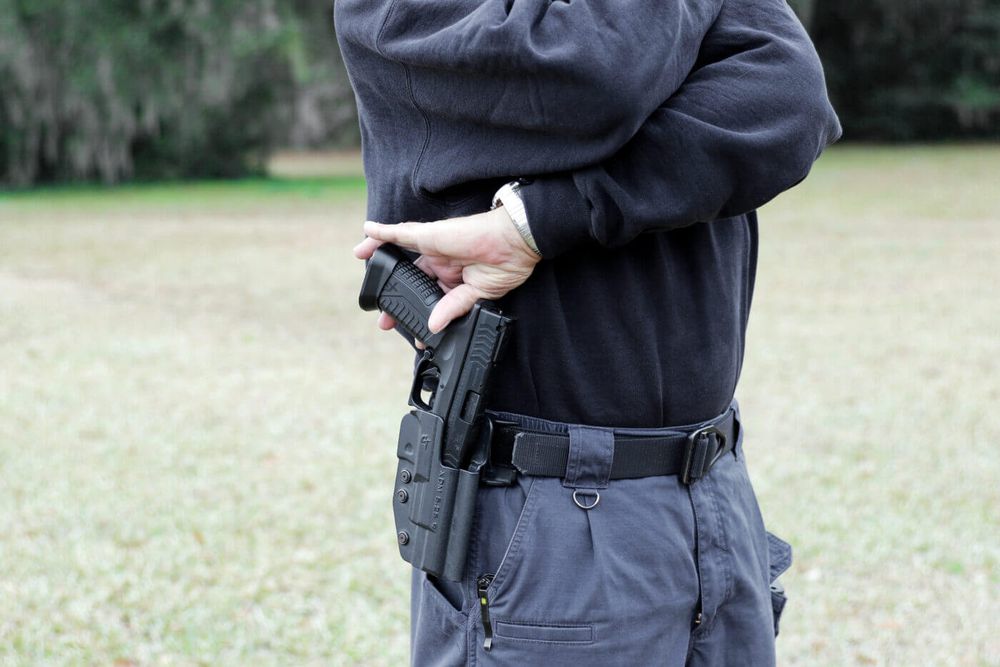
Where the Third Shot Actually Goes: The Ocular Window
“One to the head” is the sloppiest instruction in shooting, and it’s the reason a lot of people practice this drill wrong for years. The head is not a valid target. A specific window inside the head is.
The zone that matters runs roughly from the eyebrows down to the upper lip, and horizontally about as wide as the eyes — instructors variously call it the ocular window, the ocular cavity, the T-box or the triangle. The reason isn’t aesthetic. Everywhere else on the skull is curved, angled, dense bone that a handgun bullet arriving at a shallow angle can genuinely deflect off or skate around; the forehead in particular is a famously unreliable place to put a pistol round. Inside that window the bone is thin and the path leads directly to the brainstem, which is the only structure whose destruction guarantees an immediate stop rather than an eventual one. As one instructor puts it, everywhere else you’re negotiating with anatomy — in that triangle you’re switching off the computer.
That distinction has a practical consequence for how you set up the drill at the range. If your silhouette has a generic rectangular head box printed on it, the top third of that box is a lie: a hit up there scores on paper and would have been a deflection in the world the drill was built for. Serious training targets mark the ocular window separately for exactly this reason, and if yours doesn’t, draw one on with a marker — roughly a 3 × 5 inch card, centered on the bridge of the nose. Most shooters find their honest hit rate drops sharply the first session they do this, which is the whole point. The drill is supposed to tell you the truth.
It also explains why the third shot costs so much time. You’re not transitioning to a smaller version of the same target; you’re transitioning to a target whose edges you cannot see on a real human silhouette. Your eyes have to construct the window from landmarks — brow line, bridge of the nose, upper lip — and that construction takes real visual processing time. Shooters who cut their transition split the fastest are almost always the ones who stopped aiming at “the head” and started aiming at the bridge of the nose.
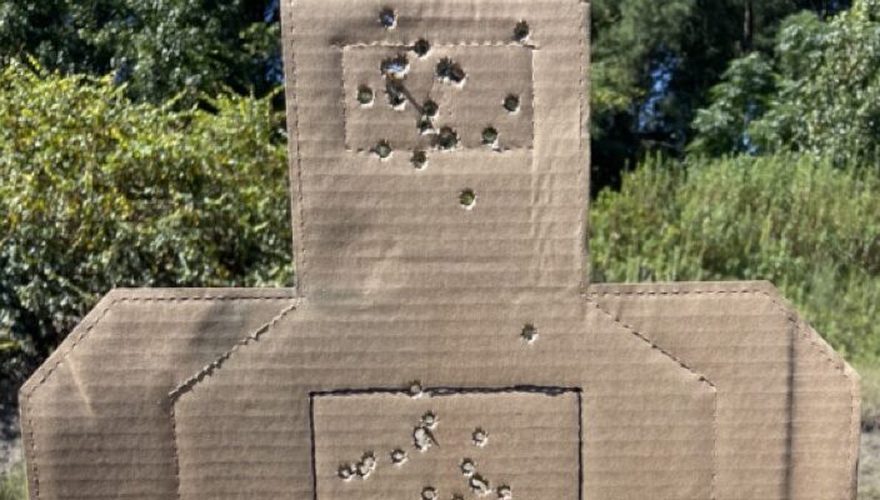
How Distance Changes the Drill
Seven yards is the standard, and it’s standard for a good reason: it’s roughly the range at which the original incident happened and it’s where most defensive handgun encounters land. But mozambique drill distance is one of the most common things people search about this drill, and the honest answer is that distance changes which part of the drill hurts.
Inside three to five yards the body shots become nearly free — you can hammer them without a real sight picture — and the entire drill collapses into a test of how fast you can drive the gun up and get one clean look at the ocular window. This is the version you see in the sub-one-second demonstrations: Bob Vogel’s famous 0.93-second run was at six feet, and other shooters have posted 0.75 at the same distance. Those numbers are real but they’re measuring a different skill than the seven-yard drill.
At ten yards the body shots stop being free, and your split between them roughly doubles. At fifteen the head shot stops being a transition and becomes an aiming problem — the ocular window is now smaller than your front sight, and you’ll find yourself pausing a full second or more. At twenty-five yards the drill becomes something else entirely: a precision test with a stopwatch attached, valuable but no longer a defensive simulation. A reasonable progression is to own the drill cleanly at seven yards, then alternate three-yard speed runs and fifteen-yard precision runs, and use the seven-yard number as your benchmark. Shooters routinely find that a month of fifteen-yard work quietly drops their seven-yard time, because the transition that felt urgent at fifteen feels leisurely at seven.
Mozambique Drill Par Times: What’s a Good Time?
The traditional standard, straight from decades of use at Gunsite and police qualifications, is five seconds from the holster at seven yards — and it remains a fair test for a carry gun from concealment. Law-enforcement standards sit in the same neighborhood: Las Vegas SWAT, for example, requires the failure drill in under five seconds, and one retired officer on that team demonstrates it comfortably around 3.2 seconds. Among competition-oriented shooters the bar is higher: around three seconds and under, you’re cooking, and the drill’s ceiling is almost comically high — world champion Bob Vogel has run 2+1 from six feet in 0.93 seconds.
| Level | Time (7 yards, from holster) |
|---|---|
| Baseline / qualification standard | 5.0s |
| Solid defensive shooter | 3.5–4.0s |
| Fast (“you’re cooking”) | Sub-3.0s |
| Competition-level | Sub-2.5s |
Treat the table as a map, not a verdict. The number that actually matters is the gap between your Bill-Drill-style fast pace and your Mozambique pace. If your two body shots plus transition add a full two seconds to what a plain three-shot string would take, your gear change is expensive — and that’s trainable. Most shooters find the transition split (body to head) starts around 1.5 seconds and can be cut nearly in half within a few weeks of deliberate practice, because the delay was never mechanical. It was the eyes and the decision.
How the Mozambique Drill Is Scored
Most people run this drill and write down one number — the time — which is exactly how you end up with a fast run full of hits that would not have counted. The Mozambique has an accuracy standard, and it is considerably stricter than the silhouette printed on your target makes it look.
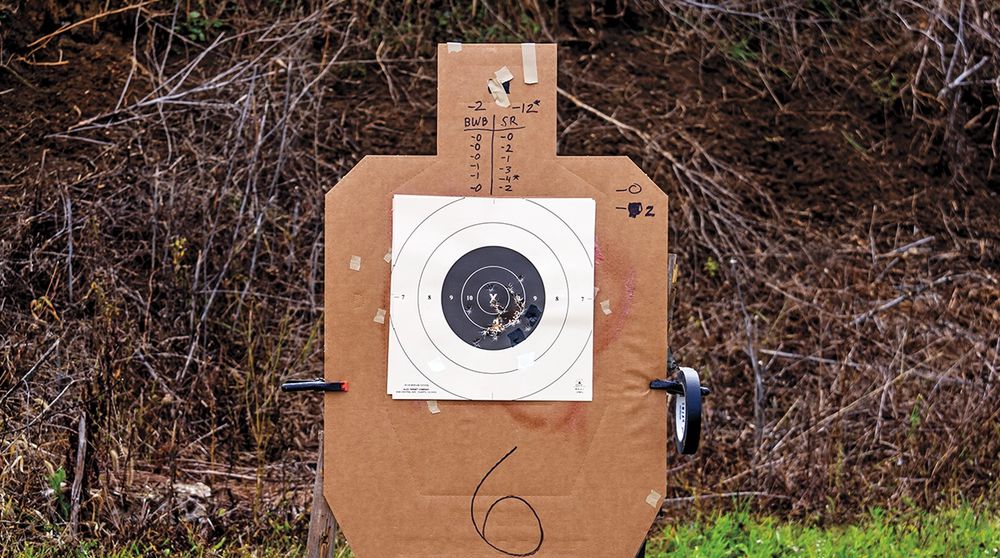
The cleanest scoring convention in common use comes from defensive-pistol instructors who paste a B-8 repair center over the chest of a USPSA or IDPA silhouette, which turns the vague instruction “center mass” into rings you can actually argue about afterwards. Brian Hill of The Complete Combatant scores the failure-to-neutralize string exactly that way inside his Mix Six standards: the B-8 ten ring is down zero, the nine ring costs you one point, the eight ring two, the seven ring three, and anything outside the seven ring is a clean miss worth ten points down. The head is scored in the same spirit but with a far harsher cliff — a hit inside the ten or nine ring of the head box is down zero, anywhere else on the head is down one, and missing the head entirely is down ten. A round that breaks a scoring line counts for the higher value, the same convention IPSC and IDPA already use.
Read that scale twice and you will see what it is really saying. A head shot that lands high on the forehead is a minor deduction; a head shot that misses the skull carries more penalty than every other shot in the string combined. That asymmetry is the drill. It is not asking you to be fast — it is asking whether you can spend the extra two tenths of a second the third shot genuinely needs instead of pressing the trigger on hope.
Hill’s own run gives you a benchmark worth copying into your training log. His failure-to-neutralize string went 3.48 seconds total from the holster at seven yards — 1.93 to the first shot, a 0.74 split between the two body rounds, and 0.81 seconds for the transition up to the head — scored down zero, and shot against a four-second par rather than the traditional five. Notice where the time actually lives. The draw eats more than half the run, and the head transition costs almost exactly one body split plus a tenth. If your own transition is sitting at 1.5 seconds while your body split is around 0.3, you do not have a shooting problem, you have a seeing problem, and that is the number to attack first.
Scoring this way also cures the most common self-deception in drill practice: grading a run pass or fail on the clock alone. Give yourself both a time and a points-down number on every single rep, and log the pair. A 2.9-second run that is down eleven is a worse repetition than a 3.6 that is down zero — and if the only thing you write down is the seconds, you will quietly train yourself into the faster, worse one and never notice it happening.
The Assess Pause: Original Version vs. How Everyone Runs It Today
Here’s a detail most articles skip, and it occasionally starts arguments at the range. Cooper’s original Mozambique wasn’t a continuous three-shot string. As taught at Gunsite, the shooter fired two to the body, lowered the pistol to the ready position, assessed whether the threat was still standing, and only then raised the gun and fired the head shot. The pause was the point — the drill was as much about judgment as marksmanship, and the head shot was a decision, not a reflex.
Modern practice has largely dropped the pause, and there’s a coherent tactical argument for why. As one retired SWAT officer puts it: if someone is still coming at you after two center-mass hits, you are not going to lower your gun and contemplate — you keep working, and the fastest way to end it is to go straight up to the head. In the modern version, the “assessment” happens during the transition: as the gun rises, if the head is no longer there it’s because the threat has dropped — and what you’ve fired is simply a double tap. The string is continuous, and the decision is built into the movement instead of a separate beat.
Which version should you train? Both, honestly, and for different reasons. The continuous 2+1 builds the raw skill — the transition, the sight-picture shift, the trigger discipline. The assess version builds the habit of seeing the target between shots instead of running a motor program blind, which is worth practicing precisely because real situations don’t follow scripts. Alternate them and your timer will show you something interesting: the assess version usually costs less time than you’d expect, because most of the “pause” overlaps with the recoil cycle you were riding anyway.
Mozambique Drill vs. Double Tap
The two get confused constantly, so here’s the clean distinction. A double tap is two fast shots to the same aiming point — one sight picture and cadence, no gear change. The Mozambique is a double tap plus a conditional precision shot: same two fast rounds, then a transition to a much smaller target with a completely different acceptable sight picture. That third shot is what transforms the skill being tested from pure recoil control into vision, decision-making and precision under time pressure.
This is also why the Mozambique is a better diagnostic than the double tap, even if you never care about the defensive context. Any intermediate shooter’s splits look impressive on a torso at seven yards. Ask the same shooter to end the string in a four-inch box and the truth comes out — about their grip consistency, their visual patience, and whether they can actually change speeds instead of just having one speed. It’s the same lesson competitive shooters take from transitions between open and partial targets on a stage, compressed into three rounds.
Mozambique vs. Bill Drill vs. El Presidente
Google puts “what’s the difference between the Mozambique drill and the Bill Drill” underneath this search constantly, and it is a fair question. The three classic pistol drills look nearly identical on paper — a handful of rounds, a silhouette or three, a stopwatch — and they test almost completely different things.
The Bill Drill is six rounds into the A-zone of a single target at seven yards, and it is a pure recoil-control test. There is no target change, no precision requirement beyond the A-zone, and no decision to make. What it measures is your grip and your ability to actually see the sight return, which is why good shooters chase splits on it and why it diagnoses faster than anything else: if your splits climb steadily across the six shots, your grip is failing under recoil. The Mozambique takes the first two shots of that same skill and then demands you abandon it mid-string for a completely different acceptable sight picture — it measures the gear change, not the speed. The El Presidente adds the two things neither of the others has, three targets and a reload, so it measures transitions between targets and whether you can keep a plan running while your hands are busy with something complicated.
A useful way to hold all three in your head: the Bill Drill tells you whether you can shoot fast, the Mozambique tells you whether you can stop shooting fast on command, and the El Presidente tells you whether either skill survives contact with an actual stage. Run all three on the same range trip and the one where your numbers look worst is honestly the thing to train next — that is the entire reason standardised drills with published times exist. Our Bill Drill guide and El Presidente guide cover each one in full, and the pistol drill par time table lines every standard up side by side.
Is the Mozambique Drill Still Taught — and Is It Legal?
These are the two questions Google shows under every Mozambique search, and the two that almost no article on the first page actually answers. They’re worth answering together, because the answer to the second is why the first has changed.
Start with who still teaches it. The drill remains standard in competition and civilian training: it shows up in IDPA-flavored practice, in practical shooting warm-ups, in almost every commercial defensive pistol course, and as a qualification standard for some tactical units — Las Vegas SWAT, for one, requires the failure drill in under five seconds. But at the level of general police patrol training in the United States, the head shot has quietly disappeared from a lot of curricula. Ask instructors who work with departments and you’ll hear a consistent version of the same thing: most agencies now teach shooting center mass and continuing to shoot center mass until the threat stops, full stop. The three-shot 2+1 pattern with a deliberate head shot is taught to specialist units, not to everyone with a badge.
The reason is not that the tactic stopped working. It’s that a head shot is extraordinarily hard to explain afterward. Every use of force gets reconstructed in slow motion by people who were not there, and a shot placed deliberately between someone’s eyebrows and upper lip invites a question that a shot to the chest does not: why that one? An instructor can answer it — the threat absorbed two center-mass rounds and kept closing, so the shooter went to the fastest available stop — but “an instructor can answer it” and “a department wants to spend a year answering it” are different things. Institutions optimize for the second.
For an individual, the legal principle underneath all of this is simpler than the internet makes it sound, and it has nothing to do with anatomy. In most US jurisdictions you may use deadly force when you reasonably believe you face an imminent threat of death or serious bodily harm, and that authority lasts exactly as long as the threat does. The law does not count your rounds and it does not care where they landed — it asks whether each shot was fired while the justification still existed. Two, three, or seven rounds are all lawful if the threat persisted; one round is unlawful if it did not. What actually gets people in trouble is firing after the threat has ended, not the shot placement chosen while it was ongoing. Seen that way, the Mozambique isn’t a legally exotic technique at all — it’s a trained answer to “the threat did not stop,” which is the exact condition under which continuing to shoot is justified.
Two caveats worth stating plainly. First, this is general background, not legal advice, and self-defense law varies enormously between US states and even more between countries — if you carry a firearm, get this from an attorney licensed where you live, not from a shooting blog. Second, and more relevant to most people reading this: if you’re an airsoft, Action Air or competition shooter, none of this applies to you at all. You are practicing a marksmanship problem — fast coarse shots, then one exact shot, on the clock — and the Mozambique is simply the cleanest three-round test of that skill anyone has designed. The history is worth knowing. The legal framing is worth knowing so you can correct the guy at the range who has it wrong. But the drill earns its place in your training log purely because of what the timer tells you.
Train the Mozambique With Airsoft or Dry Fire
Here’s the practical problem with the Mozambique: many square ranges won’t allow holster draws, some frown on head shots on silhouettes, and live-fire reps cost money every single time. The good news is that the drill’s hardest component — the fast-to-precise gear change — is a pattern skill, and pattern skills can be trained anywhere.
The dry-fire version needs nothing but a safe, empty pistol and a timer. Put up a scaled target (a full-size silhouette at three yards approximates seven), set a par time of 5 seconds to start, and run the full sequence on the beep: draw, two presses on the body, transition, one careful press on the head box before the par beep sounds. The Airsoft Shot Timer app gives you the random start signal and par buzzer for free, and as your runs get cleaner you ratchet the par down — 4.5, 4.0, 3.5 — which is exactly how the pros compress the drill. Our dry fire training guide covers the safety setup and the supporting drills.
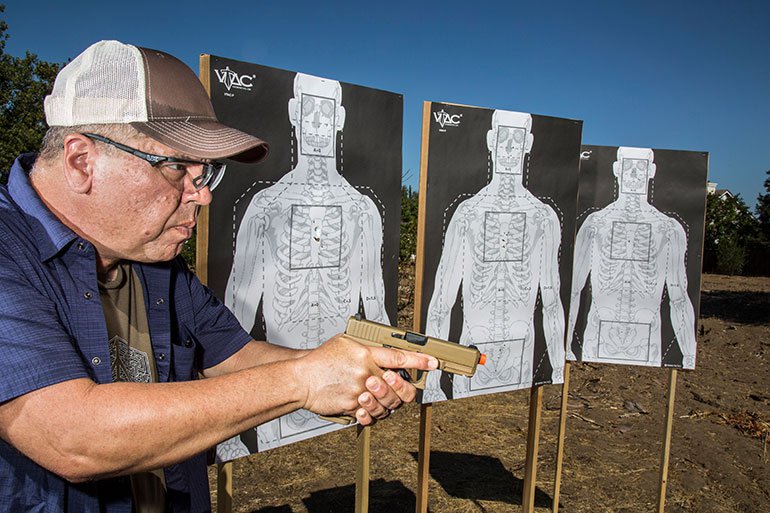
An airsoft pistol upgrades the rep with real feedback. A gas blowback gun gives you an actual trigger, a recoil impulse, and — critically for this drill — a real point of impact on a real head box, so you can’t lie to yourself about whether the third shot would have landed. Because the app’s microphone picks up airsoft shots just like live fire, you get your draw, split and transition times for every run. The 2+1 rhythm, the eye movement to the head box, the trigger-speed shift — all of it transfers directly, as we cover in the airsoft-to-firearms crossover guide. For airsoft skirmishers and Action Air competitors, the drill needs no translation at all: it’s simply the best three-round test of whether you can shift from spraying speed to called shots on demand.
Frequently Asked Questions
What is the Mozambique Drill?
It’s a close-quarters shooting drill: from seven yards, draw and fire two rounds to the torso of a silhouette target, then one precise round to the head box. It’s also known as the Failure Drill or Failure to Stop drill, because it trains the scenario where two body hits fail to stop a threat.
Why is it called the Mozambique Drill?
It’s named after an incident said to have happened around 1974 at the Lourenço Marques airport in Mozambique, where Rhodesian mercenary Mike Rousseau stopped an advancing FRELIMO fighter with two chest shots and a third round from his Browning Hi-Power. Rousseau told the story to Jeff Cooper, who built it into the Gunsite curriculum and named it after the country. Two honest footnotes: the account is anecdotal rather than documented, and by the fuller versions that third round hit the base of the neck rather than the head box.
Is the Mozambique Drill legal?
The drill itself is just a training exercise — practicing it is no more legally significant than practicing a Bill Drill. What people are really asking is whether a head shot is defensible in a real incident, and in most US jurisdictions the legal test has nothing to do with shot placement: deadly force is justified while you reasonably face an imminent threat of death or serious bodily harm, and it stops being justified the moment the threat ends. The law doesn’t count rounds or grade anatomy; it asks whether the justification still existed when each shot was fired. That said, self-defense law varies hugely by state and country — this is background, not legal advice, and you should get the real answer from an attorney where you live.
Is the Mozambique Drill still used?
Yes in competition, commercial training and specialist units — Las Vegas SWAT still qualifies on it under five seconds — but it has largely disappeared from general US police patrol curricula, which now mostly teach shooting center mass and continuing until the threat stops. The change is about the difficulty of explaining a deliberate head shot after the fact, not about the tactic ceasing to work.
Where exactly do you aim the third shot?
Not “the head” — the window between the eyebrows and the upper lip, roughly the width of the eyes. Everywhere else on the skull is angled, dense bone that can deflect a handgun bullet, while that window is thin and leads straight to the brainstem. If your target has a plain rectangular head box, the top third of it is scoring hits that wouldn’t have counted; mark a 3 × 5 inch window centered on the bridge of the nose instead.
What distance is the Mozambique Drill shot at?
Seven yards is the standard and the number every par time assumes. Inside three to five yards the body shots become nearly free and the drill turns into a pure speed test — that’s where the sub-one-second demonstrations come from. At fifteen yards and beyond the ocular window gets smaller than your front sight and the drill becomes a precision test with a clock attached. Own it at seven, then alternate short speed runs and long precision runs.
What is a good time for a Mozambique Drill?
The classic par is 5 seconds from the holster at seven yards, and that remains the common qualification standard — Las Vegas SWAT, for instance, requires it in under five. A clean run around 3 seconds puts you in genuinely fast company, and world-class shooters have run compressed versions under one second at conversational distance. All three hits must count: two in the torso’s center zone, one inside the head box.
How is the Mozambique Drill scored?
By points down, not just by the clock. The common convention pastes a B-8 repair center over the chest of a USPSA or IDPA silhouette: the ten ring is down zero, then one, two and three points down for the nine, eight and seven rings, and anything outside the seven ring is a full ten points down. On the head, the ten and nine rings score down zero, elsewhere on the head is down one, and a complete miss of the head is down ten. Line breaks count for the higher value. Record a time and a points-down figure on every rep — a 2.9-second run that is down eleven is a worse repetition than a 3.6 that is down zero.
Who invented the Mozambique Drill?
Nobody invented it as a drill — it was reverse-engineered from an incident. Rhodesian mercenary Mike Rousseau is said to have used the two-body-one-head sequence at Lourenço Marques airport around 1974, told the story to Jeff Cooper afterwards, and Cooper turned it into a formal exercise in the Gunsite curriculum and named it after the country. Cooper is therefore the drill’s author in every meaningful sense; Rousseau supplied the anecdote. The LAPD later renamed the same sequence the Failure Drill for departmental use.
What’s the difference between the Mozambique Drill and the Bill Drill?
The Bill Drill is six rounds into the A-zone of one target — a pure recoil-control and grip test with no target change. The Mozambique is two body rounds plus one precise head shot, so it tests the mid-string change from a coarse sight picture to an exact one. Put simply, the Bill Drill measures how fast you can shoot and the Mozambique measures whether you can stop shooting fast on demand. Most shooters are far better at the first than the second.
What’s the difference between a Mozambique Drill and a double tap?
A double tap is two fast shots to the same point — one sight picture, one cadence. The Mozambique adds a third shot to a much smaller target, forcing a mid-string change from coarse-and-fast to precise-and-deliberate. That transition, not the shooting speed, is the skill the drill actually measures.
Is the Mozambique Drill the same as the Failure Drill?
Yes. Failure Drill and Failure to Stop are alternate names for the same 2+1 sequence, adopted mainly by police academies that preferred a descriptive name. The only meaningful variation is whether you run it as a continuous string (the modern norm) or with Cooper’s original assess pause — lowering to ready after the body shots before deciding on the head shot.
Is that the drill from John Wick and Collateral?
Essentially, yes. The two-to-the-body-one-to-the-head pattern John Wick uses constantly is a stylized Mozambique, and Tom Cruise’s famous alley sequence in Collateral is widely cited as a textbook fast failure drill. The films compressed the timing for style, but the underlying technique is the real drill — which is part of why searches for it spike after every movie release.
Can I practice the Mozambique Drill with airsoft or dry fire?
Yes, and it’s one of the best drills to train off the range because its core skill — transitioning from fast body shots to a precise head shot — is a vision-and-cadence pattern, not a recoil problem. Dry fire it against a 5-second par time, or run it with an airsoft pistol for real hit feedback. The Airsoft Shot Timer app times your draw, splits and transition for both, free.
The Mozambique Drill has survived fifty years, three names and two Hollywood franchises for one reason: it asks the question no other three-round drill asks — can you change gears when it matters? Set up a silhouette, grab a shot timer, and find out what your 2+1 actually costs you, whether it’s live fire, green gas or a dry-fire par time in your living room. Then track the transition split for a month and watch it shrink. For the sibling drills that built practical shooting alongside it, see the Bill Drill, the El Presidente, and our pistol drill par time table.
Put a Shot Timer in Your Pocket
Airsoft Shot Timer is a free shot timer app tuned for airsoft and Action Air — it picks up BB gun shots, tracks your split times, and saves you the cost of a $150+ hardware timer for IPSC/IDPA practice.

- Mozambique Drill
- Failure Drill
- Failure to Stop
- Shooting Drills
- Shot Timer
- Practical Shooting
- Defensive Shooting
- Headshot Transition
- Double Tap
- Jeff Cooper
- Gunsite Academy
- Dry Fire
- Airsoft
- Pistol Training
- Par Time
- John Wick
- Mozambique Drill Origin
- Mozambique Drill Distance
- Mike Rousseau
- Ocular Window
- Cranial Vault
- Law Enforcement Training
- IDPA
- Mozambique Drill Meaning
- Mozambique Drill Scoring
- B-8 Repair Center
- Points Down
- Failure to Neutralize
- Bill Drill
- El Presidente
- Transition Split
- Head Box