USPSA Divisions Explained 2026: All 8 Divisions, Capacity Rules & Which One Your Gun Already Fits
USPSA Divisions in 60 Seconds (BLUF)
Short answer: USPSA runs eight divisions — Carry Optics, Limited Optics, Open, Limited, Production, Single Stack, Revolver and PCC — and the gun already in your safe decides most of it for you. Stock striker-fired 9mm with a slide-mounted red dot → Carry Optics. A 2011, or any pistol wearing a flared magwell, with a red dot → Limited Optics. Anything with a compensator or a frame-mounted optic → Open, whether you wanted that or not. Iron sights on a duty pistol → Production (15 rounds loaded) or Limited. A .45 1911 → Single Stack. A wheelgun → Revolver. A 9mm carbine → PCC.
Here is the part almost nobody tells a new shooter, and it’s the most useful number in this guide. In January 2026 USPSA published how its members actually shoot, and the sport is far more concentrated than the eight-division menu suggests: Carry Optics 37%, Limited Optics 28%, Open 13%, PCC 8%, Limited 5%, Production 5%, Single Stack 2%, with Revolver and Limited-10 sharing the small remainder. Two divisions hold roughly two-thirds of the sport. If you show up with a red-dotted 9mm, you are not making an obscure choice — you are joining the main event.
| You own… | Your division | The detail that decides it |
|---|---|---|
| Glock 34 MOS, CZ Shadow 2 OR, P320 X5, PDP Match + slide red dot | Carry Optics | 59 oz limit, 141.25mm mags, no external magwell |
| 2011 / Staccato, or any pistol with a magwell, + red dot | Limited Optics | Magwells and SAO allowed, no weight limit |
| Anything with a compensator or frame-mounted optic | Open | 171.25mm mags, Major scoring available |
| Iron-sighted 2011 or high-capacity .40 | Limited | Major needs .40 / 10mm / .357 SIG |
| Bone-stock duty pistol, iron sights, on the approved list | Production | Max 15 rounds loaded, 59 oz, Minor only |
| 1911 in .45 ACP | Single Stack | 8 rounds Major / 10 Minor, 45 oz |
| S&W 686, Ruger GP100 | Revolver | 6 before reload Major, 8 Minor |
| 9mm carbine with a stock | PCC | Minor only, comps allowed, no braces |
The rest of this guide explains what each of those rules actually costs you on the clock, and the three equipment traps that move people into Open by accident. It also untangles the three words USPSA uses for three different lists — division, class and category — explains why the 2026 Nationals were split into a Factory Gun match and a Race Gun match, and corrects the most repeated myth on the internet: that Limited-10 is a dead division.
Major vs Minor: The Rule Underneath Every Division
Before the divisions make sense, power factor has to. Power factor is just bullet weight in grains multiplied by velocity in feet per second, divided by 1,000. A 124-grain bullet at 1,100 fps makes 136 — Minor. To make Major you need 165; to make Minor at all you need 125. Chronograph duty at a major match exists to check exactly this, and if your ammo comes in under 125 your scores go to the bottom of the board.
Why care? Because it changes what your hits are worth. An A-zone hit scores 5 points regardless. But a C-zone hit is worth 4 under Major and only 3 under Minor, and a D is worth 2 under Major and just 1 under Minor. Shooting Minor means every hit outside the A-zone punishes you harder, which is why Minor divisions reward precision and Major divisions forgive a slightly loose group.
Here is the catch that reframes the whole division menu: only four divisions can score Major at all — Open, Limited, Single Stack and Revolver. Carry Optics, Limited Optics, Production and PCC are Minor-only by rule, no matter what you load. That surprises people who assume Limited Optics is “Limited with a dot” and therefore a Major division. It isn’t. If you want Major scoring with a red dot, Open is the only door.
Carry Optics: Where 37% of the Sport Actually Is
Carry Optics is the biggest division in USPSA and it got there by being the division that fits the gun most people already bought. The concept is a Production-style pistol with a slide-mounted red dot and permission to run long magazines. That’s it. A Glock 34 MOS, a CZ Shadow 2 Optics Ready, a SIG P320 X5, a Walther PDP Match — put a dot on it and you are competitive out of the box.
The rules that bite are specific and worth memorising before you spend money. The optic must be mounted directly to the slide, between the rear of the slide and the ejection port — mount it to the frame and you are in Open. Magazines are capped by length, not round count: 141.25mm, which in practice gets you around 22 to 24 rounds of 9mm on a 17-round tube with an extended base pad. The whole pistol must weigh 59 ounces or less with the optic fitted and the heaviest empty magazine inserted, which is exactly why tungsten grip modules and steel guide rods deserve a scale before a match rather than after. Compensators and barrel ports are out; slide ports are fine. The gun has to appear on the USPSA Approved Production Handgun List, and the holster must be an everyday-carry type covering the slide to half an inch below the ejection port — race rigs are not allowed here.
The single most common way people fall out of Carry Optics is the magwell. No aftermarket external magwell is permitted — you may only open up the internal dimensions of the factory one. Several factory “competition” models now ship with a flared magwell already installed, which means a gun sold to you as a competition pistol can be illegal in the division you were planning to shoot. That’s not a violation anyone catches in the parking lot; it’s the kind of thing a Range Officer notices at your third stage.
Limited Optics: The 2011 Answer, and the Fastest-Growing Room
Limited Optics is where you go when Carry Optics says no. It takes the same 141.25mm magazine gauge and the same slide-mounted optic requirement, then drops nearly every restriction that makes Carry Optics fussy. Single-action-only guns are welcome, which is why the division is full of 2011s and Staccatos. Magwells are allowed. There is no maximum weight, no approved-list requirement, no minimum trigger pull, and no holster restriction beyond the general rules. Single-stack guns get the longer 171.25mm magazine allowance.
The trade is that it is still Minor-only, and the equipment ceiling is higher — you will be standing next to people with expensive hardware. But 28% of the sport is in here, and a chunk of that 28% arrived exactly the way you might: they bought a pistol with a factory magwell, discovered it wasn’t Carry Optics legal, shrugged, and shot Limited Optics instead. If you own a 2011 with a dot, this is your home division and you did not need to buy anything else.
Open: The Race Gun Division You Can End Up In By Accident
Open is the least restricted division in USPSA and the only place where nearly everything goes. Frame-mounted optics, compensators, barrel porting, slide porting, and magazines up to 171.25mm — comfortably 28-plus rounds — are all legal. Major scoring is available at 165 power factor, with a minimum bullet weight of 112 grains, and the minimum caliber is 9x19.
The reason Open matters to beginners has nothing to do with wanting to shoot Open. A compensator puts you in Open, full stop. The market has spent the last few years selling comped carry and competition pistols to people who never intended to shoot a race gun, and every one of those guns lands in Open the moment it hits a USPSA squad. If a comped 9mm is what you own, you can absolutely shoot it — you’ll just be scored against purpose-built race guns running frame-mounted dots and 28-round magazines. Buying the same model without the comp is the difference between joining the 13% and joining the 28%.
Limited: Irons and Major Power Factor
Limited is the pre-optics high-capacity division and it still has a devoted following, though it now accounts for about 5% of activity. No optical or electronic sights at all. Magazines are the same 141.25mm as Carry Optics and Limited Optics (171.25mm for single-stacks). Compensators and barrel ports are prohibited; slide ports are permitted.
The thing that defines Limited is caliber. To make Major you need .40 S&W, 10mm or .357 SIG — a 9mm Limited gun can only ever score Minor, which puts you at a real scoring disadvantage against the .40 crowd. That single rule is why Limited shooters have historically run .40 and why the division thinned out as optics divisions arrived: most people would rather have a dot than Major.
Production: The Cheapest Way In, and the 15-Round Rule Everyone Misreads
Production is the bone-stock division. Iron sights only — notch and post. The pistol must be on the USPSA Approved Production Handgun List, must fit an 8 15/16" × 6" × 1 5/8" box, must weigh 59 ounces or less with an empty magazine, and must be a double-action, DA/SA, or striker-fired design. If it has an external hammer, it must be fully decocked at the start signal, which is its own small ritual to learn. No aftermarket external magwell; internal dimensions may be enlarged. Compensators are out, slide ports are in. Holsters follow the same everyday-carry standard as Carry Optics.
The rule that trips up almost every newcomer: the limit is 15 rounds loaded in any magazine after the start signal, not a 15-round magazine. You may own 17-round magazines and use them — you just download them to 15. People routinely misread this as a magazine-capacity rule, load 17, and eat a penalty on a stage they otherwise shot well.
At 5% of the field, Production is no longer the beginner default it once was. But it remains the only division where a completely unmodified duty pistol with iron sights is fully competitive against other completely unmodified duty pistols, and there is real value in learning stage planning before you learn to chase a dot.
Single Stack, Revolver and PCC: The Specialist Rooms
Single Stack is a 1911 division in the strictest sense: metal-framed pistols based on the original Browning design and available to the general public, no wide-body magazines, notch-and-post sights only, no compensators or ports of any kind, and a 45-ounce ceiling with an empty magazine. Capacity is tied to power factor — 8 rounds Major, 10 rounds Minor — which makes stage planning a genuinely different puzzle. At 2% of the field it is small, but it is also the division where a classic .45 is exactly the right tool rather than a handicap.
Revolver runs Major at 165 or Minor at 125, allows no optics, no compensators and no porting, and limits you to 6 rounds before a reload if you declare Major, 8 if you declare Minor. Six rounds on a stage designed around 30 means you are reloading constantly, on the clock, under pressure — which is precisely the appeal for the people who shoot it.
PCC is the pistol-caliber carbine division: 9mm, .357 SIG, .40 S&W, 10mm or .45 ACP, Minor scoring only, optics permitted and compensators or muzzle brakes permitted. The firearm must have a stock and be capable of being fired from the shoulder — braces of any variant are not allowed, suppressors are prohibited, and binary triggers may not be used. Short-barrelled rifles are fine if you are fully compliant with state and federal law. At 8% of the sport it is bigger than Limited or Production, and it is the fastest way for a rifle shooter to get onto a practical shooting stage.
Limited-10 is the division everyone assumes is dead, and in 2026 it is quietly the opposite. It caps you at 10 rounds loaded in any magazine after the start signal, keeps the same 165/125 power factors and the same .40/10mm/.357 SIG requirement for Major, bans compensators and barrel ports — and, since the rulebook USPSA released on 6 February 2025, optics are allowed but not required (Appendix D3). That one line turned a magazine-ban survival division into a home for anyone with a red-dotted duty pistol and a drawer full of 10-round magazines; Shooting Sports USA summed it up in May 2026 as nothing having changed in Limited-10 except one thing. It is still only about 1% of the field, but it is a fully recognised division: it was one of the five divisions contested at the 2026 Race Gun Nationals, and it gets its own results list at any Nationals where ten or more competitors enter it. If you live in a 10-round state, this is your division, not a consolation prize.
Division, Class and Category: Three Words USPSA Uses for Three Different Lists
Almost every confused question a first-match shooter asks comes from USPSA using three words that sound interchangeable and are not. Division is the list this whole guide is about: it sorts you by equipment, and nothing else. Class sorts you by skill: D, C, B, A, Master and Grand Master, earned by shooting classifier stages and having your hit factor compared to the national high. Class is tied to division, so the B you earn in Carry Optics does not follow you into Limited Optics — you start as Unclassified there until you have enough classifiers on record. The USPSA classifier guide covers how that percentage is calculated and how many classifiers it takes.
Category is the third list, and it is the one almost no division guide bothers to explain. Categories sort you by who you are rather than what you shoot, and the current rulebook (Appendix A2, “USPSA Recognition”) defines seven of them, all measured on the first day of the match. Junior is under 18. Senior is 55 to 64. Super Senior is 65 to 69. Distinguished Senior is 70 and older — a category added so that shooters in their seventies stop being scored against 65-year-olds. Lady is for competitors registered female at birth. Military covers current service members — active, reserve and National Guard — and Law covers full-time, part-time and reserve officers with arrest powers.
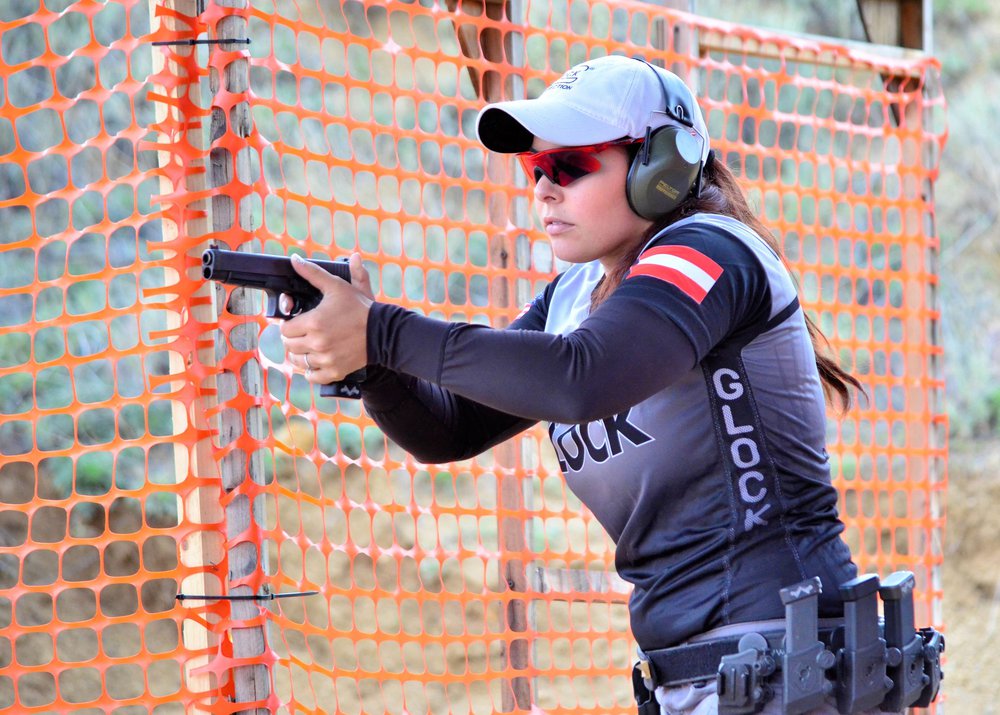 Photo: zinkpics, CC BY-SA 2.0, via Wikimedia Commons
A category never changes how your hits are scored. What it does is create a second results sheet: you are still ranked overall in your division, and you are also ranked against everyone else in your category within that division. That is why a 58-year-old C-class Carry Optics shooter can go home with a plaque from a match where they finished mid-pack overall. The catch is that categories are only recognised when enough people enter them — at the 2026 Nationals USPSA required at least ten competitors in a division, ten in a class and five in a category before that group got its own awards. At a local club match, categories are usually just a checkbox on the registration form that the scoring software reports if it can.
So when you fill in a match registration, you are answering three separate questions: which division does your gun fit, which class has USPSA assigned you in that division, and do you qualify for a category. The first is the only one you choose. The second is earned. The third is simply a fact about you that you should not forget to tick.
Factory Gun vs Race Gun: How USPSA Split the 2026 Nationals
Until 2025 USPSA ran a handful of national championships that mixed divisions in ways that changed every year. On 25 January 2026 the organisation announced a cleaner split, and it is worth knowing because it tells you which “room” your division actually lives in. The two most popular divisions, Carry Optics and Limited Optics, were each paired with a share of the remaining seven to create two separate championships.
The Factory Gun Nationals is for Carry Optics, Production, Single Stack and Revolver — the divisions built around off-the-shelf firearms with tightly limited modification. The Race Gun Nationals takes the five fast divisions: Limited, Limited-10, Limited Optics, Open and PCC. If you have been reading this guide wondering whether a Limited Optics 2011 is “really” a race gun, USPSA has answered the question for you: it is scored in the same national match as Open and PCC, not alongside the Production pistols it visually resembles.
That split mirrors the informal groups clubs have used for years. Production and Carry Optics are the stock group. Open, Limited, Limited-10 and Limited Optics are the customised high-performance group. Single Stack and Revolver are the traditional group, and PCC stands on its own as the carbine group. Steel Challenge, USPSA’s other discipline, has its own championship — the World Speed Shooting Championship — and its own set of thirteen divisions that include rimfire and optics variants USPSA does not run; the Steel Challenge guide covers those separately, because a Carry Optics classification in one sport means nothing in the other.
For a first-year shooter the practical takeaway is simple. Your division decides more than which equipment rules apply on a Saturday; it decides which national championship, which award structure, and which group of people you will be measured against if you ever travel to a big match.
The Carry Optics Gun List: How a Pistol Gets On It, and the Single-Action Trap
People search for a “Carry Optics gun list” and never find one, because it does not exist as a separate document. Carry Optics uses the USPSA Production Gun List: if a pistol is legal in Production, its optics-ready version is legal in Carry Optics, and the list says so directly — optics-ready models of every approved gun are automatically approved. A model gets on the list when the manufacturer declares that at least 500 units have been produced and the gun meets the Production criteria, which is why brand-new releases sometimes spend a season in Limited Optics before they are legal in Carry Optics.
The trap hidden in that list is the single-action note. Several popular pistols exist in both a DA/SA or striker version and a single-action-only version, and the list is explicit that the single-action variants are not legal for Production or Carry Optics — the hammer-fired SAO models of the Jericho are the textbook example. The same logic catches the 2011 crowd: a single-action gun is never a Carry Optics gun regardless of weight or magwell, which is exactly why Limited Optics exists. Before you buy, search the list for the model name and then check which trigger mechanism the entry actually approves.
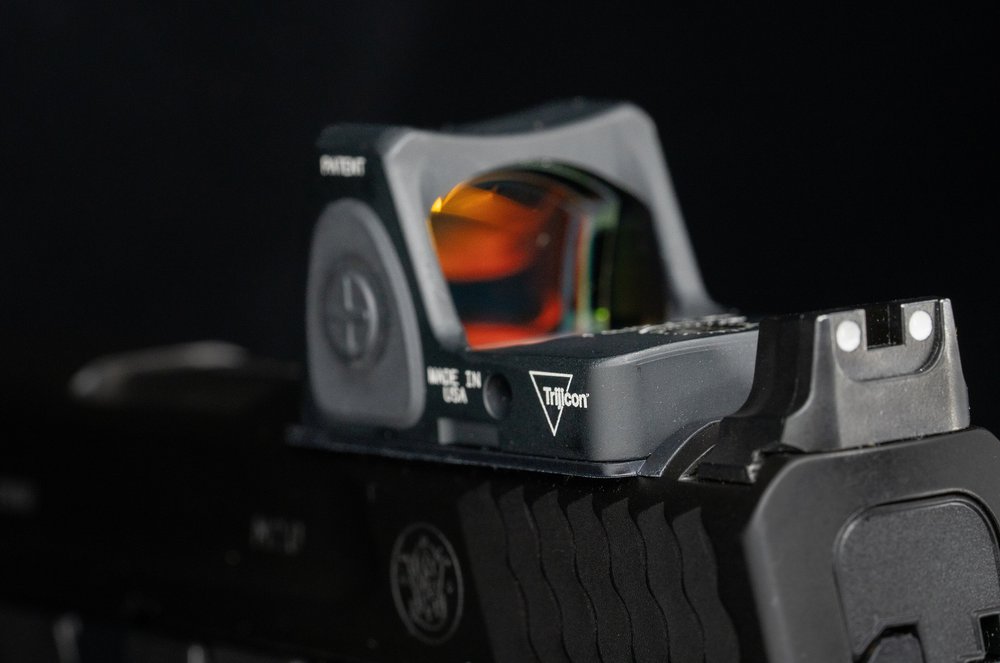 Photo: Tony Webster, CC BY-SA 2.0, via Wikimedia Commons
If you want to know what actually shows up on a Carry Optics squad, the pattern has been stable for years. Glock 34 MOS, Glock 17 MOS and Glock 45, Smith & Wesson M&P 2.0, CZ Shadow 2 Optics Ready, SIG P320 X5 and Walther PDP make up most of the field, with the Canik SFx Rival-S the newer entry. Shooting Sports USA’s survey of Carry Optics Nationals entrants found the P320 X5 on 21% of guns, the Shadow 2 on 15% and the Glock 34 on 14%, and the mix has only broadened since. None of those is faster than the others in a way that will show on your timer in your first season; what matters is that the model is on the list, that it weighs under 59 ounces with your optic and heaviest empty magazine, and that it has no magwell.
When Your Red Dot Dies Mid-Stage: You Are Not Bumped to Open
The oldest Carry Optics campfire story is that if your optic fails or falls off during a stage you are “moved to Open” for the match. That has not been true for a while, and it is worth knowing the actual ruling because it changes what you do in the moment. NROI, USPSA’s officiating body, ruled in January 2024 that an optic coming off mid-stage is competitor equipment failure under rule 5.7.2. The gun still shoots, so it is not an unsafe firearm and the Range Officer has no rule to stop you. You may fix it and keep shooting, or you may stop and have the stage scored as shot — and either way it is not a bump to Open, because the gun was legal at the start signal. A June 2024 NROI ruling repeated the same principle for optics generally.
The 2026 rulebook pushed further in the same direction. Industry summaries of the 2026 change log report that the old automatic Open bump for gear worn outside the permitted position was replaced with a chance to correct the problem first — check the current text at rules.uspsa.org before you rely on it at a major, because the online rules are the only version that is always current. USPSA has also published a 2026 Equipment Change Proposal for member comment that would, among other things, allow aftermarket backstraps in Production and Carry Optics; nothing in a proposal is in force until it appears in the rulebook, so treat it as a preview, not a permission slip.
The practical lesson is about training rather than rules. If you shoot a dotted division, practise a few draws each week with the optic taped over so that co-witnessed irons or a slide-window sight picture is not a surprise. A shot timer makes that honest — run five draws with the dot and five with it covered using the free Airsoft Shot Timer app and you will know exactly how many tenths a dead battery costs you before it happens on a stage.
What Each Division Actually Costs to Set Up
Division choice has a price tag attached, and it is worth seeing the range before you fall in love with a division. A Production-legal setup is realistically a $500 to $800 pistol and you are done — it is the cheapest legal entry into the sport. Carry Optics runs roughly $700 to $1,200 once you have added a decent enclosed-emitter dot and a couple of extended base pads. Single Stack sits around $1,000 to $2,500 depending on how nice a 1911 you want, Revolver lands near $800 to $1,500, and PCC is usually $800 to $2,000 with an optic fitted.
The two divisions where the number climbs are Limited, at roughly $1,500 to $3,000 for a high-capacity .40 build, and Limited Optics, at $2,000 to $4,000 because the division is effectively 2011 territory. Open starts around $3,000 and keeps going — a competitive race gun with a frame-mounted dot, comp, and 171.25mm magazines is the most expensive way to shoot USPSA by a wide margin.
None of this is required for a first match. Turn up with what you own, shoot four matches, and let the spending decision come after you know which division you actually enjoy standing in.
The Three Traps That Quietly Move People to Open
Almost every “wait, I’m in what division?” moment at a first match comes from one of three things.
The first is the compensator, and it is by far the most common in 2026. Comped pistols are everywhere now, they are marketed as competition guns, and a comp is a one-way ticket to Open regardless of what else the gun has.
The second is the factory magwell. Carry Optics and Production both prohibit aftermarket external magwells, and manufacturers keep shipping flared magwells on the exact “competition ready” models that competitors buy. The gun isn’t illegal — it just isn’t in the division you thought.
The third is optic placement. Carry Optics and Limited Optics both require the optic to be attached directly to the slide, between the rear of the slide and the ejection port. Frame-mounted mounts, however tidy, are Open equipment.
None of these will ruin your day. Match Directors deal with them every weekend and will simply enter you in the correct division. But there is a difference between being scored against the 37% and being scored against purpose-built race guns, and it is worth ten minutes of reading before you write a division on the sign-up sheet.
What Your Division Actually Costs You on the Clock
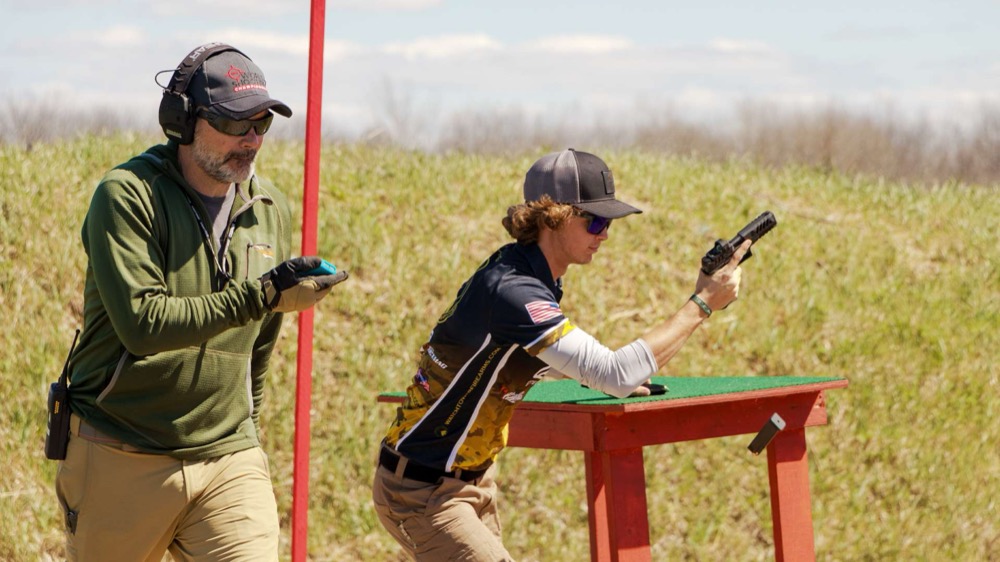
Division rules are usually presented as a gear list, which hides the thing that actually decides your match: capacity is a time budget. A 32-round field course is one standing reload if you are running 22 rounds in a Carry Optics magazine, and two if you are downloaded to 15 in Production. On paper that’s “one extra reload.” On the timer it is roughly 1.5 to 2.5 seconds of your stage time, repeated across every stage of the day, before you have fired a single extra shot.
That is a measurable number rather than an opinion, and it is worth measuring before you commit to a division. Time ten reloads from your actual belt setup with a shot timer — the free Airsoft Shot Timer app will do it from your phone with a random start delay, and the reload technique guide covers what a good one should look like. Multiply your honest average by the number of extra reloads a division forces on you, and the choice between Production and Carry Optics stops being about gear philosophy and starts being about six or seven seconds a match.
Once you have picked a division, the next thing to understand is how USPSA turns your raw times into a class — that runs through the classifier system, and it is division-specific, which means the class you earn in Carry Optics does not travel with you if you switch. Our USPSA classifier guide covers the current 26 Series and how hit factor becomes a percentage, and the USPSA beginner guide walks through everything else about your first match — squadding, range commands, and the gear you actually need in the bag.
Frequently Asked Questions
How many divisions does USPSA have?
Eight divisions are in active use: Carry Optics, Limited Optics, Open, Limited, Production, Single Stack, Revolver and PCC. You will also see the number given as seven or nine depending on how the source counts, because PCC is a long-gun division rather than a handgun division, and Limited-10 — still a fully recognised division, shot at the 2026 Race Gun Nationals, but only about 1% of the field — is often left off. If someone tells you “seven divisions,” they are counting handguns only.
Which USPSA division should a beginner shoot?
Whichever one your current gun already fits — that is genuinely the right answer, because buying equipment before your first match is how people spend money on the wrong thing. If you own a striker-fired 9mm with a slide-mounted red dot, shoot Carry Optics and you will be in the largest field in the sport at 37%. If it has iron sights, Production or Limited. If it wears a magwell or is a 2011, Limited Optics. Shoot three or four matches before you change anything.
Can Limited Optics shoot Major power factor?
No. Limited Optics is Minor-only, and this catches a lot of people who assume it is simply “Limited with a dot.” Only Open, Limited, Single Stack and Revolver can score Major. If you want a red dot and Major scoring, Open is the only division that offers both.
What is the magazine capacity limit in USPSA Carry Optics?
There is no round-count limit in Carry Optics — the limit is magazine length, capped at 141.25mm. On a typical 17-round 9mm tube with an extended base pad that works out to roughly 22 to 24 rounds. Production is the opposite: no length gauge, but a hard limit of 15 rounds loaded after the start signal.
Does a compensator change my USPSA division?
Yes, and this is the single most common accidental division change. A compensator places you in Open in USPSA, regardless of what the rest of the gun looks like. Carry Optics, Limited Optics, Limited, Production and Single Stack all prohibit compensators. If you are shopping for a competition pistol and do not intend to shoot Open, buy the version without the comp.
What is the 59 ounce weight limit in Carry Optics?
The pistol must weigh no more than 59 ounces measured complete — optic mounted and the heaviest empty magazine inserted. It is easy to creep over with a tungsten grip module, a steel guide rod, and a heavy optic stacked together. Weigh the gun as you will actually shoot it, not as it came out of the box.
What are the age categories in USPSA?
USPSA calls them categories, not divisions, and the current rulebook lists seven: Junior (under 18), Senior (55 to 64), Super Senior (65 to 69), Distinguished Senior (70 and over), Lady, Military and Law. Age is counted on the first day of the match. A category does not change your score or your division; it adds a second ranking against the other people in that category, and at Nationals it is only recognised when at least five competitors enter it.
What is the difference between a USPSA division and a class?
A division is decided by your equipment — Carry Optics, Production, Open and so on. A class is decided by your skill, from D up through C, B, A, Master and Grand Master, and is earned by shooting classifier stages. Class is tracked separately in each division, so switching from Carry Optics to Limited Optics starts you as Unclassified in the new division until you have enough classifiers there.
Which USPSA division is the most popular?
Carry Optics, by a wide margin. USPSA’s own January 2026 activity breakdown put Carry Optics at 37% of the sport and Limited Optics at 28%, with Open at 13% and PCC at 8%. Production, once the default beginner division, is now about 5%.
Is Limited-10 still a USPSA division in 2026?
Yes. Limited-10 is in the current rulebook (Appendix D3), was one of the five divisions at the 2026 Race Gun Nationals, and since the February 2025 rulebook it allows optics. It is small — roughly 1% of activity — but it is fully recognised, and it is the natural home for shooters in 10-round-magazine states.
What are the USPSA divisions at the 2026 Nationals?
USPSA split the 2026 Nationals into two matches. The Factory Gun Nationals covers Carry Optics, Production, Single Stack and Revolver. The Race Gun Nationals covers Limited, Limited-10, Limited Optics, Open and PCC. Steel Challenge has its own championship, the World Speed Shooting Championship.
What happens if my red dot fails during a USPSA stage?
You are not moved to Open. NROI’s ruling treats an optic that fails or falls off as competitor equipment failure under rule 5.7.2: the gun is still safe to fire, so the Range Officer does not stop you, and you may either fix it and continue or stop and have the stage scored as shot. The gun was legal at the start signal, and that is what your division is judged on.
Where to Go From Here
Pick the division your gun already fits, shoot four matches without buying anything, and only then decide whether you want to change lanes. Almost everyone who starts by choosing gear first ends up owning a pistol built for a division they didn’t enjoy.
If you are still deciding between practical shooting sports entirely, the IDPA vs USPSA comparison lays out how the two differ in scoring philosophy and equipment freedom, and the practical shooting beginner guide covers IPSC, Steel Challenge and 3-Gun alongside them. For the equipment side of whichever division you land in, the competition holster guide covers the everyday-carry holster standard that Carry Optics and Production both enforce.
Image Credits
- Stage photo in the categories section: Michelle Viscusi during a stage at a shooting match in Arizona, by zinkpics, CC BY-SA 2.0, via Wikimedia Commons. Unmodified apart from resizing.
- Red-dot close-up in the gun-list section: Trijicon RMR on a Smith & Wesson M&P 2.0, by Tony Webster, CC BY-SA 2.0, via Wikimedia Commons. Unmodified apart from resizing.
Put a Shot Timer in Your Pocket
Airsoft Shot Timer is a free shot timer app tuned for airsoft and Action Air — it picks up BB gun shots, tracks your split times, and saves you the cost of a $150+ hardware timer for IPSC/IDPA practice.

- USPSA
- USPSA Divisions
- Uspsa Divisions Explained
- Uspsa Divisions 2026
- Uspsa Pistol Divisions
- Uspsa Divisions List
- Uspsa Division Rules
- Carry Optics
- Uspsa Carry Optics
- Uspsa Carry Optics Rules
- Limited Optics
- Uspsa Limited Optics
- Uspsa Open Division
- Uspsa Limited Division
- Uspsa Production Division
- Uspsa Production Capacity
- Uspsa Single Stack
- Uspsa Revolver Division
- Uspsa Pcc
- Limited 10
- Power Factor
- Major vs Minor Power Factor
- Uspsa Scoring
- Hit Factor
- Practical Shooting
- Competitive Shooting
- Which Uspsa Division Should I Shoot
- Uspsa Approved Production Handgun List
- Uspsa Magazine Length
- 141.25mm
- Uspsa 59 Oz Weight Limit
- Uspsa Categories
- Uspsa Age Categories
- Uspsa Senior Age
- Uspsa Junior
- Uspsa Classifications
- Uspsa Classes Explained
- Uspsa Division vs Class
- Uspsa Carry Optics Gun List
- Uspsa Production Gun List
- Uspsa Limited 10
- Limited 10 Optics
- Factory Gun Nationals
- Race Gun Nationals
- Uspsa Nationals 2026
- Uspsa Division Groups