IDPA Rules 2026: Scoring, Penalty Seconds & Power Factor by Division
IDPA Rules 2026 in 60 Seconds (BLUF)
Short answer: IDPA scores you on raw time plus penalty seconds — lowest total wins. Hits in the centre -0 zone add nothing, -1 adds one second each, -3 adds three, and a miss is five. The 2026 rulebook calls the two scoring methods Unlimited Scoring (best hits count, extra shots allowed) and Limited Scoring (extra shots get punished) — the old “Vickers Count” and “Limited Vickers” names are gone from the book, though everyone at the range still says them. You must use cover when offered, engage near-to-far (Tactical Priority), reload behind cover, and wear a concealment garment that hides your entire rig with arms outstretched. Procedural errors are 3 seconds, Flagrant Penalties 10 seconds, FTDR 20 seconds, hits on a non-threat 5 seconds, and safety violations (sweeping a muzzle, dropping a loaded gun, AD) are an immediate DQ.
Power factor in one line: IDPA has no Major/Minor split, but it does not use one number for everything. The 2026 floors are 125 for SSP, ESP and CO, 165 for CDP, 105 for CCP, Stock Revolver and BUG, 155 for Enhanced Revolver, and 135 for PCC — and any ordinary 9mm factory load clears 125 with room to spare. Full chart and the chronograph procedure below.
Three 2026 rulebook changes you must know before your first match:
- SIG P320 (all variants) remains banned from IDPA — the suspension from July 2025 is now codified in the 2026 rulebook. If you own a P320, you cannot compete with it in any division.
- BUG capacity is now 8+1 (was 6+1), and .380 ACP is fully removed. Micro-9mm pistols like the SIG P365, Hellcat, and Shield Plus now have a real home, but pocket .380s no longer have a division.
- Non-functional manual safeties (especially 1911 thumb safeties) now trigger DQ. If your 1911’s thumb safety doesn’t actually click into “safe” on demand, you can’t compete with it in 2026.
If you’re new and own one 9mm pistol, default to SSP, CO, or CCP — lowest cost, biggest field, easiest to learn in.
30-Second Quick Picks: Jump to What You Need
- I just want to understand scoring — Unlimited vs Limited Scoring, the -0/-1/-3/Miss math, a worked score sheet
- What power factor do I need? — all nine divisions, bullet weight to minimum velocity, how chrono works
- I keep getting cover penalties — 100% body behind cover, reload position, movement between cover
- I’m confused about engagement order — near-to-far, exposed-first, Tactical Sequence vs Priority
- I want to know every penalty — PE / FP / FTDR / non-threat / DQ breakdown
- What’s new in 2026? — P320 ban, BUG 8+1, .380 removed, 1911 safety DQ
- My first match starts when? — match-day flow from registration to scoring
- How do I train at home? — draw, reload, and cover drills with a Shot Timer App
Why You Should Understand IDPA Rules Before Your First Match
For most new shooters, the biggest source of anxiety at their first IDPA match isn’t the shooting itself — it’s the fear of accidentally breaking a rule and getting penalised. That concern is perfectly valid. IDPA has considerably more rules than casual range shooting, and many of those rules are fundamentally different from USPSA, especially when it comes to engagement order and the use of cover.
The good news is that IDPA rules follow a logical thread that’s easy to grasp once you see the big picture. The entire rulebook is built around one question: what would you do in a real defensive encounter? Engage the closest threat first, use cover to protect yourself, reload behind safety. When you interpret the rules through the lens of “what if this were real,” most of them stop feeling arbitrary and start making intuitive sense.
This article walks you through the core IDPA rules from start to finish — how scoring works, what gets penalised, what changed in 2026, and what match day actually looks like. If you haven’t decided on a division yet, check out our IDPA Divisions Explained 2026 first. And if you’re deciding between IDPA and USPSA, our IDPA vs USPSA Complete Comparison will help you choose.
The IDPA Scoring System: Time Is Everything
IDPA scoring is simpler than most people expect, but it works very differently from USPSA’s Hit Factor system. In IDPA, your total score is your raw time plus penalty seconds. The lowest total time wins. That’s it.
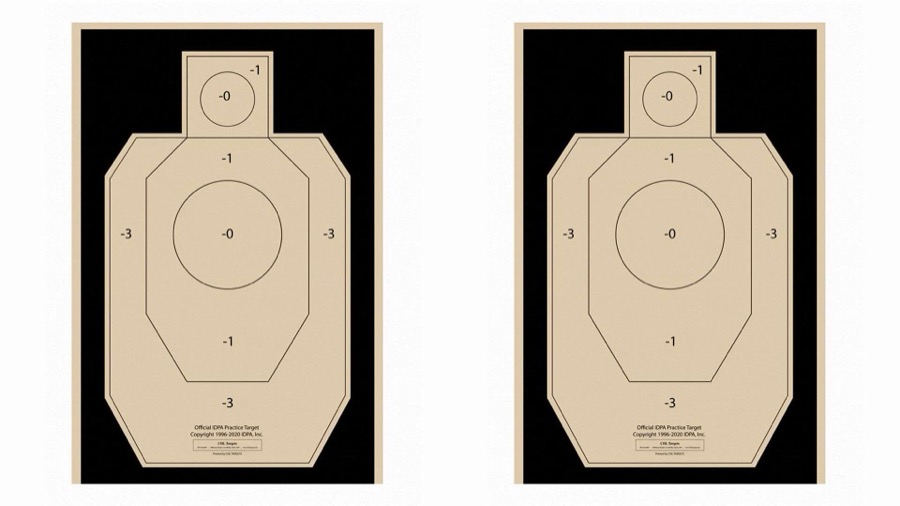
The target zones are labelled in “points down” rather than points earned. The centre -0 zone is a perfect hit — no time added. The next ring out is -1, adding one second per hit. The outer -3 zone adds three seconds, and a complete miss adds five seconds. This design forces a genuine tradeoff between speed and accuracy. Spraying shots and racking up -3 hits can easily cost you more time than slowing down to land -0s. Many experienced shooters say the fastest way to shoot IDPA is to shoot accurately — the math almost always works out in favour of clean hits.
The most common scoring method is what the 2026 rulebook calls Unlimited Scoring: you may fire at each target as many times as you think you need, and only the best hits count. If a stage calls for two hits per target and you fire three, the scorer takes your best two. That’s a genuine safety net — if you feel the shot break badly, you can make it up without penalty. The catch runs the other way: if you fire too few rounds at a target, the unfired rounds are scored as misses (five seconds each) and you collect a procedural error for not shooting the stage as written.
The stricter method is Limited Scoring, where the round count in the written stage description is exactly what you fire. Go over and two things happen at once: one procedural error per string, and for every extra shot the scorer tapes over one of your best hits before totalling. That second half is the part new shooters never see coming — the penalty isn’t just three seconds, it’s three seconds plus your -0 being deleted and replaced by whatever you left in the -3 zone.
If those two names look unfamiliar, you’re not imagining it. Through 2025 these methods were universally called Vickers Count and Limited Vickers, and that’s still what you’ll hear a Safety Officer say on the line. But the word “Vickers” does not appear anywhere in the 2026 rulebook — the methods were renamed to Unlimited and Limited Scoring, and the old third method, “Alternate” scoring, was deleted outright. Nothing about how you actually shoot changed; only the vocabulary did, which matters mainly when you’re reading a stage description or arguing a call.
How a Stage Score Is Actually Tallied
Take the raw time off the shot timer, add one second for every point down, then add every other penalty on top. That’s the whole formula, and it’s worth walking through once with real numbers because the balance surprises people.
Say you shoot a twelve-round stage in 18.40 seconds raw. You drop four points down (one -1 and one -3), you clip a non-threat once, and the SO calls one cover procedural. Your score is 18.40 + 4 + 5 + 3 = 30.40 seconds. The shooter next to you took 23.10 seconds raw — nearly five seconds slower on the clock — but shot it clean with one point down and no penalties, for 24.10. He beat you by more than six seconds while moving noticeably slower, and that is the whole argument for IDPA’s design: the points-down system is priced so that accuracy almost always wins the arithmetic.
| What happened | Seconds added |
|---|---|
| Hit in the -0 zone | 0 |
| Hit in the -1 zone | 1 each |
| Hit in the -3 zone | 3 each |
| Miss on a threat target | 5 each |
| Hit on a non-threat (HNT) | 5 each, whatever zone it lands in |
| Procedural Error (PE) | 3 per type of infraction |
| Flagrant Penalty (FP) | 10 |
| Failure To Do Right (FTDR) | 20 |
| Safety violation | DQ — match over |
Two details on that table are worth committing to memory. A non-threat is scored -5 per hit regardless of the printed scoring zone — there is no “cheap” place to clip the innocent bystander. And a PE is assessed per type of infraction, not per instance, so using the wrong hand and firing the wrong round count is two PEs, while faulting the cover line repeatedly at one position is capped at the number of cover positions on the stage.
One more rule that catches people out: once you hear the beep, you own a score. If your gun breaks or you injure yourself mid-stage, the SO writes down the time and scores the targets as they stand, adding misses for everything you never engaged. There’s no “we’ll just skip that one.” If you never fired a shot at all, the score sheet records a raw time of 0.01 seconds and then buries you in misses.
IDPA Power Factor by Division (2026): Chart and Chrono Procedure
IDPA doesn’t use a “Major / Minor” split the way USPSA does, and that fact gets mangled into a second claim you’ll see repeated all over the internet — that IDPA has a single power factor of 125,000 for everything. It doesn’t. The 2026 rulebook (rule 8.3.4) sets five different floors across the nine divisions, and if you shoot CDP or Enhanced Revolver the number that matters to you is nowhere near 125.
Here’s the full list. SSP, ESP and Carry Optics require 125. CDP requires 165. CCP, Stock Revolver and BUG require 105 — BUG was raised from the old 95 figure that still appears on a lot of club pages. Enhanced Revolver requires 155, and PCC requires 135. (Separately, steel targets are calibrated to fall at a power factor of 95, a number that was corrected in Version 2 of the 2026 rulebook.)
Calculating your own is trivial: multiply bullet weight in grains by velocity in feet per second, divide by 1,000, and throw away everything to the right of the decimal point. The rulebook’s own worked example uses a 230.1-grain bullet at 794.7 fps — 230.1 × 794.7 ÷ 1000 = 182.86, which is recorded as a power factor of 182. Note the truncation: 124.9 does not round up to 125, it becomes 124 and you fail.
The Chart: Minimum Velocity for Each Bullet Weight
Because power factor is just multiplication, the useful version of this rule is inverted — not “what’s my PF” but “how slow can my load be before it fails?” Divide the floor by your bullet weight and you get the minimum velocity you need to chronograph. These are the numbers, rounded up so you’re on the safe side of the truncation rule:
| Bullet weight | 105 (CCP / Stock REV / BUG) | 125 (SSP / ESP / CO) | 135 (PCC) | 155 (Enh. REV) | 165 (CDP) |
|---|---|---|---|---|---|
| 115 gr | 914 fps | 1,087 fps | 1,174 fps | 1,348 fps | 1,435 fps |
| 124 gr | 847 fps | 1,009 fps | 1,089 fps | 1,250 fps | 1,331 fps |
| 135 gr | 778 fps | 926 fps | 1,000 fps | 1,149 fps | 1,223 fps |
| 147 gr | 715 fps | 851 fps | 919 fps | 1,055 fps | 1,123 fps |
| 158 gr | 665 fps | 792 fps | 855 fps | 982 fps | 1,045 fps |
| 180 gr | 584 fps | 695 fps | 750 fps | 862 fps | 917 fps |
| 200 gr | 525 fps | 625 fps | 675 fps | 775 fps | 825 fps |
| 230 gr | 457 fps | 544 fps | 587 fps | 674 fps | 718 fps |
Read one row and the practical picture falls out immediately. A 124-grain 9mm needs 1,009 fps for SSP, ESP or CO — and factory 124-grain ball typically runs 1,100 to 1,150 fps from a duty-length barrel, giving you a comfortable 10 to 15 percent margin. A 147-grain subsonic needs only 851 fps, and even the mildest match load clears that. This is why most IDPA shooters genuinely never think about power factor: the only people who get bitten are handloaders chasing the softest possible recoil, and anyone shooting a short-barrelled carry gun where 100+ fps of velocity simply vanishes down the muzzle. If you shoot a 3-inch CCP pistol with light handloads, chronograph them yourself before a sanctioned match — your load may have made 125 out of a 5-inch test barrel and make 118 out of yours.
How Chronographing Actually Works
Most club-level shooters go years without seeing a chronograph stage; it’s at sanctioned matches that the check becomes routine. When it happens, the 2026 procedure (rule 8.3.5) is specific in a way that’s worth knowing in advance. You must be present, your ammunition is pulled or bagged before you arrive at the chrono stage, and — this is the 2026 change — the chrono official fires it through your own match gun, not a house test barrel. Three rounds are fired, and if two of the three meet or exceed your division floor, you’re compliant. Before each shot the muzzle may be pointed straight up to settle the powder charge to the rear of the case, which is a small courtesy that squeezes out maximum velocity. A bullet is then pulled and weighed on a powder scale, although that step can be waived if two rounds already exceeded the minimum velocity for the caliber.
There is no “scoring bonus” for shooting a larger caliber the way USPSA rewards Major-power-factor shooters. A 9mm and a .45 ACP score identically in IDPA — a -1 hit costs one second either way. This is why most IDPA shooters default to 9mm regardless of division: it’s cheaper, easier to control, and you give up nothing on the score sheet.
Caliber minimums by division round out the picture: 9mm (or .355" / 9×19) is the floor for SSP, ESP, CCP, CO, and BUG. CDP is .45 ACP only. REV requires .38 Special with a minimum 4-inch barrel. PCC is also 9mm minimum, with a 10-inch minimum barrel length. If you’re still choosing where to enter, our IDPA Divisions Explained 2026 walks through capacity and equipment limits side by side.
Cover Rules: What Makes IDPA Unique
Ask any experienced IDPA shooter what sets it apart from other competition formats, and nine out of ten will say “the cover rules.” In IDPA, when a stage includes cover positions — walls, doorframes, vehicles, barriers — you are required to use them properly.
Proper use of cover means that 100% of your body from head to toe must be behind the cover object while you’re shooting. Only your gun hand and arm should extend past the cover. The most common mistake new shooters make is “leaning out too far” — your shoulder, hip, or foot slips past the cover without you realising it, but the Safety Officer standing behind you sees it clearly.
There’s also an important reload rule tied to cover: when you need to reload behind cover, you must step back into a protected position before performing the reload. You can’t stand at the edge of cover, exposed to the “threat,” while swapping magazines. This is one of the most frequent sources of procedural penalties in competition, because under stress it’s natural to forget that one extra step backward.
When moving between cover positions, you should complete your reload before stepping out — not while you’re crossing open ground. In IDPA’s logic, moving between cover positions is when you’re most vulnerable, and your pistol should be ready to fire at all times during that transition.
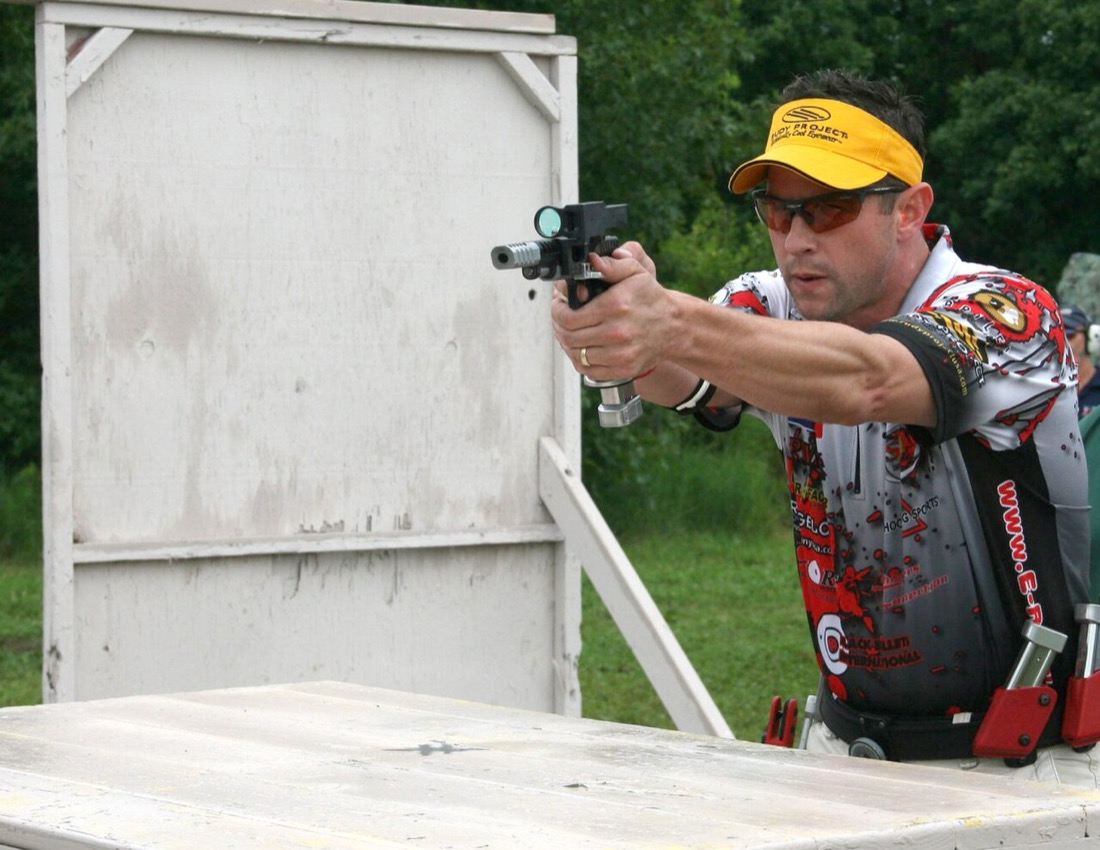
Tactical Priority: The Engagement Order Rule
Tactical Priority is another concept that sets IDPA apart from USPSA. In USPSA, you can engage targets in whatever order you want — left to right, right to left, skip around — whatever’s most efficient. In IDPA, you must follow the threat priority order.
The fundamental principle is “near to far”: when you see multiple targets from a position, you engage the closest threat first and work outward by distance. The reasoning is straightforward — in a real defensive encounter, the nearest attacker poses the greatest danger to you.
A secondary principle is “exposed targets take priority”: if a target is in the open (not behind cover), it ranks higher than a target that’s partially concealed behind a barrier. A threat standing in the middle of the road is more urgent than one hiding behind a doorframe.
Some stages specify Tactical Sequence instead of Tactical Priority, and these two are very different. Tactical Sequence requires you to fire one round on each target before returning for additional rounds. For example, facing three targets requiring two hits each, you’d shoot 1-1-1 (one on each), then 1-1-1 again (one more on each). This simulates the defensive concept of suppressing all threats quickly before confirming each one is neutralised.
Confusing Tactical Priority with Tactical Sequence is one of the most common ways new shooters pick up procedural penalties. During the stage briefing, listen carefully for which rule applies — and don’t be afraid to ask the Safety Officer to clarify.
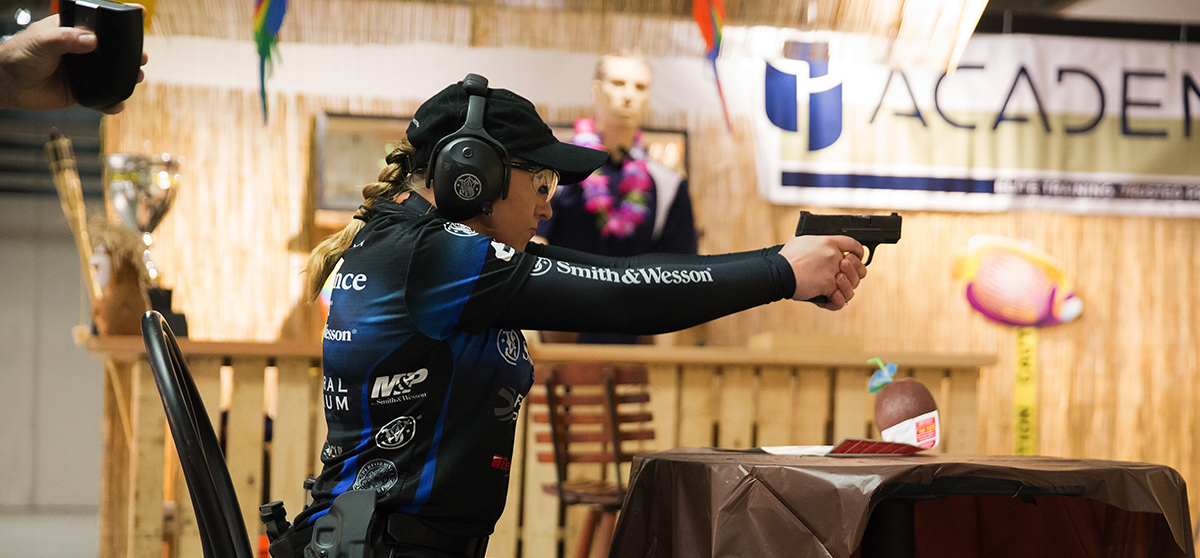
Concealment Garment, Magazine Pouches and Start Positions
IDPA requires all shooters to wear a concealment garment during competition — typically an unbuttoned vest or open-front jacket that covers your holstered pistol and all equipment. With your arms extended to your sides, your gun, holster, and magazine carriers must not be visible.
This requirement ties directly to IDPA’s core philosophy of simulating everyday concealed carry. In real life, you wouldn’t walk around with your gun and gear openly displayed, so the competition reflects that. It also means your draw time must include the motion of clearing the garment — a skill that requires dedicated practice to make smooth and fast.
On the magazine pouch side, the IDPA rules are pretty specific and they catch new shooters out more often than you’d think. You can carry a maximum of two spare magazines on your belt for most divisions (PCC and revolver have their own rules), and those pouches must sit behind the centerline of your body when viewed from the side — basically, they have to be on the side of your belt, not riding in front of your hip bone. The pouches also have to be covered by the concealment garment along with the holster, which means if your shirt rides up over a forward-mounted carrier, you’ll get flagged. For specific gear, see our Competition Magazine Pouch Guide — most IDPA-legal pouches are explicitly marked as such.
Start positions in IDPA are more varied than in USPSA. Some stages have you seated in a chair, hands on a table, facing away from the targets, or even simulating driving a car when a threat appears. These varied scenarios are part of what makes IDPA feel like a series of short stories rather than an athletic event — “you’re sitting in a coffee shop when someone bursts through the door…” This scenario-driven design is one of the things that draws people to IDPA in the first place.
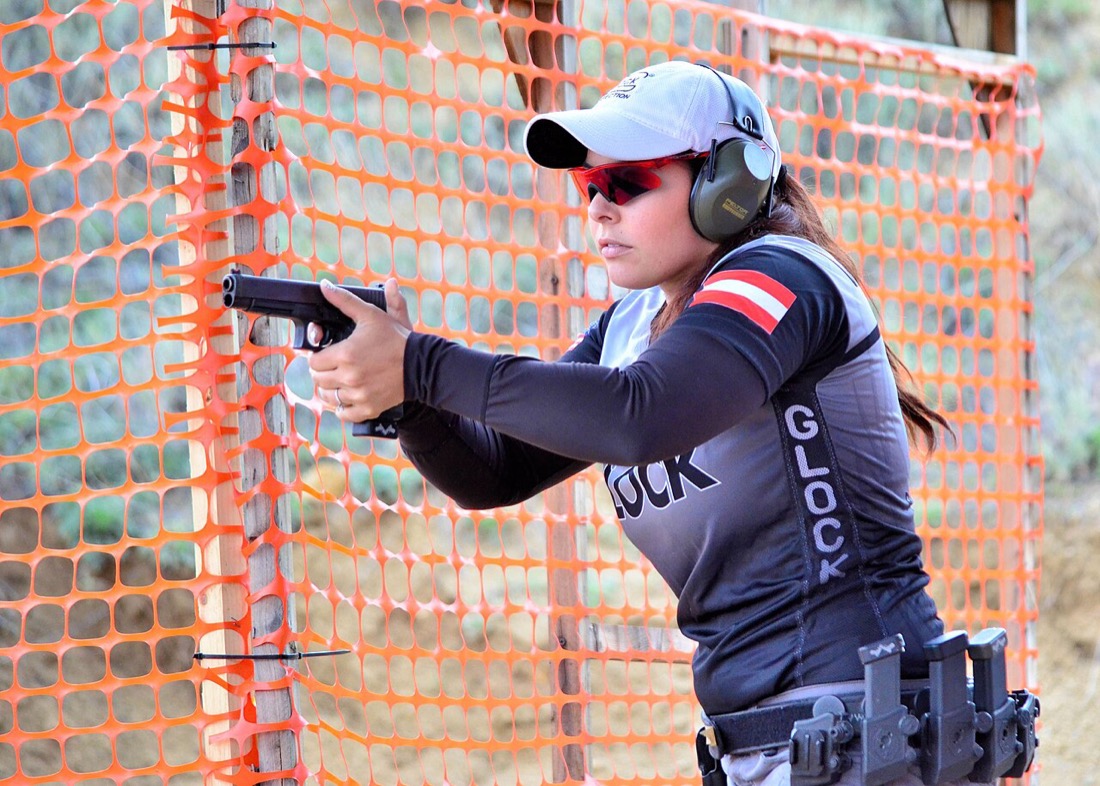
The belt above is a useful counter-example: four pouches riding openly on the outside of the belt is a perfectly normal USPSA setup, and every part of it would be illegal in most IDPA divisions. Two spares, behind the centerline, under the garment — that’s the whole rule.
IDPA Penalties Explained (2026)
Understanding the penalty system helps you avoid giving away seconds for nothing. IDPA penalties come in several tiers, and a few of them have new wording in the 2026 rulebook worth knowing.
A Procedural Error (PE) is the most common penalty, adding 3 seconds each time. PEs are triggered by improper use of cover, incorrect engagement order, reloading in the wrong location, or failing to follow stage-specific requirements (like shooting strong-hand-only when the stage calls for it). Three seconds might not sound like much, but in IDPA’s time-based scoring, a couple of PEs can drop you from the top third to the middle of the pack. One thing to flag for 2026: the rulebook now explicitly allows a PE to be issued for targets that aren’t fully engaged when the alternate scoring method previously would have handled it, so undershooting a target is now consistently penalised.
A Flagrant Penalty (FP) is a 10-second hit, reserved for situations where a shooter knowingly breaks a rule to gain a competitive advantage. Examples include shooting freestyle when strong-hand-only is required, or refusing to go prone when the stage calls for it. New shooters rarely need to worry about this one — it targets deliberate rule-bending, not honest mistakes.
Failure to Do Right (FTDR) is the harshest penalty at 20 seconds, aimed at extreme unsportsmanlike conduct or egregious intentional violations. You’ll almost never see this at a regular club match.
Hitting a non-threat target — the figure with open hands indicating an innocent bystander — adds 5 seconds per hit. Stage designers love placing non-threats right next to threat targets or partially obscuring threats behind non-threats, testing your target identification under pressure.
The most serious consequence is a DQ (Disqualification), which ends your entire match. DQs are reserved exclusively for safety violations: muzzle sweeping yourself or anyone else, dropping a loaded firearm, handling your gun outside the designated area, or an accidental discharge. The good news is that if you’ve had basic range safety training and maintain awareness of your muzzle direction, DQs are extremely rare.
One 2026 change to flag: a firearm with a non-functional manual safety now results in DQ at the start-of-day equipment check. This was added specifically to address 1911-pattern pistols where the thumb safety doesn’t reliably engage. If you shoot a 1911 or 2011, take it to a gunsmith before your first match and confirm the safety positively clicks into both positions. It’s a 30-second check that can save your entire match.
Safe Area, Range Commands, and the Four Places New Shooters Actually Get DQ’d
Penalties cost you seconds. A DQ costs you the whole day, and you drive home at ten in the morning having shot one stage. The reassuring part is that DQs cluster in a handful of very predictable moments — Safety Officers will tell you they see the same four over and over — so knowing where they live is most of the defence.
The safe area, and the rule that catches everyone. Every match has a designated safe area, and it works on an inverted logic that trips up almost every first-timer. Inside the safe area you may handle your firearm freely: holster it, draw it, do dry reps, take sight pictures. What you may not do is touch ammunition or a loaded magazine — not to top one off, not to seat one, not even to move one from a pocket to a pouch. Outside the safe area the rule flips exactly: you may handle ammunition and magazines all you like, but the gun stays holstered until a Safety Officer tells you otherwise. Both halves are DQ offences, and both are universal across IDPA and USPSA.
The practical routine that keeps you clear of it: unload the pistol at home, put it in a case in your range bag, and arrive with it that way. At the range, put your belt and holster on first, take the cased pistol to the safe area, and holster it there. Then walk away and load your magazines somewhere else. Once the gun is in the holster, it stays there until an SO says “Load and Make Ready.”
Load and Make Ready. This is the first of the two moments where the gun is out of the holster with live ammunition and nobody is shooting yet, which is exactly why it’s a DQ hotspot. Take your time — fifteen seconds is plenty — and keep the muzzle downrange the entire time, including while you seat the magazine and chamber a round. If you shoot a hammer-fired DA/SA pistol, lowering the hammer is part of this sequence, and it deserves your full attention rather than a casual thumb.
The reholster. The second hotspot, and the one that produces the most self-inflicted DQs. Bring the pistol straight back to the holster mouth, rotate it down and in, and look at the holster while you do it. The failure mode is leading with the muzzle and fishing for the opening, which sweeps your own thigh — a DQ whether or not the trigger moves. There are no style points for a no-look reholster, and experienced shooters who do them have simply banked thousands of grooved repetitions.
Breaking the 180 during a reload. Square up facing the targets and imagine a plane running left-to-right through your shoulders; the muzzle may never cross behind it. In practice this bites during reloads while moving to your support side, where the natural instinct is to bring the gun into your workspace and rotate it along with your body. IDPA additionally uses muzzle safe points on some stages, which can be tighter than a plain 180. Cure it at home with a drill that needs no ammunition at all: pick a spot on the wall, hold on it with an unloaded or airsoft pistol, and walk left, right, forward and back while the muzzle stays put. Two minutes at the start of each session, and it stops being conscious.
There’s a fifth one worth mentioning because it’s specific to IDPA’s scenario stages: doors. IDPA loves doors, and reaching for a knob while carrying the pistol low is an efficient way to muzzle your own hand. Carry it up in front of your face when you move — you can open a door cleanly, and you’re already most of the way to a sight picture when you arrive at the next position.
The Range Commands You’ll Hear, in Order
The commands are fixed, and knowing them removes a surprising amount of first-match anxiety. Before your turn, the scorekeeper works through the squad by calling one shooter as “the shooter,” the next “on deck,” and the one after that “in the hole” — when you hear your name in the hole, stop pasting targets and start getting your head in the game. When you’re up, the SO gives “Load and Make Ready” (USPSA says just “Make Ready”). Then “Are you ready?” — a nod is a perfectly good answer — followed by “Stand by,” and after a deliberately random delay of one to four seconds, the beep. The timer starts on the beep and runs to your last shot, so there’s no penalty for holding the gun up and checking your targets afterwards. When you’re done: “If you are finished, unload and show clear,” then “If clear, hammer down and holster.”
One IDPA-specific quirk to have in your head before match day: IDPA is built around the emergency reload, meaning you generally shoot to slide lock and reload from empty, where USPSA rewards the speed reload with a round still in the chamber. If your reload reps all come from USPSA practice, that’s a rhythm you’ll need to rebuild.
Don’t Crowd the Cover
One last thing that isn’t a rule but gets treated like one by newcomers: you do not need to be pressed flat against the barricade. The requirement is that your body is behind cover, not welded to it. The advice a veteran gave me at my first match — leave yourself “an arm’s length plus a beer” — is about right. Crowding the barricade is slower, it bangs your gun and optic on the wood, and it makes reloading awkward enough that people step out to do it, which is how a cover procedural gets earned. Stand back far enough to move comfortably and you’ll shoot the position faster and cleaner.
The 2026 IDPA Rulebook Changes Explained
The 2026 IDPA rulebook (effective January 15, 2026) carries some of the biggest changes the sport has seen in years. If your last match was in 2024 or earlier, here’s everything you need to recalibrate.
SIG P320 ban — all variants. Following the multi-year safety concerns and litigation around the P320 platform, IDPA suspended the entire P320 family from competition in July 2025. The 2026 rulebook now codifies this. You cannot shoot any P320 variant in IDPA — not the standard P320, not the M17 / M18, not the AXG, not the X-Five Legion. If you’ve built your entire setup around a P320, your options are to switch platforms (Glock 17, P365XL, M&P 2.0, HK VP9 are popular landings) or compete in non-IDPA disciplines like USPSA or PCSL where the P320 is still legal.
BUG (Back-Up Gun) division overhauled — 8+1, no more .380. BUG used to be a 6+1 division open to .380 ACP — which made it the natural home for pocket pistols like the Ruger LCP, Bodyguard .380, and old Kahr P380s. The 2026 rulebook bumps capacity to 8+1 and removes .380 entirely. This is essentially a redefinition: BUG is now the micro-9mm division. SIG P365 standard, Springfield Hellcat, S&W Shield Plus 9mm — these are the new BUG guns. If you own a .380, you sadly no longer have an IDPA division to compete in.
BUG-Optics is not a thing. Some shooters expected an optics-equipped BUG division for micro-red-dot setups like the P365XL with Romeo Zero. The 2026 rulebook explicitly does not include BUG-Optics. If you want to run a red dot, you need to be in CO (Carry Optics) with a larger pistol.
1911 manual safety DQ. As covered above, this is the safety-related change with the biggest impact on 1911 / 2011 shooters. The rule is enforced at the chronograph and equipment check, not in the middle of a stage, so you’ll know before your first stage of the day.
Procedural penalty wording cleanup. Several procedural penalty descriptions have been tightened to reduce Safety Officer interpretation. The most notable: standard penalties now consistently apply for targets that aren’t fully engaged, even on stages that previously used the alternate scoring method (which is itself gone).
Coaching rules tightened. The 2026 rulebook adds clearer language around what counts as “coaching” during a shooter’s run. If you’re an experienced shooter helping a squad-mate, the safest move is to give all advice during the walkthrough — once the buzzer goes, stay silent.
The IDPA website maintains the official 2026 rulebook PDF and a rule-changes summary; download the current version before your next big match.
Your First IDPA Match: What to Expect
Knowing the flow of match day can drastically reduce your pre-match jitters. Here’s what a typical IDPA club match looks like from start to finish.
Matches usually start at nine in the morning, but plan to arrive by eight. Registration involves some paperwork and selecting your division — if you’re unsure, the match staff will help you figure it out. New shooters typically get a dedicated briefing where an experienced shooter or Safety Officer walks you through the basics. Some clubs even assign a mentor who stays with you through the entire match.
A typical match consists of six stages, and you’ll be placed in a squad of 8-12 shooters who rotate through the stages together. At each stage, the Safety Officer conducts a walkthrough (Stage Briefing) explaining the start position, engagement order, target count, and any special requirements. This is your window to ask questions — no question is too basic, and no one will judge you for asking.
After the briefing, a shooting order is established. New shooters are usually placed near the end of the order so they can watch experienced competitors first, picking up on movement patterns, cover techniques, and stage strategy. When it’s your turn, the Safety Officer guides you to the start position, confirms you’re ready, and gives the start command.
After you finish shooting, you walk down range with the Safety Officer to score your targets. The scorekeeper records your results, you review and initial the score sheet, then clear out so the next shooter can go. The full match usually wraps up by early afternoon.
Five Common Mistakes New Shooters Make
After talking to dozens of IDPA shooters over the years, these are the mistakes that trip up newcomers most consistently. Knowing them ahead of time can save you plenty of penalty seconds.
The first is breaking cover. You think you’re tucked in tight, but your shoulder or foot is sticking out past the barrier. The fix is simple: during practice, have a friend stand where the Safety Officer would be and call out when you’re exposed. If you can’t do that, set up a phone to record your practice from behind. When in doubt, take an extra half-step back behind cover.
The second is getting the engagement order wrong. When you see three or more targets at once, it’s easy to lose track of which is closest under pressure. During the stage walkthrough, mentally rehearse the engagement sequence three times, and even point with your finger to lock in the 1-2-3 order.
The third is reloading at the wrong time. In IDPA, reloads should happen behind cover. Many newcomers finish shooting from one position and reload while walking to the next cover point — that’s a perfectly valid USPSA strategy, but in IDPA it earns you a procedural penalty.
The fourth is fumbling the concealment garment. When your cover garment snags during the draw, don’t panic. Sweep it cleanly with your support hand while your strong hand finds the grip. This two-hand coordination takes practice to become fluid — dry fire it hundreds of times before your first match.
The fifth is shooting non-threat targets. Under pressure, it’s tempting to fire at anything shaped like a person. Build the habit of spending a fraction of a second confirming each target before pulling the trigger — look for the threat indicator (hands holding a weapon) versus the non-threat indicator (open hands).
Practicing IDPA Skills at Home with a Shot Timer
Match performance is roughly 80% training and 20% match-day execution. The good news is that most core IDPA skills can be refined through dry fire practice at home.
Draw practice is the most fundamental drill. Use the AirsoftShotTimer app to set a buzzer-to-first-shot timer and track your draw speed over time. Since IDPA draws include clearing your concealment garment, always practice wearing the same jacket or vest you’ll compete in. A clean, consistent draw from concealment is worth more than any other single skill in IDPA.
Cover shooting movement can be practiced at any hallway corner. Work on stepping out from the edge of cover with minimal exposure, firing, and stepping back. Practice both left and right sides — you’ll encounter both in competition, and your weak side will be noticeably slower unless you train it.
Magazine changes are another area where focused practice pays huge dividends. Check out our Magazine Reload Techniques guide, and use a shot timer to measure each reload. The goal is to get your reloads under two seconds consistently.
For a more structured training program, see our IDPA at-home training drills and Dry Fire Training Complete Guide.
Frequently Asked Questions
What changed in the 2026 IDPA rulebook?
The four headline changes are: (1) SIG P320 (all variants) remains banned from competition — the July 2025 suspension is now permanently in the rulebook; (2) BUG capacity bumped from 6+1 to 8+1, and .380 ACP is removed — BUG is now a micro-9mm division, and pocket .380s no longer have a home; (3) non-functional manual safeties trigger DQ at equipment check — primarily affecting 1911 and 2011 thumb safeties; and (4) the alternate scoring method has been removed, with procedural penalties now consistently applied for unengaged targets. The 2026 rulebook took effect January 15, 2026 and can be downloaded directly from the IDPA official rules page.
How does IDPA scoring actually work?
Your final score equals your raw shooting time plus all penalty seconds. The lower your total time, the better. Hits in the centre -0 zone add nothing. -1 hits add one second each, -3 hits add three seconds, and a miss is five seconds. A procedural error is three seconds, a flagrant penalty is ten, failure-to-do-right is twenty, and a hit on a non-threat target is five regardless of which zone it lands in. The common scoring format is Unlimited Scoring — called Vickers Count before the 2026 rulebook renamed it — where you can fire extra rounds and only your best hits count.
How do I calculate IDPA power factor?
Multiply bullet weight in grains by muzzle velocity in feet per second, divide by 1,000, and discard everything after the decimal point. The rulebook’s own example is a 230.1-grain bullet at 794.7 fps: 230.1 × 794.7 ÷ 1000 = 182.86, recorded as 182. Because the result is truncated rather than rounded, 124.9 is a failing 124 — build in margin rather than aiming at the line.
Does IDPA chronograph ammunition at every match?
No. Club-level matches almost never chronograph; it’s sanctioned matches where a chrono stage becomes routine. When it happens, you must be present, your ammunition is bagged beforehand, and since the 2026 rulebook the official fires the test rounds through your own match firearm rather than a house barrel. Three rounds are fired and two of the three must meet or exceed your division’s floor for the ammunition to pass.
What’s the difference between Tactical Priority and Tactical Sequence?
Tactical Priority means engaging targets in near-to-far order — closest threat first, then work outward. You can put multiple rounds on each target before moving to the next one. Tactical Sequence requires one round per target across all visible targets first, then a second round on each (so for three targets needing two hits each, you’d shoot 1-1-1 then 1-1-1 again). Stage briefings will always specify which rule applies. Confusing them is one of the most common ways new shooters earn procedural penalties.
What are the IDPA magazine pouch rules?
You can carry up to two spare magazines on your belt for most divisions, mounted on the side of the belt (behind the centerline of your body when viewed from the side) and fully covered by your concealment garment. CCP is restricted to one spare on the belt (concealed everyday carry simulation). PCC and revolver have separate rules — see the relevant division pages for specifics. Most pouches marketed as “IDPA-legal” already meet these requirements; see our Competition Magazine Pouch Guide for vetted options.
What is the IDPA minimum power factor?
There isn’t one number — the 2026 rulebook sets five floors. SSP, ESP and Carry Optics need 125; CDP needs 165; CCP, Stock Revolver and BUG need 105; Enhanced Revolver needs 155; PCC needs 135. The widely repeated “IDPA is 125 for everything” is wrong, and the “BUG is 95” figure on many club pages is out of date. Any standard 9mm 124-grain factory load comfortably clears 125, so most shooters never have to think about it. There’s no Major / Minor split like USPSA — every legal cartridge scores identically, which is why most IDPA shooters default to 9mm regardless of division. See the minimum velocity chart for the exact fps your bullet weight needs.
Is the SIG P320 really banned from IDPA in 2026?
Yes. All P320 variants — including the standard P320, the military M17 and M18, the AXG line, and the X-Five Legion — are prohibited from IDPA competition as of the 2026 rulebook. The ban originated as a suspension in July 2025 over the platform’s well-documented safety concerns, and was carried into the permanent rulebook for 2026. If you currently shoot a P320, your competitive options are: (a) switch to a different platform for IDPA (Glock 17, M&P 2.0, HK VP9, Walther PDP are all popular replacements — see our Walther PDP Review 2026 for one option); or (b) compete in USPSA or PCSL, where the P320 is still legal.
Do I need a special pistol to start IDPA?
No. The most common starting setup is a stock 9mm service pistol you already own — Glock 17 / 19, S&W M&P 2.0, HK VP9, CZ Shadow 2, or similar. Pick the IDPA division that matches the gun you already have, get an IDPA-legal holster and two magazine pouches, throw on a concealment vest, and you’re ready. Most clubs will rent or loan a holster for your first match if you ask in advance.
What gets you disqualified from an IDPA match?
DQs are safety violations only, never scoring mistakes. The list is short: sweeping yourself or anyone else with the muzzle, breaking the 180 (or a stage’s muzzle safe point), an accidental discharge, dropping a loaded firearm, handling your gun outside the safe area or outside a Safety Officer’s commands, and handling ammunition or magazines inside the safe area. A firearm with a non-functional manual safety is also a DQ at the 2026 equipment check. In practice these cluster at four moments — the safe area, Load and Make Ready, the reholster, and reloading while moving to your support side — which is why those get their own section above.
Can I load magazines in the safe area?
No, and this catches more first-timers than any other rule. The safe area is for handling the firearm only — you can holster, draw, and dry-fire there, but touching ammunition or a loaded magazine inside it is a DQ offence. Load your magazines anywhere else on the range instead. The rule reverses outside the safe area: magazines and ammunition are fine, the gun stays holstered.
What are the IDPA range commands?
In order: the scorekeeper calls the rotation as “the shooter / on deck / in the hole,” then the Safety Officer gives “Load and Make Ready,” “Are you ready?”, “Stand by,” and after a random one-to-four-second delay, the start beep. After your last shot you’ll hear “If you are finished, unload and show clear,” then “If clear, hammer down and holster.” USPSA uses “Make Ready” instead of “Load and Make Ready”; everything else is close enough to be interchangeable.
Image Credits
- Barricade cover position — Darren Mulford, Public Domain, via Wikimedia Commons
- Competition belt and magazine pouches — zinkpics, CC BY-SA 2.0, via Wikimedia Commons
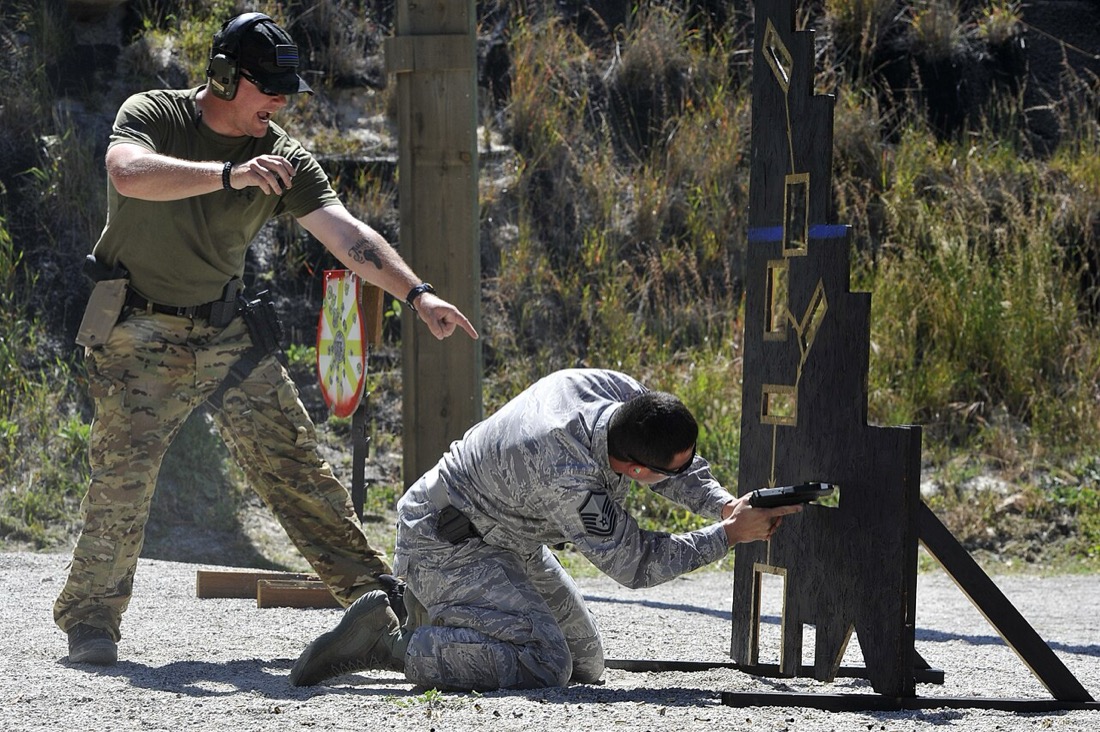
- Safety Officer running a stage — U.S. Air Force, Public Domain, via Wikimedia Commons
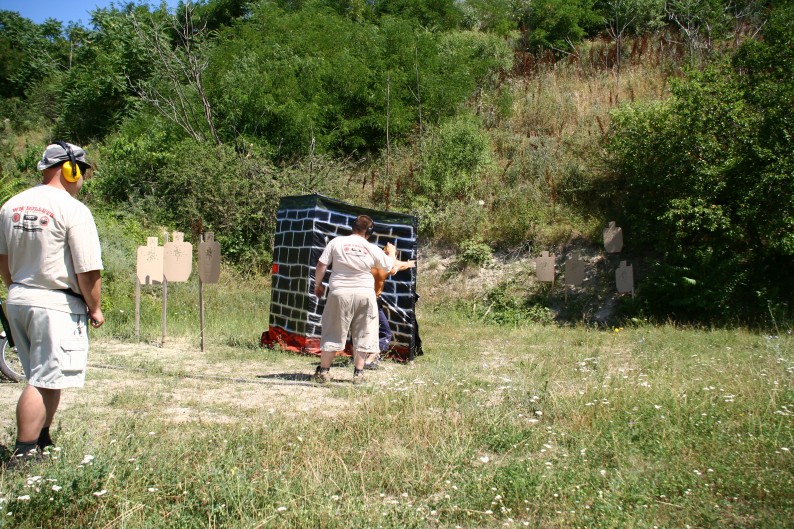
- Club-level IDPA stage — BelSE, CC BY-SA 3.0, via Wikimedia Commons


Further Reading
- IDPA Divisions Explained 2026 — All 8 divisions with rules and recommended pistols
- IDPA 5x5 Classifier Times by Division — The classifier’s own scoring and the second targets for every class
- IDPA vs USPSA Complete Comparison — Side-by-side analysis of both organisations
- IDPA Beginner Pistol Guide — How to choose your first competition pistol
- IDPA Training at Home: 6 Shot-Timer Drills — Timed draw, cover and reload drills between matches
- Competition Magazine Pouch Guide — IDPA-legal pouches and belt setups
- Practical Shooting Beginner’s Guide — Fundamentals of competitive shooting
- Magazine Reload Techniques — Training methods to speed up your reloads
Put a Shot Timer in Your Pocket
Airsoft Shot Timer is a free shot timer app tuned for airsoft and Action Air — it picks up BB gun shots, tracks your split times, and saves you the cost of a $150+ hardware timer for IPSC/IDPA practice.

- IDPA
- IDPA Scoring
- Idpa Scoring Chart
- Idpa Scoring Explained
- How Does Idpa Scoring Work
- IDPA Power Factor
- Idpa Power Factor Chart
- Idpa Minimum Power Factor
- Idpa Power Factor by Division
- Points Down
- IDPA Penalties
- IDPA Procedural
- Procedural Error Idpa
- Flagrant Penalty Idpa
- FTDR
- Hit on Non-Threat
- Unlimited Scoring
- Limited Scoring
- Vickers Count
- Limited Vickers
- IDPA Rules
- IDPA Rules 2026
- Idpa Rules 2026 Changes
- Idpa Rulebook 2026
- Idpa Rule Book
- Idpa Equipment Appendix 2026
- Idpa Chronograph
- Tactical Priority
- IDPA DQ
- Idpa Disqualification
- Idpa Safe Area
- Idpa Range Commands
- Load and Make Ready
- Idpa 180 Rule
- Idpa Mag Pouch Rules
- Idpa Magazine Pouch Rules
- IDPA SSP
- IDPA CCP
- IDPA ESP
- IDPA CDP
- IDPA CO
- IDPA BUG
- IDPA PCC
- IDPA REV
- Defensive Shooting
- Competitive Shooting
- Shot Timer
- IDPA Match
- IDPA First Match
- Idpa 2026 Changes
- Sig P320 Idpa Ban
- Idpa Bug 8+1
- Idpa Concealment Garment