IPSC Action Air Guide 2026: World-Class Practical Shooting with Airsoft
🎯 60-Second Action Air Primer
- What it is: IPSC’s official airsoft division — the same practical-shooting sport with the same Hit Factor scoring, played with GBB pistols. It has its own World Shoot, and Asia is the home field.
- Your score is half time: Hit Factor = points ÷ time. The clock literally decides half your result, which is why serious competitors train with a shot timer from day one.
- The timer is free: You don’t need a US$130–$300 hardware timer to start. The free Airsoft Shot Timer app is tuned to detect the quiet report of GBB and AEG guns and records your draw, splits, and reloads — the exact numbers that move your Hit Factor.
- Start where you are: If you already play airsoft and own a GBB handgun, you can begin training tonight at home and shoot your first match with the gear you already have.
World-Class Competition Without Real Firearms
You’ve probably heard of IPSC—the International Practical Shooting Confederation. What you might not know is that IPSC has an airsoft division called IPSC Action Air, complete with its own World Championship.
In July 2025, the 2nd IPSC Action Air World Shoot was held in Iloilo City, Philippines, drawing over 700 competitors from more than 40 nations. These competitors weren’t using real firearms—they were using Gas Blowback (GBB) airsoft pistols, the same type of guns used in recreational airsoft games.
For players in Taiwan, Hong Kong, Japan, and South Korea, Action Air represents an extraordinary opportunity. In regions where civilian firearm ownership is heavily restricted, competitors can participate in matches governed by the exact same design philosophy as real-steel IPSC, developing genuine practical shooting skills in the process. This is why Asia has become the global center of Action Air—it fills a need that no other shooting discipline can.
A Sport Born in Asia
Action Air’s history stretches further back than most people realize. Throughout the 1990s, players in Taiwan, Hong Kong, and Japan were already holding informal GBB competitions modeled after IPSC. There were no official rules back then—each local community set its own standards—but the core concept was consistent: use airsoft guns to simulate real practical shooting competition.
IPSC officially adopted Action Air in 2008 and released its first rule book in 2009. The formalization brought something invaluable: standardized rules. Today, a match in Taiwan operates under the exact same rules as a match in Australia or the UK. Scores and classifications earned in one country are recognized worldwide.
The first Action Air World Shoot took place in 2018 at Hong Kong’s KITEC Exhibition Centre—a fitting tribute to Asia’s pioneering role in the sport. The 2025 World Shoot in the Philippines continued this tradition, with Asian competitors playing a dominant role in the results.
How Action Air Compares to Real-Steel IPSC
The good news for anyone already familiar with IPSC: there’s almost nothing new to learn conceptually. The scoring system, target designs, course design philosophy, and safety rules in Action Air are nearly identical to real-steel IPSC.
Scoring uses the same Hit Factor system: total points earned divided by time. Zone scoring follows the same breakdown—Alpha (5 points), Charlie (3 points), Delta (1 point), Miss (-10 points), No-Shoot penalty (-10 points). If you’ve been training for real-steel IPSC, switching to Action Air for practice requires essentially zero adjustment. And if you build your competitive foundation in Action Air, that tactical thinking and match experience transfers directly when you eventually shoot live ammunition.
It’s worth sitting with what that scoring formula really means. Because time sits in the denominator, two shooters who put identical hits on identical targets are separated entirely by the clock—shave half a second off a stage and your Hit Factor climbs even though every hole in the cardboard is in the same place. That’s the whole reason draw speed, splits, and reload time matter so much in this sport, and it’s also why you can’t improve what you don’t measure. A shot timer isn’t a nice-to-have accessory in Action Air; it’s the instrument that tells you whether last week’s practice actually made you faster.
The main practical difference is ballistics. BB pellets are significantly affected by air resistance and the Hop-Up system’s backspin lift, causing trajectory drift beyond about 20 meters. Action Air course designers account for this, and you’ll rarely encounter the 40-50 meter steel plate challenges that appear in real-steel IPSC matches.
The other notable difference is recoil. GBB blowback force is roughly one-tenth that of a real 9mm handgun, so recoil management cannot be trained in Action Air—that’s a gap you’d need to address with real firearm practice.
The Three Divisions: Which One Is Right for You?
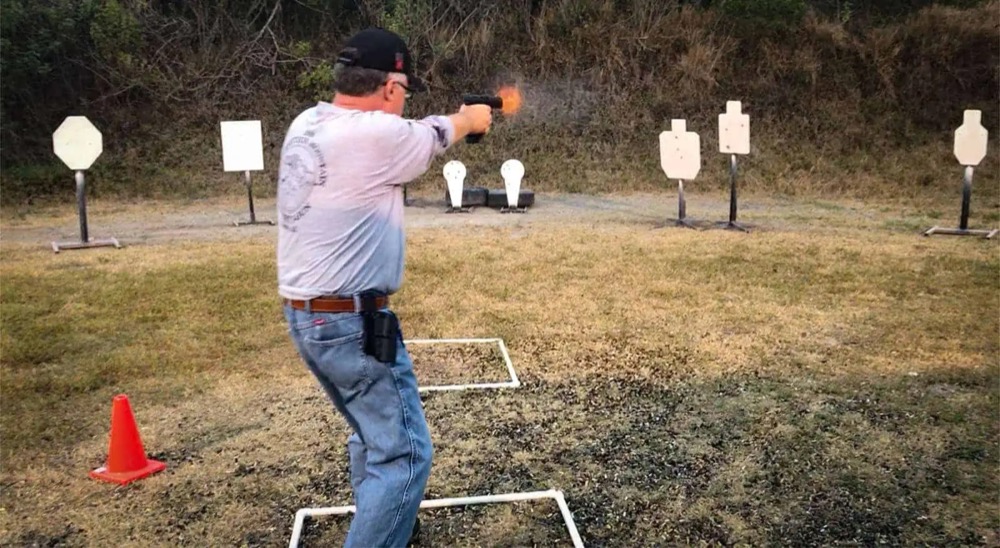
IPSC Action Air Handgun competition is divided into three main divisions, each with very different equipment constraints.
Open Division has the fewest restrictions. Compensators and optical sights (red dot) are permitted, magazines can extend up to 170mm and hold up to 28 rounds. This is where equipment investment directly translates to competitive advantage—top competitors run fully upgraded Hi-CAPA race guns with compensators and wide-field red dot optics. It looks and feels like a miniaturized race gun from a real-steel Open class.
Standard Division is Action Air’s equivalent of Production Division. Handguns must be airsoft replicas of real firearms that appear on the IPSC Production Division List, barrel length may not exceed 127mm, and magazines are limited to 15 rounds (up to 18 rounds at the start signal). In practical terms, this means you need a pistol that closely resembles its real-steel counterpart—no compensators, no optics. Glock, SIG P226, CZ P-10C, and S&W M&P airsoft replicas are popular choices here.
Modified Division (also called Classic Division) is the home of 1911-pattern pistols. The handgun must be 1911-profile, must fit within the IPSC box (225mm × 150mm × 45mm), and magazine capacity is capped at 10 rounds. This division suits players who love the classic 1911 feel. Tokyo Marui’s MEU and Government 1911 variants are frequent competitors here.
Equipment: Starting From the Right Foundation
Once you’ve chosen your division, the next question is which gun to buy.
For Open Division, the Tokyo Marui Hi-CAPA 5.1 is the starting point for virtually every serious competitor. The Hi-CAPA 5.1 Gold Match delivers solid competitive performance out of the box, and its aftermarket parts ecosystem is the largest in the airsoft world—you can upgrade gradually as your skills and budget grow. A full Open Division competition build typically includes a metal slide, short-stroke kit, upgraded trigger group, extended magazine base pads, a compensator, and a small red dot optic.
For Standard Division, choose based on the IPSC Production Division List. The Tokyo Marui Glock 17 Gen 5 MOS and Glock 34 (the longer Production-spec barrel version) are extremely popular. SIG P226 GBB variants have a stable following, and CZ P-10C GBB versions are available in some markets. The advantage of Standard Division is that equipment cost is relatively modest—the competition is about technique, not hardware investment.
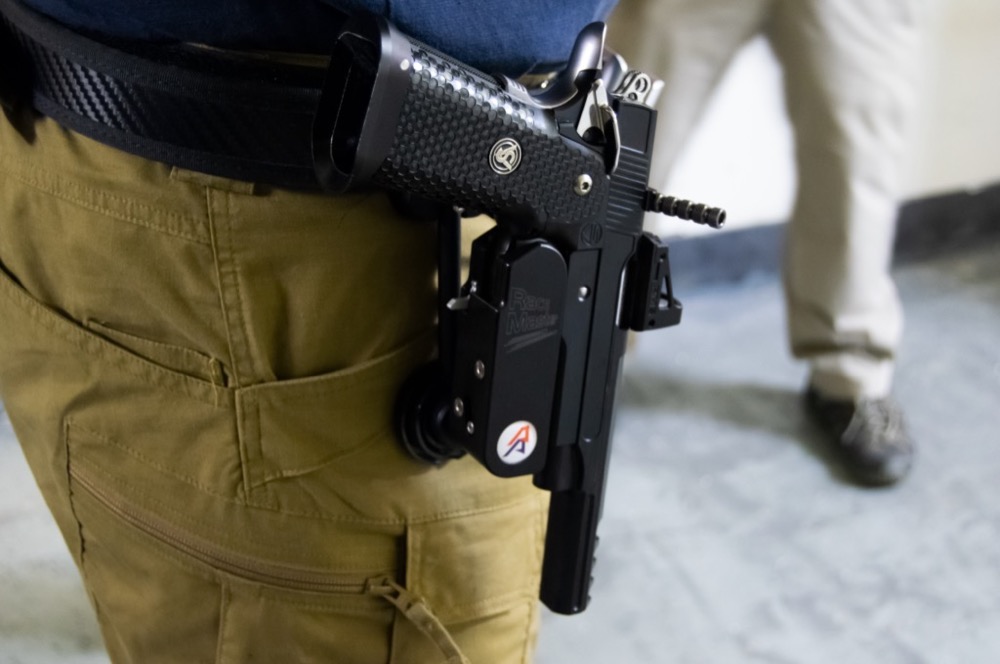
A competition-grade holster is a critical investment regardless of division. Open Division competitors typically use Safariland or DAA Race Holsters on a competition belt platform for maximum draw speed. Standard Division has more relaxed holster requirements, but you still need a rigid retention holster rather than a soft nylon or Velcro design.
Finding Action Air Competition in Asia
Asia has the most active Action Air scene in the world. Taiwan, Hong Kong, Japan, South Korea, and the Philippines all have IPSC-affiliated regional associations that regularly hold sanctioned Action Air matches.
In Taiwan, the IPSC Taiwan region operates under IPSC Asia-Pacific, with clubs in major cities organizing Level I and Level II matches throughout the year. The Hong Kong China Practical Shooting Association (HKCPSA) runs one of Asia’s most established Action Air programs, regularly hosting matches at indoor venues. If you’re based in these regions, you’re already in the global epicenter of the sport.
The most direct way to find matches is through local airsoft communities—Facebook groups, LINE groups, or simply asking at your regular airsoft field. Many airsoft facilities have formal ties to IPSC clubs or host Action Air events themselves. For your first match, attending as an observer is highly recommended. You’ll quickly discover that the Action Air community is remarkably welcoming to newcomers, with experienced shooters genuinely happy to help beginners understand the rules and stage procedures.
Using a Shot Timer to Prepare for Your First Match
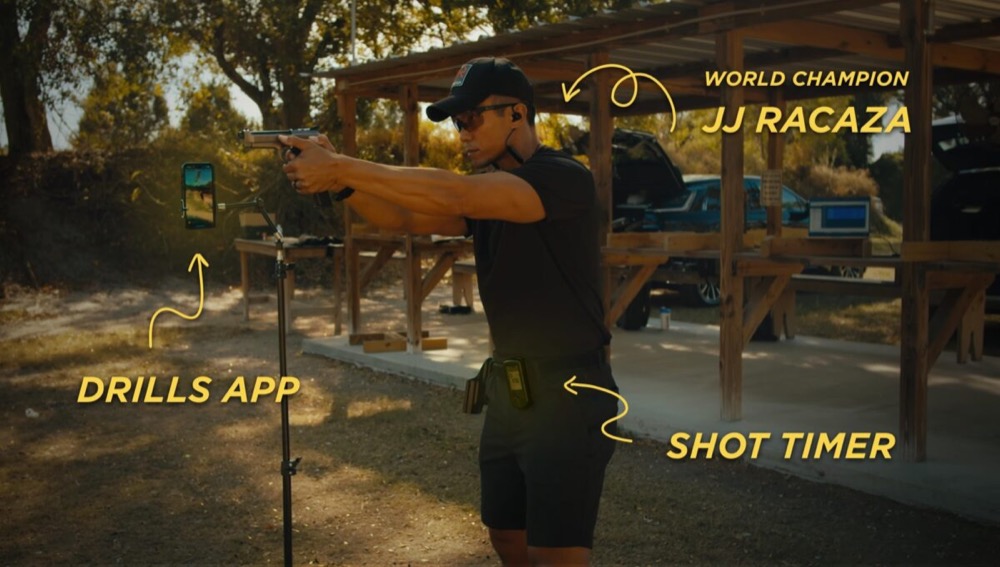
The defining difference between competitive and recreational shooting is time pressure. A technically perfect draw stroke is worthless if you can’t reproduce it under the clock. This is why training with a Shot Timer from the very beginning is essential for anyone seriously preparing for Action Air competition.
Here’s where most newcomers hesitate: do you really need to spend US$130–$300 on a dedicated timer to get started? For Action Air, the honest answer is no. Hardware timers like the PACT, CED7000, and SG Timer are built around the sharp acoustic crack of live gunfire, and the recurring complaint from airsoft shooters—you’ll find it all over the r/airsoft and competition-shooting forums—is that those timers struggle to register the soft pfft of a GBB or the muffled piston slap of an AEG. A purpose-built free shot timer app is the answer to exactly that problem: its shot detection is tuned for the low-decibel report of airsoft guns, so it picks up your shots cleanly while still giving you random start delay, par times, and split recording. If you later want to compare paid hardware for live fire, our 2026 best shot timer guide breaks the options down—but for an Action Air shooter, the phone already in your pocket is genuinely the best place to begin.
The foundational drill is the draw-to-first-shot. Set your Shot Timer to random delay (2-5 seconds works well), and practice from the audible beep through the complete sequence: draw, present, and fire. Standard Division competitors aim for 1.5 seconds; elite Open Division shooters can achieve under 0.8 seconds. Don’t chase speed initially—focus on building correct movement patterns. Bad habits embedded at low speed become much harder to break as you try to accelerate.
Magazine changes are another decisive factor. A typical Action Air match requires 3-5 magazine changes per stage; being consistently half a second slower than your competitors compounds to 1.5-2.5 seconds of total deficit. Use your Shot Timer to record your reload time—from the moment the slide locks back (empty magazine) to the next fired shot. Be aware that GBB magazines are significantly lighter than loaded ones during practice; when you’re competing with BB-filled magazines, adapt your grab and insertion timing accordingly.
The most effective comprehensive drill is El Presidente: three targets, two shots each, magazine change, two more shots each. This single exercise tests your draw speed, target transition, accuracy, and magazine change technique simultaneously. Competitive targets are 8-10 seconds with all Alpha hits. Beginners typically need 15-20 seconds, which is completely normal—what matters is that every session is recorded so you can see your genuine improvement over time.
The best part is that you don’t need a range for most of this. With an empty GBB pistol—or one running green gas at a safe backstop—and the timer app propped on a stand, you can drill draws, reloads, and target transitions in your living room. It’s the same dry-fire approach competitive shooters everywhere rely on, except your airsoft gun actually cycles and gives you a realistic trigger reset. For a full menu of structured drills with par times to work through, see our how to pick a pistol drill; pair any of them with the timer and you’ve got a complete at-home Action Air practice session.
The Action Air Mindset: Competitor, Not Soldier
The biggest mental adjustment for players transitioning from tactical airsoft to Action Air is understanding what’s being optimized. Tactical airsoft prioritizes concealment, cover, and team coordination. Action Air prioritizes speed, precision, and efficiency. You won’t be crawling or hiding—you’ll be moving through a stage along the most time-efficient path, engaging every target from every required position as quickly and accurately as possible.
Safety rules remain the highest priority. Action Air uses GBB airsoft guns, and while these are inherently less dangerous than real firearms, every real-steel IPSC safety rule applies in full. The 180-degree rule, muzzle direction control, and trigger finger discipline are not merely match regulations—they’re the foundation that makes Action Air safe to conduct in populated environments. Safety violations receive the same DQ (disqualification) that they would in a real-steel IPSC match.
Eye protection is mandatory for everyone inside the competition area—competitors, scorekeepers, and Range Officers alike. ANSI Z87.1-rated shooting glasses are the standard. This isn’t ceremonial: BB pellets do ricochet from steel targets at unpredictable angles, and eye injuries from unprotected ricochets have occurred at Action Air events.
Frequently Asked Questions
Q: Do I need IPSC membership to compete in Action Air?
Level I matches (club-level) typically don’t require formal IPSC membership. However, Level II and above competitions (regional matches and higher) usually require membership through your local affiliated association. In Taiwan and Hong Kong, the membership process is straightforward and inexpensive.
Q: Can I use my existing airsoft pistol?
It depends on the gun and your chosen division. Standard Division requires your pistol model to appear on the IPSC Production Division List, and no optics or compensators are permitted. If you own a Tokyo Marui Glock 17/34, CZ P-10C, or similar approved model, you can typically compete immediately. Open Division has minimal restrictions, so most GBB handguns qualify. Always verify the specific equipment inspection rules with the match organizer before registering.
Q: Are there BB weight restrictions?
IPSC Action Air rules specify 6mm diameter projectiles weighing between 0.12g and 0.43g. In competitive settings, most players use 0.20g for Standard and Open close-range shooting, or 0.25g when improved trajectory stability is needed. High-quality, consistently-weighted BBs are strongly recommended—inconsistent pellet weight directly affects accuracy and your ability to reliably hit the Alpha zone.
Q: Is Action Air held at the same venues as regular airsoft games?
Not necessarily, though many clubs combine both activities. Action Air competition requires IPSC paper targets and steel plates, which differ from typical wargame field setups. Many cities have dedicated Action Air shooting facilities with permanent target infrastructure. Contact your local IPSC-affiliated club to find the nearest venue.
Q: What’s the best shot timer for Action Air or airsoft?
For airsoft specifically, the best shot timer is a free app built for the job. Dedicated hardware timers are designed around the loud report of live rounds and frequently miss the quiet pfft of a GBB or AEG. The Airsoft Shot Timer app is tuned to detect those low-decibel shots and gives you random delay, par times, and split recording at no cost—everything you need to train draw and reload speed for Action Air. If you also shoot live fire and want to compare paid hardware, our best shot timer guide covers the PACT, CED7000, and SG Timer options.
Q: Do I need to buy an expensive shot timer to start competing?
No. The single most useful piece of “equipment” for a new Action Air shooter costs nothing—a free shot timer app on the phone you already carry. Put your budget toward a reliable GBB pistol, a rigid competition holster, and quality BBs first. A hardware timer (US$130 and up) is a pleasant upgrade once you’re shooting regularly, but it’s never a prerequisite to get on the clock.
Q: Can I practice Action Air at home without going to a range?
Yes, and most serious competitors do exactly that. Draw strokes, reloads, and target transitions are largely dry-fire skills—you can rehearse them at home with an empty or gas-cycling GBB pistol and a shot timer app measuring every rep. It’s the same method shooters use to prepare for USPSA and IDPA classifiers, where the clock decides your class. Just confirm a safe backstop and keep the same muzzle and trigger-finger discipline you’d use at a match.
Conclusion: Asia’s Home Field Advantage
For players in Taiwan, Hong Kong, and across Asia, IPSC Action Air isn’t just an alternative to real-steel competition—it’s a legitimate world-class sport in its own right. You can compete against shooters from 40 countries under internationally recognized rules, using equipment you already own or can easily acquire.
The technical skills you build in Action Air translate directly to real firearms: draw speed, reload efficiency, target transition sight alignment, and the psychological composure to perform under timed pressure. Competitors who have trained seriously in Action Air consistently outperform inexperienced shooters when they eventually get time on the real steel.
If you’re already playing airsoft and own a GBB handgun, Action Air is your most natural competitive path forward. The first step is simple: find your nearest IPSC club and watch a match. You’ll likely be surprised by how welcoming the community is—and by how much your existing skills already translate.
💡 Train for Action Air (Shot Timer Cluster):
- Best Airsoft Shot Timer App — Free IPSC & IDPA Timer — The free timer tuned to detect quiet GBB & AEG shots
- Best Shot Timer 2026 Guide — Free app vs. PACT, CED7000 and SG hardware compared
- pistol drills by skill and par time — Structured drills with par times for at-home practice
- USPSA Classifier Guide 2026 — How classification works when the clock is your score
💡 Gear & Skills:
- Tokyo Marui Hi-CAPA 5.1 Gold Match Complete Guide — The most popular Open Division platform
- Tokyo Marui Glock 17/19 Gen 5 MOS GBB Complete Guide — Popular Standard Division choice
- IPSC Training Complete Guide — Master IPSC rules and training methodology
- Pistol Draw Stroke Complete Guide — Build a faster, more reliable draw
- Airsoft & Firearms Cross-Training Guide — How GBB training transfers to real firearms
Put a Shot Timer in Your Pocket
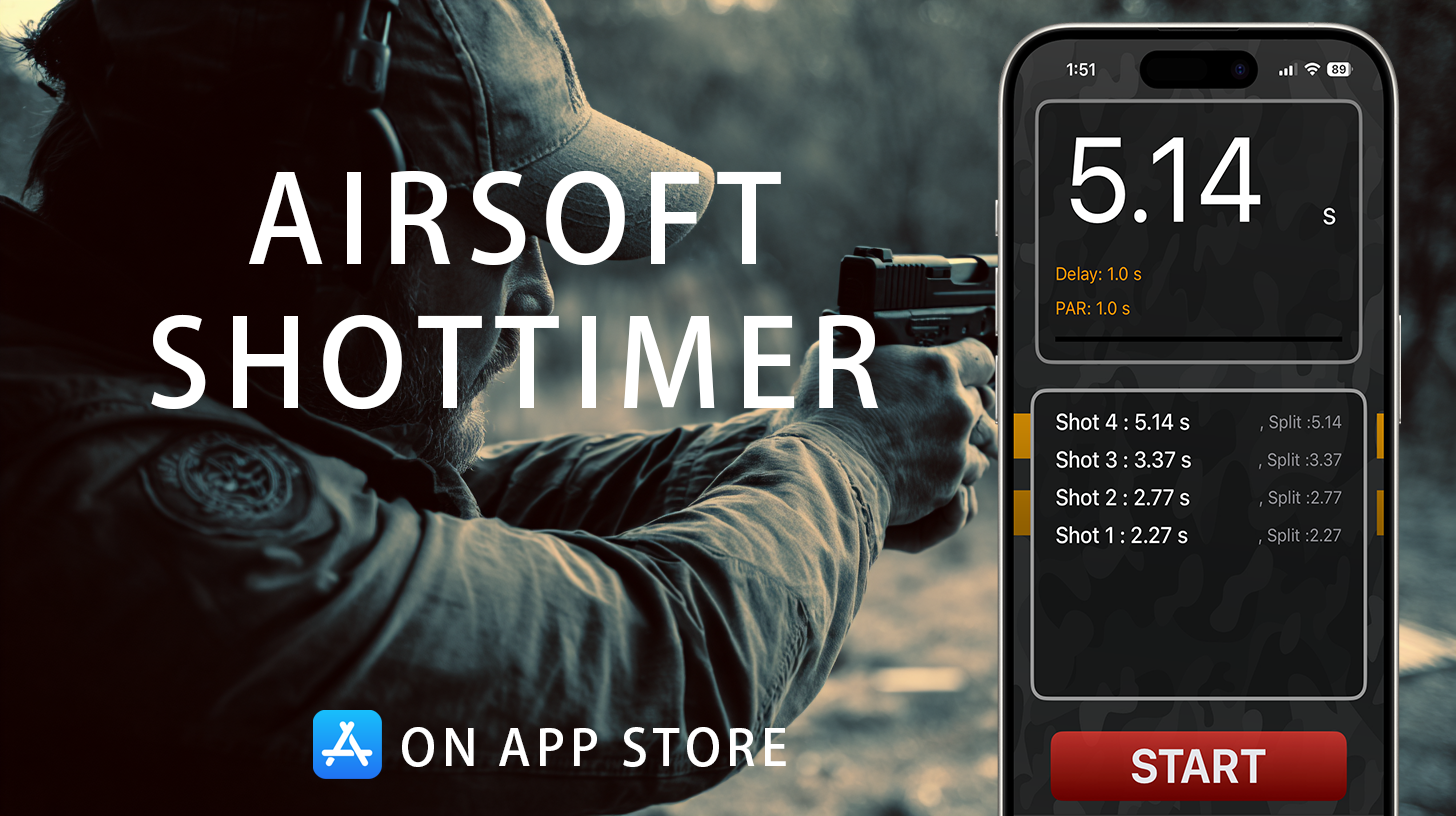
Airsoft Shot Timer is a free shot timer app tuned for airsoft and Action Air — it picks up BB gun shots, tracks your split times, and saves you the cost of a $150+ hardware timer for IPSC/IDPA practice.

- IPSC
- Action Air
- Airsoft IPSC
- GBB
- Competitive Shooting
- Hi-CAPA
- Airsoft
- Shot Timer
- Open Division
- Standard Division
- Free Shot Timer App
- Draw Speed
- Dry Fire Training