Below you will find pages that utilize the taxonomy term “Blake Drill Par Time”
Posts
read more
Blake Drill Guide: Setup, Par Times by Level & How to Fix Slow Transitions
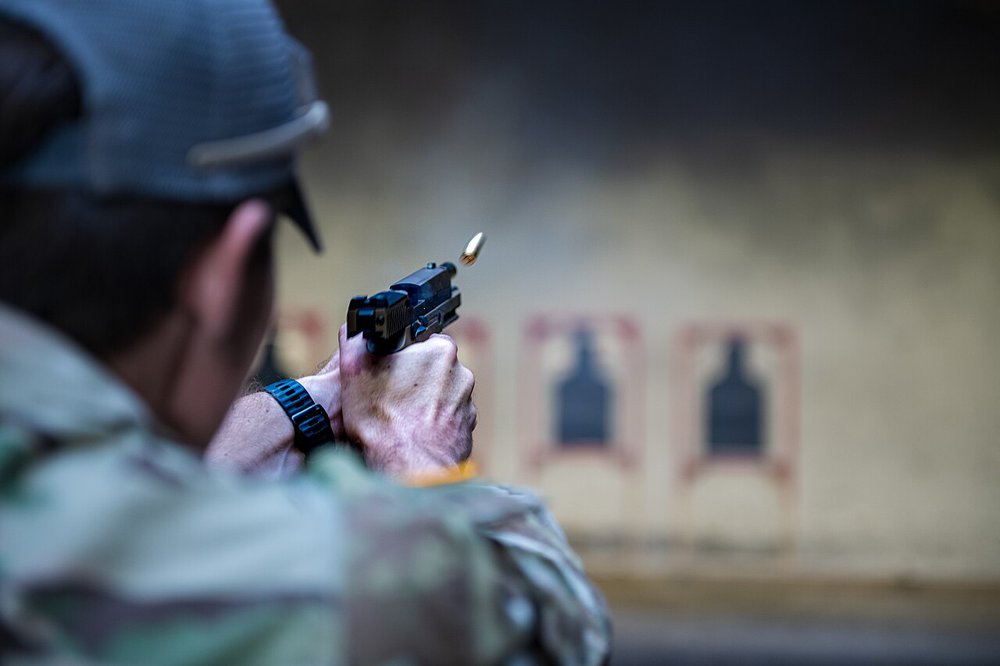
The Blake Drill in 60 seconds (BLUF)
- The course of fire: Three targets side by side, one yard apart, at seven yards. On the beep, draw and fire two rounds on each target — six rounds total. Left-to-right or right-to-left, your choice.
- The goal: 2.0 seconds with all hits in the A-zone. That is the same number as the Bill Drill, which is the whole point: the only thing that changed is that you now have to move the gun twice.
- What it really measures: Six shots means one draw, three same-target splits, and two transitions. The two transitions are the only part that is different from a Bill Drill.
- The test nobody tells you about: Shoot a Bill Drill and a Blake Drill back to back. Blake time minus Bill time, divided by two, is how much slower each transition is than a normal split. That one subtraction tells you whether to train transitions or something else.
- Realistic par times: Around 4 seconds for a new shooter, 3 seconds for a solid club shooter, 2.5 for a strong competitor, 2.0 for the people the drill was named after.
- Train it anywhere: It dry-fires and runs on an airsoft pistol unusually well, because a transition is mostly an eye skill, not a recoil skill. A free Airsoft Shot Timer app gives you the beep, the par buzzer, and every split.
Almost every shooter who has spent a season with a timer can tell you their Bill Drill time. Ask the same people for their Blake Drill time and you usually get a pause, then something like “I don’t really shoot that one.” That gap is the reason this drill exists. You can get very fast at putting six rounds into one box and still lose a surprising amount of time on a match stage, because real stages almost never give you one box. They give you three targets in an array, and the clock keeps running while your gun travels between them.