Marine Corps Pistol Qualification (CPP): Course & Scores
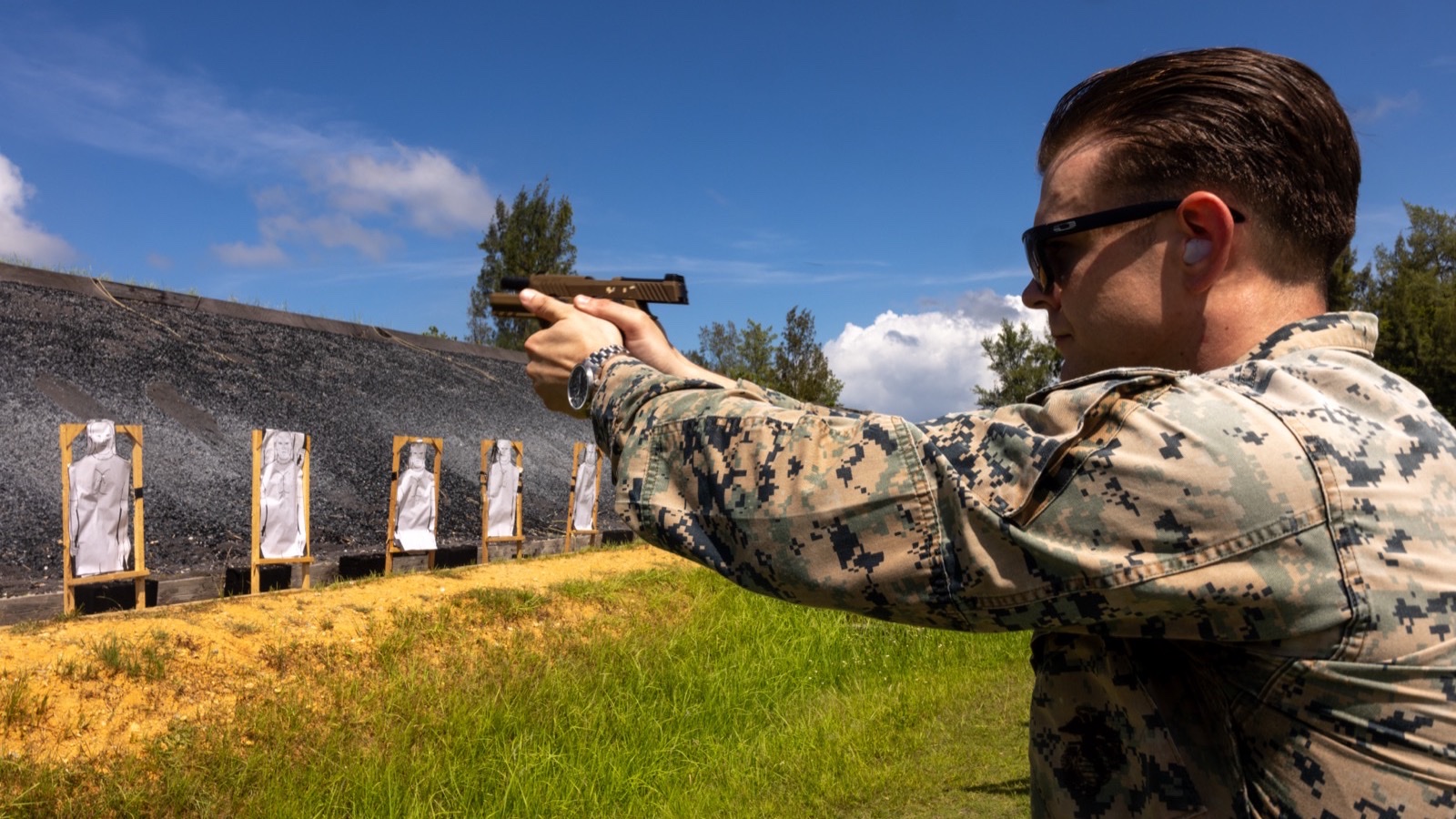
The Marine Corps pistol qualification in 60 seconds (BLUF)
- The course: The current USMC pistol qual is the Combat Pistol Program (CPP), Table One, Training Block 5, set by MCO 3574.2M (6 April 2022). It is 40 rounds, all standing, at 7, 15 and 25 yards: 16 rounds at 7, 16 at 15, and 8 at 25.
- The clock: Every 7- and 15-yard string starts from the holster: controlled pairs in 5 seconds (7 yd) and 6 seconds (15 yd), failure-to-stop drills in 7 seconds, and speed reloads in 9 and 12 seconds. At 25 yards you get 7 seconds per shot, from tactical carry.
- Scores: Hits score 10, 8, 6 or 4 points by zone on the MPMS-1 target, for 400 possible. 264 qualifies (Marksman), 324 is Sharpshooter, 364 is Expert.
- The trap: “Hits” are not enough. Forty hits in the C zone is 240 points, and that is Unqualified. Forty hits in the B zone is 320, still four points short of Sharpshooter.
- Train it anywhere: Every string is a par time. A free shot timer app with par beeps and a random start delay lets you rehearse the whole course in dry fire or with an airsoft M18.
If you searched “marine corps pistol qualification” or “USMC pistol qual,” here’s the short answer. Today’s Marines qualify on the Combat Pistol Program, a 40-round course shot from the holster at 7, 15 and 25 yards and scored in points, not hits. You need 264 of 400 to pass and 364 for Expert. It’s a different test from the Army’s pop-up course and from the old Marine bullseye course you’ll still find described in forum threads, and the old numbers (330 for Expert, 25-yard slow fire for ten minutes) no longer apply.
The rest of this guide covers every string straight from the order, what the scoring really demands, the one rule on the failure-to-stop drill that quietly costs people ten points, and a practice plan that works with dry fire or an airsoft pistol.
What Is the Marine Corps Pistol Qualification?
The Marine Corps pistol qualification is CPP Table One, the annual pistol standard in the Marine Corps Combat Marksmanship Program. The governing document is MCO 3574.2M, Marine Corps Combat Marksmanship Programs, dated 6 April 2022; the pistol rules are in Enclosure (2) and the course of fire is in Appendix K. As of the March 2026 marksmanship MARADMINs, 3574.2M is still the order they cite. There’s no 3574.2N yet.
The Combat Pistol Program was developed around 2012 and replaced the older Annual Pistol Training course through 2013 and 2014. The Marine Corps’ own 2018 article on the program points out that the old course was shot on an NRA 50-yard bullseye target. The CPP was built around a defensive shooting problem instead. The order itself doesn’t name a model and just says “service pistol.” In practice that’s now the M18, which the Marine Corps began fielding in September 2020 to replace the M9, M9A1, M45A1 and M007. Two recent updates matter if you’re preparing in 2026. MARADMIN 095/26 (March 2026) authorizes a unit-funded M17 Romeo red dot for CPP qualification, and it lets Marines in units issued Glock pistols (MARSOC, for example) qualify with them.
The range is a known-distance range from 7 to 25 yards with stationary targets, and turning target systems are recommended. The target is the MPMS-1, with new target faces required for evaluation. Every round is fired from an unsupported standing position: no kneeling, no barricade, no prone. Coaches may talk to you between stages, but during evaluation firing all coaching is prohibited.
The full Table One is five training blocks. Blocks 1 to 3 are coached practice, Block 4 is the pre-evaluation, and Block 5 is the evaluation. Blocks 4 and 5 use the same course of fire, and only Block 5 sets your classification. That means your pre-evaluation is a full-dress rehearsal of the real course, shot the same day.
The Course of Fire, String by String
Here is CPP Table One, Training Block 5 (Evaluation), as published in MCO 3574.2M Appendix K. Every iteration is fired at a single MPMS-1 target.
| Distance | String | Rounds per string | Strings | Rounds | Time limit | Start |
|---|---|---|---|---|---|---|
| 7 yd | Controlled pair | 2 | 3 | 6 | 5 s | Holster |
| 7 yd | Failure to stop (2 body + 1 head) | 3 | 2 | 6 | 7 s | Holster |
| 7 yd | Speed reload (2, reload, 2) | 4 | 1 | 4 | 9 s | Holster |
| 15 yd | Controlled pair (tactical reload after the 3rd) | 2 | 6 | 12 | 6 s | Holster |
| 15 yd | Speed reload (2, reload, 2) | 4 | 1 | 4 | 12 s | Holster |
| 25 yd | Slow fire (threat assessment) | 1 | 8 | 8 | 7 s | Tactical carry |
Add up the time limits and you get 142 seconds of shooting for 40 rounds, an average of 3.55 seconds per round. That average hides a big spread. The 7-yard stage is the fastest at 2.4 seconds per round (38 seconds for 16 rounds), and that includes two draws per string. The 15-yard stage is 3.0 seconds per round. The 25-yard stage gives you 7 seconds for each single shot, which is generous until you remember you’re standing, unsupported, at 25 yards.
The fill plan in the order is built so the gun runs dry in the middle of each speed-reload string. At 7 yards you load 14 rounds in the pistol and 9 in the pouch. Three controlled pairs and two failure-to-stop drills use 12, which leaves exactly 2 for the speed reload: two shots, slide lock, fresh magazine, two more. At 15 yards you start with 7 in the gun, fire three pairs, and then do a tactical reload on your own time with a 7-round magazine before the next three pairs. That leaves 2 rounds in the gun for the 15-yard speed reload, which is set up the same way. Whatever is left after that string (8 rounds) carries the 25-yard stage. If you’re used to topping off whenever you like, this matters. On the evaluation the reloads happen where the order puts them.
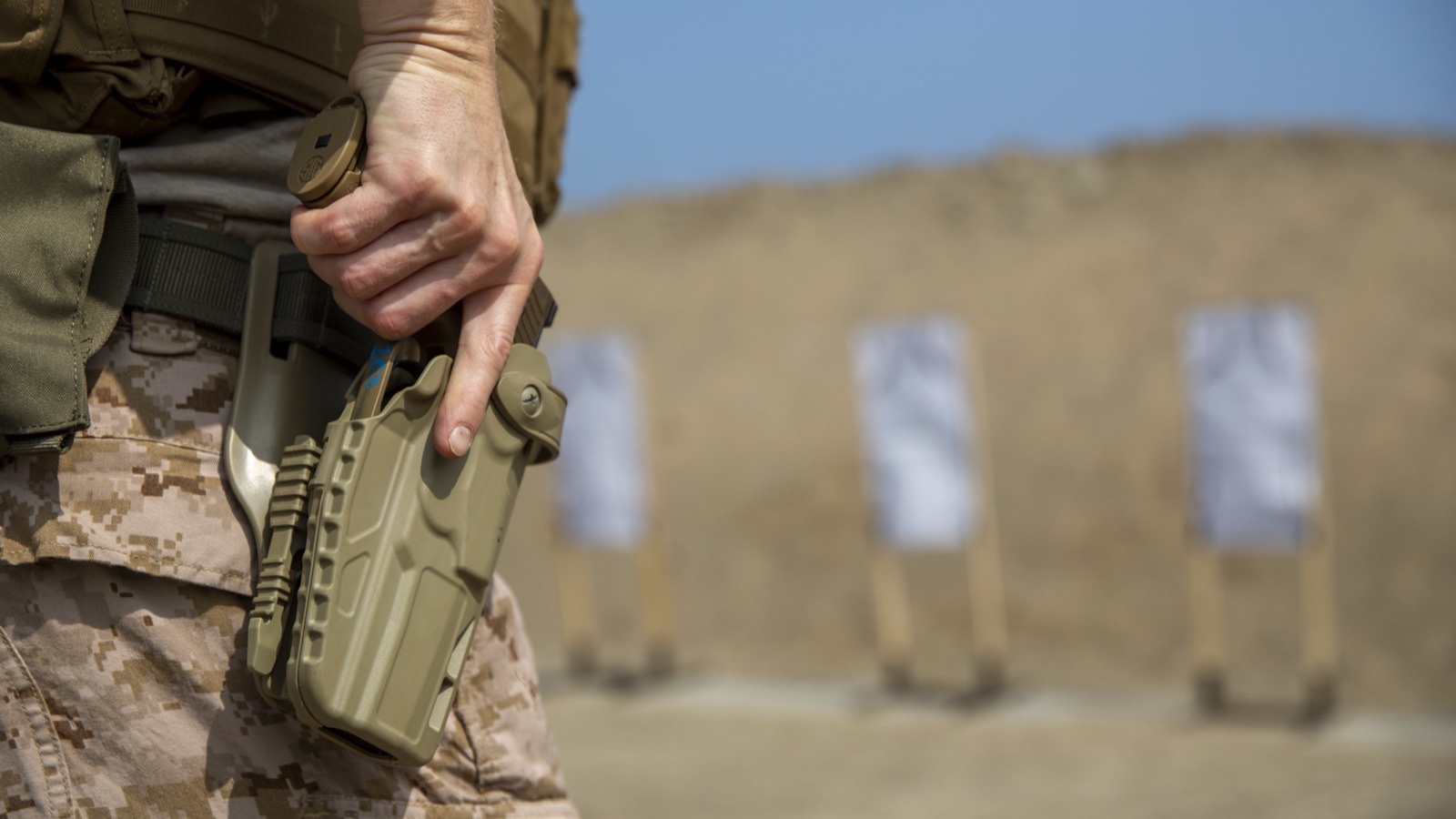
There is no stoppage drill written into the course, and that doesn’t make you safe from one. You’re expected to keep the pistol in Condition 1 throughout and clear any malfunction yourself. A failure to feed in the middle of a 5-second pair simply eats your time. A shot you don’t fire is scored as a miss. If your clearance isn’t automatic yet, the pistol malfunction clearance guide breaks tap-rack into steps you can drill.
The Scoring Math: Why Hits Aren’t Enough
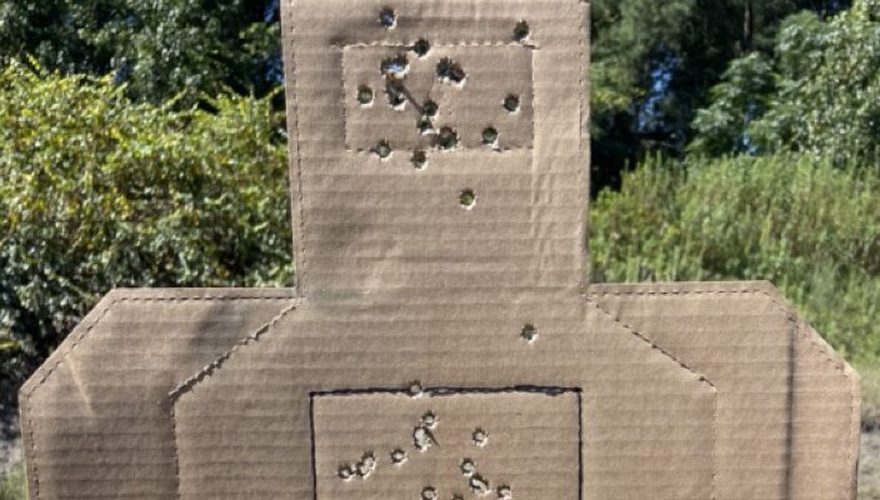
Every shot is scored by where it lands on the MPMS-1 target: A zone 10 points, B zone 8, C zone 6, D zone 4. A shot outside the D zone, off the target, or not fired at all is a miss and scores zero. Forty rounds at 10 points is 400 possible, and the classification bands from MCO 3574.2M are:
- Expert: 364 to 400, so you can give away 36 points
- Sharpshooter: 324 to 363, so you can give away 76 points
- Marksman: 264 to 323, so you can give away 136 points
- Unqualified: 0 to 263
Now turn those into shots. A B-zone hit costs you 2 points, a C-zone hit costs 4, a D-zone hit costs 6, and a miss costs 10. Divide the badge scores by 40 and you get the average you need per shot: 9.1 for Expert, 8.1 for Sharpshooter, 6.6 for Marksman.
This is where the CPP differs from a hits-based course like the Army’s. Look at three shooters who hit the paper with every single round:
- Every round in the C zone: 40 × 6 = 240. Unqualified.
- Every round in the B zone: 40 × 8 = 320. Marksman, four points short of Sharpshooter.
- 22 rounds in the A zone and 18 in the B zone: 220 + 144 = 364. Expert, with nothing to spare.
So the CPP isn’t asking whether you can hit a man-sized target on a clock. It’s asking whether you can keep most of your hits in the A and B zones on a clock. Expert also tolerates very few true misses: three misses (30 points) plus three B-zone hits (6 points) and you’re already at exactly 364.
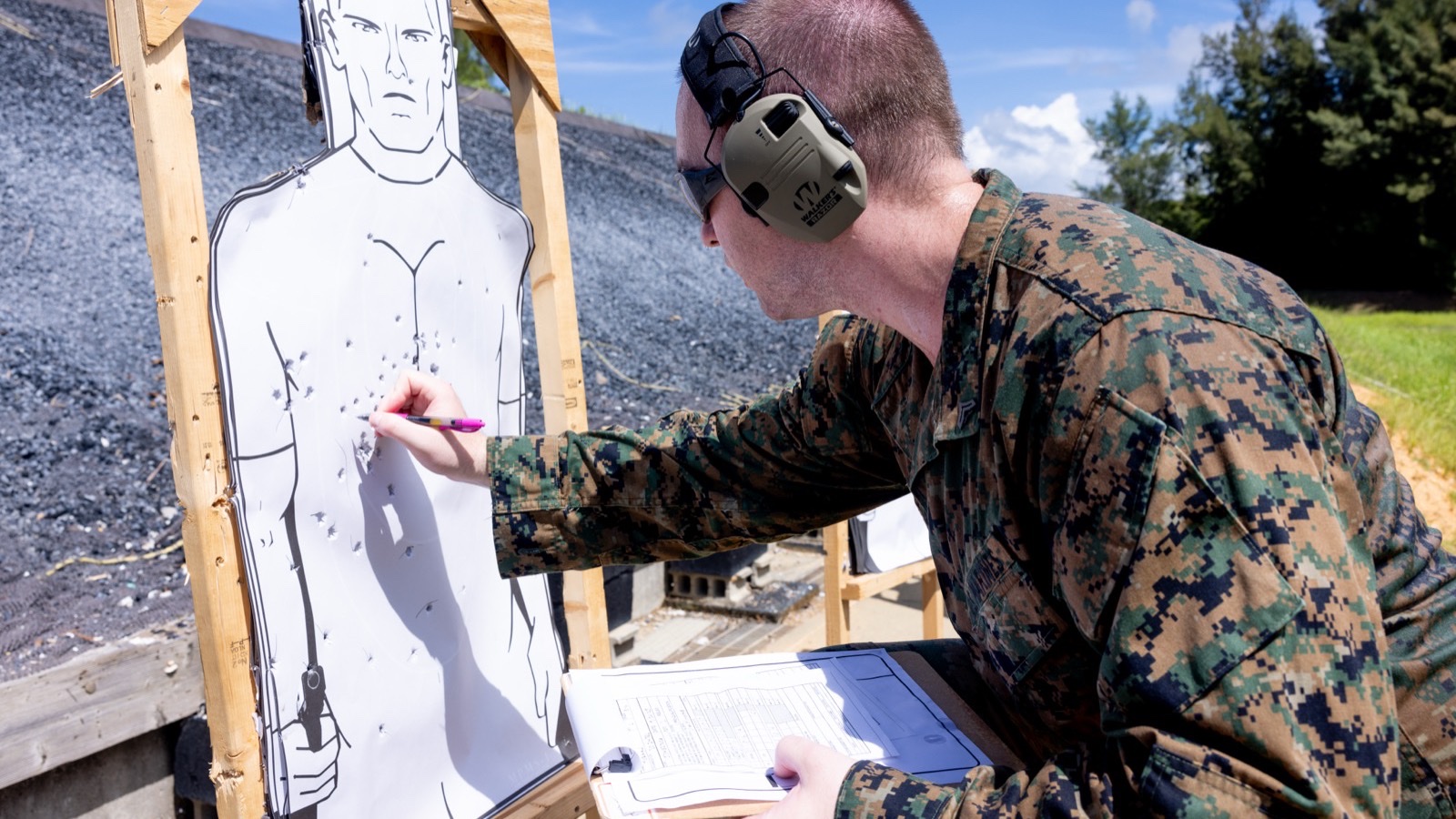
The points are also unevenly spread across the distances: 160 at 7 yards, 160 at 15, and 80 at 25. If you clean the 7- and 15-yard stages you can drop 36 points at 25 yards and still make Expert, which works out to averaging 5.5 points per shot out there (roughly every round in the C zone or better). That rarely happens, though. In practice most shooters bleed points at 15 yards, where pairs from the holster in 6 seconds are fast enough to rush and far enough to punish it.
The Failure-to-Stop Rule That Costs Ten Points
The two failure-to-stop drills at 7 yards are scored differently from everything else, and it’s worth reading the rule closely. Each drill is two shots to the body and one to the head, in 7 seconds from the holster. The scorer looks at the target for all six shots from both drills together and applies two caps:
- At most two shots in the head count at full value. Any other shot in the head, wherever it lands, counts as 4.
- At most four shots below the jaw line count. If more than four are below the jaw line, you get the four highest values, and the rest are scored as misses.
So the drill has a built-in penalty for skipping the head shot. If you put a third round into the chest because the head looked hard, your fifth body shot becomes a miss and you’ve lost 10 points. That’s more than a sloppy head shot that lands in the 4-point part of the head (6 points lost). Take the head shot every time, and take it as a separate, deliberate shot. The 7-second limit gives you room for it.
The failure-to-stop is the same idea as the Mozambique drill, two to the body and one to the head, and that guide has a progression for the transition from the chest to the small head box. The difference here is the scoring: in the CPP the head shot isn’t optional.
The 25-Yard Stage: Seven Seconds From Tactical Carry
The last stage is eight single shots at 25 yards, each with a 7-second limit, starting from tactical carry (gun out, muzzle depressed) instead of the holster. The order calls this stage “Slow Fire (Threat Assessment).” It only looks slow next to the old course, where 25-yard slow fire meant 15 rounds in 10 minutes.
Seven seconds for one shot is a lot of time if you use it well. Bring the gun up, settle the sights, and press. Most points here are lost to trigger control, not speed. A target at 25 yards appears 25 ÷ 7 = 3.6 times smaller than at 7 yards, and the same flinch or jerk that still stays in the A zone at 7 yards lands in C or D at 25. If your misses at distance cluster low, read the how to stop flinching guide before you blame the sights. The trigger control guide covers the press itself.
With a red dot now authorized on the M18 for the CPP, this is the stage where the optic helps most. The dot sits on one focal plane, so you’re no longer trading a sharp front sight against a blurry target. If you’re new to a pistol dot, the pistol red dot guide explains why the dot looks like it’s moving more than iron sights did. It’s showing your wobble, not adding to it.
Old vs. New: The Pre-CPP Marine Pistol Course
Forum posts, old range handouts and “how to get Expert” videos often describe the course Marines shot before the CPP. Under MCO 3574.2K (2007), the M9 qualification was also 40 rounds:
- 25 yards: 15 rounds of slow fire in 10 minutes, single action
- 7 yards: 5 strings of 1 round in 3 seconds (quick fire, double action)
- 7 yards: 4 strings of 2 rounds in 4 seconds (quick reaction)
- 15 yards: 2 strings of 3 rounds, reload, 3 rounds in 20 seconds (sustained fire)
The old classifications were Expert 345, Sharpshooter 305, Marksman 245. You’ll also see “330 for Expert” and other cutoffs online. The 2007 order doesn’t support those numbers.
The direction of the change is clear. Under the old course, 15 of 40 rounds (37.5%) were 25-yard slow fire at about 40 seconds a round. Under the CPP only 8 rounds are at 25 yards, every 7- and 15-yard string starts from the holster, and the bar went up: Expert moved from 345 to 364, and Marksman from 245 to 264. It’s a faster, more practical course with less room for error.
Marine vs. Navy vs. Army: Three Different Tests
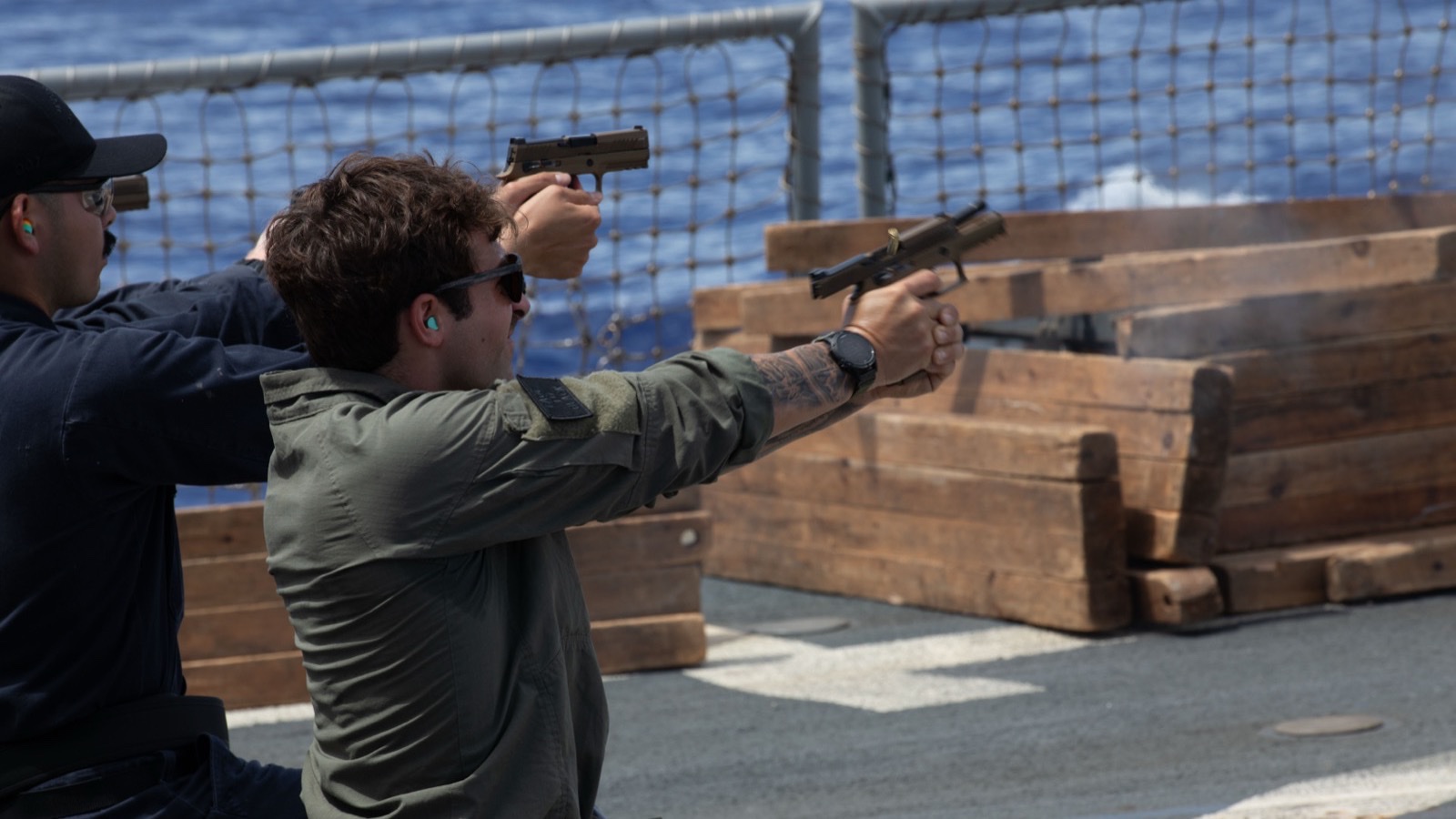
Sailors and soldiers often compare notes, and the three services really do run very different courses. The Navy Handgun Qualification Course comes from OPNAVINST 3591.1G (1 June 2021). It is 48 rounds from the holster at 3, 7 and 15 yards, built for a 15-yard range, with strong-hand and support-hand strings, three reloads and a kneeling string at 15 yards. It’s scored out of 240: Expert 228, Sharpshooter 204, Marksman 180, plus at least 36 hits inside the silhouette.
The time limits run 2 rounds in 4 seconds, 4 rounds in 8, a 2-reload-2 string in 10 seconds, and at 15 yards a 4-reload-4 string and 8 rounds kneeling, each in 20 seconds. That adds up to 108 seconds for 48 rounds, or 2.25 seconds per round, faster than the Marine course but at shorter distances.
Put the three side by side and the differences are clear:
- Marine Corps CPP: 40 rounds, 7 to 25 yards, standing only, points-based. About 3.6 seconds per round. Expert at 91%, qualify at 66%.
- Navy NHQC: 48 rounds, 3 to 15 yards, standing plus one kneeling string, points-based with a minimum-hits rule. 2.25 seconds per round. Expert at 95%, qualify at 75%.
- Army pistol qualification: 30 rounds at pop-up targets from 7 to 31 meters, standing, kneeling and walking, hits-based. About 4.5 seconds per round. Expert at 90%, qualify at 70%.
The Navy course is the closest and fastest, and it has the strictest Expert cutoff. The Army course reaches out farthest and gives the most time per shot, but it counts hits, not zones. The Marine course sits between them on distance and speed, and it’s the only one where a whole qualification’s worth of hits can still fail. For a civilian benchmark, the FBI pistol qualification is faster than all three at 1.26 seconds per round.
How to Train for It With a Shot Timer
Every CPP string is a par time, so you can rehearse the whole course with a shot timer. That covers dry fire at home, live fire, or an airsoft pistol. Practicing with no clock doesn’t build the one skill the course actually tests, which is shooting A-zone hits while a clock is running.
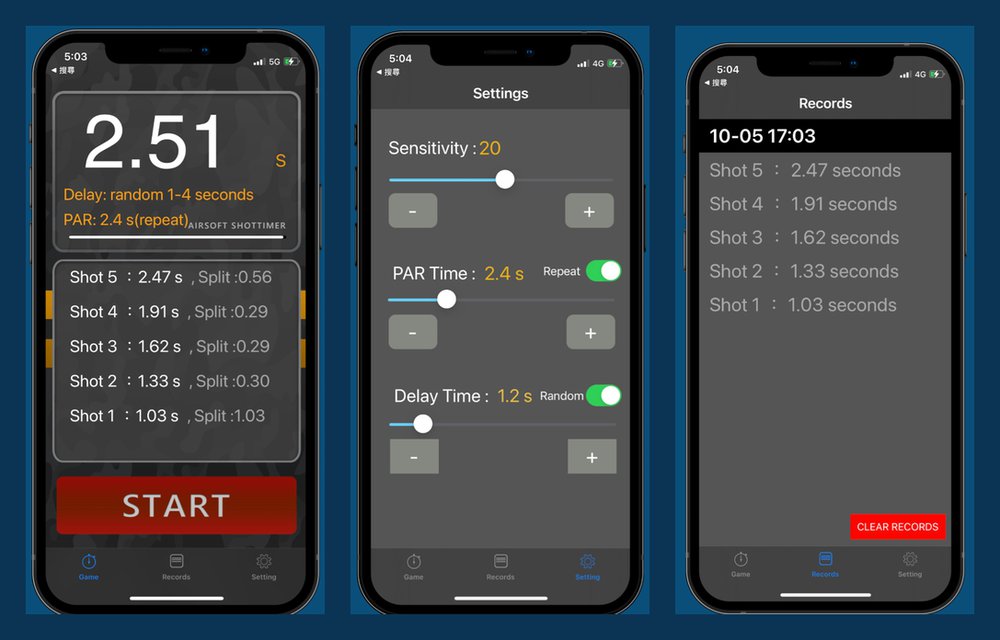
Set the par to the string time. The Airsoft Shot Timer app (iOS and Android) lets you set a par beep at any time after the start beep. Use 5.0 seconds for the 7-yard pairs, 7.0 for the failure-to-stop and the 25-yard singles, 9.0 for the 7-yard reload, 6.0 for the 15-yard pairs, and 12.0 for the 15-yard reload. Your last shot has to break before the par beep.
Turn on the random start delay. On the real range the signal to fire (a turning target or a command) doesn’t come on a rhythm you can predict. Set the app’s start delay to random so you can’t anticipate the beep. This is the cheapest way to make home practice feel like the line.
Read your splits, not just your total. The app records the time of every shot. On a 15-yard pair, a 1.6-second draw-to-first-shot with a 0.35-second split leaves you four seconds of slack, which means you can afford to slow the first shot down and buy A-zone hits. If you’re finishing in 2 seconds and scoring B and C, you’re rushing a string that has time in it.
Train a step tighter than the test. Once you’re making the real times with good hits, shave about a second off each par: 4.0 for 7-yard pairs, 5.0 for 15-yard pairs, 6.0 for the failure-to-stop. Then the real time limits feel slow, and slow is where A zones come from.
Rehearse the reloads exactly as scheduled. Load magazines to the fill plan (14 and 9 at 7 yards, 7 and 7 at 15) so the slide locks where it will on the evaluation, and run the speed reload strings against 9 and 12 seconds. Our magazine reload guide separates the speed reload from the tactical reload, and you need both here. For the draw itself, which starts 13 of the 21 strings, the pistol draw guide breaks the stroke into steps you can time.
Practicing With Dry Fire or an Airsoft M18
Dry fire covers most of the course: the draw, the first sight picture, the controlled pair cadence (press, reset, press), the transition up to the head on the failure-to-stop, and both reloads. Ten minutes a night of holster-to-pair against a 5-second par does more than a box of ammo fired with no clock. The dry fire training guide has the safety setup.
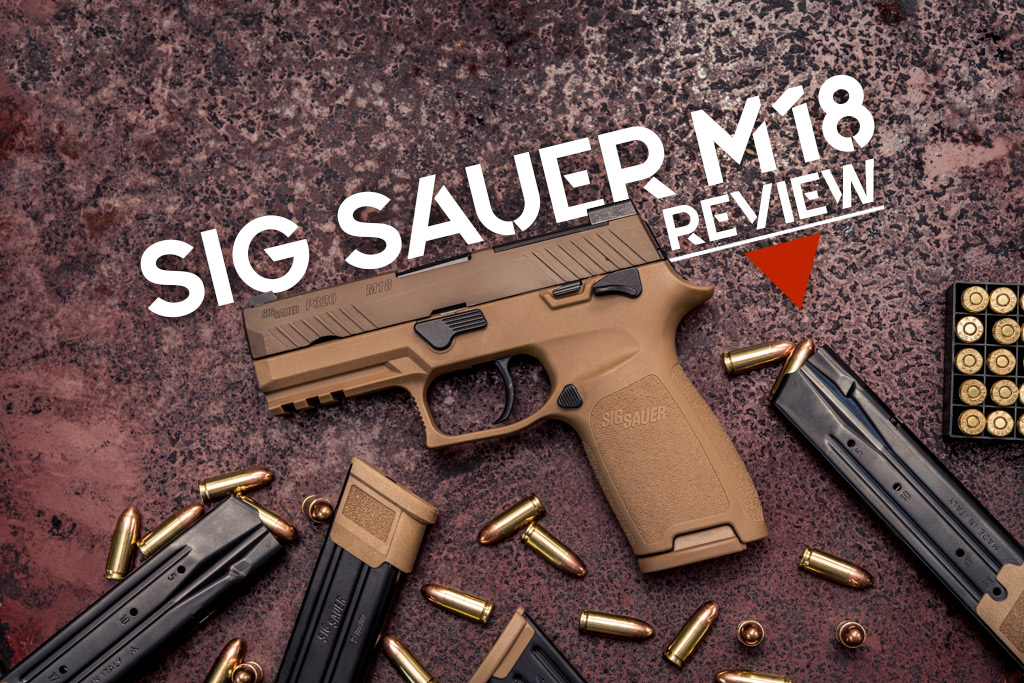
An airsoft gas blowback pistol adds what dry fire can’t: a hole in the target you can score and a slide that locks on the last round. The M18 has a licensed airsoft version, and our ProForce M17 vs M18 airsoft comparison covers how close it is to the issued pistol. Load the GBB magazines to the fill plan counts so the speed reload happens where it does on the real course.
Distance is the catch. Few GBB pistols hold an A zone at 25 yards, and most indoor spaces don’t have 25 yards anyway. So shrink the target instead of backing up: scale it by practice distance ÷ real distance. Practicing at 7 yards, print the 15-yard target at 47% of full size and the 25-yard target at 28%. At 5 yards indoors, that’s 71%, 33% and 20% for the 7, 15 and 25-yard stages. Keep the real time limits and score the scaled zones 10-8-6-4 the same way. Airsoft recoil is much lighter, so treat your airsoft score as a best case. If you hold Expert on scaled targets, live fire will still cost you some points. For what does and doesn’t carry over, see our guide to airsoft and firearms training crossover.
Common Mistakes That Cost Points
Treating it like a hits course. Every round in the C zone fails. Your practice targets need the zones drawn on them, and you need to score them honestly.
Skipping the head shot on the failure-to-stop. An extra body shot past four becomes a miss. A head shot that lands in the head’s 4-point zone still costs less.
Rushing the 15-yard pairs. Six seconds from the holster is generous for two rounds. Most shooters finish in three and give away points they had time to keep.
Topping off magazines out of habit. The course schedules the reloads. Practice with the fill-plan counts so your hands know where the slide lock comes.
Shooting 25 yards only on range day. It’s 80 points and the stage where trigger control shows most. Scaled targets at home with a 7-second par work the same skill.
Frequently Asked Questions
How many rounds is the Marine Corps pistol qualification?
The current Marine Corps pistol qualification (Combat Pistol Program Table One, Training Block 5) is 40 rounds, all from the standing position: 16 at 7 yards, 16 at 15 yards and 8 at 25 yards. The pre-CPP course was also 40 rounds, but 15 of them were 25-yard slow fire.
What score do you need to pass the USMC pistol qualification?
You need 264 out of 400 to qualify as Marksman. 324 to 363 is Sharpshooter, 364 to 400 is Expert, and 263 or less is Unqualified. Shots score 10, 8, 6 or 4 points depending on the zone of the MPMS-1 target, and a miss scores zero.
What is an Expert score on the Marine pistol qual?
Expert is 364 or higher out of 400, which is 91 percent and an average of 9.1 points per shot. In practice that means almost every round in the A or B zone: 22 A-zone hits and 18 B-zone hits is exactly 364. Under the old pre-CPP course, Expert was 345.
What pistol do Marines qualify with?
The order says “service pistol,” and since the Marine Corps began fielding it in 2020 that has been the M18. A March 2026 MARADMIN (095/26) also authorizes a unit-funded M17 Romeo red dot for CPP qualification, and lets Marines in units issued Glock pistols qualify with those.
Is the Marine Corps pistol qualification hard?
Qualifying is achievable for anyone who practices, but it’s harder than “hit the target” suggests: 40 hits in the C zone is only 240 points and fails. The time limits are moderate (about 3.6 seconds per round), so the difficulty is keeping hits in the A and B zones while drawing from the holster against the clock.
How is the Navy pistol qualification different?
The Navy Handgun Qualification Course (OPNAVINST 3591.1G) is 48 rounds from the holster at 3, 7 and 15 yards, including support-hand and kneeling strings. It’s scored out of 240: 180 qualifies, 204 is Sharpshooter and 228 is Expert, and you also need at least 36 hits in the silhouette. It’s closer and faster than the Marine course, with a stricter Expert cutoff.
Can you practice the Marine Corps pistol qualification with airsoft?
Yes. A gas blowback airsoft M18 lets you practice the draw, controlled pairs, the failure-to-stop, both reloads and the 25-yard trigger press against the real time limits. Scale the targets by practice distance divided by real distance (28% size at 7 yards for the 25-yard stage) and use a shot timer with a random start delay.
The Takeaway
The Marine Corps pistol qualification is 40 rounds, three distances, one standing position and 142 seconds of shooting time, scored in points. Passing means averaging 6.6 points a shot, and Expert means averaging 9.1. Hitting the paper doesn’t get you there. You get there by keeping hits in the A and B zones while drawing against a clock. Learn the course order, never skip the head shot on the failure-to-stop, slow down on the 15-yard pairs, and get your 25-yard reps on scaled targets. A free shot timer app with par beeps and a random delay is enough to start rehearsing tonight in dry fire.
For other timed standards to compare against, see the Army pistol qualification guide and the FBI pistol qualification guide. If you’re curious about the issued pistol, our SIG M17 vs M18 comparison covers how it differs from the commercial versions.
Course data: MCO 3574.2M, Marine Corps Combat Marksmanship Programs (6 April 2022), Enclosure (2) paragraphs 5-9 and Appendix K; MARADMIN 095/26 and 104/26 (March 2026); old course: MCO 3574.2K (1 August 2007), Enclosure (2); Navy: OPNAVINST 3591.1G (1 June 2021), Exhibit 6-2; M18 fielding: Marine Corps Systems Command (22 September 2020).
Image credits: cover and target scoring — U.S. Marine Corps photos by Lance Cpl. John Haubeil, Combat Pistol Program sustainment, Camp Hansen, Okinawa (1, 2); holster — U.S. Marine Corps photo by Cpl. Samuel Qin; Navy qualification — U.S. Navy photo by MC1 Storm Henry; airsoft M17/M18, head-box target and app screens from our own earlier articles. U.S. government photos are public domain, via Wikimedia Commons, resized and cropped to 16:9.


Put a Shot Timer in Your Pocket
Airsoft Shot Timer is a free shot timer app tuned for airsoft and Action Air — it picks up BB gun shots, tracks your split times, and saves you the cost of a $150+ hardware timer for IPSC/IDPA practice.