Shooting With Both Eyes Open: Dominant Eye & Cross-Dominance
The short answer (BLUF)
- Shoot with both eyes open for pistol, airsoft and any red dot. You keep depth perception and peripheral vision, and you find the next target faster.
- Seeing double is normal, not a flaw. Focus on a front sight at arm’s length and your two eyes produce two images of the target. At 7 yards they sit about 51 cm apart, wider than a whole USPSA target. Your brain is supposed to pick one: the one from your dominant eye.
- Find your dominant eye with the triangle test: frame a distant object in a small hole between your hands, both eyes open, then close one eye at a time. The eye that keeps the object in the hole is dominant. About 70% of people are right-eye dominant.
- Cross-dominant (right hand, left eye, or the reverse)? Don’t try to retrain your eye. Either shift the gun a few centimetres so the sights sit in front of your dominant eye, tilt your head, or put a small piece of frosted tape on your glasses or goggles.
- Prove it with a timer. Run the same draw and transition with each method and keep the one that is fastest with hits.
The first time most people shoot with both eyes open, it feels wrong. You raise the gun, focus on the front sight like you were told, and the target splits in two. Or you look at the target and now there are two front sights floating side by side. So you close one eye, everything snaps into one clean picture, and you decide two-eye shooting is something only champions can do.
It isn’t. What you’re seeing is plain optics, and once you know where the two images come from and which one to trust, both-eyes-open shooting stops being a trick. This guide explains the double vision with real numbers, shows you how to test your dominant eye, and walks through what to do if your dominant eye is on the “wrong” side. The last part is the one that frustrates roughly one shooter in three.
Should You Shoot With Both Eyes Open?
Yes, for almost all pistol, airsoft and red-dot shooting. Closing one eye cuts your field of view on that side, removes depth perception, and in bright light makes the open eye squint harder. Two open eyes give you a brighter sight picture and let you see the next target, the next door or the next opponent before you swing the gun there.
That last point is where the clock comes in. On a stage or in a CQB room, most of your time isn’t spent on the shot itself. It’s spent finding where to look next. When you shoot one-eyed, you lose half of the information that tells you where to go. Ask anyone who has played indoor airsoft with one eye squeezed shut and been shot from the side they couldn’t see.
There are exceptions. Bullseye pistol shooters and precision rifle shooters behind high-magnification scopes often close or cover one eye, because a slow, deliberate shot benefits from a calmer picture. World champion Rob Leatham points out that a magnified scope turns your vision into something close to “uni-vision” anyway. Your other eye sees the outside of the scope, not the target. For everything fast and close, though, both eyes open is the default worth learning.
Why You See Two Targets (or Two Front Sights)
Your eyes are about 63 mm apart, so they look at the world from two slightly different positions. When both eyes converge on something close, like a front sight at arm’s length, anything far away is seen from two angles that don’t match. The brain can’t merge them, and you see two copies. Focus on the far target instead, and the near front sight is the one that doubles.
That’s not a vision problem; it’s geometry. And because it’s geometry, we can calculate it. Assume a typical adult interpupillary distance of 63 mm and a front sight 70 cm from your eyes in an isosceles stance. The two images then sit apart by these amounts:
| Target distance | Sight focus: two images of the target, side by side | Target focus: two front sights, side by side |
|---|---|---|
| 3 m (10 ft) | about 21 cm | about 4.8 cm |
| 5 m (16 ft) | about 39 cm | about 5.4 cm |
| 7 yd (6.4 m) | about 51 cm | about 5.6 cm |
| 10 m (33 ft) | about 84 cm | about 5.9 cm |
| 15 yd (13.7 m) | about 1.2 m | about 6.0 cm |
| 25 yd (22.9 m) | about 2.0 m | about 6.1 cm |
Target-image gap measured at the target, = 63 mm × (distance − 0.7 m) ÷ 0.7 m. Front-sight gap measured at the gun, = 63 mm × (distance − 0.7 m) ÷ distance. Your own numbers scale with your eye spacing and arm length.
Two things jump out of that table. First, a USPSA target is 45 cm wide. From about 5 metres on, the two “ghost” targets you see during a hard front-sight focus no longer even overlap. That’s why the double image feels so dramatic. It isn’t a slight blur; you are literally looking at two full targets. Second, the doubled front sights stay about 5–6 cm apart at every distance. That’s roughly twice the width of a pistol slide, far too much to “average out.”
So you can’t fix it by trying harder to merge the pictures. The fix is to let your brain pick one, and it naturally picks the image from your dominant eye. When your dominant eye is the one behind the sights, the image it chooses is the correctly aligned one, and the ghost from the other eye fades into the background with practice. When your dominant eye is not behind the sights, your brain picks the image that’s off to the side. That is the entire cross-dominance problem in one sentence.
How to Find Your Dominant Eye
The triangle test (vision scientists call it the Miles test) takes 30 seconds. Stretch both arms out in front of you and overlap your hands to make a small triangle-shaped opening between your thumbs and index fingers. With both eyes open, centre a small object at least 5 metres away in that opening: a light switch, a door handle, a target. Now close your left eye. If the object stays in the hole, your right eye is dominant. If it jumps out of the hole, open both eyes again and close the right eye instead to confirm your left eye is the dominant one.
The pointing test (the Porta test) works the same way with one finger pointed at the object. A third version, the Dolman or “hole in the card” test, uses a card with a small hole in it. All three ask the same question: which eye was the brain really using when both were open?
A few habits make the result more reliable. Do it three times and in a couple of spots in your field of view, because dominance can shift with gaze direction. Some people are right-dominant looking straight ahead and switch when looking far to one side. Do it at roughly your shooting distance, not at a phone two feet away. And if your results keep flipping, you may have weak or mixed dominance. In that case the frosted-tape fix below usually works better than trying to match the gun to one eye.
For context, about 70% of people are right-eye dominant and about 29% left-eye dominant. Since most people are right-handed, a lot of right-handers end up with a left dominant eye. Ben Stoeger estimates cross-dominance at about a third of shooters, and the simple arithmetic lands in the same place. It’s common enough that every range has several cross-dominant shooters who don’t know it yet.
Cross-Dominant? Three Fixes That Work
If your dominant eye and your shooting hand are on opposite sides, you don’t need to fix your eyes. You only need to put the sights where your dominant eye can see them. Top shooters disagree on how, which is useful, because it means more than one method works at a world-class level.
The subtle gun shift is Ben Stoeger’s choice. Keep your normal grip and stance and simply hold the gun a few centimetres over, in front of your dominant eye instead of centred on your nose. In his demonstration the change is almost invisible from the outside, and he notes that some high-level competitors, Dave Sevigny among them, shoot cross-dominant this way without anyone noticing. What he’s firmly against is “training” your dominance away by squinting the dominant eye. As he puts it, rewiring which eye your brain prefers and then expecting it to hold up at speed, under pressure, makes no sense.
The head tilt is Rob Leatham’s preference. He argues that moving the gun across your body compromises the stable triangle of an isosceles stance. Instead, keep the gun centred and tilt or turn your head slightly so the dominant eye lines up behind the sights. Julie Golob shows the same move: a right-hander who wants to aim with the left eye turns the head a little to the right until the left eye sees the sights. It costs nothing in the arms, but it can feel awkward at first and some people get neck fatigue in long sessions.
The frosted tape method is Golob’s fix for people who can’t stop seeing double at all. Put a small piece of frosted (matte) tape on your shooting glasses, directly in front of the eye you want to quiet, at the spot where that eye would see the sights. Unlike closing the eye, light still gets in and your peripheral vision on that side stays intact. Only the sight picture from that eye is blocked, so the brain has nothing to fight over. For airsoft players this one is almost free, because you already wear goggles every time you play. Put the tape on the outside of the lens so it never interferes with the protective surface.
Closing your dominant eye is a legitimate last resort, and switching to shoot with the other hand works too, though Leatham notes most people lack the dexterity in their support hand to make that worthwhile. Whichever you choose, choose one and repeat it on every rep. The worst cross-dominant setup is the one that changes depending on how tired you are.
Red Dots, Goggles and Airsoft Optics
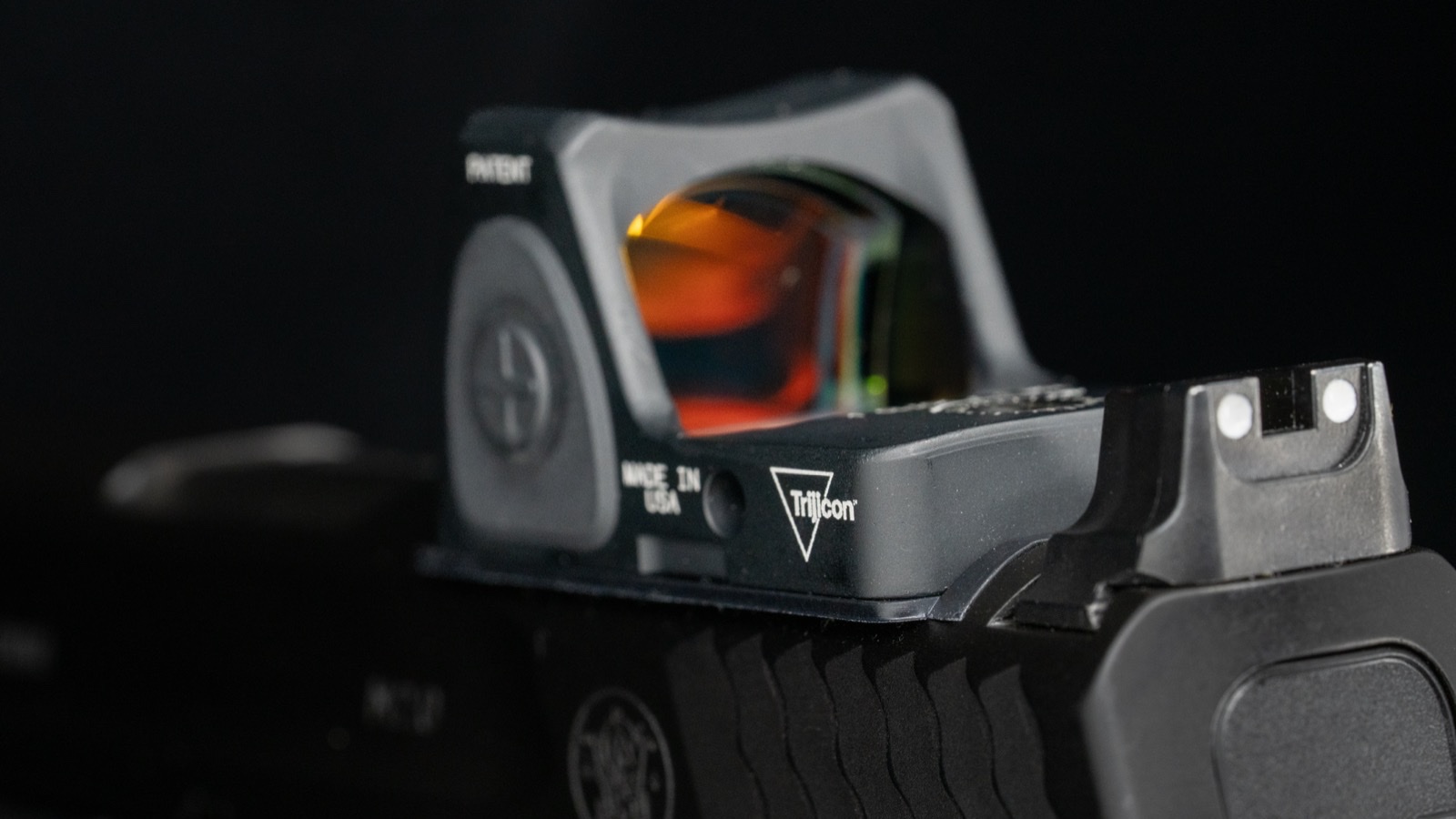
A red dot makes both-eyes-open shooting easier, because the dot is projected so it appears at the target’s distance, not at the gun. Both eyes converge on the target, and the doubling from the table above largely disappears: one target, one dot. It’s also a great cross-dominance diagnostic. Only the eye behind the window can see the dot. If the dot vanishes when you open both eyes, your brain is using the other eye. Shift the gun slightly toward your dominant eye, Stoeger-style, and it comes back.
If you’re moving from irons to a dot, our pistol red dot guide covers mounting height and finding the dot on the draw. For the iron-sight side of focus, including when to look at the front sight and when to look at the target, see the pistol aiming guide.
Airsoft adds its own wrinkles. Full-seal goggles and mesh masks cut some light and narrow your field of view slightly, which is one more reason not to throw away half your vision by closing an eye. Fogging hits both lenses, but a fogged lens over one eye can quietly flip which eye your brain trusts mid-game. If your aim suddenly drifts after a sprint, check your goggles before your technique.
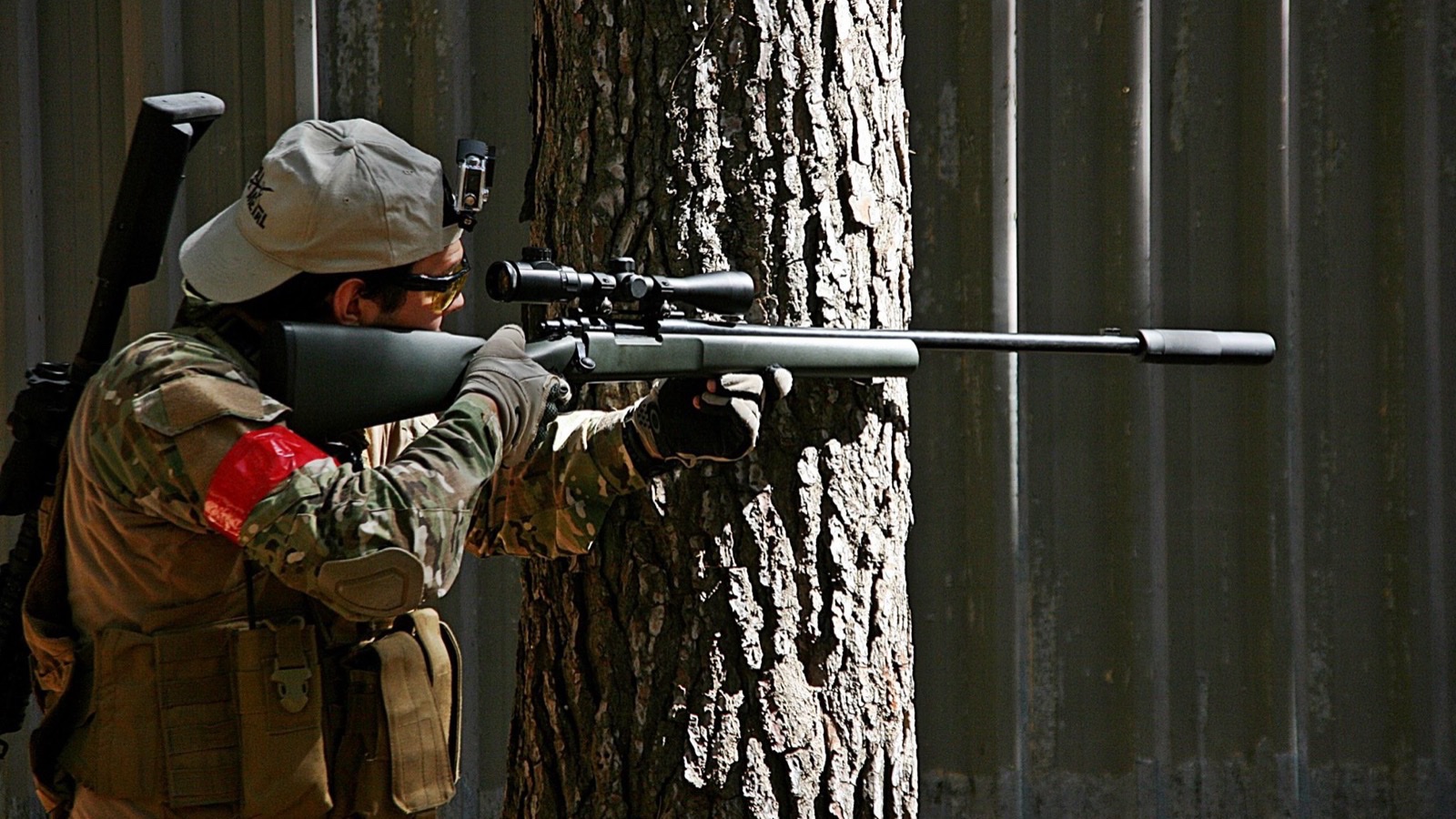
Long guns are a different story from pistols. A rifle or an airsoft AEG is locked to one cheek, so you can’t shift it a few centimetres across your face. Cross-dominant rifle shooters either learn to shoulder the gun on the dominant-eye side, or block the dominant eye (tape again works well). Many airsoft players find shooting from the “other” shoulder easier than expected, and it pays off around corners that open to that side. With a magnified scope on an airsoft sniper rifle, keeping the other eye open at low magnification lets you spot movement outside the scope. It also lets you watch the slow BB arc and correct your hold, something real-steel shooters never get to do.
How to Train Both-Eyes-Open Shooting (and Prove It With a Timer)
Start dry, at short distance, and let the ghost image fade instead of fighting it. Most shooters adapt within a few sessions of 5–10 minutes. Stand 3–5 metres from a target, bring the gun up with both eyes open and hold the sight picture for three slow breaths. Your brain’s job is to settle on the dominant eye’s image. Yours is just to stop squinting. If you can’t get there, start with the non-dominant eye half-closed and open it a little more each session. That’s the “squint” middle path many instructors teach, used as a bridge rather than a permanent setup.
Then add speed, because a method that only works when you’re slow isn’t a method. A shot timer is the honest judge here. Run the same simple test in three versions: one eye closed, both eyes open with your chosen cross-dominance fix, and both eyes open without it. Use a draw (or start at low ready) to one shot on an A-zone at 7 metres, five reps each. Then do a two-target transition with the targets about a metre apart, five reps each. Write down the average time and the number of hits.
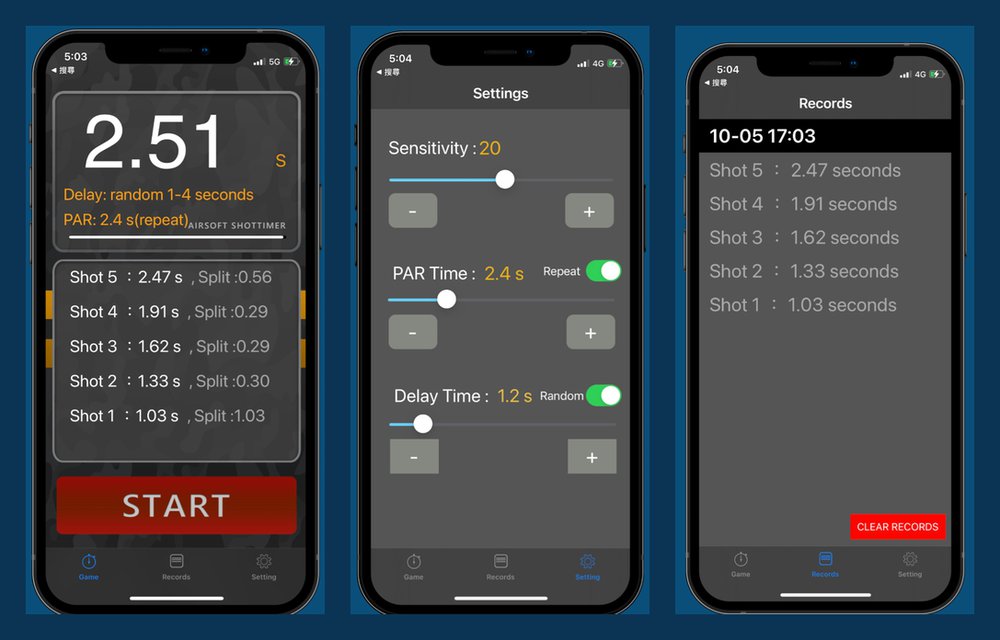
What usually shows up is that both-eyes-open costs you nothing on the first shot once the ghost image is under control, and wins on the transition. You see the second target before the gun gets there. But the point of measuring is that you don’t have to take anyone’s word for it, including ours. If one method is clearly faster for you with equal hits, that’s your method. The free Airsoft Shot Timer App records every split. Its random start delay stops you from anticipating the beep, and its adjustable sensitivity picks up the quieter report of a GBB pistol, so you can run the whole test at home in dry fire or at the field.
For the full set of drills that build on this, see our dry fire training guide. Once the transition numbers stabilise, the IPSC training guide has stage-style practice that rewards seeing the next target early.
Frequently Asked Questions
Is it better to shoot with one eye or two?
Two, for pistol, airsoft and red-dot shooting. Both eyes open keeps depth perception and peripheral vision and makes target transitions faster. One eye is fine for slow precision shooting and high-magnification scopes, and as a temporary step while you learn.
Why do I see two targets when I aim with both eyes open?
Because your eyes are about 63 mm apart. When you focus on the front sight, the distant target is seen from two angles that don’t line up, so it doubles. At 7 yards the two images are about half a metre apart. The fix is to let your brain use the image from your dominant eye, not to force the two together.
How do I know which eye is dominant for shooting?
Use the triangle test. Make a small opening with your hands, frame an object at least 5 metres away with both eyes open, then close one eye at a time. The eye that keeps the object framed is your dominant eye. Repeat it three times; if the answer keeps changing, you may have mixed dominance.
Can you change your dominant eye?
Not reliably, and top shooters like Ben Stoeger advise against trying. It’s far easier to move the gun, tilt your head or block the other eye with frosted tape than to retrain which eye your brain prefers and expect it to hold up under pressure.
Do snipers shoot with both eyes open?
Many do at low magnification, because the open eye keeps watching the area around the scope. At high magnification the scope picture dominates anyway, and plenty of precision shooters close or cover the other eye. Airsoft snipers benefit from keeping both open because they can watch the BB’s flight and correct.
Does cross-dominance matter with a red dot?
Yes, but it’s easy to spot: if the dot disappears when both eyes are open, the eye behind the window isn’t the one your brain is using. Shift the gun slightly toward your dominant eye and the dot will reappear.
The Bottom Line
Shooting with both eyes open isn’t a talent. It’s knowing that the double image is supposed to be there, and knowing which copy to believe. Test your dominant eye, pick one cross-dominance fix if you need one, and run it the same way every time until the ghost image fades. Then put a timer on it. The numbers will tell you within a week whether your eyes are helping your speed or quietly costing you on every transition.
Download the free Airsoft Shot Timer App, run the one-eye vs both-eyes test above, and keep whichever version wins.
Sources: eye dominance prevalence and the Miles, Porta and Dolman tests from Wikipedia: Ocular dominance; cross-dominance techniques from Ben Stoeger, “How to be cross dominant,” Rob Leatham with Springfield Armory, “Gun Myth | Cross Eye Dominance,” and Julie Golob with Smith & Wesson, “Tips for Cross Eye Dominance” on YouTube. Double-image distances calculated by us from a 63 mm interpupillary distance and a 70 cm eye-to-front-sight distance.
Image credits: cover — JMRC M17 Pistol Qualifications by Spc. Danil Pak, U.S. Army, public domain; red dot — Trijicon RMR Pistol Optic on S&W Gun by Tony Webster, CC BY-SA 2.0; airsoft sniper — Brian Sniper by Marina Medel Millan, CC BY-SA 4.0; App screens — Airsoft Shot Timer. Images cropped to 16:9.


Put a Shot Timer in Your Pocket
Airsoft Shot Timer is a free shot timer app tuned for airsoft and Action Air — it picks up BB gun shots, tracks your split times, and saves you the cost of a $150+ hardware timer for IPSC/IDPA practice.