USPSA & IPSC Target Dimensions: Every Zone in Inches & cm
USPSA and IPSC target dimensions in 60 seconds (BLUF)
- USPSA target: 45 x 75 cm (17.72 x 29.53 in) of scoring area, plus a 0.5 cm (0.20 in) non-scoring border all around, which is why stores list it as about 18 x 30 in. Body A-zone 15 x 28 cm (5.91 x 11.02 in), head A-zone 10 x 5 cm (3.94 x 1.97 in), C-zone 30 cm (11.81 in) wide.
- IPSC target: an octagon 45 x 57 cm (17.72 x 22.44 in) with a single octagonal A-zone 15 x 32.5 cm. No head.
- How much is A: the A-zone is 16.9% of a USPSA target’s area and 18.4% of an IPSC target’s. Almost half of either target (45-47%) is D.
- Smaller official targets: half-size USPSA is 22.5 x 37.5 cm; the IPSC Mini and the IPSC Action Air target are both 30 x 37.5 cm with a 10 x 21.5 cm A-zone, about two thirds of full size.
- Dry fire: a scaled target at distance D looks like a full-size target at D ÷ scale. A 1/3-scale target at 3 yards looks like a full-size target at 9 yards.
If you searched “USPSA target dimensions,” you are probably building a dry-fire wall, printing targets, cutting hard cover for a club stage, or trying to understand why your hits keep landing just outside the A-zone. The exact numbers are in the rulebooks, but they’re printed on diagrams that are hard to read and easy to misquote. Below is every dimension, checked against the USPSA 2026-09 rules (Appendix B1), the IPSC Handgun Rules (January 2026, Appendix B) and the IPSC Action Air Rules (January 2026, Appendix B), plus the math you need to turn those numbers into practice.
One thing first, because it causes most of the confusion online. Every official dimension is measured to the edge of the scoring area. The 0.5 cm non-scoring border sits outside it. Add a border on each side and the USPSA target becomes 46 x 76 cm, or 18.12 x 29.93 inches, which is exactly the size target makers print on their boxes. Both numbers are right; they just measure different things.
USPSA Target Dimensions
The USPSA target is a man-shaped silhouette 45 cm wide and 75 cm tall (17.72 x 29.53 in), and it has two A-zones: a large rectangle in the chest and a small one in the head. The rulebook draws it in centimeters, and the inch figures are conversions. That’s why the inch numbers look odd (5.91, 11.02, 29.53): the target was designed in round metric numbers, which is also why many shooters still call it the “metric target,” even though the rulebook simply calls it the USPSA Target.
Here is the shape from top to bottom. The head is a 15 x 15 cm square (5.91 in). Inside it, the head A-zone is a 10 x 5 cm rectangle (3.94 x 1.97 in), sitting 2.5 cm (0.98 in) below the top and 2.5 cm in from each side of the head. Below the head, the body is 45 cm wide with 5 x 5 cm corners cut off at the shoulders. The body A-zone, also called the lower A-zone, is a 15 x 28 cm rectangle (5.91 x 11.02 in), centered, starting 20 cm (7.87 in) from the top of the target. Around it, the C-zone is 30 cm (11.81 in) wide. Everything outside the C-zone is D. The bottom 15 cm of the target narrows to a 30 cm base, so the lower corners are angled in by 7.5 cm on each side.
The scoring is the same as on the IPSC target: A = 5 points, C = 4 for Major or 3 for Minor, D = 2 for Major or 1 for Minor. Older targets also have a B-zone line around the head. Since a 2018 board directive, B-zone hits are scored as C, and B-zoned targets are being phased out, so the part of the head outside the small A-box counts as C.
IPSC Target Dimensions
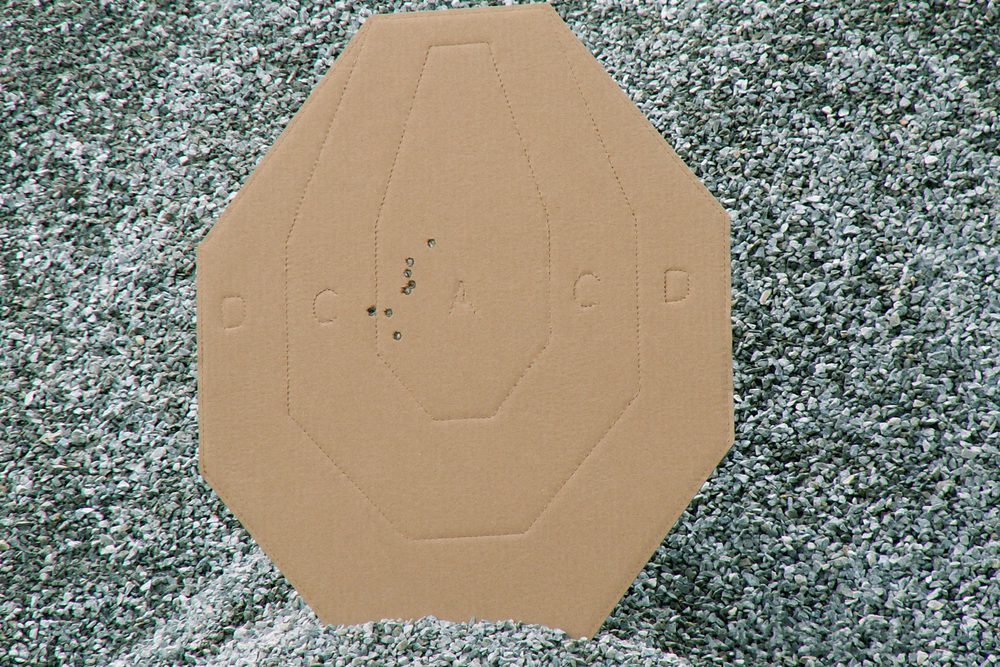
The IPSC target is an octagon 45 cm wide and 57 cm tall (17.72 x 22.44 in) with no head and one A-zone. The top and bottom edges are each 15 cm wide, and the angled corners each drop 19 cm, so the straight sides run from 19 cm to 38 cm down the target.
The A-zone is an elongated octagon 15 cm wide and 32.5 cm tall, from 2.5 cm to 35 cm below the top. Its top and bottom edges are only 5 cm wide, so the zone is a narrow point at the top, full width (15 cm, 5.91 in) between 19 cm and 27.5 cm, and narrows again at the bottom. The C-zone is 30 cm wide and runs from the top edge down to 45 cm, with a 10 cm bottom edge. The rest is D, and the border is 0.5 cm, the same as on the USPSA target.
So the A-zones on both targets are the same 15 cm (5.91 in) wide, but they are shaped differently. The USPSA body A is a plain rectangle of 420 cm². The IPSC A is taller but tapers at both ends, and it covers 367.5 cm², about 12% less. The width is the same, but the IPSC A-zone forgives less once your hits start stringing up or down.
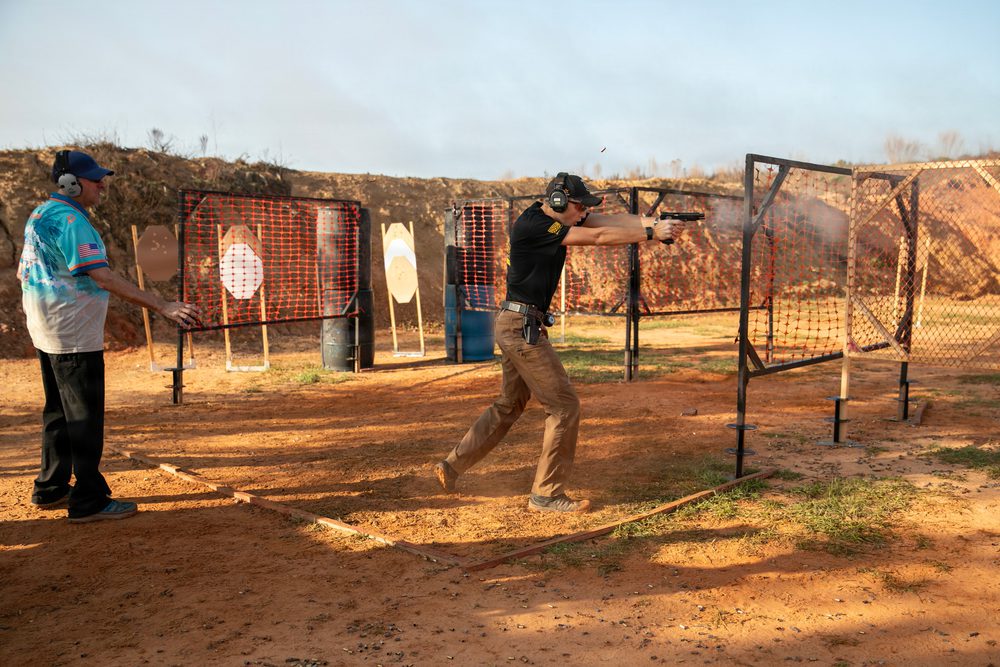
Which one will you see? IPSC matches use only the IPSC Target and the IPSC Mini Target (IPSC Handgun Rules 4.1.1.2). USPSA matches approve both the USPSA and IPSC targets, but rule 4.2.1 says the two types must not be mixed in the same stage, not even with one type used as a no-shoot. So if you’re shooting in the United States, the USPSA silhouette is the one you’ll see most, but you should be ready for a stage built entirely from IPSC octagons.
Side-by-Side: Sizes and How Much of Each Target Is A
The table below puts the official cardboard targets side by side. Areas are computed from the rulebook dimensions, scoring area only (no border).
| Target | Scoring area (W x H) | A-zone | A-zone area | A as % of target |
|---|---|---|---|---|
| USPSA | 45 x 75 cm (17.72 x 29.53 in) | Body 15 x 28 cm + head 10 x 5 cm | 470 cm² (72.9 in²) | 16.9% |
| IPSC | 45 x 57 cm (17.72 x 22.44 in) | Octagon 15 x 32.5 cm | 367.5 cm² (57.0 in²) | 18.4% |
| Half-size USPSA | 22.5 x 37.5 cm (8.86 x 14.76 in) | Body 7.5 x 14 cm + head 5 x 2.5 cm | 117.5 cm² | 16.9% |
| IPSC Mini / Action Air | 30 x 37.5 cm (11.81 x 14.76 in) | Octagon 10 x 21.5 cm | 167 cm² | 19.1% |
The USPSA target’s total scoring area is 2,787.5 cm² (432 in²), and it splits into about 17% A, 36% C and 47% D. The IPSC target is 1,995 cm² (309 in²): 18% A, 36% C and 45% D. Two things follow from that. First, a “center hit” is a much smaller target than the cardboard in front of you: less than a fifth of the paper pays full points. Second, the D-zone is the single biggest region on both targets, which is why a shooter who is only “getting hits on paper” can post a decent-looking hit count and a poor score.
If you want the angles, a 15 cm A-zone is about 1.3° wide at 7 yards and 0.6° at 15 yards. Our point shooting guide turns that into how far off your sights can be at each distance.
Hard Cover, No-Shoots and the Minimum Visible A-Zone
Course designers can hide part of a target behind hard cover or overlapping no-shoots, but never all of the A-zone. On a full-size USPSA target, at least 25% of the lower A-zone, or the entire upper (head) A-zone, must stay visible (USPSA rule 4.2.5 and Appendix B1). For the IPSC target, Appendix B1 shows the minimum A-zone area as a marked portion of the octagon, which works out to the same 25% idea.
In real numbers, 25% of the 15 x 28 cm body A-zone is 105 cm². That could be a strip about 3.75 cm (1.5 in) wide down the full height of the A-zone, or the top 7 cm (2.75 in) across its full width. That’s narrower than most people’s hits at match speed, which is why partial targets are where match points disappear. For half-size targets the rule doubles: at least 50% of the A-zone must stay visible (rule 4.2.1.1), and a half-size target can’t be stapled onto a full-size no-shoot or used as a no-shoot on a full-size target.
When designers simulate hard cover, the rules allow three ways (4.2.4): physically hide part of the target, cut the hidden part off and fit a new non-scoring border, or paint or tape the hidden part a single contrasting color. If you build practice stages at your club, the last one is the fastest: a strip of black tape across the cardboard makes a legal-looking hard cover in seconds. One more number that matters on a long stage: a cardboard target can’t be required to take more than 12 hits before it’s scored and patched (4.2.3).
Half-Size, Mini and Action Air Targets
The smaller official targets are not just shrunk copies, and the difference matters if you print your own. The half-size USPSA target is an exact half: 22.5 x 37.5 cm (8.86 x 14.76 in), with a 7.5 x 14 cm body A-zone and a 5 x 2.5 cm head A-zone. The half-size IPSC target is 22.5 x 28.5 cm (8.86 x 11.22 in) with a 7.5 x 16.3 cm A-zone. In both cases the non-scoring border stays at 0.5 cm, not half of it. USPSA allows half-size targets at every match level, mixed with full-size targets of the same type (rule 4.2.1.1).
The IPSC Mini Target is different: 30 x 37.5 cm with a 10 x 21.5 cm A-zone and a thinner 0.3 cm border. That’s two thirds of the full IPSC width but 65.8% of its height, so it’s close to 2/3 scale without being exact. The rulebook says what it’s for: Mini targets “are used to simulate IPSC Targets … placed at greater distances” (IPSC Handgun Rules 4.1.1.2).
For airsoft shooters, the key fact is that the IPSC Action Air target has exactly the same dimensions as the IPSC Mini: 30 x 37.5 cm, a 10 x 21.5 cm A-zone, and a 0.3 cm border. Action Air scores A = 5, C = 3, D = 1 with no Major/Minor split. There is also an Action Air Micro target, 18 x 22.8 cm, which is exactly 0.4 times the full IPSC target. Standard and Micro targets can’t be mixed in the same target array (Action Air Rules 4.1.1.2).
Action Air rules also cap the distance: no paper or rigid (steel) target may require a shot from more than 15 meters (rule 2.1.8.5), and scoring lines should not be visible from beyond 10 meters (4.2.2). Put the scale and the distance together and you can see how Action Air compares with a real-gun match. An Action Air target at 10 m looks the same size as a full IPSC target at 15 m, and at the 15 m maximum it looks like a full target at 22.5 m. A Micro target at 10 m looks like a full target at 25 m. So when someone says Action Air distances are short, remember that the targets are smaller too. If you’re new to the airsoft version of the sport, our IPSC Action Air guide covers divisions, guns and scoring.
Scaled Targets for Dry Fire: How Far to Place Them
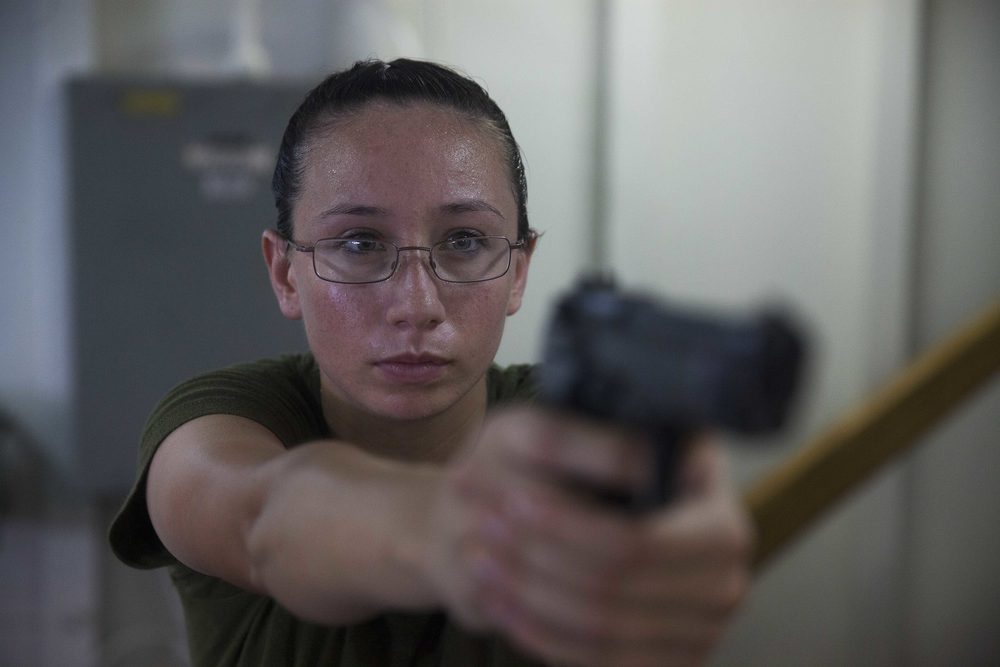
A scaled-down target at a short distance looks exactly like a full-size target farther away. The formula is the same one behind the IPSC Mini target: simulated distance = actual distance ÷ scale. Or the other way around: to simulate a full-size target at distance D, put a scaled target at D x scale.
For the two most common dry-fire scales:
- 1/3 scale: place it at 2.3 yards to simulate 7 yards, 3.3 yards for 10, 5 yards for 15, and 8.3 yards for 25. On a 1/3 USPSA target the body A-zone is 5 x 9.3 cm (1.97 x 3.67 in).
- 1/2 scale: place it at 3.5 yards to simulate 7, 5 yards for 10, 7.5 yards for 15, and 12.5 yards for 25.
That’s the answer to the common question “how big is a 33% IPSC target?” It’s a third of every dimension: a 15 x 19 cm octagon with a 5 cm wide A-zone, small enough to fit three across on a living-room wall. Paper size matters if you print at home. A 1/3-scale USPSA target (15 x 25 cm, 5.9 x 9.8 in) fits on Letter or A4 paper, but a half-size USPSA target (22.5 x 37.5 cm) is too big for both and needs tabloid (11 x 17 in) or A3. Always print at 100% scale, not “fit to page,” and check one zone with a ruler. A printer that shrinks the page by 6% to fit its margins moves your simulated 10-yard target to almost 10.7 yards.
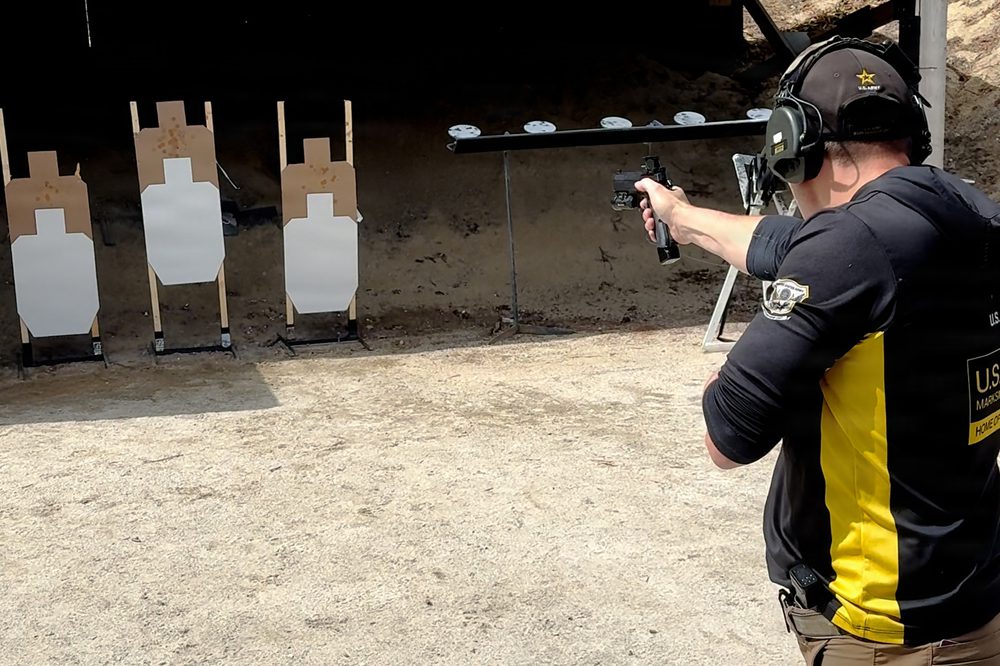
USPSA shooter Brantley Merriam describes building his whole dry-fire routine around three scaled USPSA targets in one room. He chose the USPSA target because it has two very different A-zones on one sheet: the body box for “an easy percentage shot” and the head box for a hard one. That simple setup lets you practice draws, transitions, entries and exits, and reloads on the move, while switching between body and head boxes to vary the difficulty.
How to Train With These Numbers and a Shot Timer
The point of knowing the exact zone sizes is to make your practice targets honest, and then to put a clock on them. A tape outline of the 15 x 28 cm body A-zone on cardboard, or a printed 1/3 target at the right distance, gives you a real A-zone to aim at. A shot timer tells you whether your speed comes with A hits or with C and D hits. Without both, dry fire tends to drift toward speed that only works on a bigger target than you’ll see at a match.
A simple progression works for both real-gun dry fire and airsoft. Start with the body box at a simulated 7 yards and a par time you can make cleanly, then move to the head box at the same simulated distance, and then push the simulated distance to 15 yards by moving the targets. For a feel of what speed is worth in points, run your hits through our hit factor calculator: on a USPSA target with Minor scoring, an A-to-C miss costs 2 points, so at a hit factor of 8 it has to buy you 0.25 seconds to break even.
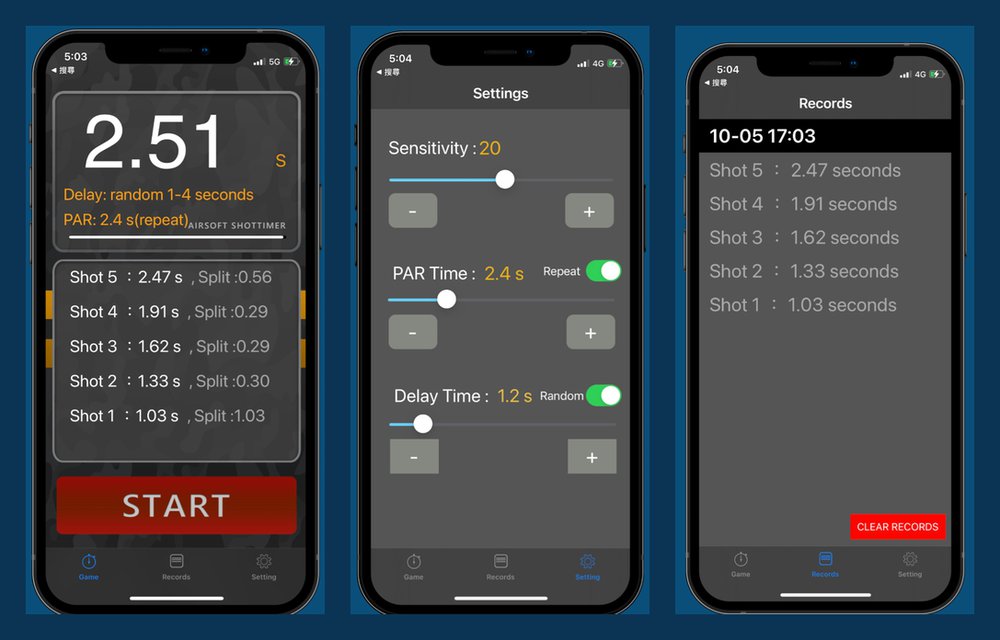
The Airsoft Shot Timer app handles this on your phone. Set a par time for the drill, turn on the random start delay so you can’t anticipate the beep, and read your splits after each run. It also detects the much quieter shots of a gas blowback airsoft pistol, so the same setup works for Action Air practice on Action Air-sized targets. If you don’t want to install anything yet, the browser-based online par timer gives you start and par beeps.
Common Mistakes With Target Dimensions
Quoting 18 x 30 as the scoring size. The 18 x 30 in (18.12 x 29.93 in) figure includes the non-scoring border. The scoring area is 17.72 x 29.53 in. If you’re making targets for club practice, draw the 0.5 cm border outside the D-zone, not inside it.
Mixing up the two A-zones. The USPSA body A is a 15 x 28 cm rectangle; the IPSC A is a 15 x 32.5 cm octagon. They have the same width, but the IPSC zone is about 12% smaller in area. Practicing only on one type and then shooting a stage built from the other is a common surprise.
Scaling the border too. The official half-size targets keep the 0.5 cm border, and the Mini and Action Air targets use 0.3 cm. A home-printed target with a scaled-down border isn’t a big problem in dry fire, but it’s wrong for anything used to score live fire.
Printing “fit to page.” A few percent of shrinkage changes the simulated distance by the same few percent. Measure the A-zone after printing.
Assuming Action Air is “easier because it’s closer.” The Action Air target is about two thirds of full size. At 10 m it gives you the same angle as a full IPSC target at 15 m.
Frequently Asked Questions
What are the dimensions of a USPSA target?
The USPSA target’s scoring area is 45 x 75 cm (17.72 x 29.53 in), surrounded by a 0.5 cm (0.20 in) non-scoring border, so the overall cardboard is about 46 x 76 cm (18.12 x 29.93 in). The head is 15 cm square and the body is 45 cm wide.
What are the dimensions of the USPSA A-zone?
The body (lower) A-zone is a 15 x 28 cm rectangle, which is 5.91 x 11.02 inches, starting 20 cm below the top of the target. The head (upper) A-zone is 10 x 5 cm, or 3.94 x 1.97 inches. Together they are 16.9% of the target’s scoring area.
What are the IPSC target dimensions?
The IPSC target is an octagon 45 cm wide and 57 cm tall (17.72 x 22.44 in) with a 0.5 cm non-scoring border. Its A-zone is an octagon 15 cm wide and 32.5 cm tall, and the C-zone is 30 cm wide. It has no head.
How big is a 33% IPSC target?
A one-third-scale IPSC target is about 15 x 19 cm (5.9 x 7.5 in) with a 5 cm (2 in) wide A-zone. Placed at 3 yards, it looks like a full-size target at 9 yards. To simulate a full-size target at any distance, multiply that distance by 1/3.
What is the difference between the IPSC and USPSA target?
The USPSA target has a head with its own small A-zone and a rectangular body A-zone. The IPSC target is an octagon with a single octagonal A-zone and no head. Both are 45 cm wide, both A-zones are 15 cm wide, and both use the same A/C/D scoring. USPSA allows either type, but not both in the same stage.
How big is an IPSC Action Air target?
The IPSC Action Air target is 30 x 37.5 cm with a 10 x 21.5 cm A-zone, the same dimensions as the IPSC Mini Target, and about two thirds of a full IPSC target. Scoring is A 5, C 3, D 1, and no target may be shot from farther than 15 meters.
The Takeaway
The two numbers to remember are 45 x 75 cm for the USPSA target and 15 cm for the width of every full-size A-zone. Everything else follows: the 18 x 30 in box size is the border added on, the A-zone is less than a fifth of the paper, the IPSC A-zone is about 12% smaller than the USPSA body box, and a scaled target works at distance x scale. Build your practice targets from the real dimensions, put them at the right distance, and time every rep with a free shot timer app.
For next steps, our USPSA beginner guide covers your first match, the IDPA vs USPSA comparison explains how the IDPA target and its scoring differ, and the dry fire training guide builds a weekly routine around scaled targets.
Dimension sources: USPSA Competition Rules, online edition 2026-09, rules 4.2.1-4.2.5 and Appendix B1 (diagrams read from the identical Appendix B1 of the USPSA Rifle, Shotgun and Multigun Rules, March 2026); IPSC Handgun Rules, January 2026 edition, rule 4.1.1.2 and Appendix B2-B3; IPSC Action Air Handgun Rules, January 2026 edition, rules 2.1.8.5, 4.1.1.2, 4.2.2 and Appendix B2-B3. Areas, percentages and scaled distances are our own calculations from those dimensions. Dry-fire setup described by Brantley Merriam (“Two Position Dryfire Drill,” YouTube).
Image credits: cover and stage photo — U.S. Army photos by Lt. Col. Michelle Lunato, U.S. Army Marksmanship Unit, public domain via DVIDS (1, 2); IPSC target — Rude, public domain; dry fire — U.S. Marine Corps photo by Cpl. Anna Albrecht, public domain; Hi-Capa 4.3 — Dwt110, CC BY 3.0.


Put a Shot Timer in Your Pocket
Airsoft Shot Timer is a free shot timer app tuned for airsoft and Action Air — it picks up BB gun shots, tracks your split times, and saves you the cost of a $150+ hardware timer for IPSC/IDPA practice.