Practical Shooting Complete Beginner Guide: IPSC, USPSA, IDPA, Steel Challenge & 3-Gun Explained
What Is Practical Shooting?
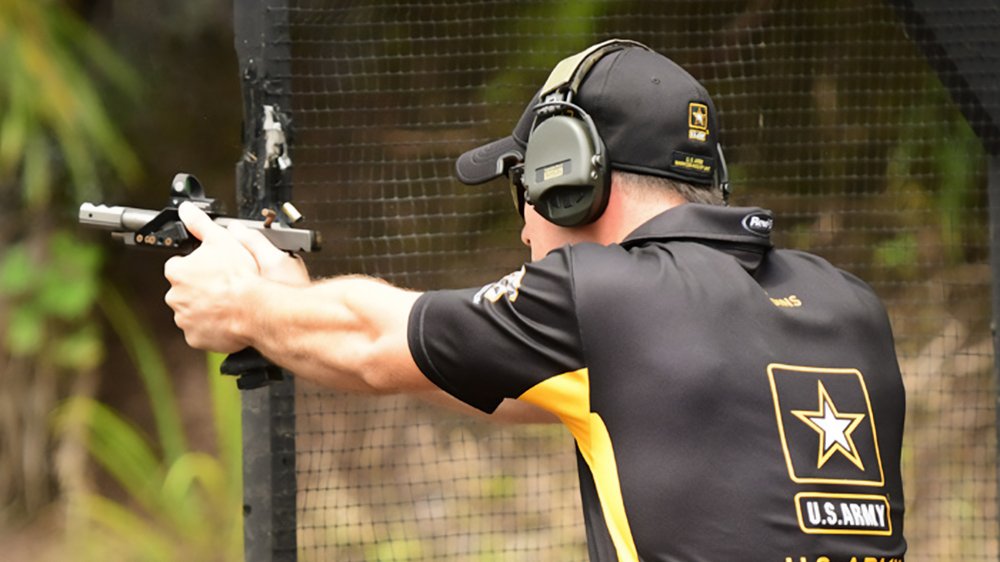
Have you ever felt that standing at a fixed position putting holes in paper targets doesn’t quite capture the full potential of shooting? Practical shooting is the concept that transforms shooting from a static skill exercise into a dynamic, fast-paced sport. In the world of practical shooting, you’re running, turning, crouching, leaning out from behind barriers, and reloading under time pressure — every second testing your speed, accuracy, and decision-making.
The sport traces its origins to 1950s California. A group of shooting enthusiasts felt that traditional range shooting was too boring and wanted something closer to real-world application. The most influential figure was Colonel Jeff Cooper, who founded the first practical shooting club in Big Bear, California, and later organized the Southwest Combat Pistol League. Shooters competed in “leather slap” matches, racing to draw and fire as fast as possible while timed with a stopwatch. These early matches were the prototype for modern practical shooting.
In 1976, shooting enthusiasts from around the world gathered in Columbia, Missouri, for the first International Practical Shooting Conference. Forty representatives established competition rules and an organizational charter, and IPSC (International Practical Shooting Confederation) was officially born. Jeff Cooper served as the first president and established the core philosophy of D.V.C. (Diligentia, Vis, Celeritas) — Accuracy, Power, Speed. These three elements remain the foundation of all practical shooting competition to this day.
The Five Major Disciplines
Over nearly half a century of evolution, practical shooting has branched into five major competitive disciplines, each with its own unique character and appeal. Understanding the differences between them will help you find the best starting point for your journey.
IPSC — Where It All Began
IPSC (International Practical Shooting Confederation) is where this all started, and it remains the largest practical shooting organization in the world, with affiliates in over 100 countries. IPSC match design emphasizes versatility: you navigate complex stages, engaging targets at varying distances and angles while finding the optimal balance between speed and accuracy.
IPSC uses Hit Factor scoring — your points divided by time — meaning shooting accurately and shooting fast are equally important. Competitions are divided into multiple divisions, from equipment-restricted Production to the nearly unlimited Open division, each with its own gear rules and strategic considerations. If you’re in Asia or Europe, IPSC is typically the easiest competition format to find.
For a deep dive into IPSC, check out our IPSC Practical Shooting Complete Training Guide.
USPSA — North America’s Practical Shooting Home
USPSA (United States Practical Shooting Association) is IPSC’s US affiliate, but after years of independent development, its rules and division structure have diverged considerably. If you’re in the US or Canada, USPSA will be the most accessible practical shooting competition for you.
USPSA also uses Hit Factor scoring, but differs from IPSC in several details — for example, USPSA’s Major Power Factor requirement is 165 (versus IPSC’s 170), and USPSA has unique divisions like Limited Optics and PCC (Pistol Caliber Carbine). The competitive culture in USPSA also leans more toward “pure competition,” with greater acceptance of equipment modifications.
We have a dedicated USPSA Practical Shooting Complete Beginner Guide covering all eight divisions and how to get started.
IDPA — Real-World Defensive Simulation
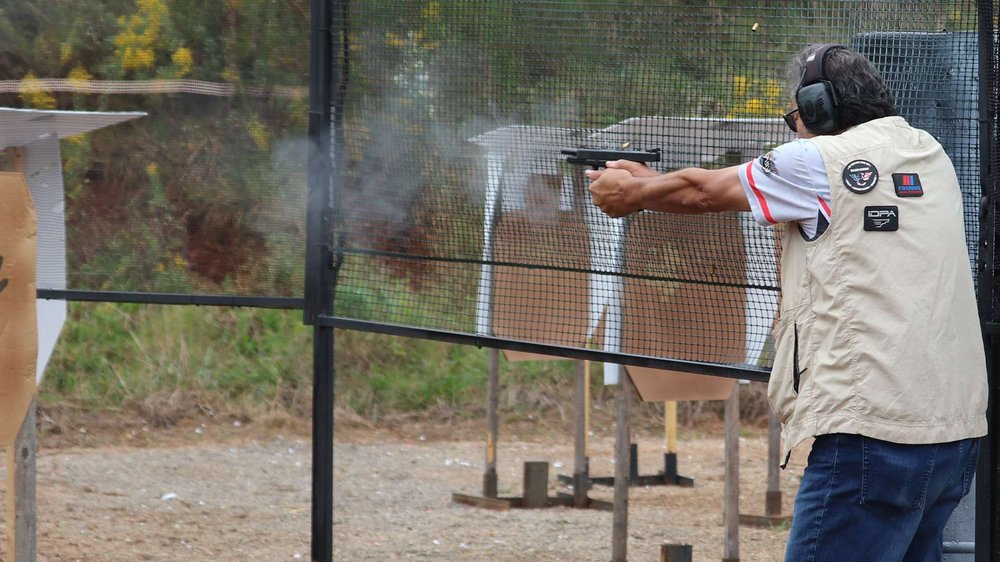
IDPA (International Defensive Pistol Association) takes a completely different approach. If IPSC/USPSA are the F1 of shooting sports, IDPA is rally racing — it emphasizes practicality and defensive scenario simulation. Founded in 1996, its creators felt IPSC had become too “gamey” and was drifting too far from the essence of self-defense shooting.
In IDPA matches, you must draw from concealment (lifting a cover garment), use available cover to protect yourself, and retain partially loaded magazines during reloads. These rules are designed to simulate real defensive situations. IDPA uses Vickers Count scoring — your raw time plus penalty seconds for misses — encouraging shooters to balance speed and accuracy rather than chasing speed at all costs.
IDPA also has stricter equipment restrictions. You can’t use heavily modified “race guns,” and most people compete with their everyday carry pistol. This makes IDPA the favorite competition format for many concealed carry permit holders.
For details, see our IDPA Defensive Shooting Complete Training Guide or IDPA vs USPSA Complete Comparison Guide.
Steel Challenge — The Purest Form of Speed
If you find other competitions’ rules too complex, Steel Challenge might be exactly what you’re looking for. This is the purest form of practical shooting: five steel plates in front of you, and your only job is to hit them all as fast as possible. No complex stage designs, no movement shooting, no barriers — just draw, shoot, draw, shoot.
Steel Challenge features eight standardized stages with fixed target positions and distances, identical worldwide. This means you can precisely simulate every stage during dry fire practice at home. Scoring is dead simple: five runs, drop the slowest, sum the remaining four. Fastest total wins.
One reason Steel Challenge is particularly beginner-friendly is that it allows rimfire (.22 LR) pistols and rifles. A Ruger Mark IV can get you into competition, ammunition costs are minimal, and recoil is virtually nonexistent — perfect for building confidence and fundamental skills when you’re just starting out.
For a complete breakdown, see Steel Challenge Speed Shooting Complete Beginner Guide.
3-Gun — The Ultimate Multi-Weapon Challenge
3-Gun (multi-gun competition) is the most spectacular and demanding practical shooting discipline. As the name implies, you use three weapons in a single match: a pistol, a rifle (typically an AR-15), and a shotgun. Each stage requires transitions between weapons, testing not just your proficiency with each platform but also your ability to safely switch between them.
Picture this scenario: you start by engaging clay targets with your shotgun, then safely stage it and pick up your rifle to engage steel plates at 200 yards, then transition to your pistol for close-range paper targets. The entire sequence flows smoothly, with strict safety procedures at every weapon transition — that’s the essence of 3-Gun.
The barrier to entry is higher because you need three weapon systems with all their accessories. But if you enjoy variety in your shooting experience, no other competition format offers the diverse shooting scenarios you’ll find in a single day of 3-Gun.
For detailed equipment and rules, see 3-Gun Competition Complete Beginner Guide.
Which Discipline Should You Choose?
Facing five options, many beginners feel paralyzed by choice. The truth is there’s no “best” discipline — only the one that’s best for you. Here are some perspectives to help you decide.
If your top priority is a low barrier to entry, Steel Challenge is the ideal starting point. A .22 caliber pistol is all you need, ammunition is cheap, rules are simple, and you don’t need a holster or magazine pouches. Many clubs run Steel Challenge monthly matches that don’t even require membership — just show up and register.
If you already have a concealed carry permit and carry daily, IDPA will feel especially meaningful. You can compete with the same gun and holster you carry every day, and the skills you practice are the closest to real-world defensive use.
If what you’re after is pure competitive enjoyment and a clear path of progression, IPSC or USPSA Production division is the classic choice. The rule systems are mature, classification systems are well-established, and there are matches to shoot worldwide (or nationwide). Many shooters spend their entire careers climbing from C-class to A-class to Master, and that clear trajectory of improvement is addictive.
If you want to try everything, 3-Gun offers the richest experience — but consider building a solid foundation in pistol competition first.
| Discipline | Entry Budget | Weapons Used | Defining Feature | Beginner-Friendly |
|---|---|---|---|---|
| IPSC | $800-1,500 | Pistol | Largest globally, most varied stages | ★★★★ |
| USPSA | $800-1,500 | Pistol | North American mainstream, many divisions | ★★★★ |
| IDPA | $600-1,000 | Pistol | Defense-oriented, minimal gear required | ★★★★★ |
| Steel Challenge | $300-800 | Pistol/Rifle | Pure speed, .22 LR eligible | ★★★★★ |
| 3-Gun | $2,000-4,000 | Pistol + Rifle + Shotgun | Multi-weapon transitions, diverse scenarios | ★★★ |
Essential Gear Checklist for Beginners
Regardless of which discipline you choose, here’s what you’ll need to get started. The good news is that most gear is cross-compatible between different competition formats.
A reliable pistol is the foundation of everything. For IPSC/USPSA Production division, the CZ Shadow 2, Glock 34, and Canik Rival-S are the most popular choices. For IDPA, the Glock 19, SIG P320, and Smith & Wesson M&P 2.0 are classic picks. You don’t need to spend big on a top-tier race gun — a reliable $500-700 pistol will serve you well for years of competition. For detailed buying advice, see our IPSC Beginner Pistol Selection Guide or IDPA Beginner Pistol Selection Guide.
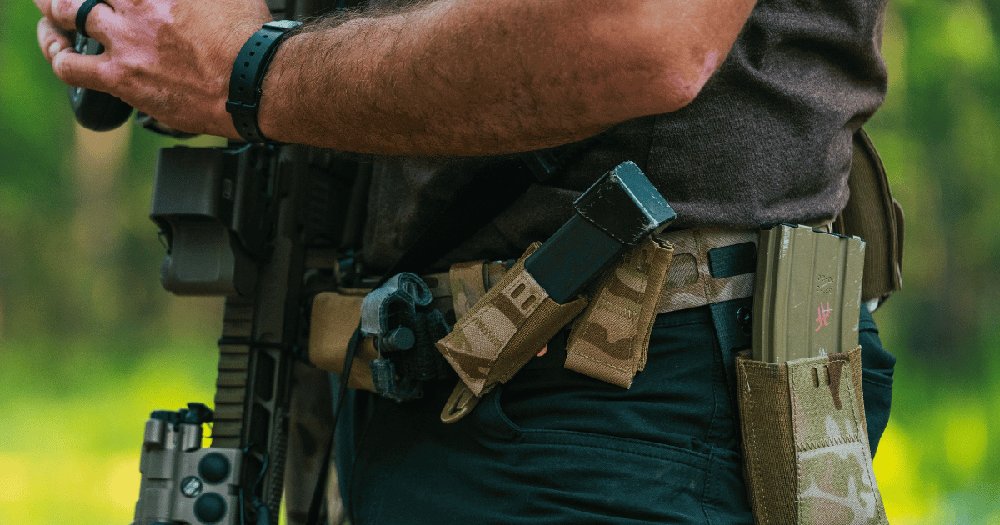
A holster and magazine pouches are the next priority. IPSC/USPSA allows exposed competition holsters (like the DAA Alpha-X or Ghost), while IDPA requires concealment holsters. A good competition belt is fundamental — it needs to be stiff enough to securely support the weight of your holster and mag pouches. You don’t need the most expensive option to start; an entry-level Blade-Tech or Comp-Tac setup runs about $100-150. Learn more in our Competition Holster Selection Guide and Competition Belt Selection Guide.
Eye and ear protection are mandatory safety equipment. A pair of ANSI Z87.1+ rated shooting glasses and a set of electronic earmuffs (like the Howard Leight Impact Sport) is the bare minimum investment, running about $60-80 total. If your eye protection falls off during a match, you’ll be stopped immediately. For detailed gear recommendations, see Shooting Protection Gear Complete Guide.
From Zero to Your First Match: A Training Roadmap
Many people think they need to be skilled before they can compete. The reality is exactly the opposite — competing is the fastest way to improve. Most shooters perform modestly at their first match, and that’s perfectly normal. What matters is that you took the first step.
The first phase of training is dry fire practice. Before you own a gun, or when you want to practice without spending on ammunition, dry fire is free and incredibly effective. Practice draws, sight alignment, trigger presses, and reloads — all of these can be safely rehearsed at home. Many elite shooters spend more time on dry fire than live fire. Just 15-20 minutes of daily dry fire practice can dramatically accelerate your fundamental skills. For detailed methods, see Dry Fire Training Complete Guide.
The second phase is airsoft or air gun practice. If you haven’t obtained a firearms license yet, or want to practice dynamic shooting without heavy ammunition costs, a GBB (Gas Blowback) airsoft pistol is an excellent training tool. IPSC Action Air competitions use the same scoring and stage designs as real-steel IPSC. A Tokyo Marui Hi-CAPA or Glock GBB lets you practice draws, movement shooting, and reloads at a fraction of the cost. Learn more in our IPSC Action Air Complete Guide and Airsoft & Firearms Cross-Training Guide.
The third phase is live fire training. Visit the range weekly or biweekly, focusing on a few fundamental drills: the Bill Drill (six shots from the holster at seven yards), El Presidente (turn, draw, engage three targets), and Blake Drill (target transitions). You don’t need to shoot hundreds of rounds — 50-100 rounds of purposeful practice beats 500 rounds of unfocused shooting every time. For a complete drill library, see Shooting Drills Complete Guide.
The fourth phase is simply signing up for your first match. Check the USPSA or IPSC website for matches near you, or search Facebook for local shooting clubs. Most local monthly matches charge only $20-30 and don’t require membership. When you arrive, tell people you’re new — almost everyone will go out of their way to help. The shooting community is one of the most welcoming sports communities you’ll ever encounter.
Using a Shot Timer to Accelerate Your Progress
No matter which practical shooting discipline you choose, a Shot Timer is your most essential training partner. Its core function is simple: it detects gunshots and records each one’s timing. But the improvement this simple tool can drive is remarkable.
A Shot Timer’s most important use is establishing baseline data. Without a timer, you might feel like your draw is pretty fast — but until you see “1.8 seconds” displayed on the screen, you don’t truly know where you stand. With data, you can set specific goals, track progress, and identify bottlenecks.
For practical shooting beginners, here are some benchmark times to use as starting points and goals. Draw to first shot: beginners around 2.0-2.5 seconds, target is under 1.5 seconds. Split times (shot-to-shot): beginners 0.4-0.6 seconds, intermediate shooters aim for 0.25-0.35 seconds. Reload: beginners 3.0+ seconds, target under 2.0 seconds. These numbers aren’t meant to create pressure — they help you know where to invest your practice time.
PAR time training is one of the Shot Timer’s most powerful features. You set a target time (say 3 seconds), and the timer beeps when time expires. Your task is to complete a designated action within that window — draw and fire one shot, perform a reload, engage two targets. When you can consistently finish within the PAR time, shorten it by 0.2 seconds and practice again. This “pressured but manageable” training mode is the fastest path to improvement.
Our Shot Timer App Complete Guide has detailed setup tutorials and training drills, and pairing it with our Personal Shooting Training Plan Guide can help you build a systematic training program.
Frequently Asked Questions
Q1: I have zero shooting experience. Can I go straight to a match?
You can, but we recommend visiting a range a few times first to get comfortable with basic gun handling and safety rules. Most matches welcome beginners, and many even have dedicated new shooter orientations or mentor programs. For your first match, don’t put any pressure on yourself about scores — your only goal is to safely complete every stage.
Q2: How much budget do I need to get started?
If you already own a pistol, you can get the essentials (holster, mag pouches, and eye/ear protection) for about $150-200 and start competing. Starting from scratch (including buying a pistol), IDPA or USPSA Production runs about $800-1,200 in initial investment. Steel Challenge with a .22 pistol is even cheaper at $400-600 to get started.
Q3: Is practical shooting dangerous?
Practical shooting actually has an excellent safety record. All matches enforce strict safety rules with professional Range Officers (ROs) supervising every shooter. Safety violations result in immediate match disqualification (DQ). Competition safety standards are actually more stringent than typical recreational range shooting. As long as you follow the four gun safety rules and listen to RO instructions, the risk is extremely low. For comprehensive safety knowledge, see Gun Safety Rules Complete Guide.
Q4: Can I participate without owning a firearm?
In some countries and regions, yes. Many shooting clubs offer firearm rental, and some matches allow borrowing from other shooters. In the airsoft world, IPSC Action Air competitions only require a GBB airsoft pistol. But for most live-fire competitions, owning your own firearm and gear will provide a much better experience.
Q5: Is this suitable for women, older adults, or people with limited physical ability?
Absolutely. Practical shooting isn’t a physical fitness contest — it tests technique, speed, and mental composure. Many top-ranked shooters are women, and many compete well into their sixties and seventies. Division designs accommodate different needs: Steel Challenge involves no running at all, and IDPA stage distances are quite short. You don’t need to run fast or be strong — you need steady hands and a cool head.
Conclusion
Practical shooting is one of the most addictive sports you’ll ever encounter. It transforms shooting from a static skill exercise into a competitive sport full of strategy, speed, and challenge. Whether you choose IPSC’s global stage, USPSA’s North American circuit, IDPA’s defensive focus, Steel Challenge’s pure speed pursuit, or 3-Gun’s multi-weapon ultimate test, you’ll discover a friendly, passionate community that never stops pushing to improve.
Don’t wait until you feel “ready” to begin — nobody is ready on day one. Go buy a pair of safety glasses and earmuffs, find your nearest shooting club and ask when their next match is, and sign up. The hardest step is always the first one, and once you take it, you’ll find this world is far more exciting than you ever imagined.
📚 Related Articles
- IPSC Practical Shooting Complete Training Guide - IPSC rules and training methods
- USPSA Practical Shooting Complete Beginner Guide - All eight USPSA divisions explained
- IDPA Defensive Shooting Complete Training Guide - IDPA rules and defensive techniques
- IDPA vs USPSA Complete Comparison Guide - Detailed head-to-head comparison
- Steel Challenge Speed Shooting Complete Beginner Guide - Pure speed competition
- 3-Gun Competition Complete Beginner Guide - Multi-gun competition guide
- IPSC Action Air Complete Guide - Airsoft IPSC competition
- IPSC Beginner Pistol Selection Guide - First competition pistol advice
- Shooting Drills Complete Guide - Training drills and Shot Timer application
- Shot Timer App Complete Guide - Timer setup and training techniques
- Practical Shooting
- IPSC
- USPSA
- IDPA
- Steel Challenge
- 3-Gun
- Action Shooting
- Competitive Shooting
- Shot Timer
- Shooting Sports