Steel Challenge Times by Class: How Peak Time Scoring Works (All 8 Stages & 13 Divisions)
What Is Steel Challenge?
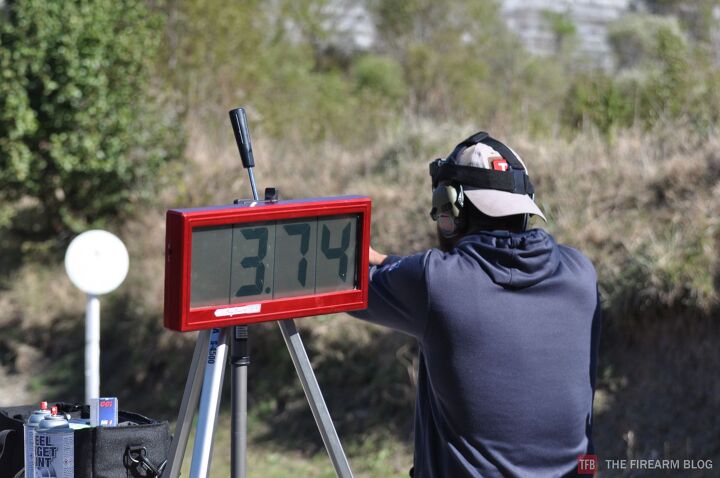
Steel Challenge is the one shooting sport where your entire result is a stopwatch reading. No scoring zones, no hit factor, no stage plan — five steel plates, hit them all, fastest time wins. That is the whole rulebook in a sentence, and it is why the sport is both the easiest to explain to a newcomer and the hardest to hide in.
It also means your classification is not an opinion. SCSA, which has been part of USPSA since 2008, publishes a Peak Time for every stage in every division — essentially the benchmark a top shooter posts — and your class is simply your time compared against it. Shoot a stage in 12.5 seconds where the Peak Time is 10, and you scored 80% for that stage, which puts you in A Class. There is no committee and no subjectivity, just division.
The format is eight standardized stages, five plates each, one of which is the Stop Plate you must hit last. You shoot each stage five times (Outer Limits is four), drop your slowest run, and total the rest. Add the eight stage scores and that is your match. Because the stages never change, your times are directly comparable across every match you will ever shoot — which makes Steel Challenge unusually good for tracking whether your training is actually working.
There is no Power Factor requirement either, so you can shoot the lightest, cheapest ammunition available, and a .22LR pistol or rifle is fully competitive in its own divisions. For a lot of shooters that combination — fixed stages, pure time scoring, rimfire-friendly — makes it the cheapest serious competitive shooting there is.
This Guide Will Cover
- Official layouts and a planning note for all eight stages (SC-101 to SC-108)
- Detailed breakdown of 13 divisions with selection advice
- Classification system and advancement paths
- Key differences between Steel Challenge and USPSA/IPSC
- Complete preparation checklist for your first match
- Shot Timer training methods and speed improvement techniques
💡 Further Reading: If you’re interested in other competitive shooting sports, check out our Your First USPSA Match, IPSC Training Guide, and IDPA Training Guide.
The Eight Standardized Stages of Steel Challenge
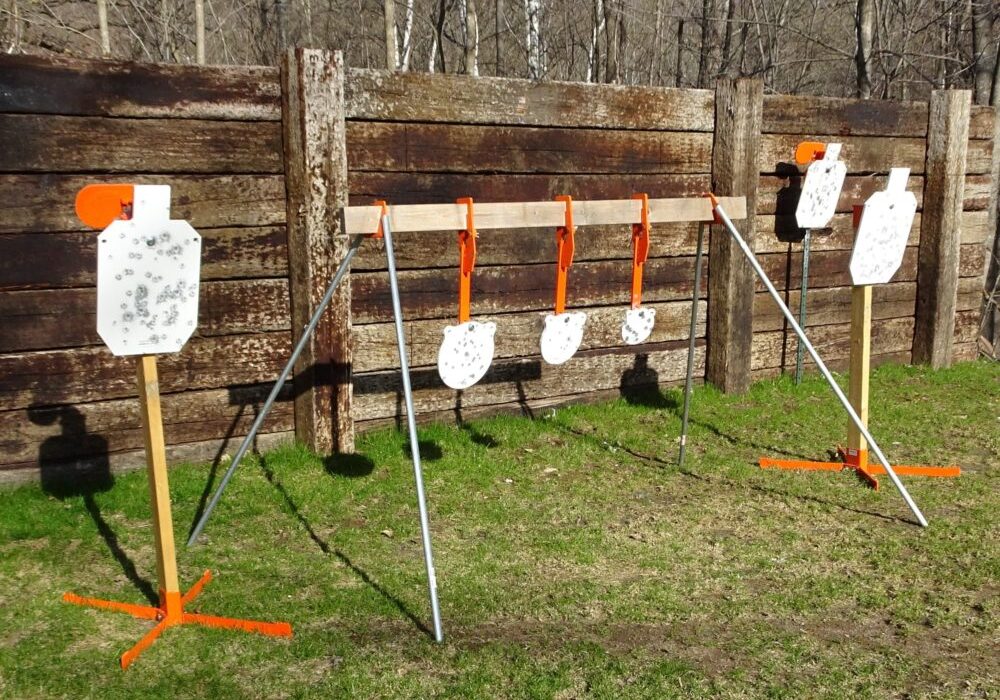
One of Steel Challenge’s most unique features is that all matches use the same eight standardized stages. This means no matter where you compete, the challenges are identical, allowing you to focus on refining your technique and strategy for each stage. Each stage has five steel targets, one of which is the Stop Plate — the last target you must hit.
Steel Target Specifications
Steel Challenge uses three sizes of steel targets:
- Small round plate: 10 inches (approximately 25 cm) diameter
- Large round plate: 12 inches (approximately 30 cm) diameter
- Rectangular plate: 18 × 24 inches (approximately 46 × 61 cm)
The Eight Official Stages at a Glance (SC-101 to SC-108)
The stages carry official SCSA numbers, and the order below is the order in the rulebook’s stage diagrams (Appendix B), not a difficulty ranking. Every distance here is measured from the front of the shooting box and comes from those official diagrams; plate sizes use the three standard targets above.
| Code | Stage | Standard plates | Plate distances | Stop plate |
|---|---|---|---|---|
| SC-101 | 5 to Go | 4 × 10" rounds | 10, 12, 15, 18 yd | 12" round, 7 yd, far right |
| SC-102 | Showdown | 2 × 10" + 2 × rectangles | 10 yd (plates), 25 yd (rectangles) | 12" round, 12 yd, center |
| SC-103 | Smoke & Hope | 4 × rectangles | 7 yd and 9 yd | 12" round, 14 yd, center |
| SC-104 | Outer Limits | 2 × 12" + 2 × rectangles | 20 yd (plates), 35 yd (rectangles) | 12" round, 18 yd, center |
| SC-105 | Accelerator | 10" + 12" + 2 × rectangles | 10 yd (left pair), 20 yd (right pair) | 12" round, 15 yd, center |
| SC-106 | The Pendulum | 2 × 10" + 2 × 12" | all four at 18 yd | 12" round, 10 yd, center |
| SC-107 | Speed Option | 4 × 12" rounds | 8, 10, 15, 20 yd | 18"×24" rectangle, 35 yd, far left |
| SC-108 | Roundabout | 4 × 12" rounds | 7 yd and 15 yd | 12" round, 10 yd, just right of center |
Two things jump out once you see the stages side by side. First, the stop plate is almost never the “last target in line” — on 5 to Go it is the closest plate but far out to the right, on Speed Option it is a big rectangle at 35 yards, and on six of the eight stages it sits in the middle of the array, so you must swing back to it. Second, the “easy” stages are not the close ones but the big-target ones: Smoke & Hope has rectangles at 7 and 9 yards, while 5 to Go makes you hit 10-inch plates out to 18 yards.
Stage-by-Stage Layout and Planning
The notes below describe each official layout and then the planning decision that actually costs or saves time on it. Engagement order is up to you on every stage — the only rule is that all four standard plates must be hit before the stop plate, or each missed plate costs 3 seconds.
SC-101 — 5 to Go
Four 10-inch plates step away from you from left to right — 10, 12, 15 and 18 yards — and the 12-inch stop plate stands alone at 7 yards, roughly 17 feet right of center. The plates are the smallest targets in the match, and the farthest one is a real 18-yard shot, so this is a precision stage wearing a speed stage’s name.
The natural plan is to sweep left to right, near to far, and then make the long swing back down to the stop plate. That last transition is the biggest movement in the string, but it lands on the closest and largest target, so you can drive the gun hard and let the stop plate come to you. Where people bleed time is the 15- and 18-yard plates: a hurried shot there turns into a make-up shot, and one make-up costs more than any transition you could shave. On the timer, compare your first-shot time with your total; if the splits between the two far plates are much longer than the rest, slow the trigger there and speed up everywhere else.
SC-102 — Showdown
Showdown is shot from two boxes 6 feet apart. Two 10-inch plates stand at 10 yards, 4 feet either side of center; two 18×24 rectangles sit far out at 25 yards, 9 feet either side; and the 12-inch stop plate is at 12 yards dead center. You shoot three strings from one box and two from the other (you choose which box gets three), and there is no movement during a string.
A common plan is to take one side as a pair — near plate, far rectangle — then the other side’s pair, then the stop plate in the middle, and to mirror that exact order from the second box. The rectangles look huge but 25 yards is the second-longest distance in the match, so this is where you learn whether your “big target” confidence is real. Because the two boxes produce two different pictures, time both in practice; many shooters find one side noticeably slower and choose to shoot their three strings from the faster box.
SC-103 — Smoke & Hope
Four big 18×24 rectangles — two at 7 yards set wide (14 feet each side of center) and two at 9 yards set closer in (9 feet each side) — with the 12-inch stop plate out at 14 yards in the middle. This is the fastest stage in Steel Challenge; the records sit well under two seconds per string, and even club shooters post strings that feel like one long burst.
The usual plan is a single sweep — outer rectangle, inner rectangle, across to the other inner, out to the other outer — and then back to the stop plate. The rectangles are so forgiving that the whole stage comes down to two things: not overswinging past the wide outer rectangles, and respecting the stop plate. It is the smallest target on the stage, twice as far as the closest rectangles, and it is where the name comes from: shooters carry their rectangle pace into it, miss, and give back everything they gained. Build a par time for the four rectangles alone, then add a deliberate stop-plate shot on top.
SC-104 — Outer Limits
The long stage, and the only one with movement. There are three 4×4-foot boxes 6 feet apart. Two 12-inch plates stand at 20 yards (12 feet either side of center), two 18×24 rectangles at 35 yards (6 feet either side), and the 12-inch stop plate at 18 yards in the middle. Per the rules you start in the outside box on your weak side, engage the 20- and 35-yard targets on that side of the center line, move to the middle box on the clock, and finish the other side’s two targets and the stop plate. It is shot four times with the best three counting.
Planning here is mostly about the move. Shoot the weak-side pair, start moving as the last shot breaks, and set up in the middle box with the gun already on the next target. Engaging a target from the wrong box costs 3 seconds per occurrence, so walk the stage mentally before you load. The 35-yard rectangles are the longest shots in the match; this is the stage where a red dot or a rifle-caliber sight picture pays off most, and where rimfire shooters discover how much wind and a little trigger jerk matter.
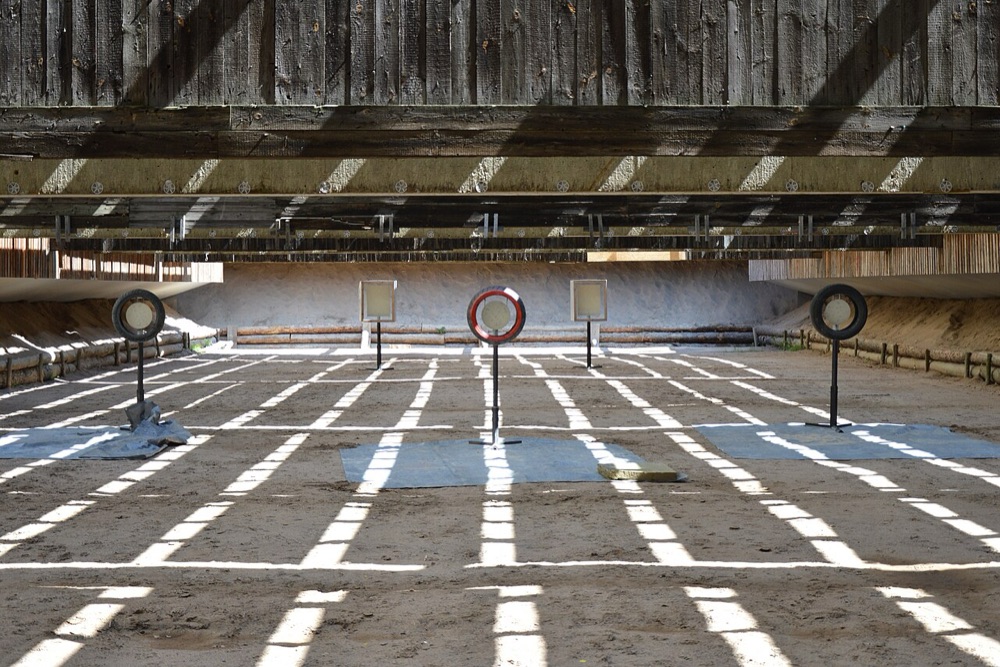
An Outer Limits setup at a 2013 match in Germany — the round plates and stop plate in front, the two rectangles at the back. Photo: Krd, Wikimedia Commons, CC BY-SA 3.0.

SC-105 — Accelerator
Five targets that literally get farther away as you go. On the left, at 10 yards, stand a 10-inch plate and an 18×24 rectangle; the 12-inch stop plate is at 15 yards in the center; on the right, at 20 yards, stand a 12-inch plate and a second rectangle set far out to the side.
The name tells you the intended rhythm: start fast on the close left pair, cross the center without touching the stop plate, and settle for the 20-yard pair before coming back to the stop plate. The trap is carrying your 10-yard pace to the 20-yard plate — that is the “accelerate, then brake” moment the stage is built around. Shooters who struggle here usually have the same split on every target; a timer makes it obvious, because a good run shows short splits on the left and deliberately longer ones on the right.
SC-106 — The Pendulum
Four plates in a straight line at 18 yards, 6 feet apart — the two inner ones are 10-inch plates set 5 feet high, the two outer ones are 12-inch plates set 6 feet high — and the 12-inch stop plate at 10 yards, center. The swing from end to end is modest; the difficulty is that every standard plate is an 18-yard shot, and the inner two are the small 10-inch size.
Shoot it as a single sweep, end to end, and then drop to the stop plate. Because the plates are evenly spaced, this is the purest test of consistent transitions in the match, and the timer’s split view will show it immediately — four near-identical splits is the goal. Watch the height difference: the outer plates sit higher than the inner ones, and a gun that drifts low on the last outer plate is a common source of misses.
SC-107 — Speed Option
Four 12-inch plates scattered at 8, 10, 15 and 20 yards, alternating sides of center, and a stop target that is an 18×24 rectangle at 35 yards, far to the left. Speed Option is the only stage where the stop is a rectangle, and it is the farthest stop in the match.
The “option” is the order of the four plates, and it is a real decision because they are spread both left and right and at four different depths. A common approach is to work the plates so the string finishes on the left side, close to where the 35-yard stop stands, rather than swinging all the way across at the end. Try two or three orders on a timer in practice and keep whichever is fastest across ten strings, not across one lucky run. The stop is big but far; hitting it with one clean shot is worth more than any clever route.
SC-108 — Roundabout
Four 12-inch plates set in a loose box: two at 7 yards and two wider at 15 yards (about 9 feet left and 8 feet right of center), one of each pair on each side. The 12-inch stop plate sits at 10 yards, just right of center — in the middle of the four. That is the “roundabout”: you drive around the stop plate and then take it last.
Because all five targets are the same size and the distances are short, Roundabout rewards a planned, repeatable path around the box — for example near-left, far-left, far-right, near-right, then the stop — more than raw speed. The mistake to avoid is hitting the stop plate by accident while transitioning past it, which ends the string early and leaves a standard plate as a miss. Time it enough and you will find it is one of the stages where improvement comes fastest.
Are There New Steel Challenge Stages?
Not official ones yet. In May 2025 the USPSA Board approved the Steel Challenge Committee’s recommendation to add two new official stages. The candidates are being run in 2026 as provisional “TS” stages (TS-001, TS-002 and so on) with provisional Peak Stage Times, and SCSA has been collecting match-director and shooter feedback through surveys. As of the rules edition effective September 1, 2026, the official classifier list in Appendix B is still the eight stages above, SC-101 to SC-108 — so those are the only stages that count toward your classification today. If your club runs a provisional stage, treat it as a preview rather than a classifier.
Steel Challenge Divisions Explained
Steel Challenge currently features 13 divisions, split between centerfire and rimfire categories. This diverse division structure allows shooters with different preferences and budgets to find their perfect fit.
Rimfire Divisions
Rimfire divisions are a signature feature of Steel Challenge and the top choice for many beginners. Using .22LR ammunition provides virtually zero recoil and costs far less than centerfire ammunition.
| Division | Abbreviation | Optics Allowed | Equipment Needed | Beginner Rating |
|---|---|---|---|---|
| Rimfire Pistol Open | RFPO | ✅ | .22LR pistol + red dot | ⭐⭐⭐⭐⭐ |
| Rimfire Pistol Iron Sights | RFPI | ❌ | .22LR pistol | ⭐⭐⭐⭐ |
| Rimfire Rifle Open | RFRO | ✅ | .22LR rifle + optic | ⭐⭐⭐⭐⭐ |
| Rimfire Rifle Iron Sights | RFRI | ❌ | .22LR rifle | ⭐⭐⭐⭐ |
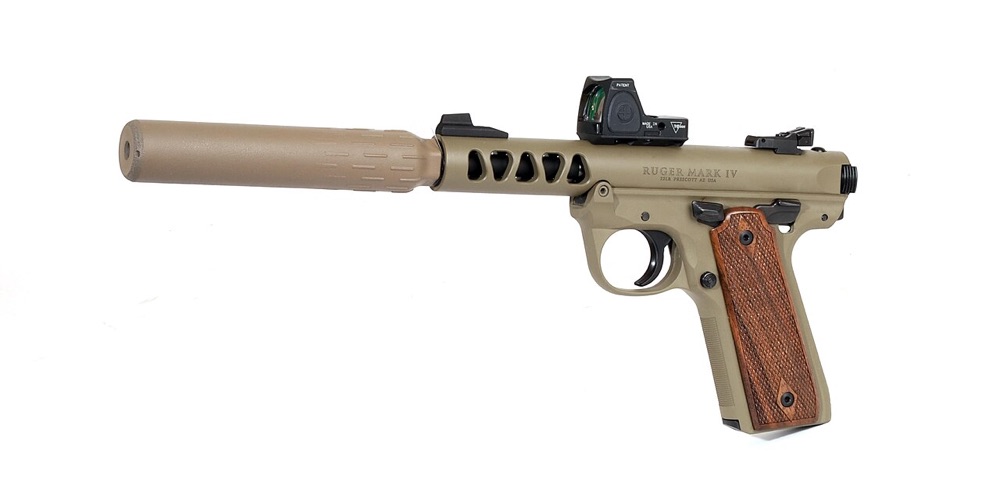
A Ruger Mark IV 22/45 Lite in .22LR with a Trijicon RMR red dot (shown here with a suppressor fitted). Photo: Mitch Barrie, Wikimedia Commons, CC BY-SA 4.0.

Why Beginners Should Start with Rimfire
- Extremely low cost: .22LR ammunition costs less than $0.10 per round — a full match costs under $5 in ammo
- Virtually zero recoil: Lets you focus on technique rather than fighting recoil
- Simple equipment: No competition belt and holster system needed; rifle divisions don’t even need a belt
- Low entry barrier: A basic .22LR pistol and ammunition is all you need to start competing
Recommended Rimfire Pistols
- Ruger Mark IV 22/45: The most popular entry-level choice with high reliability and abundant aftermarket parts
- Browning Buck Mark: Another classic option with excellent accuracy
- Volquartsen Black Mamba / Mamba-X: High-end competition choice for shooters pursuing peak performance
- Smith & Wesson SW22 Victory: Excellent value-for-money entry option
Centerfire Pistol Divisions
| Division | Abbreviation | Optics | Compensator | Mag Capacity Limit | Corresponding USPSA Division |
|---|---|---|---|---|---|
| Open | OPEN | ✅ | ✅ | None | Open |
| Limited | LTD | ❌ | ❌ | None | Limited |
| Limited Optics | LTDO | ✅ | ❌ | None | Limited Optics |
| Production | PROD | ❌ | ❌ | None | Production |
| Carry Optics | CO | ✅ | ❌ | None | Carry Optics |
| Single Stack | SS | ❌ | ❌ | 10 rounds | Single Stack |
| Revolver | REV | ❌ | ❌ | 6 rounds | Revolver |
Key Difference: Steel Challenge Has No Power Factor!
This is one of the biggest differences between Steel Challenge and USPSA/IPSC. In Steel Challenge, there is no Power Factor requirement, meaning you can use the lightest ammunition available. For centerfire divisions, this means you can shoot the softest 9mm loads to reduce recoil and speed up transitions.
Pistol Caliber Carbine Divisions
| Division | Abbreviation | Description |
|---|---|---|
| Pistol Caliber Carbine | PCC | Carbines chambered in pistol calibers |
| PCC Open | PCCO | Allows optics and compensators |
Division Selection Guide
| Shooter Type | Recommended Division | Reason |
|---|---|---|
| Complete beginner | RFPO / RFRO | Lowest cost, lowest barrier, most fun |
| Has a handgun but no competition gear | Production / CO | Compete with existing handgun |
| Already has USPSA equipment | Corresponding USPSA division | Equipment is cross-compatible |
| Seeking maximum speed | Open / PCC | Fewest restrictions, highest speed potential |
| Budget-conscious | RFPI / RFRI | No optics needed, minimal equipment cost |
Steel Challenge Classification System
Steel Challenge uses a classification system similar to but calculated independently from USPSA, with eight classification levels. Classification is based on how your performance compares to the Peak Time for each stage.
Classification Levels
| Class | Full Name | Abbreviation | Percentage |
|---|---|---|---|
| Grand Master | Grand Master | GM | ≥ 95% |
| Master | Master | M | 85% - 94.99% |
| A Class | A Class | A | 75% - 84.99% |
| B Class | B Class | B | 60% - 74.99% |
| C Class | C Class | C | 40% - 59.99% |
| D Class | D Class | D | 2% - 39.99% |
| Unclassified | Unclassified | U | Fewer than 4 stage scores |
How Classification Is Calculated
Steel Challenge classification calculation is straightforward:
- Peak Time: Each stage and division has a “Peak Time” representing the performance level of top shooters
- Your percentage = Peak Time ÷ Your Actual Time × 100%
- Overall classification: Your percentages across all stages you’ve shot are combined
For example, if a stage’s Peak Time is 10 seconds and your time is 12.5 seconds, your percentage for that stage is 10 ÷ 12.5 × 100% = 80%, corresponding to A Class.
Requirements for Classification
- You need valid scores in at least four different stages to receive an initial classification
- Classification is calculated independently per division — your RFPO classification doesn’t affect your Production classification
- Classification updates progressively as your performance improves
Approximate Match Total Times by Class (Centerfire Production)
| Class | Approximate Total Time | Description |
|---|---|---|
| GM | < 80 seconds | Elite-level shooter |
| M | 80-95 seconds | Highly skilled shooter |
| A | 95-110 seconds | Experienced competitive shooter |
| B | 110-135 seconds | Solid intermediate shooter |
| C | 135-170 seconds | Shooter with fundamentals |
| D | > 170 seconds | Entry level |
Note: These times are rough approximations only. Actual classification is based on Peak Time percentages.
Steel Challenge vs USPSA/IPSC: Key Differences
If you’re already familiar with USPSA or IPSC, understanding Steel Challenge’s differences will help you adapt quickly.
Core Differences Comparison
| Feature | Steel Challenge | USPSA | IPSC |
|---|---|---|---|
| Stage Design | 8 fixed standardized stages | Different every match | Different every match |
| Target Types | Steel plates only | Paper + steel | Paper + steel |
| Scoring Method | Pure time (fastest wins) | Hit Factor | Hit Factor |
| Power Factor | No requirement | Minor/Major | Minor/Major |
| Runs Per Stage | 5 runs keep 4 (Outer Limits: 4 keep 3) | 1 run per stage | 1 run per stage |
| Movement | Stationary shooting position | Extensive movement | Extensive movement |
| Paper Target Scoring | N/A | A/C/D zones | A/C/D zones |
| Rimfire Divisions | Yes (4 divisions) | No | No |
| Entry Barrier | Low | Medium | Medium-High |
| Match Duration | Short (2-3 hours) | Medium (3-5 hours) | Long (4-6+ hours) |
Unique Advantages of Steel Challenge
- Lowest entry barrier: Compete with .22LR, no complex equipment needed
- Simplest rules: No need to understand Hit Factor, Power Factor, or scoring zones
- Multiple practice opportunities: 5 runs per stage gives you chances to improve each run
- Fixed stages enable tracking progress: Same challenges every time, so you can precisely track improvement
- Short match duration: Usually completed in 2-3 hours, great for busy schedules
- Extremely spectator-friendly: Simple rules anyone can understand
Tips for USPSA/IPSC Shooters Transitioning to Steel Challenge
- Adjust your mindset: No need to plan stage movement; focus purely on shooting speed
- Retrain transitions: Steel Challenge transitions are more frequent and faster
- Take advantage of ammunition: Use lighter loads to improve speed
- Focus on the first shot: Draw-to-first-hit accuracy is absolutely critical
Your First Steel Challenge Match: Complete Preparation Guide
Pre-Match Preparation
Membership
- SCSA/USPSA membership: Some matches require membership, but many local (Level 1) matches accept non-members
- Annual fee: USPSA membership is approximately $75/year (includes SCSA)
- Recommendation: Attend 1-2 matches as a non-member first, then sign up once you’re sure you enjoy it
Finding Matches
- SCSA website (scsa.org): Search for certified matches in your area
- Practiscore.com: The most commonly used match registration platform — search for “Steel Challenge”
- Local shooting clubs: Many clubs host monthly Steel Challenge matches
- Social media: Join local shooting groups on Facebook or other platforms
Equipment Checklist
Rimfire Division (Minimum Requirements):
| Item | Description | Budget Reference |
|---|---|---|
| .22LR pistol or rifle | Any reliable .22LR firearm | $200-600 |
| Ammunition | At least 200 rounds of .22LR | $15-25 |
| Eye protection | ANSI Z87.1 rated | $15-40 |
| Ear protection | Electronic recommended | $30-80 |
| Gun bag | For safe firearm transport | $20-40 |
Centerfire Pistol Division:
| Item | Description | Budget Reference |
|---|---|---|
| Handgun | Must meet division requirements | $400-800 |
| Ammunition | At least 250 rounds | $50-75 |
| Holster | Outside-the-waistband (OWB) | $40-150 |
| Belt | Sturdy leather or competition belt | $40-120 |
| At least 5 magazines | Reduces loading time during match | $75-150 |
| Eye protection | ANSI Z87.1 rated | $15-40 |
| Ear protection | Electronic recommended | $30-80 |
Match Day Flow
- Registration: Arrive early to confirm your division and squad assignment
- Equipment Check: Officials verify your gear meets division requirements
- Safety Briefing: Learn range rules and any special arrangements for the day
- Shoot by squad: Follow your squad rotation through the stages
- At each stage:
- Listen to the Written Stage Briefing (WSB)
- Assume start position
- Begin shooting when the buzzer sounds
- Hit the four regular targets, then finish with the stop plate
- Repeat for five runs (four for Outer Limits)
- Results: Scores are typically posted shortly after the match concludes
Top 10 Tips for New Competitors
- Accuracy beats speed: A miss requiring makeup shots wastes far more time than spending an extra 0.1 seconds aiming
- Confirm every hit: Listen for the ring of steel before transitioning to the next target
- Always shoot the stop plate last: If you hit the stop plate first, the timer stops
- Practice your draw: Draw-to-first-hit time accounts for a huge portion of your total time
- Maintain safety: The 180-degree rule and trigger discipline apply here too
- Bring enough ammunition: At least 25 rounds per stage (5 targets × 5 runs), minimum 200 for all eight stages
- Stay hydrated: Bring water and sunscreen for outdoor matches
- Watch experienced shooters: Observe how skilled competitors approach each stage
- Record your times: Use your phone to note each run’s time as a training baseline
- Have fun: Your first match goal is to learn and enjoy, not chase placements
Shot Timer Training: Improving Your Steel Challenge Performance
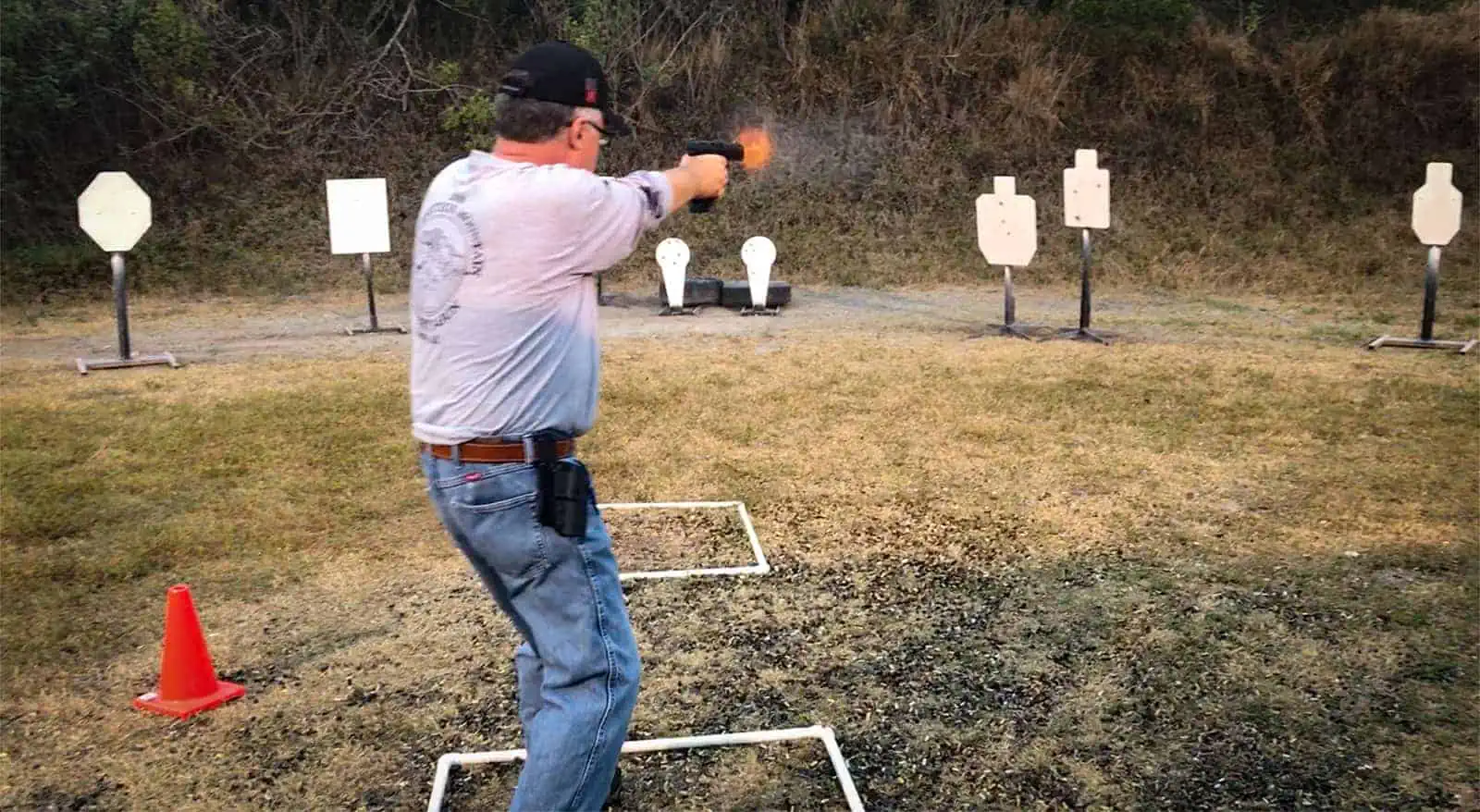
Steel Challenge is the competitive shooting sport most directly linked to Shot Timer usage — because it’s all about time. Here are effective training methods using a Shot Timer.
Fundamental Skill Training
1. Draw to First Shot
The time from draw to hitting the first target is one of the most critical skills in Steel Challenge.
| Level | Target Time | Training Method |
|---|---|---|
| Beginner | < 2.0 sec | Focus on correct mechanics |
| Intermediate | < 1.5 sec | Add PAR time pressure |
| Advanced | < 1.2 sec | High-rep dry fire practice |
| Competition | < 1.0 sec | Full-speed live fire |
Training Methods:
- Use Shot Timer’s random delay feature
- Set PAR times and progressively shorten them
- Practice at least 30 draws per training session
- Use Shot Timer buzzer during dry fire to simulate match pressure
2. Transition Time
The Shot Timer’s split time function precisely measures each transition between targets.
| Level | Close-Range Transition Goal | Long-Range Transition Goal |
|---|---|---|
| Beginner | < 0.50 sec | < 0.80 sec |
| Intermediate | < 0.35 sec | < 0.60 sec |
| Advanced | < 0.25 sec | < 0.45 sec |
| Competition | < 0.20 sec | < 0.35 sec |
Training Methods:
- Set up two targets and practice rapid transitions
- Record split times with your Shot Timer
- Gradually increase the angle between targets
- Practice the “eyes lead” technique — move your visual focus to the next target first
3. Stop Plate Drill
The stop plate is a unique element of Steel Challenge. You must confirm all four regular targets are hit before delivering a precise final shot on the stop plate.
Training Methods:
- Designate one target as the stop plate
- Use Shot Timer to record: Draw → Engage 3-4 targets → Final stop plate hit
- Key point: Don’t rush the stop plate — ensure a solid hit
Advanced Training Drills
PAR Time Pressure Training
Use the Shot Timer’s PAR mode to set target times for each run.
- Baseline test: Shoot 5 runs and record your average time
- Set PAR: Reduce your average by 10% as the PAR target
- Progressive compression: Reduce PAR by another 5% each week
- Stay clean: If you can’t hit all targets within the PAR, revert to the previous PAR time
Dry Fire Training
Steel Challenge is perfectly suited for dry fire practice because the stage layouts are fixed and can be simulated at home.
- Place 5 small stickers on a wall to simulate target positions
- Use Shot Timer buzzer to start
- Practice the complete flow: draw, transitions, stop plate
- Train 20-30 minutes per session
- Important: Follow all safety rules and ensure the firearm is completely unloaded
💡 App Recommendation: Our Airsoft Shot Timer App supports PAR time mode and random delay features, making it an ideal training companion for Steel Challenge practice.
Stage-Specific Training Strategies
Different stages require different training emphasis:
| Stage Type | Representative Stages | Training Focus | Recommended Drill |
|---|---|---|---|
| Big targets, pure speed | Smoke & Hope, Roundabout | Draw + fast transitions, a deliberate stop plate | Bill Drill variations |
| Small plates at distance | 5 to Go, The Pendulum | Accurate first shot, equal splits on 10" plates | Single-plate accuracy under a par time |
| Changing distances | Accelerator, Showdown | Speeding up close, braking for the far targets | Near-far transition drills |
| Long range and movement | Outer Limits, Speed Option | Stable sight picture at 20-35 yd, shooting on the move into a box | Long-range single-target drills |
Frequently Asked Questions
Q1: Is Steel Challenge suitable for complete beginners with no shooting experience?
Absolutely! Steel Challenge has the simplest rules of any competitive shooting sport, and the rimfire divisions have the lowest barrier to entry (.22LR is all you need). It’s the easiest competitive shooting sport to get started in. Many shooters begin their competitive journey with Steel Challenge.
Q2: How many rounds do I need for a Steel Challenge match?
Theoretically, 8 stages × 5 targets × 5 runs = 200 rounds (Outer Limits is 4 runs, so 195 total minimum). Accounting for possible misses and makeup shots, bring 250-300 rounds. With .22LR, that’s approximately $20-30.
Q3: Can I use my IPSC/USPSA equipment for Steel Challenge?
Yes! If you already have USPSA equipment, you can enter the corresponding Steel Challenge division directly. Holsters, belts, magazine pouches, and other gear are fully cross-compatible.
Q4: Are there age restrictions for Steel Challenge?
SCSA allows shooters 12 years and older to compete (in rimfire divisions), but minors require a legal guardian present. Some local matches may have stricter age requirements, so check in advance.
Q5: How can I advance from D Class quickly?
Focus on these key areas:
- Eliminate misses: Makeup shot time far exceeds the time saved by rushing
- Practice your draw: Draw-to-first-hit usually has the biggest room for improvement
- Fix your engagement order: Use the same sequence for each stage to build muscle memory
- Train with a Shot Timer: Quantify your progress and identify your weakest areas
Q6: What’s the difference between Steel Challenge and a Plate Rack?
A Plate Rack is a single training apparatus with six steel targets in a row, while Steel Challenge is a complete competitive sport with eight standardized stages and a formal classification system. Plate Rack practice is excellent transition training, but the strategy and technique differ from Steel Challenge.
Q7: What .22LR pistol is best for Steel Challenge?
- Budget entry: Ruger Mark IV 22/45 ($400-500) — Most popular choice with abundant aftermarket support
- Mid-range upgrade: Ruger Mark IV + Volquartsen upgrade kit ($600-800) — Improved trigger and accuracy
- Top-tier competition: Volquartsen Black Mamba or Mamba-X ($1,200+) — Purpose-built for competition
Q8: How does Steel Challenge benefit airsoft players?
Steel Challenge training — rapid target identification, precise aiming, fast transitions — overlaps significantly with airsoft gameplay skills. Even if you primarily play airsoft, participating in Steel Challenge (especially rimfire divisions) can significantly improve your reaction speed and target acquisition. Pair it with daily training using the Airsoft Shot Timer App for maximum benefit.
Q9: What times do I need for each Steel Challenge class?
Classification is a percentage, not a fixed time: your class comes from Peak Time ÷ your time. GM starts at 95%, Master at 85%, A at 75%, B at 60%, C at 40% and D at 2%. Because Peak Times differ by stage and by division, there is no single time chart that applies everywhere — the approximate match totals in the classification section above are a rough orientation for Centerfire Production only. SCSA publishes the current Peak Times per stage and division, and you need valid scores in at least four different stages before you get an initial classification at all.
Q10: What are the divisions in Steel Challenge?
Thirteen, split broadly into rimfire and centerfire, pistol and rifle, iron sights and optics. The practical consequence for a newcomer is that classification is calculated independently per division, so your Rimfire Pistol Open class has no bearing on your Production class. That makes it entirely reasonable — and common — to shoot rimfire to build speed cheaply while classifying separately in a centerfire division. The division breakdown and selection advice are in the divisions section above.
Q11: Why is my match time much slower than my practice time?
Almost always transitions rather than draws or splits, and the gap shows up under match pressure because that is when shooters start confirming each hit visually instead of trusting the plate. Time your practice runs by segment rather than as a total: if your first shot is fine but the plate-to-plate intervals inflate by a tenth or two each, you have a visual problem, not a speed problem. Running the stages on a timer with par times set slightly below your current pace is the standard fix, and it is exactly what the training section above covers.
Q12: What are the 8 Steel Challenge stages in order?
In rulebook order: SC-101 5 to Go, SC-102 Showdown, SC-103 Smoke & Hope, SC-104 Outer Limits, SC-105 Accelerator, SC-106 The Pendulum, SC-107 Speed Option and SC-108 Roundabout. Matches do not have to shoot them in that order, and many local matches run only five or six of them, but those eight codes are the only stages that count toward classification. The layout table in the stages section above gives every stage’s plate sizes, distances and stop-plate position.
Q13: Which Steel Challenge stage is the hardest?
For most shooters it is Outer Limits: it has the longest shots in the match (rectangles at 35 yards), it is the only stage with movement between boxes, and only three of four strings count, so one bad string hurts more. 5 to Go is the one that surprises newcomers — it looks simple, but its four 10-inch plates go out to 18 yards. Smoke & Hope is the easiest to run fast and the easiest to lose on the stop plate.
Q14: Are there new Steel Challenge stages in 2026?
Candidates, not official stages. USPSA approved adding two new official stages in 2025, and in 2026 the candidates are being run as provisional TS-series stages with provisional Peak Stage Times while SCSA gathers feedback. The rules edition effective September 1, 2026 still lists only SC-101 to SC-108 as official classifier stages.
Conclusion
Steel Challenge is the purest speed challenge in competitive shooting. No complex stage plans, no Power Factor restrictions, no ambiguous paper target scoring — just you versus steel in a race against time. Whether you’re a beginner with a .22LR or an elite shooter chasing world records, the eight standardized stages provide the same consistent challenge, allowing you to precisely track every bit of improvement.
If you’re considering trying competitive shooting, Steel Challenge is the friendliest starting point. Grab your gun and safety gear, find a local match, and begin your steel plate journey.
Related Articles:
- Your First USPSA Match - Learn about North America’s largest practical shooting sport
- IPSC Training Guide - Complete IPSC international competition guide
- IDPA Training Guide - Defense-oriented shooting sport guide
- Shot Timer App Guide - Improve your shooting training with our App
- which pistol drill to shoot - Classic training drill compendium
- Pistol Draw Guide - Key techniques for improving draw speed
Put a Shot Timer in Your Pocket
Airsoft Shot Timer is a free shot timer app tuned for airsoft and Action Air — it picks up BB gun shots, tracks your split times, and saves you the cost of a $150+ hardware timer for IPSC/IDPA practice.

- Steel Challenge
- Peak Time
- SCSA Classification
- Steel Challenge Times
- Steel Challenge Stages
- SCSA Divisions
- Speed Shooting
- Rimfire
- USPSA
- Shot Timer