Airsoft Gearbox Versions Explained 2026: V2 vs V3, Which Gun Uses What, and Which Parts Actually Swap
The 60-second version (BLUF)
- The version number is a shape, not a quality grade. It tells you which receiver the gearbox fits and which parts bolt into it. A V3 is not “better than” a V2 in the way a 2.0 is better than a 1.0.
- If you own an AR-pattern gun you own a V2. M4, M16, MP5 and G3 replicas all run it, which is why the V2 has an aftermarket nothing else comes close to.
- AK, G36 and AUG replicas run a V3, and the V3’s one-piece lower shell is genuinely more rigid at the front, which is why high-FPS and DMR builds tend to live there.
- The five differences that matter are how the shell opens, where the motor hangs, whether you can test-fire it on the bench, the trigger group and wiring, and where it cracks.
- Gears, shims, pistons, cylinders and piston heads cross over between V2 and V3. Shells, tappet plates, nozzles, spring guides and trigger assemblies do not.
- Gear ratio is motor turns per piston cycle: 18:1 is standard, 16:1 is a mild step up in speed, 13:1 and 12:1 are high speed, and 26:1 to 32:1 are high torque for heavy springs.
- A cracked V2 is almost always a cracked cylinder window. Radius the corners, fit a sorbo pad, correct your angle of engagement, and stop reaching for an M130 you don’t need.
- Every upgrade claim is a claim about time. Trigger response and rate of fire are both intervals, so measure them with a timer instead of arguing about them.
Nobody buys an airsoft gun because of its gearbox. You buy it because it looks right, because the reviews were decent, because it was the one in stock. Then one Saturday, usually about forty minutes into a game day, the trigger clicks and nothing comes out, and you discover that the thing you never thought about is the only thing that matters.
That’s the moment most players meet the words “version 2” for the first time, usually from a tech in the safe zone who says them the way a mechanic says “it’s the gearbox” — flatly, as if you should have known. You go home, open a parts site, and immediately hit a wall of numbers: V2, V3, 8mm, 18:1, M120, front-wired, rear-wired. None of it is complicated. All of it is unexplained.
So this is the explanation. By the end you’ll know which gearbox is in your gun without opening it, which parts you can buy with confidence, what the version number does and doesn’t tell you, and — because this is a training site — how to find out whether the upgrade you just paid for actually changed anything measurable.
What a Gearbox Actually Is, and Why the Version Comes First
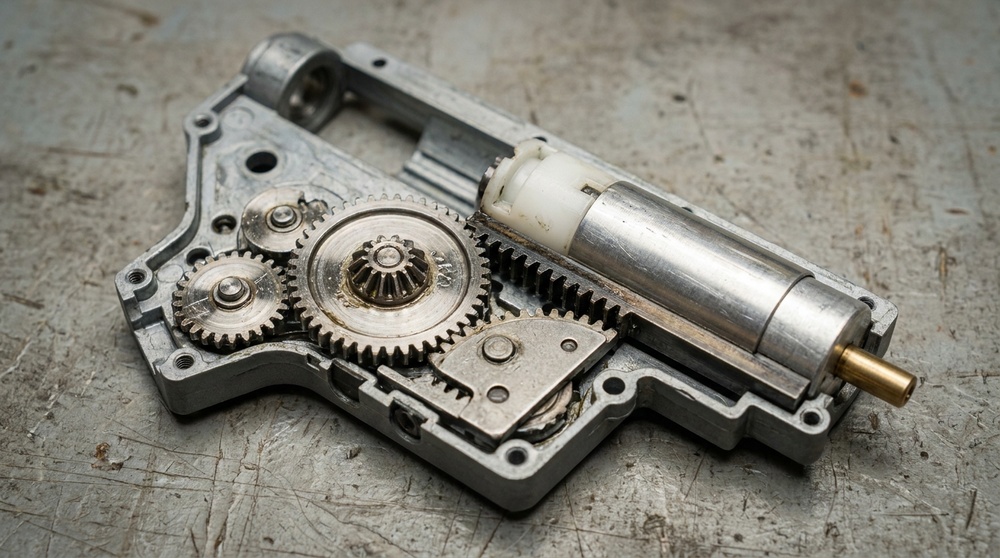
An AEG gearbox is a small, violent, very simple machine. A battery spins a motor. The motor turns three gears. The last of those gears drags a piston backwards against a spring, then lets go. The spring slams the piston forward, pushing a column of air through a nozzle into the back of a BB, and the BB leaves. That’s it. Everything else in the shell exists to make that cycle repeat without destroying itself.
The sealed metal box all of that lives in is the gearbox shell, and the number on it — version 1 through version 9 — describes the shape of that box and the layout of the holes in it. It is a mechanical fitment code, in exactly the same way a car’s engine mount pattern is. A V2 shell fits inside an M4 receiver and nothing else. A V3 shell fits inside an AK receiver and nothing else.
This is the single most useful thing to understand before you spend money, because it reframes every parts page you’ll ever read. When a listing says “fits V2”, it isn’t making a claim about performance. It’s telling you the part is the right shape for the hole. And when a listing says “V2/V3 compatible”, which plenty of internals do, it’s telling you that particular part sits in a region of the gearbox that happens to be identical across both — a genuinely useful fact we’ll come back to.
The reason the version number comes before every other decision is that it silently sets your ceiling. The V2 has the deepest aftermarket in airsoft: drop-in electronic trigger units, reinforced shells, quick-change spring systems, a dozen brands of everything. A V6 in a P90 has a handful of proprietary parts and that’s your lot. Same hobby, same budget, completely different set of possibilities — decided for you the day you picked the gun’s silhouette.
Every Airsoft Gearbox Version and the Gun It Lives In
Here’s the whole family. This is the only table in this article, and it’s the one worth bookmarking.
| Version | Guns it’s found in |
|---|---|
| V1 | FAMAS (Tokyo Marui originally, now Cybergun and Cyma) |
| V2 | M4 / M16 / AR-15 family, MP5, G3, many PDWs and ACR/Masada types; a stretched “extended V2” appears in SR-25 / AR-10 builds |
| V3 | AK family, G36 family, AUG, MP5K, most SIG 55x replicas |
| V4 | Tokyo Marui PSG-1 |
| V5 | Tokyo Marui Uzi |
| V6 | P90 and M1A1 Thompson |
| V7 | M14 and M14 EBR |
| V8 | Tokyo Marui Type 89 |
| V9 | Tokyo Marui AK74MN |
Two honest caveats about that list. The first is that V2 and V3 cover something like nine out of ten guns on a typical field, and V4, V5, V8 and V9 are effectively Tokyo Marui curiosities — you will probably never touch one. The second is that a few platforms genuinely sit on the boundary. The SIG 55x family and the MP5K get filed under V2 by some retailers and V3 by others, because different manufacturers have solved the same receiver in different ways over the years. If your gun is one of those, don’t trust a chart, including mine. Open the gun or ask the maker.
You’ll also meet named variants that aren’t really new versions: ICS splits its V2 into a two-piece shell so the upper half lifts out with the receiver, and ARES/Amoeba build V2 and V3 shells shaped around their own electronic trigger units. They’re V2s and V3s with a factory twist, and the twist usually means stock parts fit but some aftermarket ones won’t.
V2 vs V3: The Five Differences That Actually Change Your Life
This is the comparison everyone searches for, and most answers to it are a shrug plus “V3 is stronger”. Here’s what actually differs, in the order you’ll feel it.
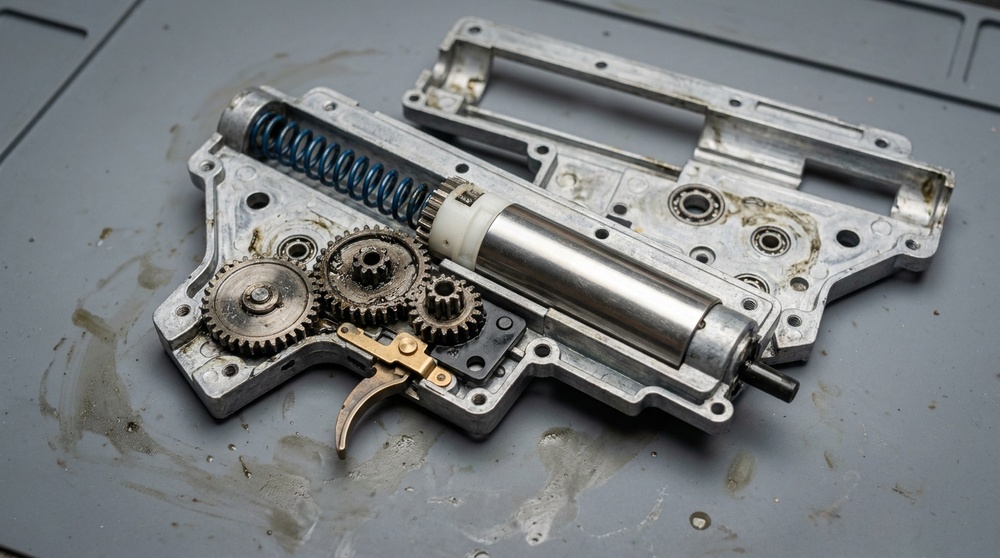
How the shell opens. A V2 is two mirror halves that split vertically — you take the screws out and the box opens like a book, with every internal part sitting loose in one half. A V3 is a one-piece lower shell with a separate plate, so the internals drop into a tub rather than being sandwiched. The practical consequence is rigidity: the V3’s front end is a single casting, while the V2 relies on the two halves staying clamped together under the hammer blow of the piston. That is the real engineering reason the V3 has a reputation for handling heavy springs better, and it isn’t marketing.
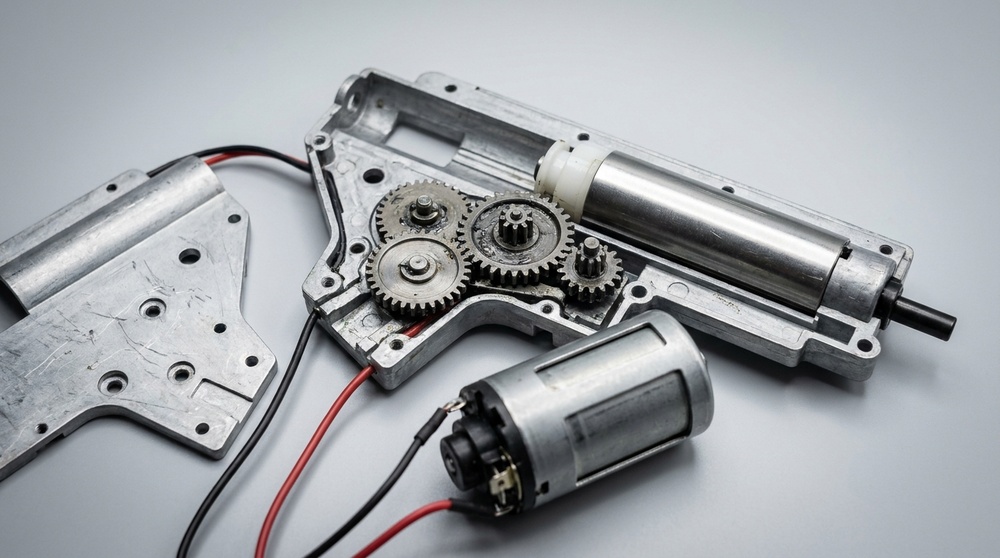
Where the motor hangs. On a V2 the motor is a long-type unit that lives in the pistol grip, completely separate from the gearbox, with its height — and therefore how deeply its pinion meshes with the bevel gear — set by a single screw in the bottom of the grip. On a V3 the motor is usually a short type sitting in a cage bolted to the gearbox itself, and the wiring runs outside the shell. The V3 arrangement is easier to get at and harder to get wrong; the V2 arrangement means that one grip screw, which nobody tells beginners about, is responsible for a surprising share of all the whining, grinding noises in airsoft.
Whether you can test-fire it on the bench. A V3’s trigger mechanism is self-contained, so a tech can put a battery on a V3 sitting bare on the table and cycle it. A V2’s trigger contacts rely on the selector plate and the receiver around them, which means testing your work usually requires reassembling the gun first. If you’ve ever rebuilt something and wanted to check it before putting the house back together, you already know why this matters. It’s the single biggest reason techs are relaxed about V3 jobs.
The trigger group and the wiring. The two versions use entirely different trigger boxes, and V2s come in two flavours — front-wired, with the battery lead running forward into the handguard, and rear-wired, running back into the stock or buffer tube. That distinction decides which drop-in MOSFET or electronic trigger unit you can buy, so it’s the first thing to check before ordering one. The upside of the V2 is choice: because the AR platform is so dominant, the V2 has by far the widest selection of drop-in electronics from makers like GATE and PERUN, along with reinforced shells and quick-change spring kits.
Where it cracks. Both versions fail, but they fail in different places, and the V2’s failure point is famous enough to have its own folklore. We’ll give it its own section below, because preventing it is mostly free.
What’s striking, once you line all five up, is that none of them is about how hard the gun shoots. Muzzle velocity comes from the spring, cylinder and barrel, and those are version-agnostic. The version decides how pleasant your gun is to own.
Inside the Shell: What Happens Between the Trigger and the BB
Follow one shot through and the parts list stops being a parts list.
You press the trigger. On a stock gun that physically closes a pair of metal contacts, which completes the circuit between battery and motor. (A MOSFET replaces this brutal arrangement with a switch that tells an electronic board to do the actual current-carrying, which is why MOSFETs save trigger contacts from burning.)
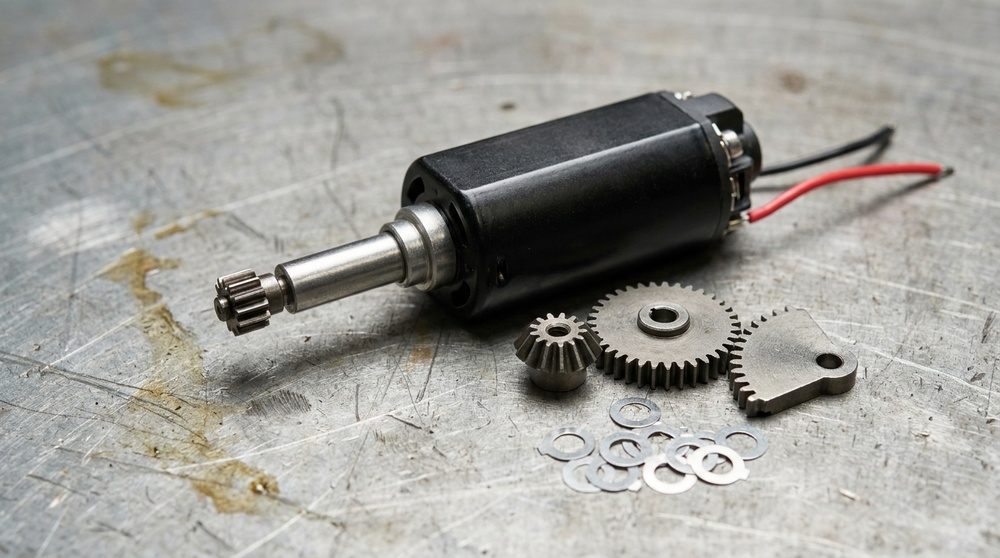
The motor spins up and turns the bevel gear, the one sitting directly over the pinion. The bevel turns the spur gear in the middle, which turns the sector gear, the big one with teeth on only part of its circumference. Those three gears are the whole drivetrain, and the ratio between them — the number stamped on the set, like 18:1 — is simply how many turns the motor makes to drive the piston through one complete cycle.
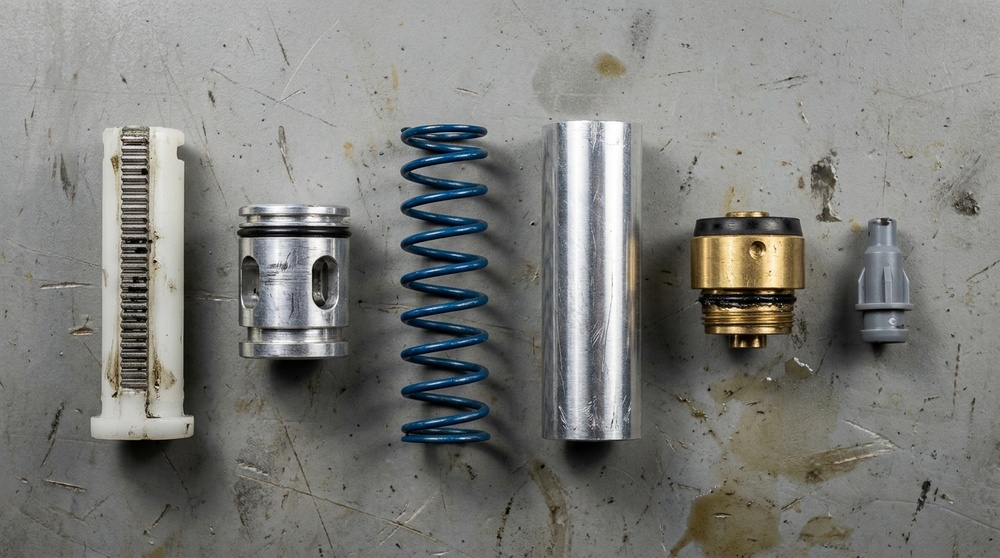
As the sector gear comes round, its teeth catch the rack on the underside of the piston and drag it backwards, compressing the main spring against the spring guide. At the same time a little cam on the sector gear pushes the tappet plate back, and the tappet plate pulls the air nozzle out of the hop-up chamber so a BB can drop in from the magazine. An anti-reversal latch sits against the gears, allowing them to turn one way only, so the compressed spring can’t push the whole train backwards when you let go of the trigger mid-cycle.
Then the sector gear’s teeth run out. The piston is released, the spring throws it forward inside the cylinder, the nozzle snaps back into the chamber just in time, and the air in front of the piston head has nowhere to go except through the cylinder head and out of the nozzle into the back of the waiting BB. One cycle, perhaps a twentieth of a second, repeated as long as you hold the trigger.
Three unglamorous parts decide whether that cycle is smooth or self-destructive. The bushings or bearings in the shell walls hold the gear axles; they come in 6mm, 7mm and 8mm bores, and the bigger the bore the more load it spreads. The shims are thin washers that set each gear’s vertical position so the teeth mesh in the middle of their faces rather than on an edge — and bad shimming is one of the most commonly cited causes of gearbox failure, which should tell you how much of airsoft tech work is really just careful assembly. And the air seal, meaning the cylinder head O-ring, piston head O-ring and nozzle, decides how much of that compressed air reaches the BB at all.
Which Parts Swap Between Versions and Which Don’t
This is where the version number saves or wastes your money, and the dividing line is cleaner than you’d expect.
Parts that live in the middle of the gearbox — the drivetrain and the air system — are largely shared between V2 and V3. Gear sets and gear ratios cross over. Shims cross over. Bearings and bushings cross over as long as the bore size matches the shell. Pistons, piston heads, cylinders and most cylinder heads cross over. In practice this means that the expensive, performance-relevant internals you’d buy for a tune — a steel-toothed piston, a ported cylinder, a decent gear set — are not version-locked, and a tech’s parts drawer serves both.
Parts that touch the shell or the gun do not swap. Shells obviously don’t. Trigger assemblies and selector plates don’t, because the two versions’ trigger boxes are built differently. Tappet plates don’t: the V3 plate has a longer face and attaches its spring differently. Spring guides usually differ. And nozzles are the trap — nozzle length is dictated by the hop-up chamber and the cylinder head, so it’s specific not just to the version but often to the manufacturer and even the particular replica. Published nozzle charts disagree with each other for exactly this reason. If you’re changing a cylinder head, measure your old nozzle or buy the one listed for your specific gun, rather than trusting a length you read in a forum post.
Motors are a third category: they fit the mount, not the version. V2 guns take long-type motors because the grip is deep; V3 guns usually take short types because the cage is shallow. Buy for the mount.
Upgrade Paths: Gear Ratios, Bearings, Springs and MOSFETs
Most upgrade regret in airsoft comes from buying parts in the wrong order, so here’s the order that works.
Start with the air seal and the shimming, not the spring. A gun with a leaking cylinder head and badly shimmed gears will get a bigger number out of a bigger spring and still feel awful. Fixing the seal and the mesh costs almost nothing, makes the gun quieter and more consistent, and is what a tech does first.
Then decide what you want: speed or torque. This is the gear ratio decision, and it’s genuinely simple once you know what the numbers mean. The ratio is motor turns per piston cycle, so a smaller first number means fewer turns and therefore a faster cycle. The standard 18:1 set that comes in almost everything is a deliberate middle ground. 16:1 is a mild step towards speed. 13:1 and 12:1 are high-speed sets, which raise rate of fire but ask the motor for more torque at every moment and will not get along with a heavy spring. 26:1 to 32:1 are high-torque sets, which go the other way: slower cycle, much easier life for the motor, and the right answer for a heavy spring in a DMR-style build. Pairing a high-speed gear set with a strong spring is the classic expensive mistake — you’ve asked the motor to do more work in less time with more resistance, and something gives.
Match the motor and the battery to that choice. A high-torque motor with a high-torque gear set and a sensible 7.4V LiPo is a long-lived combination; a high-speed set generally wants a high-speed motor and more current available, which is a battery decision as much as a gearbox one. The battery guide goes into voltage, C rating and why 11.1V is a tuning decision rather than a free upgrade.
Upgrade the load-bearing hardware to suit the spring, not the other way round. Heavier springs justify 8mm bearings, a reinforced spring guide, a steel-toothed or at least steel-first-tooth piston and a reinforced shell. They also justify a quick-change spring system, which brings the spring out through the back of the gearbox so you can change power without a full teardown — the most quietly useful upgrade on the list if you play at fields with different limits.
Fit a MOSFET earlier than you think. A MOSFET or electronic trigger unit takes the current load off those little mechanical trigger contacts, which both protects them and sharpens trigger response. On a V2 you have the richest choice of drop-in units in airsoft — just confirm front- or rear-wired first. It’s also the upgrade that unlocks running 11.1V with a clear conscience.
Why V2 Shells Crack, and the Four Fixes
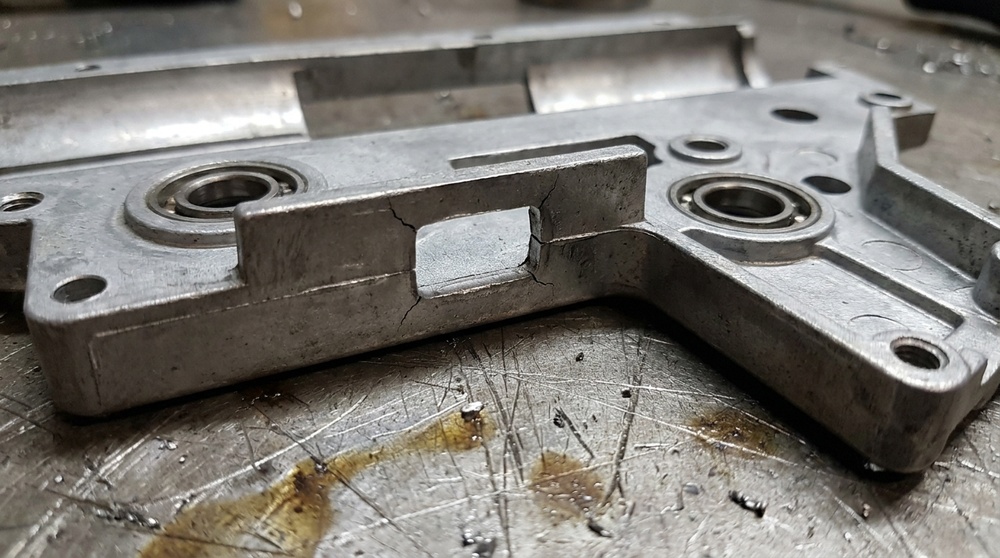
If you run a V2 with anything stronger than a stock spring for long enough, you will eventually meet a crack. It has a favourite address: the corners of the cylinder window, the rectangular cut-out in the shell wall where the cylinder’s port sits. Sharp internal corners concentrate stress, and the piston arriving at the end of its travel hands the shell a hard shock a few thousand times per game day. A second, less common failure zone is the rear of the shell around the motor plate, which gets unhappy with springs around M120 and stronger.
The fixes are mostly a Saturday afternoon and almost no money.
Radiusing is the first and the best: you take a small file or a Dremel and round off the sharp corners of the cylinder window, turning a stress concentrator into a curve. Some shells come from the factory better radiused than others, which is a real quality difference between brands that nobody puts on the box. Second, fit a sorbo pad — a disc of shock-absorbing foam inside the cylinder behind the piston head, which cushions the piston’s impact and, as a side effect, corrects the geometry of how the sector gear first catches the piston rack. That geometry is the third fix, known as correcting the angle of engagement: it means making sure the first tooth to engage takes the load squarely rather than at an angle, which is also what saves piston teeth from shearing off. And the fourth fix is restraint. Most players who crack shells did it chasing a muzzle velocity their field won’t even allow. Check what your local site’s limit actually is at the chrono before deciding you need an M130.
Maintenance by Round Count, Not by Feel
Gearboxes don’t fail suddenly. They fail gradually and then suddenly, and the gradual part is visible if you look.
A workable rhythm, drawn from the service intervals retailers and techs publish, is a light inspection every five to ten thousand rounds and a deeper one every twenty to thirty thousand. A light inspection means opening the shell, cleaning out the grit and old grease, re-lubricating the gears thinly, looking at the piston teeth for rounding or chips, and checking that the air seal still seals. The deeper one adds replacing a worn piston, inspecting the shell for the beginnings of cracks around that cylinder window, swapping the cylinder head O-ring, and honestly assessing whether the spring has sagged.
Those numbers sound abstract until you convert them. A mid-capacity magazine and a normal game day puts a couple of thousand rounds through a gun, so “every five to ten thousand” is roughly every three to five full game days, or once a season for a weekend player. Keep a rough count — your battery charge cycles are a decent proxy — and the whole thing stops being guesswork.
Two symptoms deserve immediate attention rather than a schedule. A rising, whining pitch that changes when you tighten the grip screw is motor mesh, and running it is grinding your bevel gear. And a gun that fires once and then locks up is usually a piston that has lost teeth or a gearbox that has stopped mid-cycle with the spring compressed — both of which get worse every time you pull the trigger to “see if it does it again”.
Did the Upgrade Actually Work? Put a Timer on It
Here’s the part other gearbox guides don’t cover, and the reason this one is on a training site.
Read any upgrade thread and notice what the claims are actually about. “Snappier trigger” means the interval between pressing the trigger and the BB leaving got shorter. “Higher rate of fire” means the interval between consecutive shots got shorter. “The high-speed gears woke it up” is a claim about both. Every one of those is a time measurement, and nobody measures it — which is precisely why the arguments never end.
A shot timer settles them in two minutes, and the Airsoft Shot Timer app is built around exactly these intervals. Set a random-delay start, and on the beep fire a five-shot semi-auto string as fast as you can press. The app gives you the time to the first shot and the split between every shot after it. Do three strings, write down the average split, then do your gearbox work — new gear set, new motor, MOSFET, whatever it is — and run the same three strings again. The difference in average split is your answer, in hundredths of a second, on your gun.
For rate of fire, hold a one-second burst on full auto and let the app count the shots. That number is your rounds per second, and it’s the one to compare against whatever the parts listing promised. A 13:1 gear set that claims a dramatic increase and delivers a tenth of a second off your split has told you something useful about where to spend the next hundred dollars.
The humbling result is the common one. Players run this test, find their gun got measurably faster, and then notice that their own time to the first shot off the beep is a third of a second longer than the entire improvement they just bought. That’s not an argument against upgrading — it’s an argument for knowing which number is actually costing you the game. If that’s where you land, our guides to the pistol draw and dry fire training are a cheaper place to find a second than any gear set.
Frequently Asked Questions
What is a gearbox in airsoft?
It’s the sealed metal box inside an electric airsoft gun that holds the gears, piston, spring and cylinder. A motor spins three gears, the last of which pulls the piston back against the spring and releases it; the piston pushes a column of air through a nozzle and the air pushes the BB out. Everything about an AEG’s trigger feel, rate of fire and reliability happens in that box.
What is a V2 gearbox?
The most common gearbox shape in airsoft, found in M4, M16 and AR-15 replicas as well as MP5 and G3 types. It’s a two-piece shell that splits vertically, with a long-type motor mounted separately in the pistol grip. Because the AR platform is so dominant, the V2 has the deepest parts and electronics support of any version.
What airsoft guns use a V3 gearbox?
AK-pattern rifles, the G36 family, the AUG, the MP5K and most SIG 55x replicas. The V3’s lower shell is a single piece with a separate top plate, which makes the front end more rigid, and its motor sits in a cage on the gearbox rather than in the grip.
What is the difference between a V2 and a V3 gearbox?
Five things: the V2 splits into two vertical halves while the V3 is a one-piece tub (so the V3 is more rigid up front), the V2’s motor lives in the grip while the V3’s hangs in a cage on the shell, a V3 can be test-fired outside the gun but a V2 generally can’t, the trigger assemblies and wiring layouts are completely different, and they crack in different places. Neither version makes the gun shoot harder — that’s the spring, cylinder and barrel.
Is a V3 gearbox better than a V2?
Not better, different. The V3 is more rigid at the front and friendlier to work on, which is why high-FPS and DMR builds favour it. The V2 has a vastly larger aftermarket, including drop-in electronic trigger units, reinforced shells and quick-change spring kits. For most players the aftermarket matters more than the rigidity.
Are V2 and V3 gearbox parts interchangeable?
Partly, and the dividing line is useful. Gears, shims, bearings and bushings (if the bore matches), pistons, piston heads, cylinders and most cylinder heads cross over. Shells, trigger assemblies, selector plates, tappet plates, spring guides and nozzles do not. Motors fit the mount rather than the version: long type for V2, usually short type for V3.
What does an 18:1 gear ratio mean?
That the motor turns eighteen times to drive the piston through one complete cycle. It’s the standard ratio in almost every stock AEG and a deliberate compromise. 16:1 is slightly faster, 13:1 and 12:1 are high-speed sets that need a light spring and a strong motor, and 26:1 to 32:1 are high-torque sets for heavy springs.
Why does my airsoft gearbox keep cracking?
Almost always at the corners of the cylinder window, because sharp internal corners concentrate the shock of the piston landing, and because the spring is stronger than the shell was designed for. Round off those corners with a file, fit a sorbo pad, correct the angle of engagement so the first gear tooth loads the piston squarely, and check whether you actually need that spring given your field’s velocity limit.
Do I need a MOSFET for my airsoft gun?
You don’t need one, but it’s one of the best-value upgrades available. It moves the current load off the small mechanical trigger contacts, which stops them burning, sharpens trigger response, and makes running an 11.1V LiPo a reasonable decision rather than a gamble. On a V2, check whether your gun is front-wired or rear-wired before ordering.
How often should I service an airsoft gearbox?
A light service every five to ten thousand rounds — clean, re-grease the gears thinly, check piston teeth and air seal — and a deeper one every twenty to thirty thousand, adding piston replacement, a crack inspection, a new cylinder head O-ring and an honest look at the spring. For a weekend player that’s roughly once every three to five game days and once a season respectively.
Does upgrading the gearbox increase FPS?
Not by itself. Muzzle velocity comes from the spring, the cylinder volume and the barrel, plus how well the air seals. Gear ratios, motors and MOSFETs change how fast and how responsively the gearbox cycles, which you feel as trigger response and rate of fire rather than power.
Which gearbox version is in my gun?
Work it out from the receiver before you open anything. AR-pattern, MP5 or G3 means V2. AK, G36 or AUG means V3. P90 or Thompson means V6, M14 means V7, FAMAS means V1. If your gun is a SIG 55x or an MP5K, or if the manufacturer uses its own electronic trigger shell, check with the maker rather than a chart.
A Note on the Images
All five images in this article are AI-generated illustrations, made for this guide because freely licensed photographs of AEG gearbox internals essentially don’t exist — almost every real photo of a V2 or V3 shell online is a retailer’s copyrighted product shot. They’re here to break up the text and show you roughly what these parts look like on a bench, not to serve as a reference for identifying a specific gearbox or ordering a specific part. For that, open your own gun or ask your local tech.
The thing about gearbox versions is that the number is doing much less work than the internet implies. It isn’t a score. It’s a shape, and the shape was chosen for you the moment you picked a gun that looks like an M4 or looks like an AK. What follows from that shape is which parts you can buy, how easy your gun will be to live with, and where it will crack if you push it.
So learn your version, fix the seal and the shimming before you touch a spring, pick your gear ratio for the job you actually want the gun to do, and radius that cylinder window while the shell is open anyway. Then, when somebody at the safe zone tells you their new gear set made their gun “so much faster”, you’ll know the right question. Ask them what their split time is. If you’ve read this far, you already know how to find yours.
If you’re building the rest of the kit, the airsoft battery guide covers the other half of the drivetrain, the G&G CM16 Raider 2.0 guide is a good look at what a mid-range V2 gun gives you out of the box, and the chronograph guide covers the number the safe zone will actually check.
Put a Shot Timer in Your Pocket
Airsoft Shot Timer is a free shot timer app tuned for airsoft and Action Air — it picks up BB gun shots, tracks your split times, and saves you the cost of a $150+ hardware timer for IPSC/IDPA practice.


- Airsoft Gearbox
- V2 Gearbox
- V3 Gearbox
- AEG Gearbox
- Airsoft Gearbox Versions
- V2 vs V3
- Airsoft Gearbox Types
- Gear Ratio
- Airsoft Shimming
- MOSFET
- Quick Change Spring
- AEG
- Airsoft Tech
- Airsoft Upgrade
- Airsoft Maintenance
- Airsoft Motor
- Gearbox Cracking
- Airsoft Beginner
- Airsoft Gear
- Rate of Fire