Laser Training Pistol & Dry Fire Training System Complete Guide: Mantis Laser Academy, SIRT, G-Sight & Strikeman Compared

Why You Need a Laser Training System
If you’ve ever been serious about improving your shooting, you’ve run into the same problem everyone does: you want to practice, but you can’t hit the range every day. Between range fees, ammunition costs, and travel time, putting in a daily 30-minute practice session becomes a luxury.
Dry fire training has always been the classic solution — no ammo needed, practice at home, work on your draw, sight alignment, and trigger control. But traditional dry fire has one obvious weakness: after you pull the trigger, there’s no objective feedback telling you where that shot would have gone. You think your sights were aligned, but were they really? Did your trigger press push the muzzle off target at the last moment?
That’s exactly what laser training systems solve. They add instant visual feedback on top of traditional dry fire — every trigger pull sends a laser dot onto your target, showing you precisely where your shot landed. Paired with a smartphone app for data tracking, you can see your groupings, reaction times, and progress curves over time. What used to be a vague “I think that felt good” becomes hard numbers you can actually work with.
This guide breaks down the major laser training systems on the market today, from budget laser cartridges to the professional-grade SIRT training pistol, so you can find the one that fits your needs and budget.
How Laser Training Systems Work
Before diving into specific products, it helps to understand the three basic approaches these systems take. The core concept is the same across all of them: replace the bullet with a laser and record where each shot lands. The implementation, however, falls into three distinct categories.
The first category is the laser training cartridge. This is the most straightforward design — a cartridge matching your firearm’s caliber that sits in the chamber. When you pull the trigger, the firing pin strikes a rubber pad on the cartridge’s base, activating a brief laser pulse. The biggest advantage is that you’re training with your own gun — grip angle, trigger feel, weight distribution — everything is identical to live fire. G-Sight and LaserLyte are the most recognized brands in this space.
The second category is the app-based laser system, represented by Mantis Laser Academy and Strikeman. These also use laser cartridges, but add smart targets and a smartphone app to the equation. You set up your phone next to the target, and the app uses the camera to detect the laser dot’s position in real time, automatically logging each shot’s placement, reaction time, and score. This turns practice into something that genuinely feels like a game, and all your data gets saved for later review.
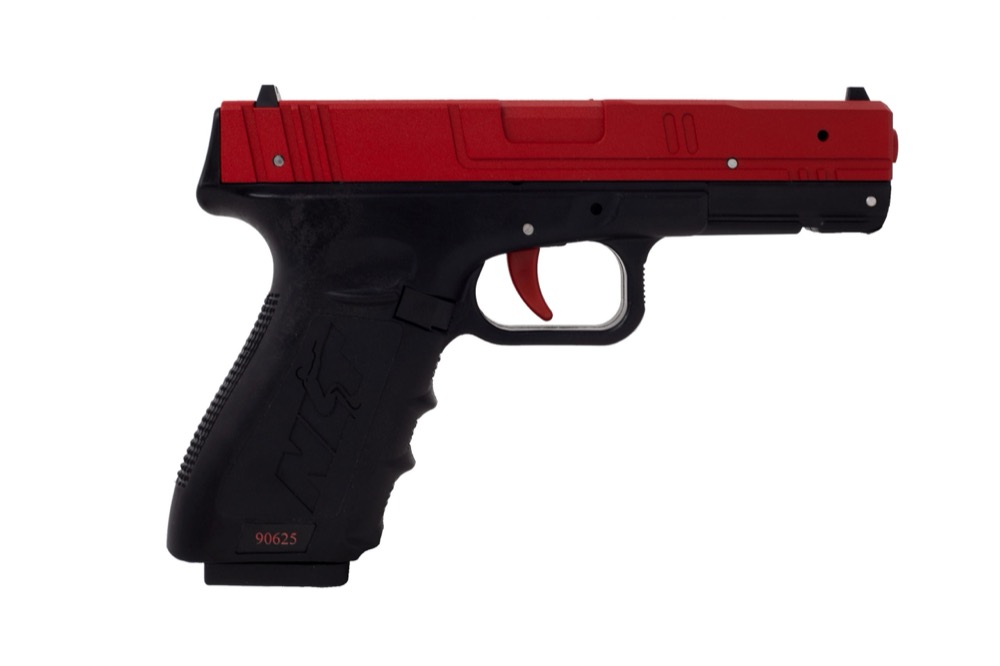
The third category is the dedicated training pistol, with the SIRT being the gold standard. It’s not an accessory — it’s a standalone training handgun that mimics the size and weight of a real pistol (typically a Glock 17), but with a built-in laser module and auto-resetting trigger. You don’t need to rack the slide between shots — the trigger resets on its own, letting you fire continuously without interruption.

Mantis Laser Academy: The Best All-Around Training System
If I had to recommend just one system, Mantis Laser Academy would be my pick. It strikes the best balance between feature completeness, ease of use, and value for money.
The system centers on a Pink Rhino laser cartridge (manufactured by G-Sight), paired with Mantis’s own smart targets and a free smartphone app. Setup is intuitive: stick the target to a wall, mount your phone, open the app, calibrate once, and you’re ready to train. The app tracks each shot through your phone’s camera in real time, providing instant audio and visual feedback.
What truly sets Mantis apart is the app experience. It includes over twenty preset training modes, from basic accuracy drills to timed competition scenarios. You can configure time limits, target count, and shot sequences, and the app scores automatically while logging every session. That addictive “one more try, I can beat my record” feeling transforms what should be boring dry fire practice into something genuinely hard to put down.
In actual use, Mantis’s detection accuracy is solid — laser dot recognition is nearly instantaneous. You’ll occasionally get a false positive (the app detects a hit before you’ve actually pulled the trigger), but this rarely disrupts training in practice. If your training space has complex lighting, dimming the ambient lights improves detection reliability.
Mantis offers two kit options: the Standard Kit ($150) includes the laser cartridge, targets, phone mount, and full app access; the Portable Kit ($100) is a slimmed-down version for travel or limited spaces. For home training, the Standard Kit is the way to go.
SIRT Training Pistol: The Professional’s Choice
If your budget allows it and you demand maximum training efficiency, the SIRT (Shot Indicating Resetting Trigger) training pistol operates on a completely different level.
The SIRT’s defining feature is its auto-resetting trigger. With a regular laser cartridge, you have to rack the slide after every trigger pull to reset the firing pin, which breaks your rhythm and makes it impossible to practice rapid fire realistically. The SIRT’s trigger resets the instant you release your finger, letting you pull the trigger continuously just like live fire. For drills like El Presidente that require rapid strings of fire, this difference is enormous.
The SIRT also features a unique dual-laser system. The red laser activates during trigger take-up, showing you where the muzzle is pointing during the initial press. The green laser fires only at the moment of full trigger break, indicating your actual point of impact. The gap between these two lasers reveals exactly how much your muzzle shifts during the final stage of the trigger press. Many shooters realize for the first time, through this feature alone, just how much their trigger control needs work.
Two main models are available: the SIRT 110 simulates a Glock 17/22 ($339 for the polymer slide / $439 for the metal slide), while the SIRT 107 matches the Smith & Wesson M&P grip angle. Both are carefully weighted to feel authentic in your hands.
The SIRT’s downsides are equally clear: it’s expensive, and it’s not your gun. The grip angle and trigger feel you practice on the SIRT may differ from the pistol you actually compete or carry with. This is why many instructors recommend the SIRT as a supplementary tool rather than your only tool — use the SIRT for fundamentals and rapid-fire rhythm, use a laser cartridge in your own gun for draw practice and grip muscle memory.
Budget Entry Points: G-Sight and Strikeman
If you just want to dip your toes into laser training with minimal investment, a standalone laser cartridge system is the simplest way to start.
The G-Sight ELMS Plus kit comes in at around $70 and includes a laser cartridge, smart target, and phone mount. The app is free, and while it’s not as feature-rich as Mantis, it covers the basics of shot placement tracking and group analysis. The cartridge itself is reasonably durable — users report getting over two thousand trigger pulls before the rubber strike pad needs replacing, and spare parts come included in the kit. G-Sight supports a wide range of calibers from 9mm to .45 ACP, so just match the cartridge to your firearm.
Strikeman is another popular option. Its Marksman Kit (~$120-150) features improved target detection technology, a faster calibration process, and a more modern app interface than G-Sight. Strikeman also has a clever folding target stand that makes the whole system genuinely portable — you can toss it in a suitcase and set up in a hotel room in five minutes. If you travel frequently but don’t want to skip training, that portability is a real selling point.
One important limitation shared by all laser cartridges: you must manually rack the slide after every trigger pull to reset the firing pin for the next shot. This differs from live fire rhythm, and the repeated dry cycling adds wear to your pistol. Most laser cartridge rubber pads are designed to withstand thousands of strikes, but if your pistol has a particularly sharp firing pin (like a Glock), the pad’s lifespan may be shorter.
Comparing All Four Systems: Which One Should You Choose?
When choosing a laser training system, the most important step is being honest about your training goals and budget. Everyone’s situation is different — there’s no universal “best” choice, only the best choice for you.
If you’re new to shooting and just want to see what dry fire feels like at home, the G-Sight ELMS Plus is the lowest-risk entry point. A $70 investment won’t sting if you discover dry fire isn’t your thing. And because you’re training with your own gun, every bit of muscle memory translates directly to live fire.
If you’re already committed to serious training and want to systematically track your progress, the Mantis Laser Academy Standard Kit offers the best value. Its diverse training modes, thorough data tracking, and gamified design keep you engaged instead of quitting from boredom. Pair it with a Shot Timer App for simultaneous reaction time and accuracy tracking, and your training effectiveness doubles.
If you’re a competitive shooter or firearms instructor who needs high-volume repetitions of draws, rapid fire, and transitions, the SIRT’s auto-resetting trigger saves massive amounts of time. One hour of SIRT practice yields roughly three to four times the trigger pulls compared to a laser cartridge. Many IPSC and IDPA competitors own both a SIRT and a laser cartridge — the SIRT for speed and rhythm work, the laser cartridge with their match gun for draw and reload practice.
If you travel frequently and refuse to let training lapse, Strikeman’s portable design deserves serious consideration. Its folding target stand and compact packaging let you stuff the entire system into a carry-on, set up in a hotel room in five minutes, and get your reps in.
Advanced Training Methods with a Shot Timer
The real value of a laser training system is enabling quality deliberate practice at home. But to maximize training effectiveness, you need a timer to track your speed alongside your accuracy.
Using the Airsoft Shot Timer App alongside your laser system, you can practice virtually every core competition shooting drill from home. Set the Shot Timer’s random delay beep, draw from the holster on the signal, acquire your sight picture, and press the trigger. The app records your reaction time while Mantis or G-Sight logs your point of impact. Combined, these two data streams show you exactly where the balance point lies between “fast” and “accurate.”
When practicing your draw stroke, prioritize correct mechanics first. Once you can consistently land in the A-zone on every draw, start compressing your time. An effective progression: week one target 2.5 seconds, week two push to 2.0, week three challenge 1.5. The Shot Timer keeps you honest — no fooling yourself about how fast you actually are.
Reload drills are also perfectly suited for laser training. Fire until empty, reload, re-acquire the target, and fire again — time the entire sequence with the Shot Timer and verify accuracy with the laser system. Many shooters discover their first shot after a reload drops significantly in accuracy, which is exactly what needs deliberate practice. For more reload techniques, check out our Magazine Reload Complete Guide.
After each practice session, spend two minutes reviewing the data in your app. Look for trends in your grouping — is it drifting consistently in one direction? Is your reaction time stable? Are your split times between rapid fire shots consistent? These details are easy to miss at the range, but in the quiet of your home training space, you can dissect every nuance.
Safety Considerations for Home Laser Training
Even though laser training systems don’t use live ammunition, every firearms safety rule still applies. In fact, the familiar environment of home training often breeds complacency — which is precisely when accidents happen.
Before every session, the most critical step is confirming your gun is empty. Drop the magazine, lock the slide back, visually and physically inspect the chamber — do this sequence every single time, no exceptions. The majority of laser training accidents happen because someone “thought” they’d already checked, but a live round was still chambered. For a complete review of safety protocols, see our Shooting Safety Rules Complete Guide.
Your muzzle direction during training matters too. Even with a laser cartridge loaded instead of live ammo, always ensure your target is positioned against a safe backstop direction. Building this habit at home means you won’t slip up when it actually matters at the range.
If other people are home during your training, always inform them that you’re conducting dry fire practice, and keep your training area clearly separated from the rest of the house. Ideally, designate a fixed “training corner” so your household knows that when you’re in that space, firearms are being handled.
Conclusion: Invest in Training, Not Just Gear
Many shooters pour their entire budget into buying and upgrading guns while overlooking the fact that training is the most effective investment for improving skill. A $100-150 laser training system paired with 15-20 minutes of daily deliberate practice can yield more improvement than burning through an extra thousand rounds at the range.
Whether you ultimately choose Mantis, SIRT, G-Sight, or Strikeman, the point isn’t how fancy the system is — it’s whether you actually pick it up and practice every day. The best training system is the one you’ll consistently use.
💡 Recommended Reading:
- Dry Fire Training Complete Guide — Master the fundamentals of dry fire technique
- Shooting Drills Complete Guide — Practice these classic drills at home with your laser system
- Shot Timer App Complete Guide — Pair with laser training to track reaction times
- Pistol Draw Technique Guide — Drawing is the most effective drill for home laser practice
- Trigger Control Complete Guide — Laser systems clearly expose trigger control issues
- Magazine Reload Guide — Post-reload accuracy recovery requires deliberate practice
- Shooting Safety Rules Guide — Home training safety rules are just as important
- Dry Fire Training System
- Laser Training Pistol
- Mantis Laser Academy
- SIRT Training Pistol
- Dry Fire
- Laser Training
- Home Training
- Shot Timer
- Shooting Training
- G-Sight
- Strikeman