CO2 vs Green Gas Airsoft: Pressure by Temperature Chart
The short answer (BLUF)
- Green gas is propane with silicone oil. CO2 is carbon dioxide in a 12 g cartridge. At 20°C green gas sits at about 107 psi, CO2 at about 816 psi — roughly 7.6 times higher.
- Neither number is fixed. Both are the vapour pressure of a liquid, so they move with the temperature of the magazine. The “115 psi” and “150 psi” you see quoted for green gas are simply the same gas at 22.5°C and 32°C. The famous “850 psi” for CO2 is CO2 at 21.7°C.
- CO2 is not temperature-proof. It loses about 40% of its pressure between 30°C and 0°C — almost the same percentage as green gas. What it has is headroom: CO2 at −10°C (369 psi) is still 2.6 times what green gas makes on a 30°C summer day.
- The 13°C rule: green gas behaves like Japanese 134a gas would at a temperature about 13°C warmer. 134a at 20°C = green gas at 6°C.
- Pick green gas for most training and game pistols, Tokyo Marui-pattern guns, and anything you want to top off quickly. Pick a CO2 model if you regularly play below about 10°C, want harder recoil, or want shot-to-shot consistency — and accept faster wear.
- Whatever you run, measure it. One full magazine on a shot timer shows you exactly which shot your gas stops keeping up.
If you’ve ever shot a gas blowback pistol on a cold morning, you know the feeling. The first few rounds are crisp, the slide snaps back, the BB flies straight. Then around shot eight the gun starts to feel lazy. The slide goes “thunk” instead of “crack,” the BBs drop at twenty metres, and by shot twelve you’re getting a sad little puff and a gun that didn’t cycle.
Then someone at the safe zone says, with total confidence, “That’s why you run CO2.” And someone else says, with equal confidence, “CO2 will wreck your gun.” Both of them are partly right, and the reason they can’t settle it is that they’re arguing from numbers — “100 psi,” “850 psi” — that only describe one temperature.
This guide gives you the numbers for every temperature you’ll actually play in, and turns the argument into something you can check.
What Green Gas and CO2 Actually Are
Green gas is propane mixed with a small amount of silicone oil. That’s not a secret; retailers like Evike and TorontoAirsoft describe it the same way, and Airsoft Explained (Novritsch’s tech channel) is blunter: “the main ingredient in airsoft gases is propane.” The silicone is there to keep the magazine and nozzle O-rings lubricated with every shot. The colours — blue, green, red, black — are a rough marketing scale for “weaker to stronger blend,” and two brands’ “green” can behave noticeably differently. Japanese guns were designed around a weaker refrigerant gas, HFC-134a, which is why Tokyo Marui manuals list it as the standard.
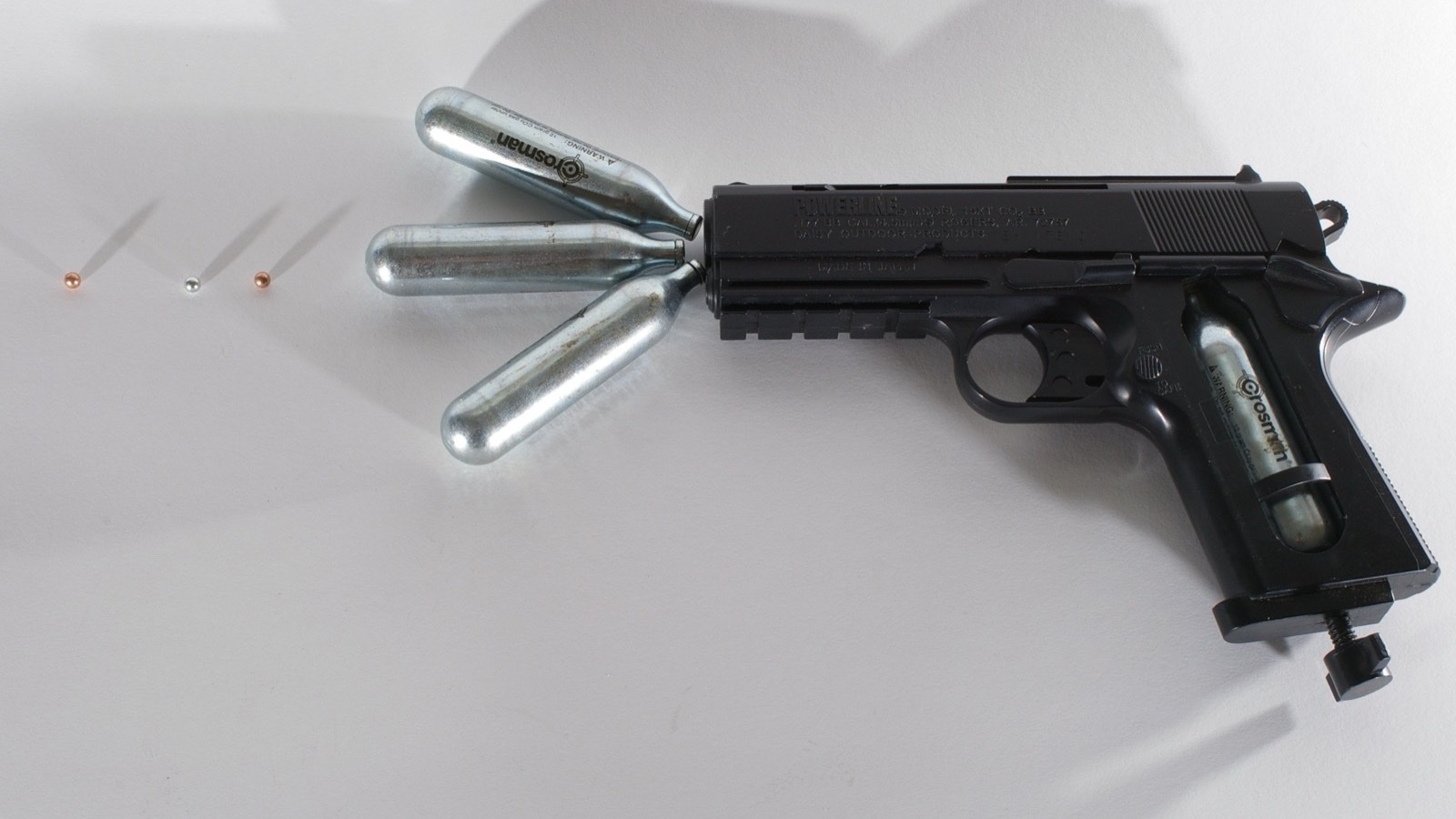
CO2 is carbon dioxide sold in 12-gram steel cartridges. You drop one into a CO2-specific magazine, tighten a screw or lever, and a pin pierces the seal. A CO2 magazine and a green gas magazine are not interchangeable: the CO2 valve is built to hold back several hundred psi more.
Here’s the part almost every comparison skips. In both cases the magazine holds a liquid, and the pressure is the liquid’s vapour pressure. As long as there’s any liquid left, the pressure depends only on temperature — not on how full the magazine is. That single fact explains nearly everything about how these gases behave in the field: why topping off a magazine doesn’t make it stronger, why CO2 shoots so consistently until it suddenly stops, and why every gas gun gets weaker as you shoot it fast.
The Pressure-by-Temperature Chart
This is the chart nobody publishes. Values are gauge pressure (what a gauge on your magazine would read), calculated from the saturated vapour pressure tables in the NIST Chemistry WebBook. Green gas is shown as pure propane; real blends with silicone oil land close to it.
| Magazine temp | Green gas (propane) | 134a | 152a | CO2 |
|---|---|---|---|---|
| −10°C (14°F) | 35 psi | 14 psi | 12 psi | 369 psi |
| 0°C (32°F) | 54 psi | 28 psi | 24 psi | 491 psi |
| 10°C (50°F) | 78 psi | 45 psi | 39 psi | 638 psi |
| 20°C (68°F) | 107 psi | 68 psi | 60 psi | 816 psi |
| 30°C (86°F) | 142 psi | 97 psi | 85 psi | 1,032 psi |
| 40°C (104°F) | 184 psi | 133 psi | 117 psi | supercritical — keeps rising |
Read across a row and you see the gap between gases. Read down a column and you see the thing that actually ruins your day: every gas loses roughly 3% of its pressure per degree Celsius around room temperature. Green gas drops about 3.2 psi per degree near 20°C, 134a about 2.6 psi, CO2 about 19.5 psi. CO2 loses more psi per degree in absolute terms; it just starts so high that it doesn’t matter.
This is also why the internet can’t agree on a single number. “Green gas is about 100 psi” is green gas at 18°C. “Green gas is about 115 psi” is 22.5°C. “Green gas maxes out around 150 psi” is a hot day at 32°C — and on a 40°C summer afternoon in a car, it’ll be well past that. “CO2 is 800 psi” is 19°C, “850 psi” is 21.7°C. None of the shops are wrong. They just each quoted one row of this table.
One more thing in the CO2 column: above 31°C, CO2 passes its critical point and stops being a liquid at all. A loaded CO2 magazine left in a hot car doesn’t level off at a vapour pressure; it just keeps climbing with temperature. That is the physics behind the standard advice to never store a CO2 magazine with a pierced cartridge in it.
The 13°C Rule: Which Gas Does Your Gun Need Today?
Green gas makes the same pressure that 134a makes at a temperature about 13°C warmer. 134a at 20°C (68 psi) is matched by green gas at 6.3°C. 134a at 25°C (82 psi) is matched at 11.6°C. 134a at 30°C (97 psi) is matched at 16.9°C. The offset stays between about 13 and 14 degrees across the range where people actually play.
That gives you a practical way to think about it. If your pistol was designed for 134a — a stock Tokyo Marui Hi-CAPA, Glock or M&P — and it runs happily on a 20°C day with 134a, then green gas will give you that same “comfortable” pressure down to about 6°C. On a 25°C day, green gas is already pushing that gun as hard as 134a would at 38°C. That’s the real reason Hi-CAPA owners outside Japan crack stock ABS slides: they’re running a summer-strength gas all year. (Our Hi-CAPA guide covers the slide and spring options if that’s you.)
The same Airsoft Explained video arrives at a similar rule from the opposite direction: running their black gas at 5°C gives “roughly similar results” to green gas at 20°C. The idea is the same — you choose a gas to put the magazine in the right pressure window for today’s temperature, not because one gas is universally “better.” Their own field habit is to pack two strengths, try the weaker one first, and step up only if it can’t cycle the slide. That’s a good habit, and there’s a non-obvious reason behind it: too much pressure can stop a gun just as surely as too little, because the hammer can no longer knock the magazine’s exhaust valve fully open. If a gun on red gas in summer suddenly feels weaker, try stepping down.
Why Your Magazine Dies Halfway Through a String
The cooldown effect is the liquid gas stealing heat from the magazine every time it boils. When you fire, a little vapour leaves; more liquid boils to replace it; boiling absorbs heat; the magazine gets colder; colder liquid has lower vapour pressure. Shoot fast enough and you’re walking down the chart’s column in real time.
You can put rough numbers on it. TorontoAirsoft’s comparison video estimates that an 8-ounce can of green gas lasts about 600 shots including fills — call it 0.38 g of propane per shot. Boiling propane at room temperature absorbs about 344 joules per gram (NIST again), so each shot pulls roughly 130 J of heat out of the magazine. If you assume a 300 g metal magazine with a specific heat around 0.4 J/g·°C, that’s roughly 1°C per shot before your hand and the air put any heat back. Ten quick shots: the magazine is close to 10°C colder, and green gas that started at 107 psi is now somewhere around 78 psi — which is 134a territory on a mild day. Those are back-of-envelope figures with assumptions stated, not lab measurements, but they match what you feel: the gun goes from snappy to sluggish in about a magazine.
CO2 does better here for two reasons. The same video puts a 12 g cartridge at about 50 shots, or 0.24 g per shot, and CO2’s heat of vaporisation at 20°C is only about 152 J/g — so roughly 36 J per shot, about a quarter of green gas. And even if it does cool by ten degrees, CO2 at 10°C is still 638 psi. That’s why players describe CO2 as staying “pretty constant until the gas runs out,” while green gas “drops off almost immediately.” It isn’t that the green gas magazine is emptying — it’s chilling.
The fixes follow directly. Rotate magazines instead of refilling and re-dumping the same one. Keep spares in a trouser pocket or an inside pouch so your body warms them. Don’t refill a magazine that’s still cold to the touch — you’re filling it to a low pressure. And if you play a lot below 10°C, that’s precisely the condition where CO2 earns its keep.
CO2 vs Green Gas: How to Choose
For a first pistol, a training pistol, or anything Tokyo Marui-pattern, green gas is the default. It’s easy to top off between rounds — a few seconds with the can upside down, no draining a half-used cartridge — and the built-in silicone lubricates seals as you go. Green gas pistols are almost always field-legal, the parts ecosystem is huge, and you can tune your power by changing gas strength through the seasons. If you want to save money, plain propane with a cheap adapter and a few drops of silicone oil works out much cheaper per shot than either branded green gas or CO2.
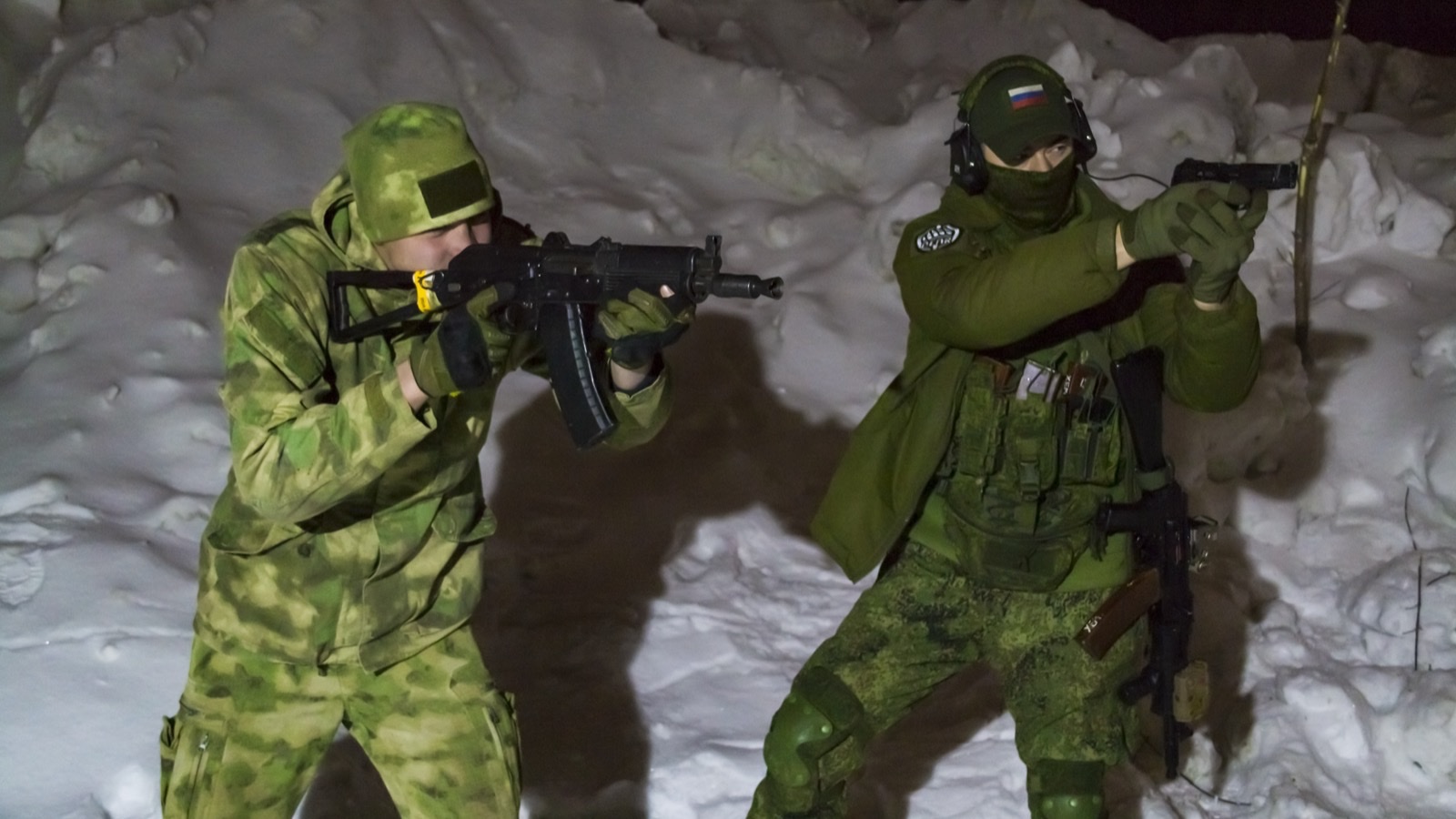
A CO2 model makes sense if your weather is cold or your priority is consistency. If your games happen in the mornings at 5–10°C, CO2 is the gas that keeps the slide cycling. It also delivers a heavier, sharper recoil that many players like for realism, and its shot-to-shot velocity is steadier — useful for a target pistol. The trade-offs: more stress on internals (higher pressure “means more broken parts,” as TorontoAirsoft puts it), velocity that can exceed CQB limits, and the cartridge routine. You shouldn’t store a magazine with a loaded cartridge, and you shouldn’t purge it through the release valve, so emptying a half-used CO2 magazine means shooting it out.
The decision is really about the magazine, not the gas. You can’t put CO2 into a green gas magazine. Some pistols are sold as either a green gas model or a CO2 model; others, like the ProForce M17/M18, run on both but only through separate magazine housings — many owners keep one CO2 magazine for winter and run green gas the rest of the year. Choose the gun and magazine for the conditions you’ll actually shoot in. Our ProForce M17 vs M18 comparison has a cold-weather section if you’re looking at that pair.
Whichever you choose, chrono it with the gas and the temperature you’ll actually play in. A pistol that chronos at 290 fps in a 22°C shop can be noticeably hotter at 32°C on green gas — the gas pressure in the chart rises about a third between those two temperatures. The chronograph and joule chart guide shows how to convert what the chrono says into energy.
Test Your Gas With a Shot Timer
One full magazine on a timer tells you how many shots your gas can keep up with at today’s temperature. Load a full magazine, set your shot timer to record every shot, and shoot the whole magazine at a steady, controlled pace you could hold in a match. Then read the split times.
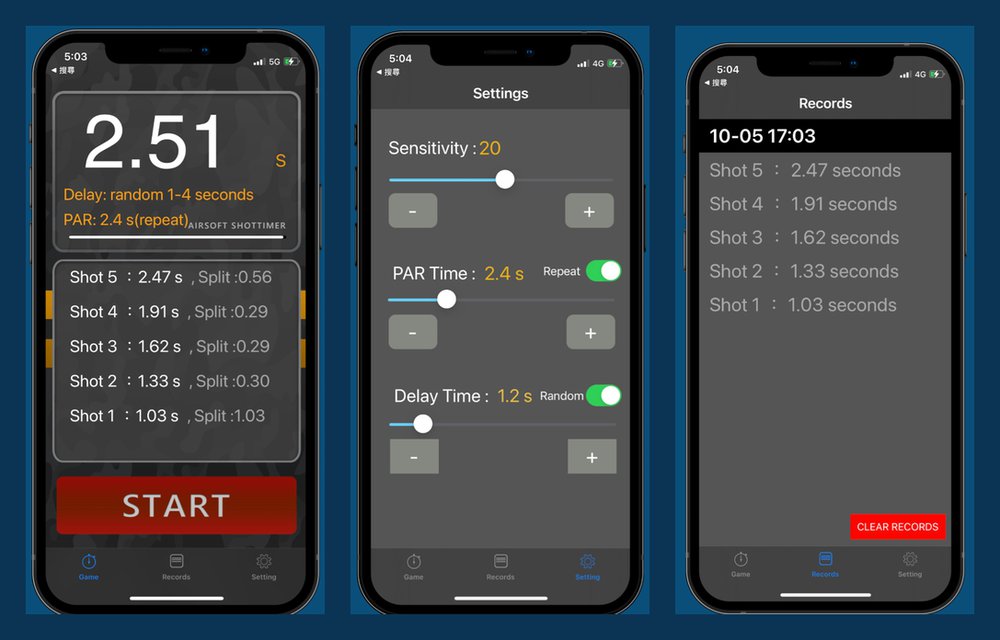
On a warm day with a good gas, the splits will be fairly flat from first shot to last. On a cold day, you’ll often see the pattern shift partway through: splits stretch as the slide slows, a shot fails to register because the gun barely puffed, or the slide stops locking back. The shot number where that happens is your real working capacity at this temperature — if it’s shot 9 of a 25-round magazine, you now know you have nine good shots, not twenty-five. Repeat with a warmer magazine from your pocket, or with the next gas strength up, and compare.
The Airsoft Shot Timer App is free on iPhone and Android and can pick up the quieter report of a GBB through its adjustable sensitivity, so you can run this test at home or at the field. It’s the same idea behind every drill on this site: the number on the screen settles arguments that feelings can’t. If you compete in IPSC Action Air, running this test once per season with your match magazines tells you how many magazines to warm before a cold-morning stage.
Frequently Asked Questions
Is CO2 better than green gas for airsoft?
Neither is better overall. CO2 is stronger, more consistent and works in colder weather; green gas is gentler on the gun, quicker to refill and more flexible across seasons. Green gas is the better default for most players; CO2 is the better pick if you often play below about 10°C.
Can I use CO2 instead of green gas in my pistol?
Not in a green gas magazine. CO2 needs a magazine built to hold 12 g cartridges and roughly eight times the pressure. Some pistols are sold in both a green gas version and a CO2 version, and some offer separate magazines, but you have to buy the CO2 magazine.
What is the PSI of green gas?
It depends on temperature: about 54 psi at 0°C, 78 psi at 10°C, 107 psi at 20°C, 142 psi at 30°C and 184 psi at 40°C (gauge pressure, from propane vapour pressure). Branded “green” blends land close to these, while red and black gases are stronger blends.
Is green gas the same as propane?
Essentially yes. Green gas is propane with silicone oil added for lubrication and, in some brands, small amounts of other gases. Many players run plain propane through an adapter and add a drop of silicone oil to the magazine to get the same result for less money.
Which is cheaper, CO2 or green gas?
Per shot, branded green gas and CO2 cartridges end up fairly close; plain propane with an adapter is clearly the cheapest. The bigger hidden cost of CO2 is wear — higher pressure means seals, valves and slides need replacing sooner.
Why does my gas pistol get weaker the more I shoot?
Because the magazine cools. Each shot boils a little liquid gas, boiling absorbs heat, and colder gas has lower pressure. Rotate magazines, keep spares warm against your body, and don’t refill a magazine while it’s still cold.
The Bottom Line
The CO2 vs green gas argument has lasted so long because each side is quoting a single row of a table. Put the whole table in front of you and it stops being a matter of opinion: green gas lives at 50–150 psi and is best when you’re above about 10°C; CO2 lives at 400–1,000 psi and keeps working when green gas can’t, at the cost of more wear. Pick the gun version that matches the weather you actually play in, warm your magazines, and measure what your gas is doing with a timer rather than guessing.
If you’re setting up a gas pistol for practice, start with our dry fire training guide for the drills, then download the free Airsoft Shot Timer App and run the full-magazine test above before your next cold-morning game.
Sources: saturated vapour pressure and enthalpy of vaporisation for propane, HFC-134a, HFC-152a and carbon dioxide from the NIST Chemistry WebBook, Thermophysical Properties of Fluid Systems (values converted to gauge pressure); gas composition and field practice from Novritsch / Airsoft Explained, “Airsoft Gas – All you need to know!” and TorontoAirsoft, “Choosing your first gas pistol: Green gas vs CO2” on YouTube.
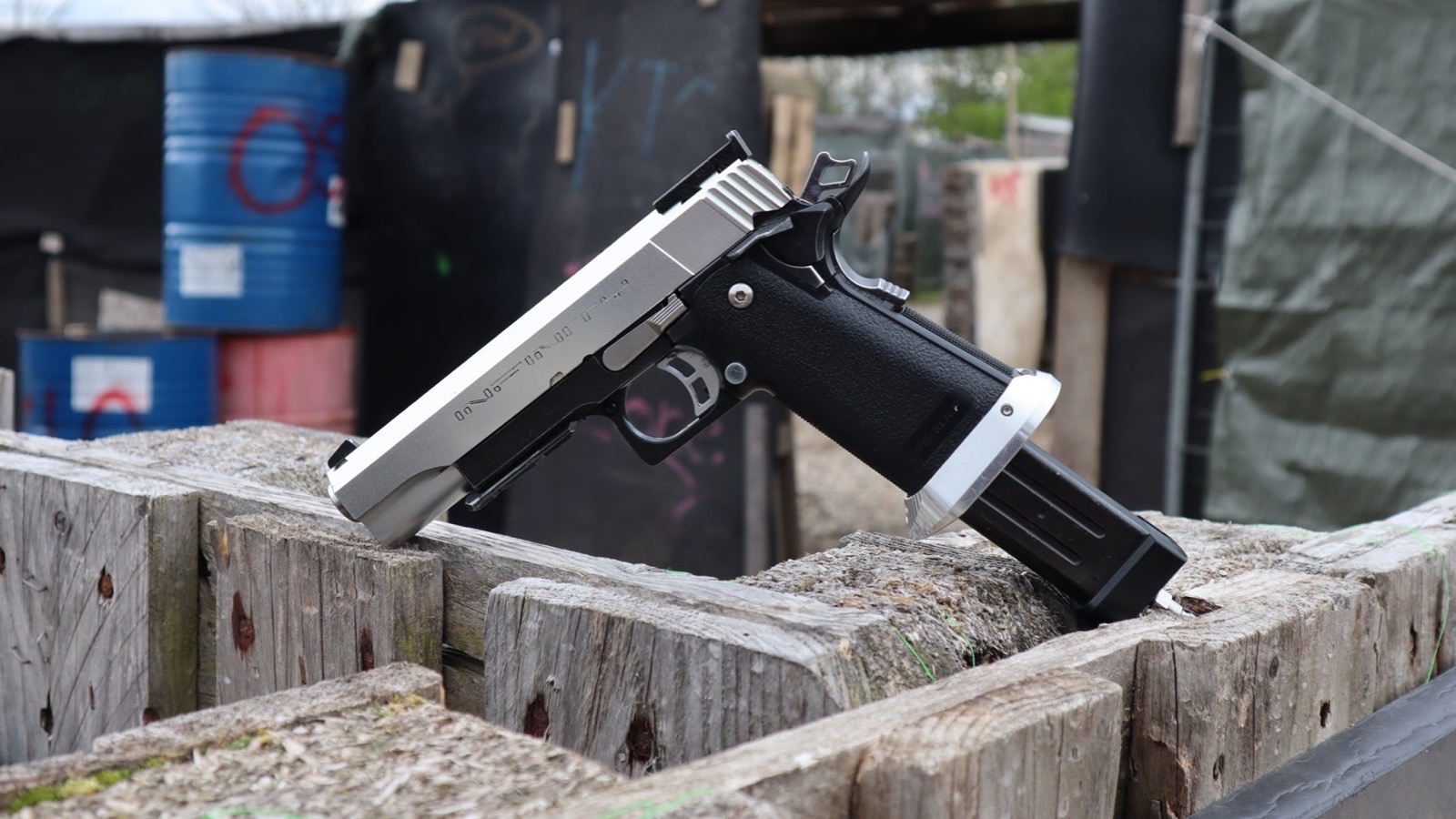
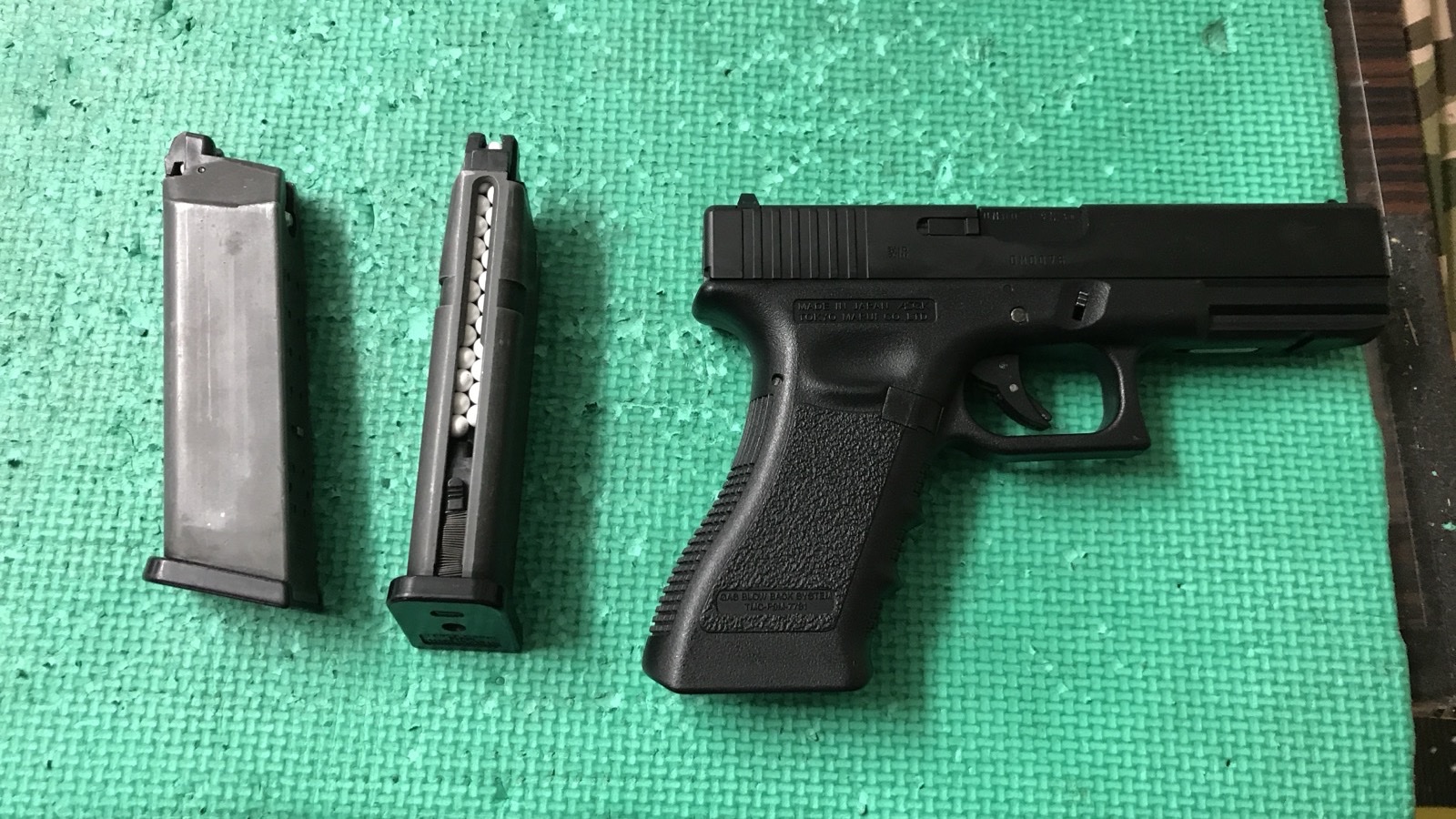
Image credits: cover — Tokyo Marui 5.1 Hicapa rebuilt by Kimse84, CC BY-SA 3.0; CO2 cartridges — BB pistol with co2 and BBs by Hustvedt, CC BY-SA 3.0; Glock 17 GBB — TM Glock 17 with magazines by Ominae, CC BY-SA 4.0; winter game — O.C.A. airsoft command, Nizhny Novgorod by Aleksey Trefilov, CC BY-SA 4.0. All images cropped to 16:9.


Put a Shot Timer in Your Pocket
Airsoft Shot Timer is a free shot timer app tuned for airsoft and Action Air — it picks up BB gun shots, tracks your split times, and saves you the cost of a $150+ hardware timer for IPSC/IDPA practice.