Pocket Pro Shot Timer Review 2026: Manual, Settings & Pocket Pro II
Contents
If you buy a brand-new Pocket Pro in 2026, you’re getting the original Competition Electronics Pocket Pro (model CEI-2800)—not the Pocket Pro II that shows up in most forum threads and YouTube reviews. That model was retired around the end of 2021. The CEI-2800 runs $137.95 direct from Competition Electronics (around $126 at some dealers this week). You get roughly 20 hours on a single 9V battery, up to 99 shots per string, one par beep, and a slide switch for an instant or 4–6 second random start. Sensitivity is adjusted with a tiny screwdriver dial, and there’s no backlight, volume control, or Bluetooth.
That name mix-up is worth knowing about, because the Pocket Pro II is the timer that built the reputation—and the two units are very different machines. The Pocket Pro II offered a backlit menu screen, adjustable volume, and an adjustable random delay, while the classic Pocket Pro sticks to five labelled buttons and almost zero setup. Now that Competition Electronics sells both the classic Pocket Pro and its newer ProTimer for the exact same price, the real decision in 2026 is which of those two belongs in your range bag.
Think of this guide as both a lineup breakdown and a plain-language Pocket Pro manual. Everything here comes from Competition Electronics’ 2022 Pocket Pro manual (Rev 4), the 2019 Pocket Pro II manual, the September 2026 ProTimer manual, the company’s store listings, and its demo video—plus a look at how it handles airsoft and dry fire.
Pocket Pro vs Pocket Pro II vs ProTimer: Which One Is Which?
Shooters casually call all three Competition Electronics timers “the Pocket Pro.” Here’s how they stack up based on the manufacturer’s manuals and store listings as of November 2026:
| Pocket Pro (CEI-2800) | Pocket Pro II (CEI-4700/4710) | ProTimer (CEI-4730) | |
|---|---|---|---|
| Status | Sold new | Retired (about late 2021) | Sold new |
| Official price | $137.95 | — | $137.95 (BT version $167.95) |
| Memory | 99 shots, last string only | 99 shots, last string only | 70 shots × 50 strings, dated |
| Par beeps | 1, up to 99.9 s | 1, up to 199.9 s | Up to 5, up to 600 s |
| Random start | Fixed 4–6 s (switch) | Adjustable 0.5–9.9 s | Adjustable 0.1–9.9 s |
| Sensitivity | Screwdriver dial | Menu, 0–25 | Menu, 0–25 |
| Echo control | Fixed | Dead time 0.05–0.12 s | Dead time 0.05–0.12 s |
| Buzzer volume / backlight | Fixed / none | Adjustable / yes | 10 levels, headset jack, LED / yes |
Want to tell which one you’re holding at a glance? Just check the buttons.
- Pocket Pro (classic): Five front buttons labelled with their exact jobs—REVIEW, NUMBER, SPLIT, 2nd BEEP, and POWER ON—plus a small slide switch next to the side START button. The screen displays plain half-inch numbers with no backlight.
- Pocket Pro II: Four front buttons (MENU up/down and SET up/down), a backlit text-menu screen, and a blue or gray case.
- ProTimer: Also four buttons (MENU FWD, MENU REV/OFF, SET INCR, SET DECR/ON), in a longer 5 × 3 inch case (compared to the Pocket Pro’s 4 × 3) with a headset jack and a white start LED.
All three run on a 9V battery, start via a big side button, carry a two-year warranty, and are made in the USA. Once the warranty expires, Competition Electronics will still repair any current-production model for half its retail price.
What Happened to the Pocket Pro II?
It was quietly discontinued, with no formal announcement from Competition Electronics. Today, the company’s “Retired Shooting Products” page lists “Pocket Pro II – CEI 4700/4710” as unavailable while keeping the manuals online. Archived snapshots of their shot-timer page narrow down the timeline: in September 2021 it listed the Pocket Pro and Pocket Pro II, and by January 2022 it showed the Pocket Pro, ProTimer, and ProTimer BT instead.
Competition Electronics doesn’t officially call the ProTimer a replacement—it says it took “all the best parts of our Pocket Pro II design and added improvements.” In practice, that’s exactly what it is. The menu buttons, 0–25 sensitivity scale, echo setting, and RPM mode all carried over, joined by 50-string memory, extra par beeps, a headset jack, and a start LED.
That’s why so much online advice feels confusing. When an experienced shooter says “just grab a Pocket Pro II,” they’re talking about a timer you can only buy used now. Search “Pocket Pro” and click buy, and you’ll get the older, simpler classic model instead. It’s a solid timer, just not the one those reviews describe. Our best shot timer roundup compares the ProTimer against other current options.
A cheap used Pocket Pro II can still be a nice find, though keep in mind the half-price repair program only covers models still in production (even though the manual is still online). Before buying one, check the 9V battery snap—older units sometimes develop a loose connection that resets the timer when squeezed or clipped to a belt.
The Pocket Pro Manual in Plain Language
Because every button on the classic Pocket Pro does just one thing, it’s way easier to pick up than a menu-driven timer. Here’s the entire manual, boiled down in the order you’ll actually use it.
Battery and power
Pop off the rear cover and snap in a 9V battery. Competition Electronics recommends alkaline for a louder buzzer, though lithium works too. You’ll get about 20 hours of runtime, and the screen flashes “bAtt” when it’s running low. No need to hunt for an off switch—it shuts itself down after 10 minutes idle while keeping your last string in memory.
Running a string
Hit POWER ON, then press the side START button. It beeps, starts counting, and displays the time of each shot as it hears it. When you’re done shooting, just stop—there’s nothing to save.
It holds up to 99 shots in a single string (anything past that isn’t logged) and only remembers one string at a time. Pressing START again wipes the previous run, so jot down or snap a photo of any times you want to keep.
Reviewing shots and splits
Here’s where those clearly labelled buttons shine:
- REVIEW steps forward one shot at a time, showing the shot number first and its time when you release the button.
- SPLIT + REVIEW shows the split between each shot and the one before it—handy for checking your Bill Drill splits.
- NUMBER + REVIEW steps backwards through the string, starting with the last shot.
- NUMBER + SPLIT + REVIEW steps backwards through your splits.
- NUMBER by itself tells you which shot number is currently on screen.
Setting a par time
On the Pocket Pro, par time is labelled “2nd BEEP.” Hold it down until “PAr” flashes for about a second and a half, followed by the current time. Keep holding 2nd BEEP while pressing REVIEW for tens, NUMBER for ones, and SPLIT for tenths—up to 99.9 seconds. Set it to zero to turn it off. Your par setting stays saved when the timer powers down.
You only get one par beep, so you can’t program separate beeps for reloads or extra targets. If you want multiple pars, step up to the ProTimer, which supports up to five.
Instant or random start
Next to the START button sits a two-position slide switch: INST and RAND. INST beeps immediately when pressed—great for range officers running a shooter. RAND adds a random 4 to 6 second delay so you have time to get set when training solo.
You can’t adjust that 4–6 second window, which is the biggest gripe from solo shooters. After enough reps, you start anticipating the beep and can’t stretch the delay to keep yourself honest. Both the Pocket Pro II and ProTimer let you adjust it up to 9.9 seconds.
The 50 vs 99 Shots Contradiction
Shop around for a Pocket Pro and you’ll spot a spec mismatch. Competition Electronics’ product page, Amazon listings, and at least one dealer claim you can “review up to 50 shots.” Yet the Pocket Pro manual—both the 2010 edition and the current Rev 4—plus the company’s own comparison chart all say 99.
The manual is almost certainly right; the 50-shot line reads like old store copy that never got updated. For most drills under 30 shots it won’t matter, though it’s good to know if you shoot long field courses or 50-round rimfire strings.
Sensitivity and Echo: The Screwdriver Dial
Forget menus—on the side opposite the START button, there’s a small dial you adjust with a flat-blade screwdriver. Clockwise increases sensitivity, and the factory setting points the arrow straight up. The dial stops around the 7 o’clock and 5 o’clock positions; the manual warns against forcing it past either stop.
There’s a hidden perk here: nobody can accidentally bump the sensitivity in a pocket or range bag, and a club timer stays right where you set it. The trade-off is having no number to reference. Unlike Pocket Pro II or ProTimer owners who can say “I run it at 18,” you’re stuck noting something like “arrow at 2 o’clock.”
Echo rejection is fixed, and Competition Electronics doesn’t publish the number (newer timers let you tune dead time between 0.05 and 0.12 seconds to ignore echoes). On a loud, hard-walled indoor range, your only move is dialing sensitivity down until the shooter in the next lane stops showing up in your string.
Two quick tips from the manual: tap the case near the sensor to trigger a test “shot” before heading to the line, and never cover the sensor opening with your hand, a pouch flap, or tape. Blocking it muffles real shots and can bounce the buzzer’s own beep into the mic as a ghost shot.
Does the Pocket Pro Work for Airsoft and Dry Fire?
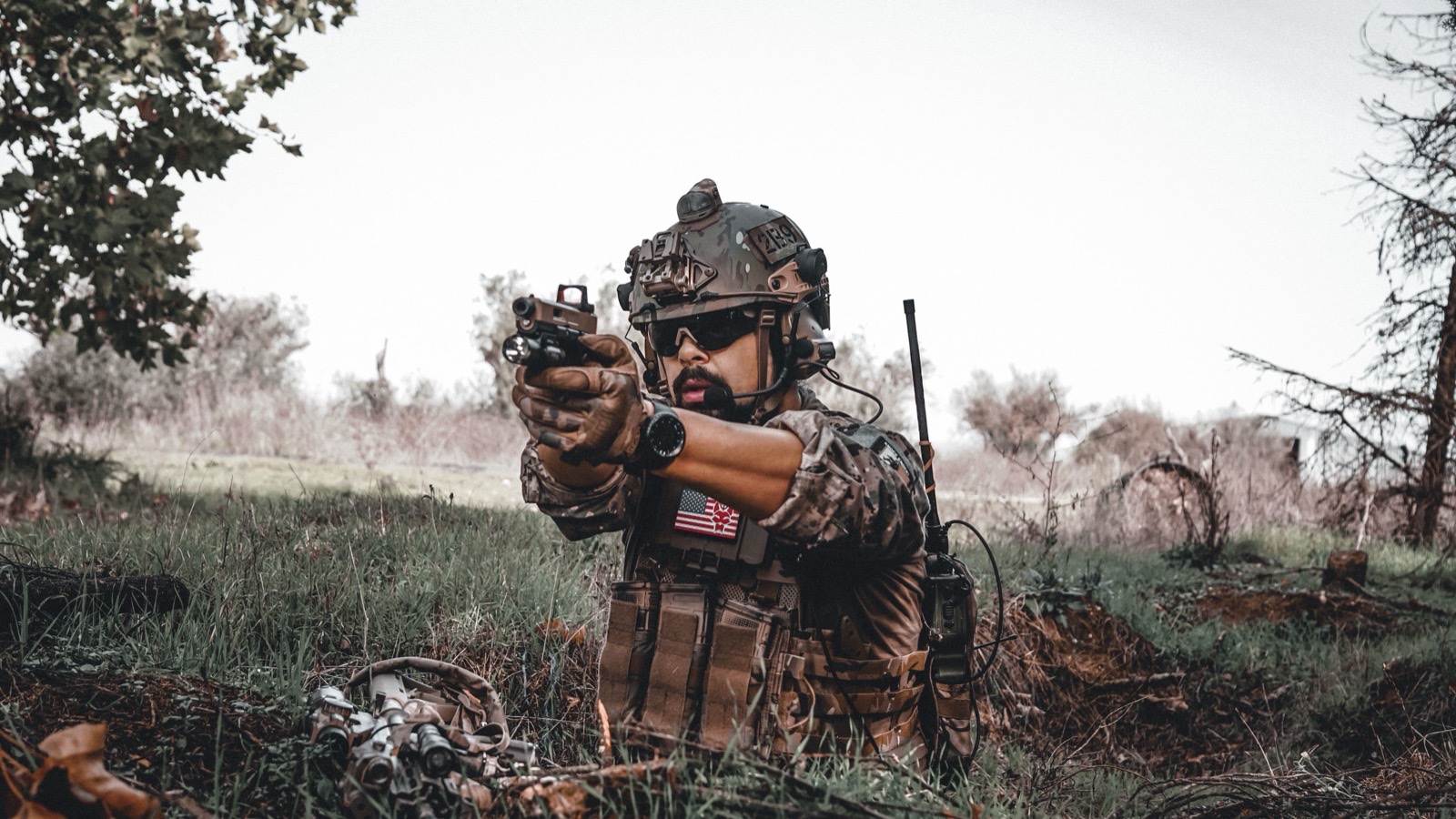
Competition Electronics doesn’t publish airsoft specs for any of its timers, so what follows is based on how the Pocket Pro is built rather than official numbers.
Dry fire
For dry fire, Competition Electronics points you to the par beep rather than the mic. Its Pocket Pro demo video suggests setting a par and beating the second beep so the timer doesn’t have to hear your trigger click. Asked about the ProTimer, the company said it “can’t guarantee” picking up a dry-fire click even at max sensitivity, though a hammer drop as loud as a finger snap should register. The Pocket Pro isn’t more sensitive, so build your dry fire around the par beep. Just note the buzzer is locked at 105 dB at 1,500 Hz—pretty loud for an apartment—with no volume control or headset jack. The ProTimer has both, and our online par timer handles the same drills at whatever volume you want.
Gas pistols
Gas-blowback pistols are much quieter than live firearms, so start well above factory sensitivity and work from there:
- Place the timer about a metre from the muzzle with nothing blocking the sensor.
- Turn the dial clockwise roughly a quarter turn from straight up, flip the switch to RAND, and fire five shots.
- Check the count. If it missed shots, turn the dial further clockwise and try again.
- If it logged more than five—or a phantom first shot a few hundredths of a second after the beep—the buzzer or an echo is triggering it. Back the dial off slightly and move away from walls.
Because you can’t turn down the buzzer, running high sensitivity is trickier than on timers with adjustable volume. You’ll usually settle just shy of catching every single shot.
AEGs on full auto
Here’s where hardware timers hit a wall. Every timer ignores sounds that arrive too close together, capping the rate of fire it can count. On the Pocket Pro II and ProTimer, the default 0.11-second dead time tops out around 9 shots per second, and even the 0.05-second minimum caps at 20. Since most AEGs cycle at 15 to 25 rounds per second, even adjustable timers drop shots at the high end—and because the Pocket Pro’s fixed echo rejection is undocumented, you can’t even calculate its ceiling. Stick to semi-auto for timed drills and treat full-auto counts as rough estimates.
If most of your training is airsoft or dry fire, a live-fire hardware timer isn’t the smoothest tool. The Airsoft Shot Timer app runs right on your phone, displays your first shot and every split on one screen, offers a 1 to 8 second random start (wider than the Pocket Pro’s fixed 4–6), and gives you single or repeating par beeps in settings. Like hardware timers, it’s made for semi-auto strings—it ignores shots closer than 0.1 seconds apart, so it won’t count full-auto bursts round by round. Outdoors in wind, fire a few test shots first. A great setup is hardware for matches and your phone for home practice, which works just as well if you shoot Action Air.
Battery Life and Care
One 9V lasts around 20 hours—months of range trips for most shooters. Still, toss a spare in your bag, because “bAtt” means replace it soon, not right this second. Lithium 9Vs cost more but handle cold mornings better. The manual rates operating temps at 32–100 °F (0–38 °C), so tuck the timer in a pocket between stages in winter rather than leaving it on a freezing barricade.
The ProTimer manual advises pulling the battery for long-term storage since it draws a tiny current even when off. Doing the same with a Pocket Pro stored over winter is smart, and you lose nothing since it only holds one string anyway.
Pocket Pro vs ProTimer at the Same Price

For years, the ProTimer was the pricier option—in 2024 Competition Electronics listed the Pocket Pro at $150.95 and the ProTimer at $167.95. As of November 2026, both sit at $137.95 on the company store (with the ProTimer BT at $167.95), and dealer prices are close too.
For the exact same money, the ProTimer packs in way more: five par beeps, 50 dated strings, adjustable random start, numbered sensitivity, adjustable echo, ten volume levels, a headset jack, a start LED, a backlight, and built-in hit factor scoring. If you train solo, indoors, at home, or with multi-par drills, it’s easily the better pick.
That said, the Pocket Pro still makes sense in a few spots:
- Club or match use. One job per button and a hard-to-bump sensitivity dial mean you can hand it to a new range officer after a one-minute briefing.
- Zero-fuss simplicity. No menus to learn, and nothing to reset if someone else borrows it.
- Longer single strings. It holds 99 shots per string versus the ProTimer’s 70, provided you only care about the latest run.
Otherwise, grab the ProTimer. And if you’re mainly timing dry fire and airsoft at home, you might not need hardware yet—our complete guide to using a shot timer breaks down what to look for.
The Downsides
- One string in memory. Pressing START erases your last run.
- Fixed 4–6 second random start. You can’t widen the window to keep the beep unpredictable.
- No volume control, backlight, or headset jack. Loud indoors and tough to read in dim light.
- Unnumbered sensitivity dial. Hard to bump by accident, but also hard to log or repeat.
- Fixed echo rejection. On a busy indoor range, lowering sensitivity is your only option.
- Conflicting specs. The 50 vs 99 shot mix-up comes straight from the manufacturer and pops up on dealer pages too.
Frequently Asked Questions
Is the Pocket Pro the same as the Pocket Pro II?
No. The Pocket Pro (CEI-2800) is the original model with five labelled buttons, a numeric screen, a random-start slide switch, and a screwdriver sensitivity dial. The Pocket Pro II (CEI-4700/4710) had a backlit menu screen, adjustable volume, and an adjustable random delay. The classic Pocket Pro is still sold new, while the Pocket Pro II was retired around late 2021.
Is the Pocket Pro II discontinued?
Yes. Competition Electronics lists it under Retired Shooting Products, and archived site pages show it left the lineup between September 2021 and January 2022. The company says its ProTimer (CEI-4730) builds on the best parts of the Pocket Pro II design.
How do I set a par time on a Pocket Pro?
Hold the 2nd BEEP button until “PAr” appears, keep holding it, and use REVIEW for tens, NUMBER for ones, and SPLIT for tenths of a second. It goes up to 99.9 seconds; set it to zero to switch the par beep off.
How do I adjust the sensitivity on a Pocket Pro?
Turn the small dial opposite the START button with a flat-blade screwdriver. Clockwise increases sensitivity, and factory default has the arrow pointing straight up. Don’t force it past the stops around 7 and 5 o’clock.
How many shots does the Pocket Pro record?
Up to 99 shots in a single string according to Competition Electronics’ manual and comparison chart, even though the product page and several dealers say 50. Only your most recent string is saved.
What battery does the Pocket Pro use?
A single 9V battery. Alkaline is recommended, though lithium works too. Expect roughly 20 hours of use and swap it when the screen flashes “bAtt”.
Does the Pocket Pro work with airsoft guns?
It can catch gas-blowback pistols at close range if you crank up the sensitivity—fire five test shots and fine-tune from there. Since buzzer volume is fixed, high sensitivity can sometimes trigger off the start beep, and full-auto AEG counts aren’t reliable. For everyday airsoft practice, an airsoft-tuned shot timer app is much easier to run.
Does the Pocket Pro have Bluetooth or an app?
No. Among Competition Electronics timers, only the ProTimer BT (CEI-4720, $167.95) includes Bluetooth, connecting to the PTLink app and PractiScore.
Final Thoughts
The Pocket Pro on shelves today is Competition Electronics’ classic workhorse, and it doesn’t pretend to be anything else: five buttons, one string, one par, and a sensitivity dial you set once and forget. It’s great for a club box or anyone who hates menus. Still, the timer behind the hype is the retired Pocket Pro II—and the model that carries its DNA forward is the ProTimer, now selling for the exact same price.
If you’re mostly running dry fire or airsoft drills at home, start with a shot timer app on your phone or the online par timer, and save the hardware purchase for when you start shooting matches.
Image Credits
No freely licensed photo of a Competition Electronics timer was available, so none of the photos above show a Pocket Pro—they simply illustrate the shooting described in the guide. The pistol in the tactical-gear photo isn’t identified and may not be an airsoft gun. Images were cropped and resized to 16:9 with no other changes.
- Cover: Competitor at the 2013 IPSC Australasian Handgun Championship, A. Taverner, CC BY 2.0, via Wikimedia Commons
- Shooter at an indoor range, Tima Miroshnichenko, Pexels License
- Player in tactical gear aiming a pistol, Javier Leal, Pexels License
- Score sheet signing at the 2013 IPSC Australasian Handgun Championship, A. Taverner, CC BY 2.0, via Wikimedia Commons


 Airsoft Shot Timer
Put a Shot Timer in Your Pocket
Automatic airsoft shot detection, split times, multiple PAR times and training records — no sign-up.


Related articles