SG Timer GO vs SG Timer 2: Which One Should You Buy?
Contents
For most shooters the SG Timer GO is the better buy. It costs about $165, against roughly $300-330 for the SG Timer 2, and it uses the same Drills app, Spy Mode and RO mode. Since the September 2026 redesign it also has a third button, so you can change the basic settings on the timer itself. The SG Timer 2 is the one to pay for if you run a busy indoor bay, act as a range officer, shoot airsoft AEGs, or simply want to do everything on the device. It has a louder 110 dB buzzer, a sharper 172 PPI front screen, sensitivity you can set from 1 to 100, wireless charging and five times the Bluetooth range.
That’s the short answer to “SG Timer GO vs SG Timer 2”. Most comparisons online were written about the original two-button GO, so they still list “no water resistance” and “settings only in the app” as GO drawbacks. Both changed in 2026. This comparison is built from Shooters Global’s current product pages and the 2026 SG Timer 2 user manual. Where reviewers measured something, we say who and when.
SG Timer GO vs SG Timer 2 at a Glance
The two timers share a brand, an app and most of their software. The real differences are the buzzer, the screen, the battery and how much you can do without your phone.
| SG Timer GO (2026) | SG Timer 2 | |
|---|---|---|
| Price (Shooters Global, Nov 2026) | $164.99 one mount, $174.99 both | $299.99 list ($329.99 in 2025) |
| Buzzer | 99 dB | 110 dB, volume 0-100 |
| Screen | Top-mounted, 46 PPI, backlight without light sensor | Front-mounted, 172 PPI, reflective, automatic backlight |
| Charging and battery | USB-C, “up to 5,000 sessions” | USB-C or any Qi wireless pad, 100 hours / “7,000 sessions” |
| Bluetooth range | 50 ft | 260 ft |
| Mount | Belt quick release or pocket clip | Magnetic U-Grip belt mount |
| Water | Water resistant (new in 2026), no IP rating | Dust and water resistant, no IP rating |
Both carry a two-year warranty and a 30-day return window direct from Shooters Global. Prices on the official store change with the region you browse from, because VAT is folded into the price in some countries. They also change with frequent sales. When we checked on November 22, 2026, the store showed sale prices of $148.49 for the GO and $269.99 for the SG Timer 2. Treat the list prices above as the baseline.
Which SG Timer GO Do You Have? Two Buttons vs Three
The GO has two versions with the same name, and that’s why reviews disagree. Shooters Global previewed the new GO at SHOT Show in January 2026 and released it on September 11, 2026. Forums call it the “SG GO II”, but the official name is still SG Timer GO.
Count the buttons. The original GO has two, so par times, volume, sensitivity and presets lived in the Drills app. Changing a par time on the line meant taking out your phone. The 2026 GO has three, and Shooters Global says “essential settings can now be adjusted directly on the timer.” Advanced features still go through the app. The new body is polycarbonate and water resistant, and the acoustic chamber was redesigned for a wider pickup field. The battery grew from 900 to 1,000 mAh, about 11% more.
This explains the conflicting specs online. The Firearm Blog’s November 2025 comparison lists the GO with “two buttons” and “no water resistance rating.” That was correct for the unit it described, which was the original. If you’re buying new, check that the listing shows three buttons. A first-generation unit is only worth it at a real discount, and only if you don’t mind setting it up from your phone.
Screen and Buzzer: Where the Extra Money Goes
The SG Timer 2’s screen is the bigger upgrade of the two. It’s front-mounted, about 2 inches, 172 PPI, and uses a reflective layer that gets easier to read in direct sun. A light sensor switches the backlight on indoors. The GO’s screen is on top of the unit at 46 PPI with a plain backlight, and its official page says “without light sensor.” On the belt that’s actually handy: you can glance down at a top screen without unclipping the timer. In your hand, or held up for a shooter to read, the SG Timer 2 shows more at once and is easier to read.
The buzzer gap matters more than the numbers suggest. 99 dB is plenty for one shooter in ear protection. 110 dB is what you want when a range officer starts a shooter wearing plugs and muffs on a windy outdoor bay. The SG Timer 2 also lets you set volume anywhere from 0 to 100. Uncle Zo, who reviewed it in March 2025, found 5% “perfect for dry fire.” That matters if you train in an apartment at night.
What You Can Do Without the Phone
This is the question that decides most purchases, and the SG Timer 2 manual answers it clearly. On the SG Timer 2, every Free Shooting setting can be changed on the timer or in the app. That covers buzzer volume, sensor sensitivity, Spy Mode, start delay, time limit, shot limit, pause between sets and number of sets. You get up to seven custom presets, and you can add, delete and edit them on the device.
There are two app-only jobs, even on the flagship. Preset names can only be changed in the Drills app. “Gun types,” the saved combinations of sensitivity, volume and echo filter, can only be created in the app, though you can edit existing ones on the timer. So set your gun types up once at home: one for live 9 mm, one for dry fire, one for airsoft. After that, the range is phone-free.
The 2026 GO puts the essentials on the device and leaves the rest to the app. In practice you’ll build presets and gun types in the Drills app and pick between them at the range. That’s fine for training, and it beats the original GO. If you want to change shot limits and set counts mid-session without your phone, though, the SG Timer 2 is the one built for that. It isn’t fast either. Uncle Zo counted “nine steps, at least eleven button presses” to set a par time on the SG Timer 2 starting from the home screen. That’s why most owners save presets ahead of time.
Dry Fire: Classic vs Smart Mode
Both timers support dry fire through the Drills app, and the 2026 SG Timer 2 manual describes two modes worth understanding before you blame the timer. In Classic mode the timer is just a par timer. It beeps start, counts down your time limit and beeps end. It doesn’t record anything, and those sessions don’t appear in your drill stats. In Smart mode the timer listens for your hammer or striker fall and records the actual time.
Smart mode has one setting that trips people up: Waiting time. A mag drop, a slide rack or gear rattle sounds a lot like a hammer fall to a microphone. So the timer waits for a period of silence after the last sound before it accepts that sound as your shot. If waiting time is 1 second and you finish a reload drill with the trigger press, you have to stay quiet for a second until the confirmation beep. The manual’s example has a 3-second limit, an 8-second reset pause, a random 1-4 second delay and five reps. A shooter who presses at 4.3 seconds is shown as 1.3 seconds late.
Expect dry fire times to be a little off. A GO owner on r/CompetitionShooting reported dry fire mode reading “about 0.10-0.20” seconds off, and Uncle Zo says dry fire sensitivity “should always be 100%.” Keep the timer on your belt facing the gun, or on the table right under it. Watch the display the first few times to make sure it actually hears your trigger. If your dry fire splits look about 0.15 s slow compared to your live-fire splits, the timer may be the reason, not you. Compare against your own dry fire baseline, not against your live-fire times.
For a full home routine to run on either timer, our dry fire training guide has the drills and par times.
Do SG Timers Work for Airsoft?
Only the SG Timer 2 is officially marketed for it. Its product page lists detection “from AEG and CO2 to any firearm caliber,” suppressed included. The GO’s page says “CO2, suppressors and any firearms” and “captures dry fire,” but doesn’t mention AEGs. The Firearm Blog’s sponsored comparison says the two use the same smart-sensor technology and both work with airsoft. That may be true, but it isn’t what Shooters Global puts on the GO’s own page.
Our practical advice is the same for both. A gas-blowback pistol is louder than a striker click, so if the timer hears your dry fire it’ll usually hear your GBB. Set sensitivity high, keep the timer within a metre or so of the muzzle, and run a slow five-shot string first to check the shot count. AEGs are the hard case. They’re quieter, and full auto sends 20-plus shots a second at the microphone. That’s where the SG Timer 2’s 1-100 sensitivity and echo filter matter most. On an outdoor field with other players shooting, any acoustic timer will pick up shots that aren’t yours. Spy Mode and the echo filter help, but they don’t fix that.
If your training is mostly airsoft drills at home or in your backyard, you may not need either. An airsoft-tuned shot timer app on the phone you already own covers draws, reloads and splits. Buy hardware once you start shooting matches where an RO needs a separate timer.
Match Day: Spy Mode, RO Mode and PractiScore
Spy Mode is the feature that sells SG timers to competitors, and both models have it. When Spy Mode is on and you press start, the timer waits until it hears another timer’s beep, then starts the string. You get the same times on your belt as the range officer’s timer, plus the history and video tools in the Drills app. The SG Timer 2 manual lists the timers it can spy on: SG Timer, SG Timer 2, SG Timer GO, CED7000, Special Pie M1A2-F, PACT Club Timer 3, Pocket Pro, AMG Lab Commander and RangeTech. There are several options for some brands because, as the manual puts it, some buzzers “degrade over time and change their tone.” If one option doesn’t trigger, try the next.
Two cautions from real use. Uncle Zo ran Spy Mode at 70% sensitivity against an AMG Commander and a RangeTech, and it “catches the buzzer most of the time.” So it works most of the time, not every time. He also missed a start on his own timer because he’d left Spy Mode on. Check for the Spy Mode icon on the main screen before your string.
RO mode is a separate, simpler interface, and both product pages list it. On the SG Timer 2 it records “Shootings” (one per competitor) instead of sessions. If the timer gets stopped early, you can continue the same shooting with the times intact. There’s also a Walkthrough timer for the walkthrough before the stage, and you can adjust it while it runs. Data recorded in RO mode stays out of your personal history. Both timers connect to PractiScore 2 and IPSC ESS. For scoring a whole squad from behind the shooter, the SG Timer 2’s 260 ft Bluetooth range and better screen make it the RO’s timer. The GO’s 50 ft range is fine for the phone in your own pocket.
Battery, Charging and Mounts
Both are rechargeable, with no spare batteries to carry. The SG Timer 2 manual quotes 100 hours of active operation per charge, and the product page says about 7,000 sessions. It charges from any 5 V USB-C source or any Qi wireless pad. It also switches itself off after 30 minutes of standby, so you won’t come back to a dead timer after leaving it on overnight. The GO charges over USB-C only and is rated at “up to 5,000 sessions.” The Firearm Blog quotes about 70 hours. Either one easily covers a weekend match.
The mounts are different in a way you’ll notice. The SG Timer 2 ships with the U-Grip, a magnetic belt mount for 1.5-2 inch belts, and its accelerometer flips the screen when you turn the timer upside down. Early U-Grips had complaints about the timer coming loose. Uncle Zo reported “zero slips or drops” with the current stronger magnets, and you can also move the belt clip directly onto the timer. The GO uses a belt quick release or a pocket clip. Buy the $174.99 kit if you want both.
Which One Should You Buy?
Buy the SG Timer GO if you mostly train alone, live fire or dry fire, and you’re happy to set presets in the app once and pick them at the range. You get the whole Shooters Global system for about half the price. It’s also the easier timer to wear all day, because it’s small and you read it from the top.
Buy the SG Timer 2 if you work as an RO or instructor, train in a loud indoor bay, want to change sets and shot limits without your phone, or need the AEG detection Shooters Global actually advertises. The 110 dB buzzer and the 260 ft Bluetooth range are the two specs the GO can’t match.
Consider neither if what you really want is a simple, no-app timer you can hand to anyone at a club match. In that case, look at the PACT Club Timer III or the CED7000 Gen-2. For the full field of twelve timers, including the AMG Commander and Double-Alpha EDGE, see our best shot timer buying guide.
Frequently Asked Questions
What is the difference between the SG Timer GO and SG Timer 2?
The SG Timer 2 has a louder buzzer (110 vs 99 dB), a sharper front screen (172 vs 46 PPI), sensitivity adjustable from 1 to 100, wireless charging, longer battery life and 260 ft Bluetooth range against 50 ft. Both run the same Drills app, Spy Mode and RO mode. The GO costs about half as much.
Is the SG Timer 2 worth it over the GO?
Only if you’ll use its loudness, screen or on-device control. Range officers, instructors and shooters in busy indoor bays get real value from it. For solo training the GO does nearly everything for about $135 less.
Can you use the SG Timer GO without the app?
Partly. The 2026 three-button GO lets you change essential settings on the timer, but presets, gun types and advanced features are set up in the Drills app. The original two-button GO depends on the app for almost every setting.
How do I tell the new SG Timer GO from the old one?
Count the buttons. The September 2026 redesign has three buttons and a water-resistant polycarbonate body. The original has two buttons. The official name didn’t change, so check photos and the listing before you buy.
Does the SG Timer GO detect dry fire?
Yes. It detects striker and hammer falls in the Drills app’s Smart dry fire mode. Keep sensitivity high, keep the timer close to the gun, and expect readings that can be around a tenth of a second off. Compare your dry fire times with each other, not with your live-fire times.
Can an SG Timer pick up airsoft guns?
Shooters Global advertises AEG and CO2 detection for the SG Timer 2. The GO’s page lists CO2 and dry fire but not AEGs. Gas-blowback pistols are usually loud enough for either timer at close range with high sensitivity. Test with a counted string first.
Final Thoughts
Since the 2026 three-button redesign the SG Timer GO has had no real weak spot, and it’s the one most shooters should buy. The SG Timer 2 is a better tool for a narrower group: people who run the line, train in loud bays, or want the whole timer under their thumb. Whichever you pick, spend ten minutes at home setting up gun types for live fire, dry fire and airsoft, and check that Spy Mode is off before you shoot your own string.
If you’re not sure you need hardware yet, start with a shot timer app or our online par timer. You can buy a timer later, once you know which features you actually use.
Image Credits
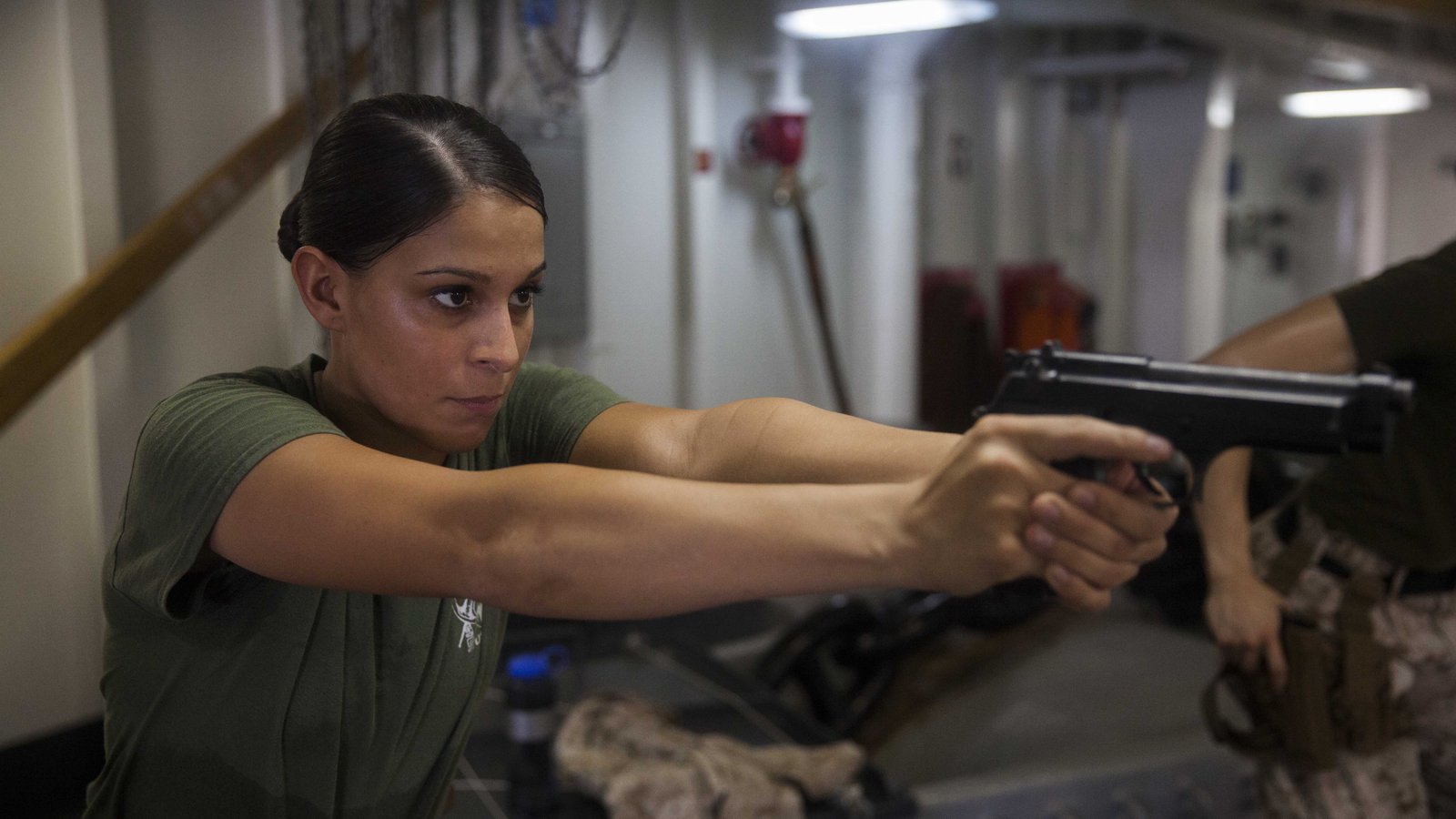
None of these photos shows an SG Timer. The timer in the second photo is an unidentified yellow handheld unit; the first two photos are from a U.S. Marine Corps intramural marksmanship competition in Okinawa, not a USPSA or IPSC match. All three are U.S. government works in the public domain, cropped and resized to 16:9 and not otherwise altered.
- Cover: IndoPacific Marines Demonstrate Lethality in Okinawa Intramural Marksmanship Competition, U.S. Marine Corps photo by Lance Cpl. Robert Blanks, public domain, via Wikimedia Commons
- U.S. Marines compete in the Okinawa Intramural Marksmanship Competition at Camp Hansen, U.S. Marine Corps photo by Lance Cpl. Joseph Kreis, public domain, via Wikimedia Commons
- Dry-fire drills aboard USS Essex (LHD 2), July 2015, U.S. Marine Corps photo by Cpl. Anna Albrecht, public domain, via Wikimedia Commons


Related Articles
- Best Shot Timer 2026: Twelve Timers Compared
- PACT Club Timer III Review and Plain-Language Manual
- CED7000 Shot Timer Review: Gen-2 Manual & Airsoft Setup
- AMG Lab Commander Shot Timer Guide
- Best Shot Timer App for iPhone, Android and Airsoft
 Airsoft Shot Timer
Put a Shot Timer in Your Pocket
Automatic airsoft shot detection, split times, multiple PAR times and training records — no sign-up.


Related articles