Special Pie Shot Timer Review 2026: M1A2+ Setup & Airsoft Use
Contents
The Special Pie shot timer is the M1A2+, a pocket-sized Bluetooth timer from Guangdong Special Pie Technology that IPSC’s own web store sells as the “Official IPSC Timer Gen 2.” It has a 1000 mAh battery rated for about 48-50 hours of use, eight sensitivity levels, instant, random and fixed start delays, a par mode, and PractiScore pairing. In Europe it sells for around €142, which puts it in the same bracket as a CED 7000 and below an AMG Commander. For live fire it is a solid, slightly fiddly timer. For airsoft, it only hears your gun at the top of its sensitivity range and close to the shooter, unless you buy Special Pie’s separate Action Air system, which skips sound detection entirely.
That last point is why most people end up searching for this timer. If you shoot Action Air or train with a gas pistol, you have probably heard that Special Pie is “the airsoft timer brand,” because its stop-plate system has run the clock at IPSC Action Air events for years. The M1A2+ you find on Amazon is a different product, and the difference matters before you spend €140 on it.
This guide covers both sides. First the review: which Special Pie is which, what it costs, and how it compares. Then the instructions, which are usually the reason people search for this timer in the first place, because the button labels are cryptic and the manual is a six-page leaflet: delay, par, sensitivity, history, countdown and PractiScore pairing, in plain language.
Who Makes Special Pie, and Why It Shows Up at IPSC Matches
Special Pie is the trade name of Guangdong Special Pie Technology, a shooting-training equipment maker based in the Songshan Lake science park in Dongguan, China. Supplier directories list it as a branch of Shenzhen Indesign Technology, which explains why the Amazon storefront is called “Indesign Special.” The company sells far more than timers: laser training kits, auto-reset steel targets, LED scoreboards, a ballistic chronograph and a shot camera all share the same wireless ecosystem.
The competition credibility comes from Action Air. According to Special Pie, its wireless airsoft timing system was used at IPSC Action Air events from 2018 through 2024 and was the designated timing system for the 2025 Action Air World Shoot in the Philippines. On the firearm side, IPSC’s own web store (ipscstore.com) sells the M1A2+ as the “Official IPSC Timer Gen 2.” That is roughly the same position the AMG Commander holds with USPSA, and it’s the reason you will see the little white-and-orange timers in RO hands at European and Asian matches.
None of that tells you whether you’d enjoy owning one, though, so let’s start with the model mess.
M1A2+ vs M1A2-F vs the Action Air System: Which Special Pie Is Which
Special Pie’s naming is the biggest source of confusion, and it trips up buyers in both directions: airsoft players buy the M1A2+ expecting the Action Air system, and live-fire shooters land on old M1A2-F listings and wonder why PractiScore won’t see the timer on their iPhone.
| Model | What it is | How it detects shots | Connectivity |
|---|---|---|---|
| M1A2-F / M1A2-FW | Earlier firearm timer (FW = wireless version) | Microphone, sensitivity 1-8 | FW adds RF link to LED displays; Bluetooth to PractiScore (Android only in the manual) |
| M1A2+ (“Official IPSC Timer Gen 2”) | Current firearm timer, launched January 2025 | Microphone, sensitivity 1-8, auto echo filter | Bluetooth (PractiScore, PractiScore 2, IPSC ESS, SSI), RF to LED scoreboards, USB-C |
| M4P1+ Action Air Timing System | Timer plus wireless stop plate for airsoft | Not sound: the stop plate reports the hit | RF, about 50 m indoors and 100 m outdoors |
If you shoot live fire, the M1A2+ is the one to buy, and anything still listed as M1A2-F is the older generation. The M1A2+ also anchors what Special Pie calls a “timer family”: a QuickGlance kit that adds a second display over USB-C, a big LED score display synced over RF, the SC9 chronograph that sends velocities to the timer over Bluetooth, and integration with the Argus camera for overlaying shot times on video. You don’t need any of it to use the timer, but it explains why the M1A2+ has more menu entries than a CED 7000.
If you shoot Action Air, the stop-plate system is what the matches use. The handheld timer starts the beep, and the string ends when you hit the plate, which changes color and radios the time back. It never tries to hear a gas pistol, which is exactly why it works.
Special Pie Shot Timer Instructions: The Settings That Matter
The M1A2+ runs on a hold-versus-tap logic: a quick press moves through options, and holding a button for a couple of seconds selects or toggles something. Once that clicks, the menu stops feeling random. The labels printed under the screen tell you what each button does when held.
Power and menu. Hold the power button (upper right) for about five seconds to turn the timer on or off. Hold it briefly while the timer is idle to enter the settings menu, where you’ll find Mode (Firearm, Stopwatch, Countdown), Delay, Par and System. Tap to move down the list, hold to enter, and use the upper-left button to back out.
Start delay. Under Delay there are three choices: Instant, Random (3-5 seconds) and Fixed, which you can customize up to 10 seconds. One reviewer runs a custom 2-3 second fixed delay to collect themselves before the beep. For solo practice, though, Random is the better habit, because a fixed delay teaches you to anticipate the beep, and that habit falls apart the first time a real RO runs you.
Par mode. Set the par time and the number of cycles in the menu (up to 10 cycles), then hold the “+” button to switch par on or off. A “PAR” marker on the home screen tells you it’s armed. The tutorial made for Texas State Championship ROs has a whole segment on this because par gets switched on by accident more often than you’d think, and a timer that double-beeps in the middle of a stage confuses everyone.
Quick set: volume, tone and sensitivity. Hold the lock/quick-set button for two or three seconds. On that screen the speaker button cycles volume (three levels) and beep tone, and “+” and “-” change sensitivity. The RO tutorial’s advice is to stay on the low-frequency tone, because more people can hear it through ear protection, especially older shooters.
Reviewing a string. On the M1A2-F, a quick press of power steps through each shot’s time and split. On the M1A2+, hold the history button to list every string since the timer was switched on, then step through each string’s splits. The one thing nobody tells you: turning the timer off deletes those strings. The RO tutorial recommends leaving it on all match long for that reason, and the memory is large enough for it, with 20 strings of up to 99 shots each according to the Australian distributor.
Countdown. Hold “-” for about three seconds to start a countdown of up to 600 seconds. ROs use it for the stage walkthrough so they don’t need a second stopwatch.
Eco mode and language. Under System you can set the auto-shutdown time (one reviewer found it defaulting to 15 minutes) and pick from nine languages. If the screen ever shows upside down, that’s the low-battery warning the manual mentions, so charge it.
Sensitivity: Where to Start on the 1-8 Scale
Sensitivity runs from level 1 (least sensitive) to level 8 (most sensitive), and that short scale is both the timer’s strength and its limit. It’s quick to change, but each step is a big jump, so there’s less fine-tuning than on timers with a 1-10 scale plus a separate echo filter.
For live fire, start in the middle. One reviewer shooting 9mm outdoors left it at 5 and had no missed shots. The Texas RO tutorial settles on 6 or 7 for matches with quiet pistol-caliber carbines. The M1A2+ also has automatic echo filtering, and the menu exposes a filter value from 1 to 10 ms, which helps indoors where the shot bounces off the walls. Go too high at a busy range and the timer will start counting your neighbor’s shots, so test it the way you’d test any timer: fire a known number of rounds, check the count, and move one level at a time until ten shots read as ten.
Level 7-8 is airsoft territory, which brings us to the question behind most searches.
Does a Special Pie Shot Timer Work for Airsoft?
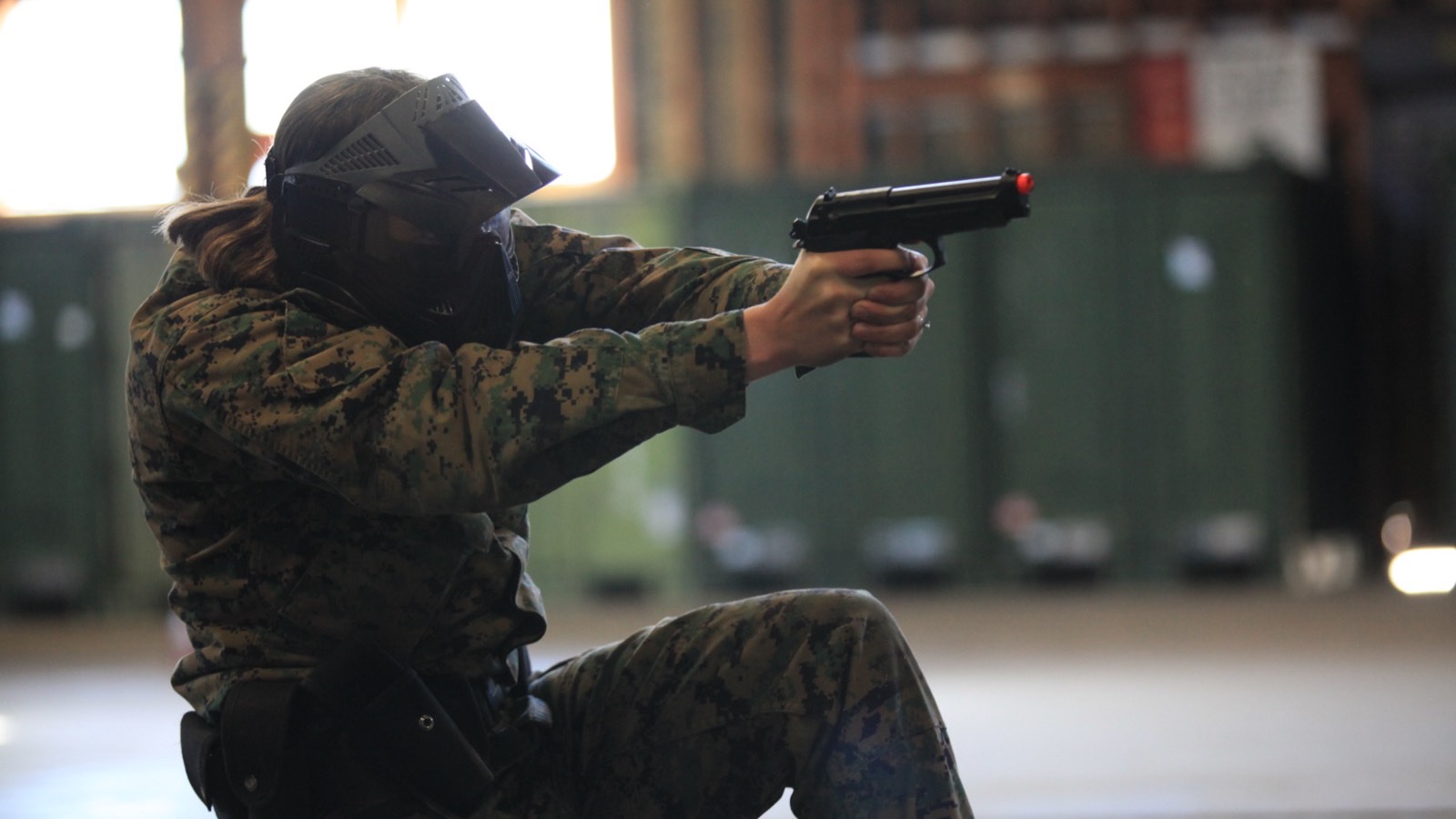
Partly, and only within limits Special Pie itself spells out. The company’s own demonstration of the M1A2-F with an Action Air gun says the timer picks up airsoft shots once sensitivity is raised to level 7 or 8, and recommends keeping the timer within about one meter of the shooter. That’s a close-range, quiet-environment setup. At a busy indoor arena, with other lanes firing and BBs rattling off steel, level 8 starts counting noise as shots.
Player reports fit that picture. On Reddit, one competitor called it one of the few hardware timers you can make sensitive enough to register airsoft guns at all, with a caveat about fast strings. On an airsoft forum, an M1A2 owner who couldn’t get their shots registered was told that the timer’s “airsoft mode” is meant for use with Special Pie’s sensor target, not the microphone. Earlier M1A2 units advertised four modes (Fire, Airsoft, Stopwatch, Countdown), and the RFID setting in the menu exists to link the timer to a stop target or wireless display.
So the practical answer depends on what you want to time:
- Action Air matches or a stop-plate drill: buy the Action Air timing system. It ends the string when you hit the plate, never hears the gun, and it’s what the matches use.
- Gas pistol practice at home or at your field: a microphone timer at level 7-8, clipped close to you, can work, but you’ll be checking the shot count after every string.
- AEG or a mix of guns: a hardware timer tuned for gunpowder reports is the wrong tool. An AEG’s motor and piston noise are quieter and more spread out than a gas pistol’s blowback crack.
This is the gap we built AirsoftShotTimer for. Its sensitivity runs from 0 to 40 instead of 1 to 8, and its detection was written for the sound of airsoft guns rather than gunpowder, so you can find a band that reads ten out of ten for a GBB pistol (typically around 8-12) or an AEG (10-15). It also has random start delay, par time and per-shot splits, and it’s already in your pocket. If you mostly shoot airsoft, try the app first and decide later whether you need hardware.
PractiScore Pairing, and the iPhone Question
Like the AMG, the Special Pie doesn’t pair through your phone’s Bluetooth settings. You connect from inside PractiScore. Bluetooth is on by default, and each timer has its own code, which you can read under System → Bluetooth. In PractiScore, open Enter Scores, pick the stage and shooter, tap the three-dot menu at the top right, choose Timer and select your timer’s code. The RO tutorial suggests writing that code on the back of each club timer so nobody has to dig through the menu at a match.
Once connected, you can start the string from the timer or from the app’s timer icon, and “pull” the time into the scoresheet with a tap. The timer keeps listening as long as its red light is on, and closing the microphone from the app both stops listening and resets for the next shooter.
Now the catch. The M1A2-F manual says plainly that the timer works only with PractiScore on Android, not on iPhone. Special Pie’s M1A2+ page lists PractiScore and PractiScore 2 without naming a platform, and a September 2026 firmware update (which also adds an “RO Delay Mode” and a “Limited Time Mode”) lists compatibility with PractiScore 2 versions 3.19 and 3.20. The Shoot’n Score It (SSI) app also announced M1A2+ support on both the App Store and Google Play. If your club scores on iPads, check the current PractiScore build with your exact timer before buying a stack of them. One more detail: firmware updates need a Windows PC.
Price, and How It Compares to the CED 7000, AMG and PACT
Pricing depends on where you live. Double-Alpha lists the M1A2+ at €141.95, D&B Shooting Supplies in Australia at AUD 201.25, and South African retailers at R2,695-2,895. In the US it’s sold mainly through Amazon under the Indesign Special storefront, where the price moves around enough that you should check the listing rather than trust a number here.
Against the other mainstream timers, that lands it right next to the CED 7000 Gen-2 at $139.95, which is the timer most club shooters already know. The Special Pie gives you a bigger menu, USB-C charging, the Action Air and scoreboard ecosystem, and IPSC’s store endorsement. The CED gives you a simpler interface and a much bigger installed base, which matters when you need to borrow a charger at a match. The PACT Club Timer III (around $125) is louder and simpler but still runs on a 9V battery. The AMG Commander at around $189 is USPSA’s official timer, with a 105 dB beep and smoother PractiScore integration on iOS, but it’s often backordered.
In short: in IPSC country (Europe, Asia, Australia), or if you shoot Action Air, the Special Pie ecosystem makes sense. If you’re in the USPSA world and score on an iPhone, the AMG or CED is the lower-friction choice.
The Downsides
The most common complaint is the interface. Holding buttons for two, three or five seconds to do different things means you’ll misfire a setting now and then, and the accidental par toggle is common enough to get its own segment in an RO tutorial. The short 1-8 sensitivity scale is fast but coarse.
Build quality draws mixed reviews. A Reddit user summed it up as “okay, seems delicate,” and in one Facebook shooting group an owner wrote that their “fairly new” unit had already failed. Special Pie’s warranty is 12 months and excludes damage caused by the user. Plenty of RO teams run these timers all season without trouble, but it doesn’t have the tank-like reputation of a Pocket Pro.
Finally, battery figures vary by source: Special Pie says 50 hours of continuous use, the Amazon listing says 72, and the Australian distributor says 48 and warns that Bluetooth shortens it. Plan on a charge before every match day and it won’t matter.
Should You Buy One?
If you’re an RO, a club running IPSC-style matches, or an Action Air shooter whose matches already use the Special Pie stop-plate system, yes. It’s competitively priced, it fits that ecosystem, and as long as you never switch it off mid-match, it does the job.
If you’re a solo shooter who mostly wants to know whether your draw got faster this month, especially with an airsoft gun, a €140 timer isn’t the first thing to buy. Start with a timer that hears your gun at a normal sensitivity, gives you random start delay and par times, and saves every string so you can compare next week. Then pick hardware when your matches require it.
Frequently Asked Questions
What is the difference between the Special Pie M1A2+ and the M1A2-F?
The M1A2-F is the earlier firearm timer, and the M1A2-FW is its wireless version that links to LED displays. The M1A2+ replaced them in January 2025 with USB-C charging, a 1000 mAh battery, automatic echo filtering, nine languages and Bluetooth for PractiScore, PractiScore 2, IPSC ESS and SSI. The basic operation (delay, par, sensitivity 1-8, countdown) carries over.
Where can I find the Special Pie shot timer manual?
The box includes a short user guide, and the same document appears as a PDF on the Amazon listing. Distributors such as D&B Shooting Supplies host the M1A2-F guide as well. Both are brief, which is why the settings are explained step by step above.
How do I set a random start delay on a Special Pie timer?
With the timer idle, hold the power button to open settings, go to Delay and hold to enter it. Choose Instant, Random (3-5 seconds) or Fixed (customizable up to 10 seconds), then hold to select it. An asterisk marks the active choice.
What sensitivity should I use?
Start at 5 for a 9mm pistol outdoors, move to 6-7 for quiet pistol-caliber carbines, and only go to 7-8 for airsoft, with the timer within about a meter of the shooter. Always check the count against a known number of shots, because level 8 at a busy range will pick up the next bay.
Does the Special Pie timer work with PractiScore on iPhone?
The M1A2-F manual says Android only. Special Pie’s M1A2+ material lists PractiScore and PractiScore 2 without naming a platform, and the SSI app supports the M1A2+ on both iOS and Android. Test with your exact device and app version before relying on it at a match.
Can I use a Special Pie shot timer for airsoft?
The microphone timer can pick up a gas pistol at sensitivity 7-8 when it’s close to the shooter, but it’s unreliable with AEGs and in noisy arenas. For Action Air matches use the Special Pie Action Air timing system, which ends the string when you hit a wireless stop plate. For everyday airsoft training, an airsoft-tuned shot timer app is easier and doesn’t depend on hearing the gun at maximum sensitivity.
Why did my Special Pie timer lose my strings?
Turning the timer off clears the string history. Leave it on for the whole session, and set the eco-mode shutdown long enough that it doesn’t power itself off between stages.
Final Thoughts
The Special Pie M1A2+ is a capable, reasonably priced timer with real competition credentials, especially in IPSC and Action Air. It asks for more patience with its buttons than a CED, and less money than an AMG. Learn the hold-versus-tap logic, leave it on between strings, and it will serve a club or an RO well.
For airsoft, keep the two products separate in your head: the stop-plate system is the Action Air standard, and the microphone timer is a live-fire tool that can stretch to gas pistols up close. If what you really want is to time your own drills tonight, you can use a phone app built for airsoft and come back to hardware once a match requires it. And if you’re still comparing brands, the 2026 shot timer buying guide puts the CED 7000, PACT, ProTimer and AMG side by side.
Image Credits
None of the photos show a Special Pie timer; they illustrate the match and training settings described in the text. Images were cropped and resized to 16:9 and not otherwise altered.
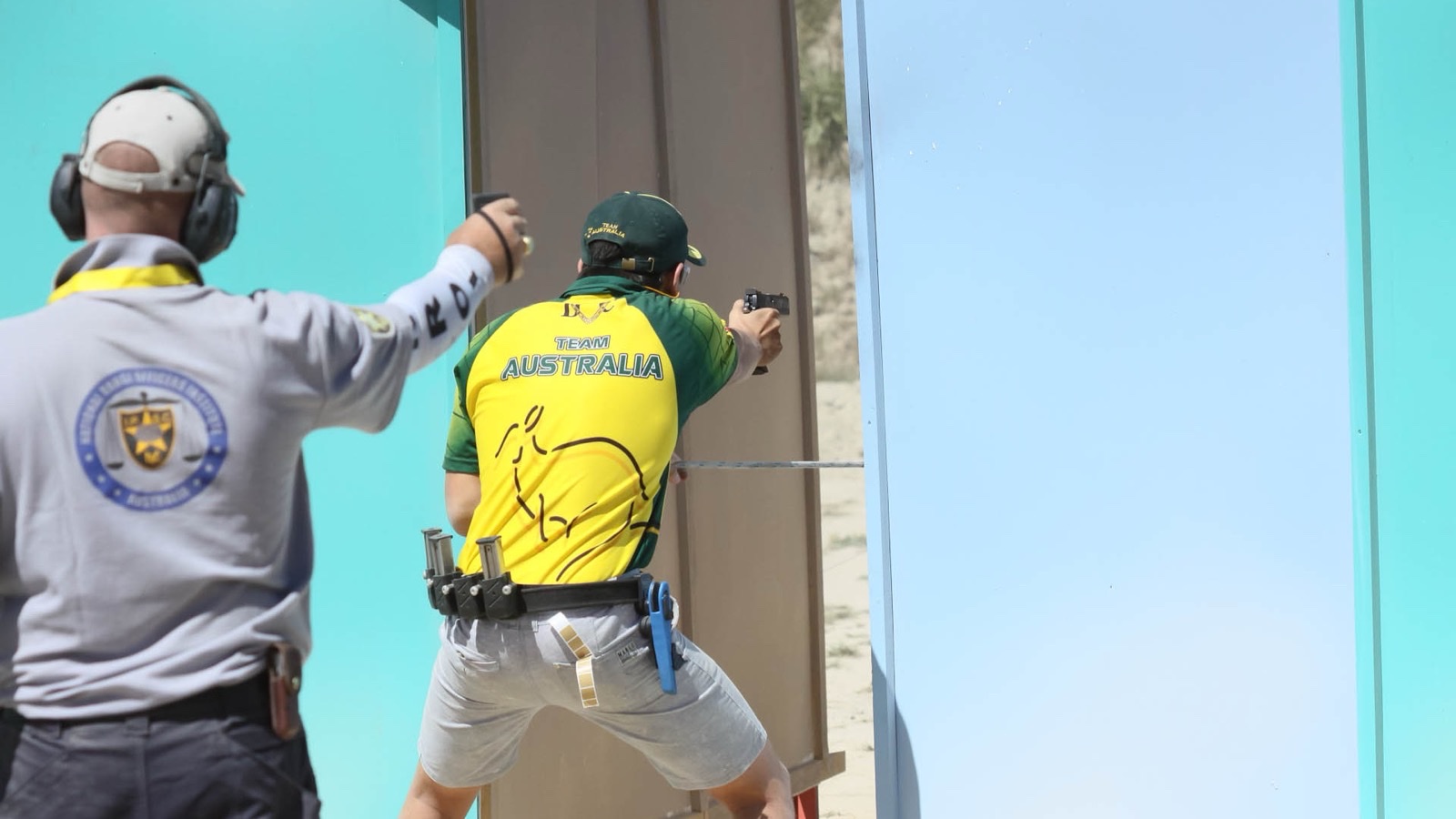
- Cover: Strong hand only stage at the 2013 IPSC Australasian Handgun Championship, A. Taverner, CC BY 2.0, via Wikimedia Commons
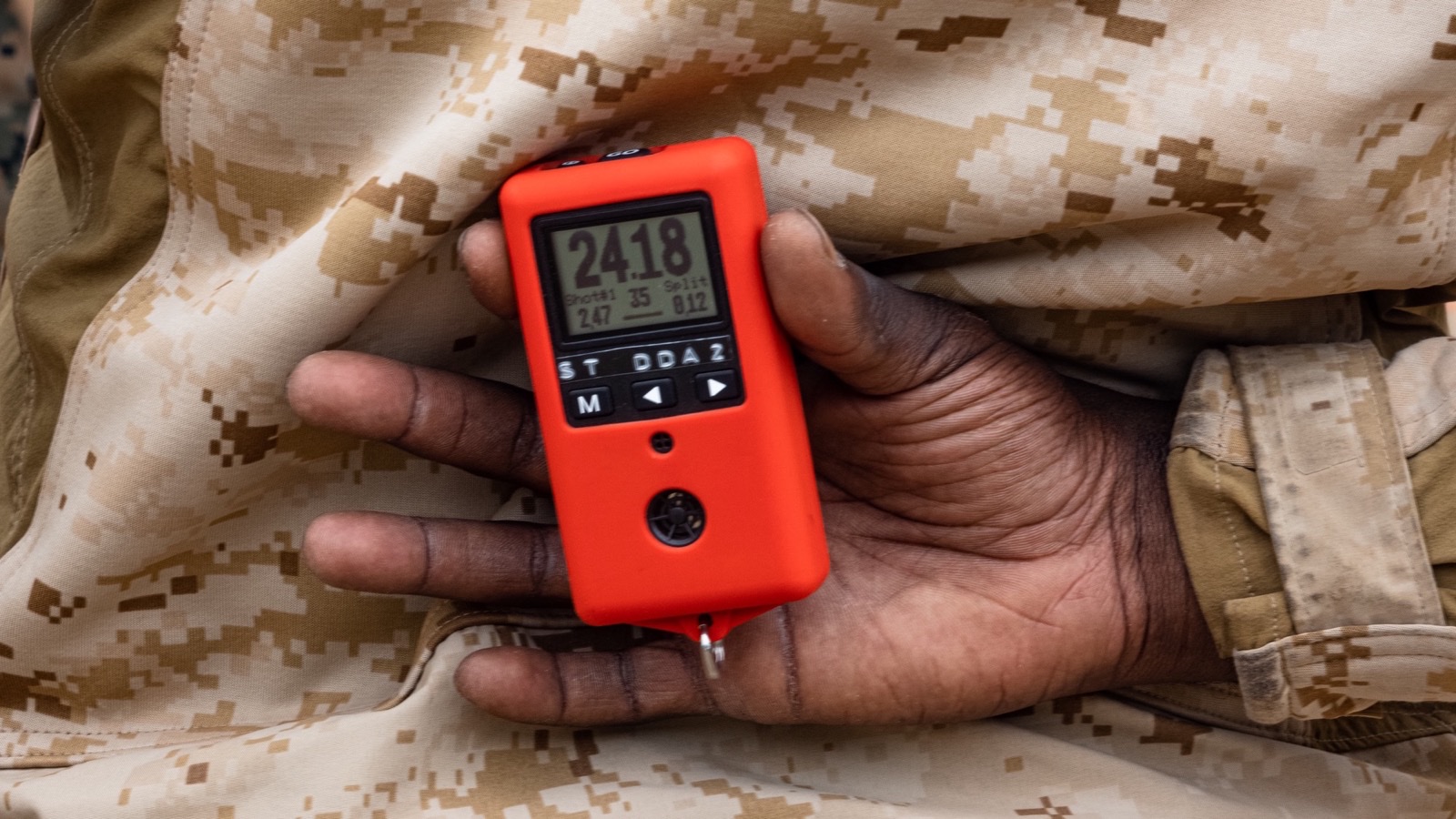
- Handheld shot timer at the 2025 MCMC East match, U.S. Marine Corps photo by Cpl. Loriann Dauscher, public domain (DVIDS); the timer brand is not identified
- Tactical training drill using an airsoft weapon, U.S. Marine Corps, public domain, via Wikimedia Commons
- Eric Crostley at the 2018 USPSA Multigun Championship, U.S. Air Force photo by Senior Airman Kevin Tanenbaum, public domain, via Wikimedia Commons


 Airsoft Shot Timer
Put a Shot Timer in Your Pocket
Automatic airsoft shot detection, split times, multiple PAR times and training records — no sign-up.


Related articles