NRA Pistol Qualification: Course of Fire for Every Rating
Contents
The NRA pistol qualification in 60 seconds
- What it is: a self-paced ladder inside the NRA Marksmanship Qualification Program. You shoot it on your own range time, keep your own records and order the patch and rockers yourself. Only the top rating, Distinguished Expert, needs a witness.
- Pistol Qualification (6 ratings): 15 and 30 feet. Pro-Marksman and Marksman have no time limit. Marksman First Class gives 6 minutes per 50-shot stage, Sharpshooter is 5 shots in 20 seconds, Expert is one-handed with a 5-in-10-second string, and Distinguished Expert is four strings of 5 shots in 10 seconds, two-handed and one-handed.
- Defensive Pistol I and II: 21 feet on a D-1 target, and every shot has to score 8 or better. DP I adds loading from the bench, cover and kneeling. DP II is holster draws: 1 shot in 5 seconds at the bottom, 180° turns, a draw and 2 shots after each, 12 seconds at the top.
- The real wall: not speed. The 10-second strings give you 2 seconds a shot. What stops people is the one-handed weak-side score at Expert and the “every shot an 8” rule in Defensive Pistol.
- Rehearse it: every timed rating is a par time. A shot timer app with par beeps replaces the “recorded tape” the NRA booklet still tells you to use.
The NRA pistol qualification is the pistol part of the NRA Marksmanship Qualification Program (MQP): six ratings from Pro-Marksman to Distinguished Expert, shot at 15 and 30 feet on paper plates and AP-1 or AP-2 precision targets. After it come two follow-on courses, Defensive Pistol I and II, that add a clock, a holster and a “score 8 or better or it doesn’t count” rule at 21 feet. You can start with any safe pistol or revolver, any sights, and a friend with a stopwatch.
That last part is where it gets interesting for anyone who trains with a timer. The official booklet says that when a course has a time limit, “shooters should have another individual act as timekeeper, or play a recorded tape with timing sequences and start/stop signals.” That sentence was written for cassette tapes. Today a phone does it, with better precision, and it records your splits too.
The problem is the booklet itself. It packs six ratings into two narrow columns, uses “strong side” and “weak side” in a way almost everyone misreads, and leaves at least two time limits open to interpretation. We pulled the current NRA PDFs for Pistol, Defensive Pistol I and Defensive Pistol II and turned every rating into plain numbers. Watching one instructor read the course aloud on YouTube and mix up which stage gets the 6-minute limit is a good reminder of why that’s worth doing.
How the NRA Marksmanship Qualification Program Works
The MQP is an honor-system ladder. You shoot each rating’s course whenever you like, as often as you like, and move up when you’ve posted the required scores. The NRA’s qualification guide is blunt about it: “NRA does not track earned ratings.” You keep your own record, and you or your club’s program administrator orders the awards from the NRA Program Materials Center.
Three rules shape everything else. Ratings must be earned in sequence, so you can’t skip from Marksman to Expert because you happen to shoot well. Scores count only toward the rating you’re working on: you can’t bank a great target now and spend it later on a higher rating. And the required number of targets or courses does not have to be fired in succession or on the same day. Ten Sharpshooter targets can be spread across ten range trips. What does have to happen in one session is each course: both stages of a two-stage course, or all four stages of Distinguished Expert.
Distinguished Expert is the only rating with a witness requirement. Every DE course must be watched by an NRA member or an NRA instructor or coach, each with a current ID number. The exception is formal competition, where the match bulletin serves as proof. NRA members who finish DE can file a recognition form for national recognition.
Scores shot in practice, leagues and matches all count. In practice that means a club league night can double as qualification shooting, which is how many clubs run it.
The awards are cheap, which is part of the appeal. The NRA store lists a Pro-Marksman packet at $6.00, an Expert packet at $17.50 and the MQP booklet at $2.50 at the time of writing; check the store for current prices.
Pistol Qualification: Every Rating’s Course of Fire
Any semi-automatic pistol or revolver, any sights, all calibers together. The first two ratings are about grouping on a 9-inch paper plate. From Marksman First Class up, you shoot scored precision targets: the AP-1 hung at 30 feet or the smaller AP-2 at 15 feet, with the top edge at eye level. Each target takes 10 shots for a possible 100.
| Rating | Position | Time | What you must shoot |
|---|---|---|---|
| Pro-Marksman | Benchrest, two hands, 15 ft | None | 10 plates, 5 shots each, all inside a ½-inch margin from the edge |
| Marksman | Standing, two hands, 15 ft | None | 10 plates, 10 shots each, all inside a 1½-inch margin from the edge |
| Marksman First Class | Standing, two hands, strong side then weak side | 6 min per stage of 5 targets × 10 shots | 10 targets: five scoring 46+, five scoring 56+ |
| Sharpshooter | Standing, ready, two hands, strong then weak side | 5 shots in 20 s per side | 10 targets: five scoring 60+, five scoring 65+ |
| Expert | Standing, ready, one hand, strong then weak side | Per side: 5 shots in 3 min + 5 shots in 10 s | Course (200 pts) shot twice at 130+ and three times at 150+ |
| Distinguished Expert | Standing, ready, strong and weak side | Four stages, 5 shots in 10 s each | Course (200 pts) shot three times at 145+ and three times at 170+; witnessed |
Translate the plate margins into circles and they get clearer. A ½-inch margin on a 9-inch plate means every shot inside an 8-inch circle at 15 feet. A 1½-inch margin means a 6-inch circle. Those are the only two ratings where one stray shot fails the plate. Everything above Marksman is scored, so a flyer costs points instead of the whole target.
The four Distinguished Expert stages are 5 rounds strong side two-handed, 5 rounds strong side one-handed, 5 rounds weak side two-handed and 5 rounds weak side one-handed, each in 10 seconds, all in the same session.
“Strong Side” and “Weak Side” Don’t Mean What You Think
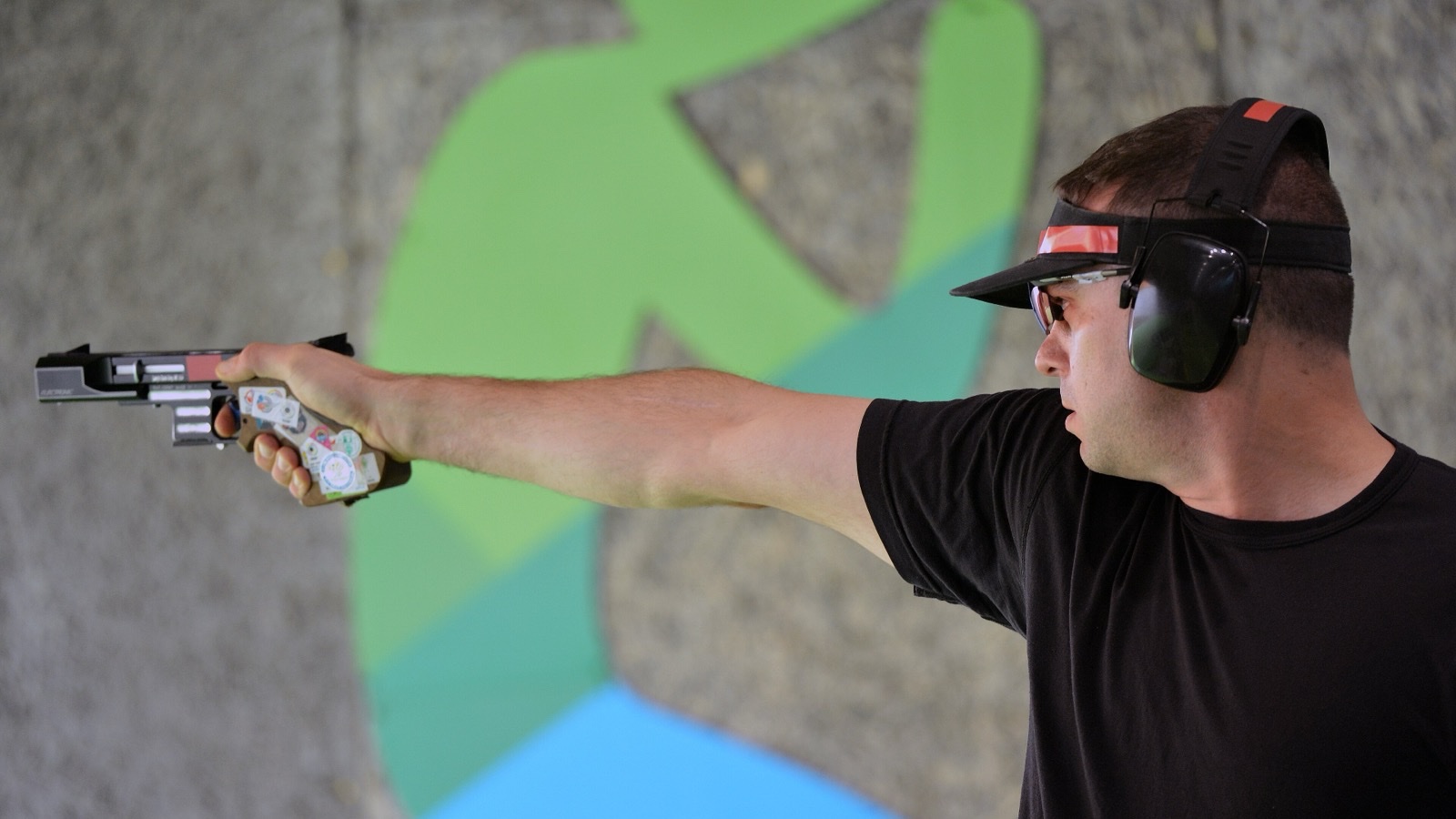
In the NRA pistol course, “weak side” at Marksman First Class and Sharpshooter is still two-handed. The booklet defines strong side as the dominant hand gripping the gun and pressing the trigger while the other hand supports it. Weak side means the weak hand grips first and works the trigger, with the strong hand in support. It’s a two-handed grip with the roles swapped, not one-handed shooting.
One-handed shooting only enters at Expert, where the position line reads “standing, ready, one hand.” Distinguished Expert then mixes both: two-handed and one-handed strings, each from the strong side and the weak side.
This matters because the most common mistake in reading the course is assuming Sharpshooter’s weak-side string is one-handed. That makes Sharpshooter look harder than Expert. If you’ve never shot a two-handed grip with your support hand on the trigger, though, expect it to feel awkward for the first few range trips. Mirror your normal grip exactly, thumbs forward, and the pistol grip guide works just as well in reverse.
The Time and Score Budget, Rating by Rating
The clock in the NRA pistol course is generous. The scores are what climb. Divide the time by the shots and the required score by the shots, and you get a clearer picture than the booklet gives.
Marksman First Class gives you 6 minutes for 50 shots: 7.2 seconds per shot, enough time to reload magazines inside the stage. You need an average of 4.6 points per shot on half the targets and 5.6 on the other half. Sharpshooter shrinks the clock to 4 seconds per shot and raises the average to 6.0 and 6.5.
Expert is where the course changes character. Each side is a slow string (5 shots in 3 minutes, 36 seconds a shot) and a fast string (5 in 10 seconds, 2 seconds a shot, starting from the ready). All 20 shots are one-handed. Passing takes 130 and 150 out of 200, which is 6.5 and 7.5 points per shot. For most shooters, the weak-hand one-handed string is the whole rating.
Distinguished Expert has no slow strings at all. Twenty shots, four strings of 5 in 10 seconds, and you need 7.25 points per shot three times and 8.5 per shot three more times.
Two seconds per shot sounds tight but isn’t. In the one YouTube run we checked, a capable shooter’s one-handed fast string had a 1.48-second first shot and the fifth shot at 5.14 seconds, about half the allowance. Speed is almost never why people stall at Expert. They stall because they try to use the time they don’t need, and the one-handed sights drift while they wait for a “perfect” picture. Train the fast string to break each shot when the sights settle, not when the clock says you have time left.
Defensive Pistol I: Loading, Cover and Kneeling
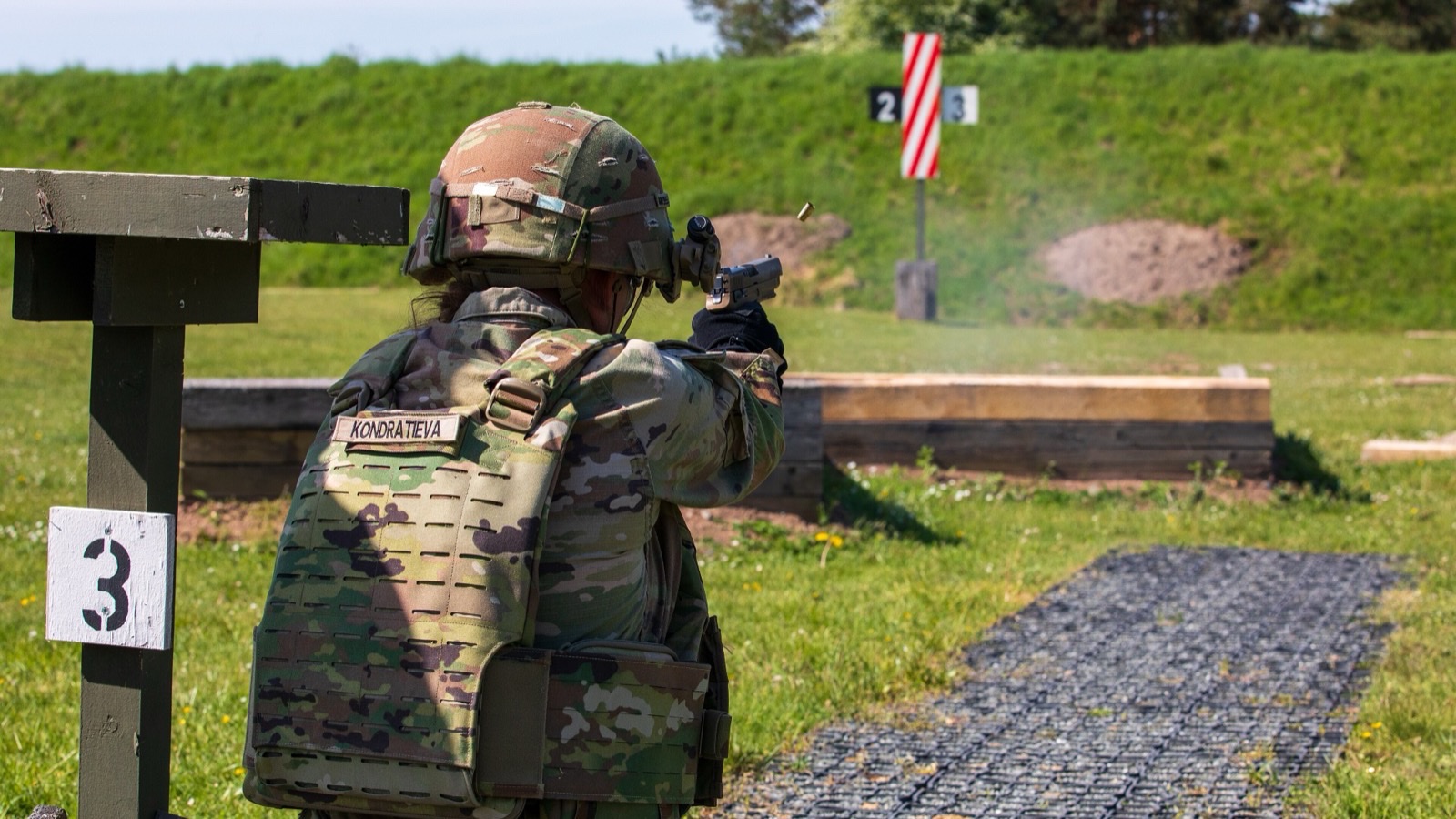
Defensive Pistol I uses a D-1 (or equivalent) target at 21 feet, and every shot must score 8 or better. It isn’t an average. One shot in the 7-ring and that repetition doesn’t count. NRA asks you to finish the Pistol Qualification first, and every repetition ends with a “search and assess”: lower the gun slightly and scan left and right without losing the target.
The ratings climb like this:
- Pro-Marksman: standing, two hands, 5 shots in 15 seconds, 4 times. Marksman: pick the loaded gun up off the bench, 5 shots in 20 seconds, 4 times.
- Marksman First Class: gun unloaded on the bench; pick it up, load, fire 5 in 20 seconds, 4 times. Sharpshooter: the same in 18 seconds, 4 times.
- Expert: load, move to cover, fire 5 from the right side; reload, move, fire 5 from the left side. 15 seconds per side, 4 times each side.
- Distinguished Expert: load, move to cover, give a verbal challenge, fire 5 kneeling, reload, fire 5 standing, all in 25 seconds, 8 times, witnessed.
The Marksman First Class to Sharpshooter step is just 2 seconds off the same task. That’s a reload-efficiency test. Most of those 2 seconds come back from a cleaner load from the bench, not from faster shooting.
The 21-foot “8 or better” standard is also why Defensive Pistol feels harder than the 10-second precision strings. The precision course lets one bad shot cost a few points. Here one bad shot costs the whole rep. If you want a picture of what that does to your pace, run the same drill twice: once trying to beat the par, once trying to never drop a shot. The second version is the qualification.
Defensive Pistol II: Drawing From the Holster
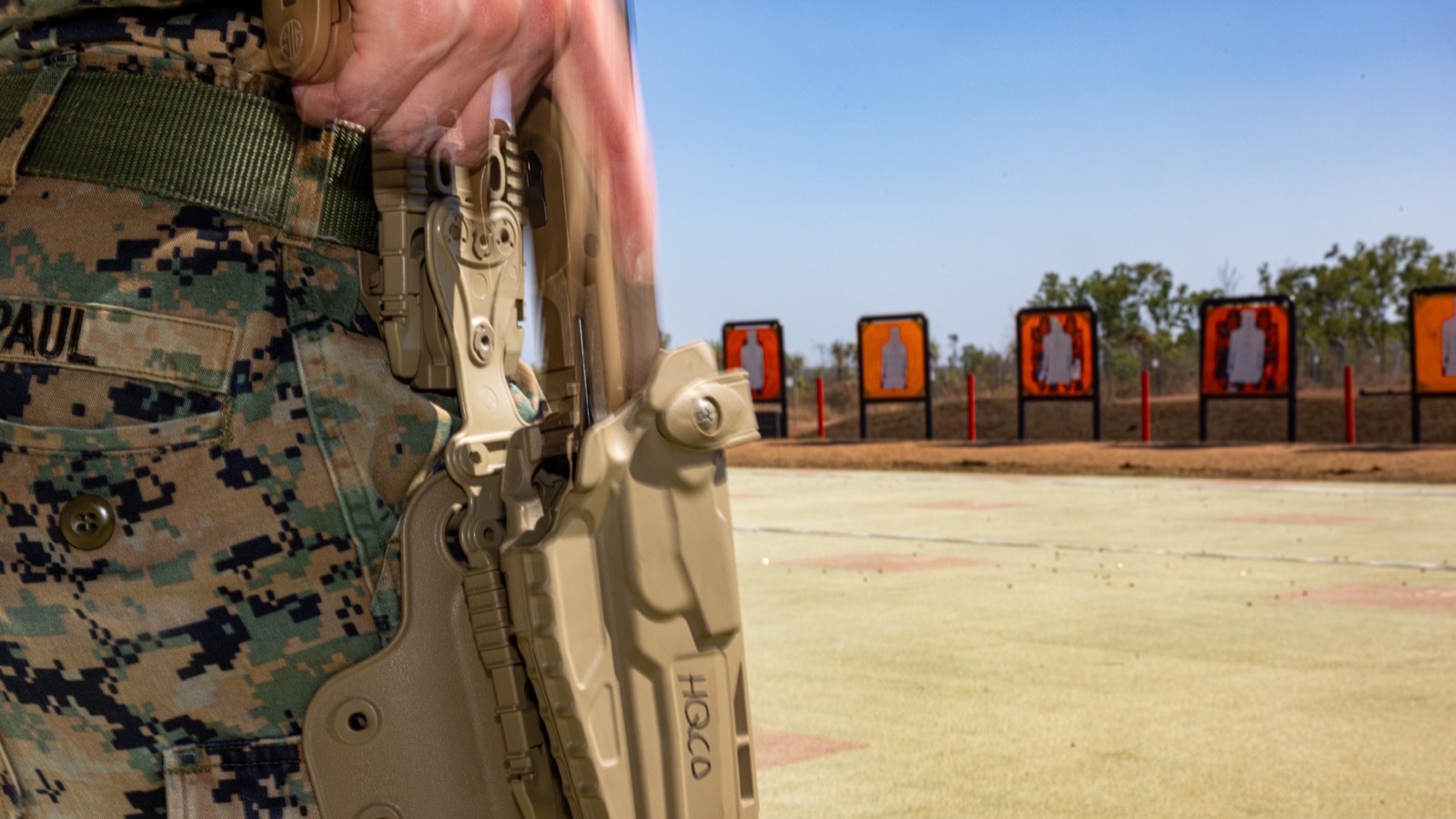
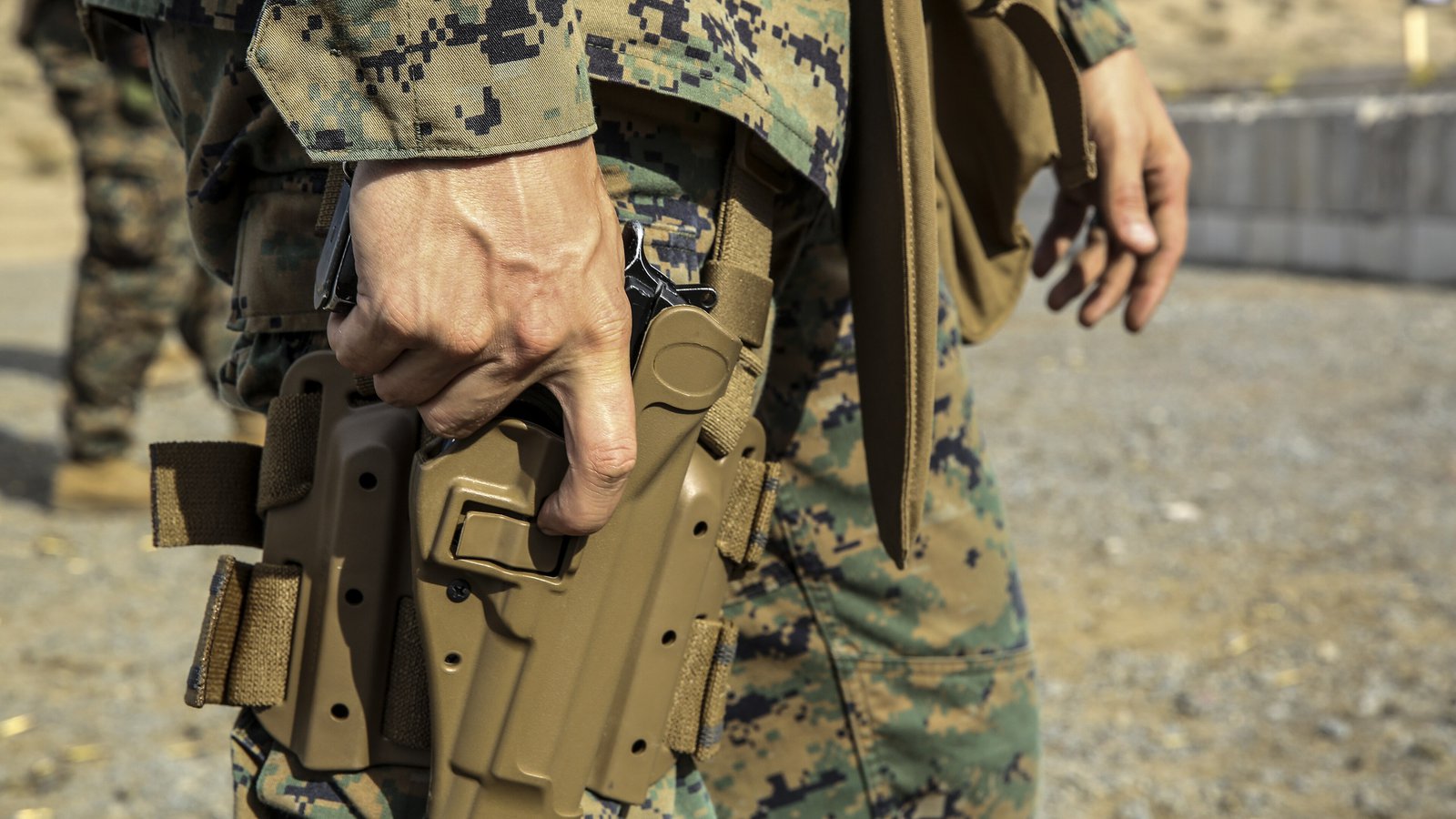
Defensive Pistol II is a holster course: same D-1 target at 21 feet, same “8 or better” on every shot. The NRA wants its own draw sequence used: access the gun, grip, pull it from the holster, rotate the muzzle toward the target (only now does the finger go to the trigger), join the hands, extend, fire if necessary, lower and scan, then reholster with the finger straight.
- Pro-Marksman: draw from a strong-side holster, 1 shot in 5 seconds, 20 times. Marksman: draw, 2 shots in 6 seconds, 20 times.
- Marksman First Class: draw, 3 shots in 10 seconds, 10 times. Sharpshooter: the same 3 shots in 10 seconds, but from concealment, 10 times.
- Expert: 90-degree turns to the right and to the left, drawing and firing 2 shots after each turn, 9 seconds, 10 times.
- Distinguished Expert: the same with 180-degree turns, 12 seconds, 20 times, witnessed.
The Expert and Distinguished Expert time is the one real ambiguity in the booklet. The chart lists “2 shots right turn and 2 shots left turn” next to a single time (9 or 12 seconds). It doesn’t say whether that’s per turn or for both turns together. Read per turn, it’s a relaxed standard. Read as both turns together, 9 seconds for two turns, two draws and four hits is a real test. NRA didn’t settle it in the PDF, so ask the instructor or coach who’ll witness your DE runs, and train to the strict reading so you pass either way.
Compared with competition standards, these times are slow. For context, the FBI’s own qualification asks for a draw and 3 shots in 3 seconds at 5 yards. The NRA course is built for people who carry, and it rewards a safe, repeatable draw over a fast one. That’s exactly what the access-grip-pull-rotate sequence is drilling. Our pistol draw guide breaks the draw into the same steps and gives a timed progression once the sequence is automatic.
How Many Rounds Does the Whole Ladder Take?
At minimum, about 1,010 rounds: 570 for the Pistol Qualification, 200 for Defensive Pistol I and 240 for Defensive Pistol II. That assumes every target and every course passes on the first try, which nobody does. Budget at least half again for failed targets and practice.
The Pistol ladder breaks down to 50 rounds for Pro-Marksman, 100 each for Marksman, Marksman First Class and Sharpshooter, 100 for Expert (five 20-shot courses) and 120 for Distinguished Expert (six). Defensive Pistol I is 20 rounds for each of the first four ratings, 40 for Expert and 80 for DE. Defensive Pistol II is 20, 40, 30, 30, 40 and 80.
Run that through current ammunition prices and the full ladder costs more in ammo than in awards, by a lot. That’s the best argument for doing the timing work in dry fire before range day.
How to Train for It With a Shot Timer
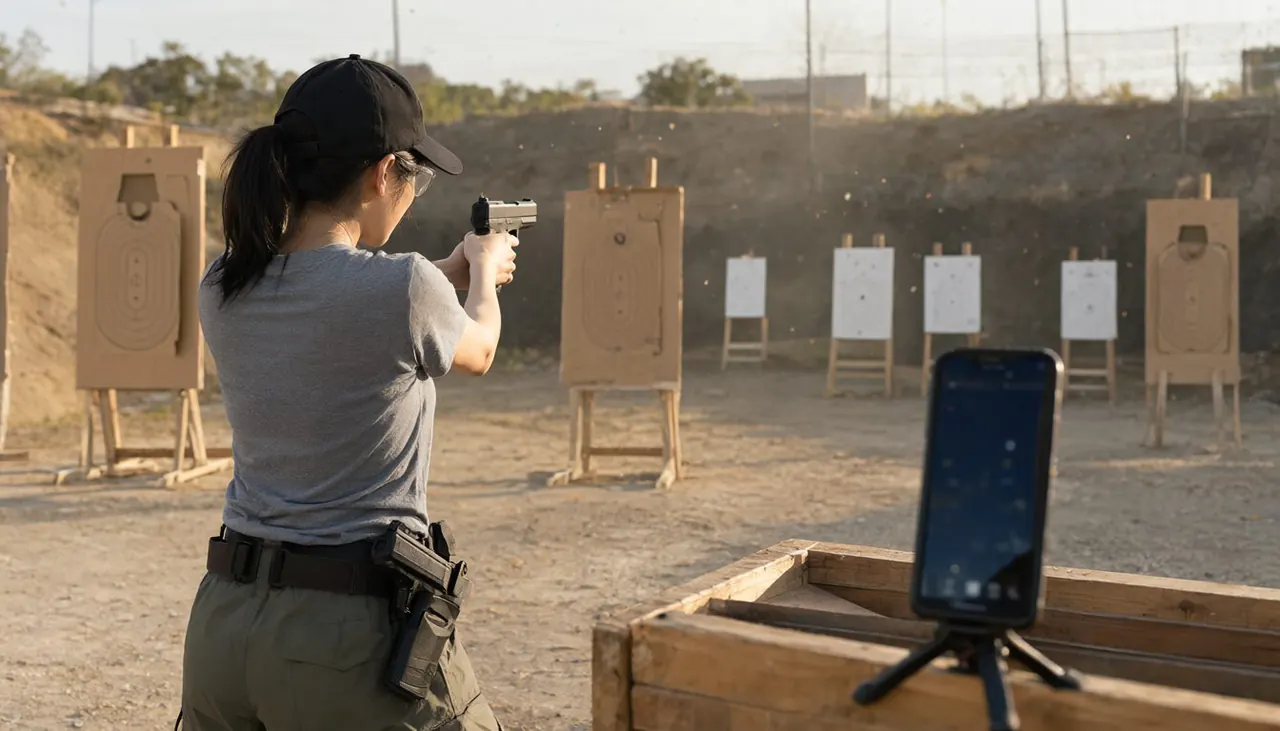
Every timed rating in the NRA course is a par time, so a shot timer turns any range session or dry-fire session into a rehearsal. Here are the settings that match each stage. In the Airsoft Shot Timer app (iOS and Android), the start beep can come after a fixed or random delay, you can set several par beeps in one run, and par repeat loops the run.
- Sharpshooter: par 20.0 seconds. Five two-handed shots, then switch roles for the weak-side string with a fresh par.
- Expert fast string: par 10.0 seconds, from the ready, one-handed. Add a second par at 5.0 seconds while training: if your fifth shot breaks before it, you’re rushing.
- Distinguished Expert: par 10.0 with repeat on, and a short break between runs to change hands or grip. Four cycles is one course.
- Defensive Pistol I Sharpshooter: par 18.0 from an empty gun on the bench. DP II Pro-Marksman: random delay with a 5.0-second par, one shot, 20 reps.
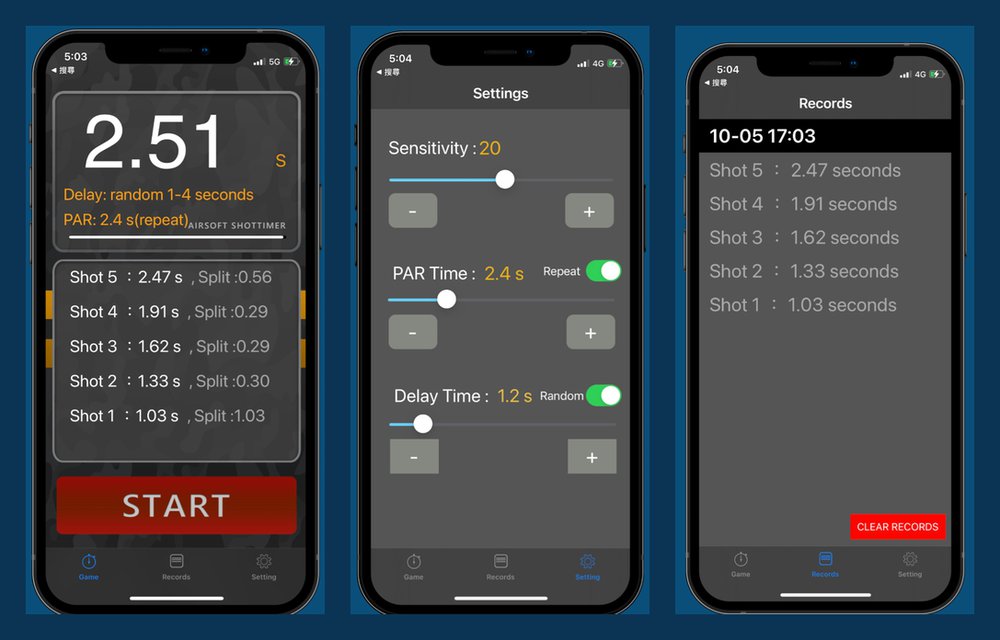
Use the random delay on the defensive courses. The real course is a reaction to a start signal, and a fixed delay lets you anticipate it. If you just want a par beep without the app, our browser-based online par timer does random starts and multiple par beeps too.
Then look at the splits, not just the final time. A 9.8-second fast string where the first shot took 4 seconds is a different problem from one where every split is 2 seconds. The first is a presentation problem, the second a trigger-control problem. The trigger control guide and the one-handed shooting guide cover the two skills that decide Expert.
Practicing With Dry Fire or an Airsoft Pistol
Airsoft guns can’t earn NRA pistol ratings, but the distances make the course unusually easy to rehearse with one. The Pistol Qualification calls for “any semi-automatic pistol or revolver.” The MQP’s separate Air Pistol course is limited to .177-caliber spring, pneumatic or CO2 pistols at 10 meters, which rules out 6 mm airsoft too. Treat airsoft as practice for the real course, not as a way to earn the patch.
As practice, though, it fits. Fifteen feet is 4.6 meters, a hallway in most homes, and Defensive Pistol’s 21 feet is 6.4 meters. A decent gas blowback pistol groups well inside a 6-inch circle at that range, so you can shoot the actual Marksman plate and actual Sharpshooter targets to the real dimensions. Load magazines with exactly 5 BBs for the defensive courses and the slide locks where the real reload happens. For the holster draws, use the same holster type you’ll use at the range. Our airsoft and firearms crossover guide covers what transfers and the habits to watch for, mainly that airsoft recoil flatters your one-handed fast strings.
Dry fire covers the rest: the weak-side two-handed grip, the one-handed press, the bench load and the draw sequence, all against the same par beeps. The dry fire training guide has the safety routine. Keep the live gun and the dry-fire gun in separate sessions, with no ammunition in the room.
Frequently Asked Questions
What are the NRA pistol qualification requirements?
Six ratings earned in order. Pro-Marksman and Marksman are untimed groups on 9-inch plates at 15 feet (inside an 8-inch and a 6-inch circle). Marksman First Class through Distinguished Expert are scored on AP-1 (30 ft) or AP-2 (15 ft) targets, with times of 6 minutes per stage, 5 shots in 20 seconds, one-handed 5 shots in 10 seconds, and finally four strings of 5 in 10 seconds. Distinguished Expert must be witnessed by an NRA member, instructor or coach.
What score do you need for NRA Distinguished Expert in pistol?
You shoot the 20-shot, 200-point course six times: three times at 145 or better and three times at 170 or better. Each course is four 5-shot strings in 10 seconds (strong side two-handed and one-handed, weak side two-handed and one-handed), all in the same session, witnessed.
Does NRA track my qualification ratings?
No. The MQP guide states that NRA does not track earned ratings. You keep the record and order the awards yourself. Distinguished Expert finishers who are NRA members can submit a recognition form for national recognition.
What is the difference between NRA Defensive Pistol I and II?
Both use a D-1 target at 21 feet and require every shot to score 8 or better. Defensive Pistol I starts with the gun on a bench and adds loading, cover and kneeling. Defensive Pistol II is drawn from a holster, including concealment and turns. NRA recommends finishing the Pistol Qualification before starting Defensive Pistol I.
Can I practice the NRA pistol qualification with an airsoft pistol?
Yes for practice, no for ratings. Ratings require a firearm, and the air pistol course is .177 only. But the 15-foot and 21-foot distances fit indoors, so a gas blowback pistol and a shot timer set to the real par times rehearse the course at full scale.
The Takeaway
The NRA pistol qualification is a slow-to-fast ladder: two untimed grouping ratings, a 6-minute stage, 5 shots in 20 seconds, then one-handed 10-second strings, and finally Distinguished Expert’s four 10-second strings in front of a witness. Defensive Pistol I and II then trade precision scoring for a stricter rule, every shot an 8 or better at 21 feet, and add loading, cover and the holster. Speed is rarely what stops anyone. The one-handed weak-side score and the zero-miss defensive standard are. Set the par times in a shot timer app, rehearse in dry fire or with a GBB at the real distances, and use your range trips for scoring targets.
For a faster, military-style standard to compare against, see our Army pistol qualification guide, the FBI pistol qualification guide and the Marine Corps pistol qualification guide.
Course data: NRA Marksmanship Qualification Program, “Pistol Qualification” and “Defensive Pistol Qualification” (mqp.nra.org, PDF pages 4–7); general rules, witness requirement and air pistol eligibility from the Winchester/NRA Marksmanship Qualification Program guide (qualbook, pages 2–3 and 10). Award prices from the NRA Program Materials catalog at the time of writing.
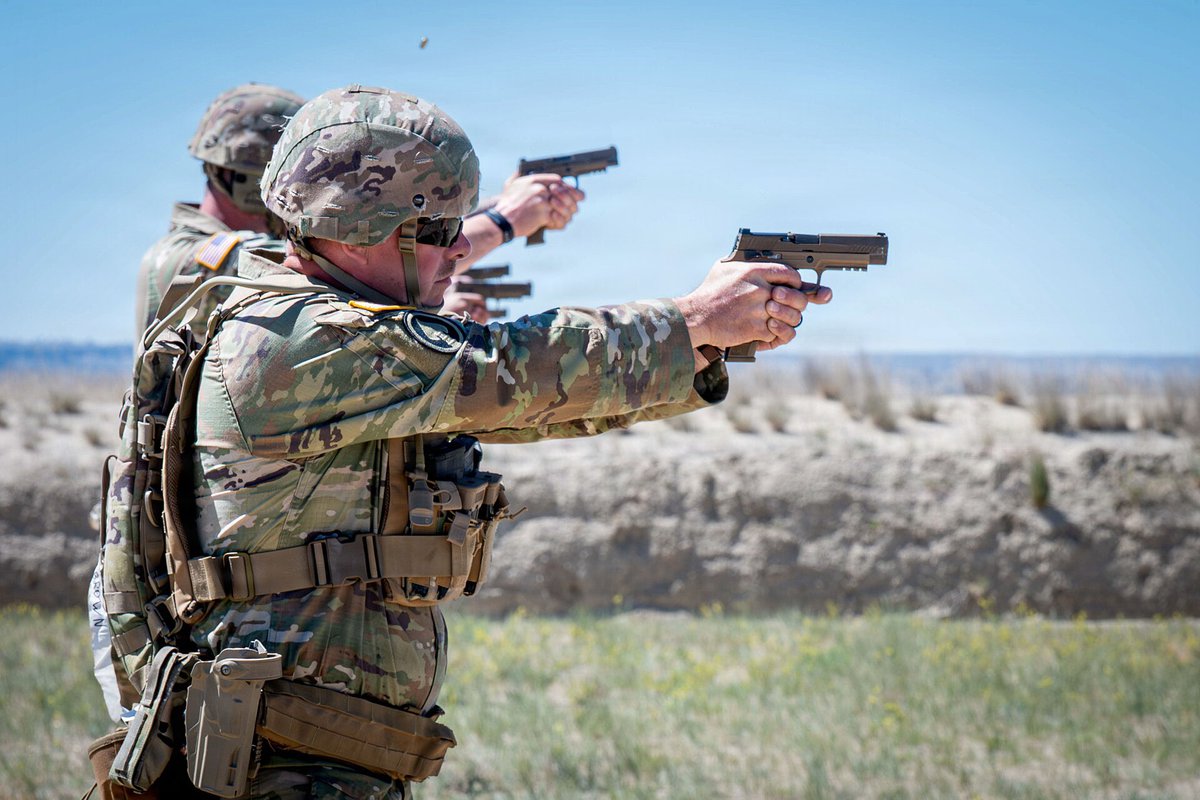
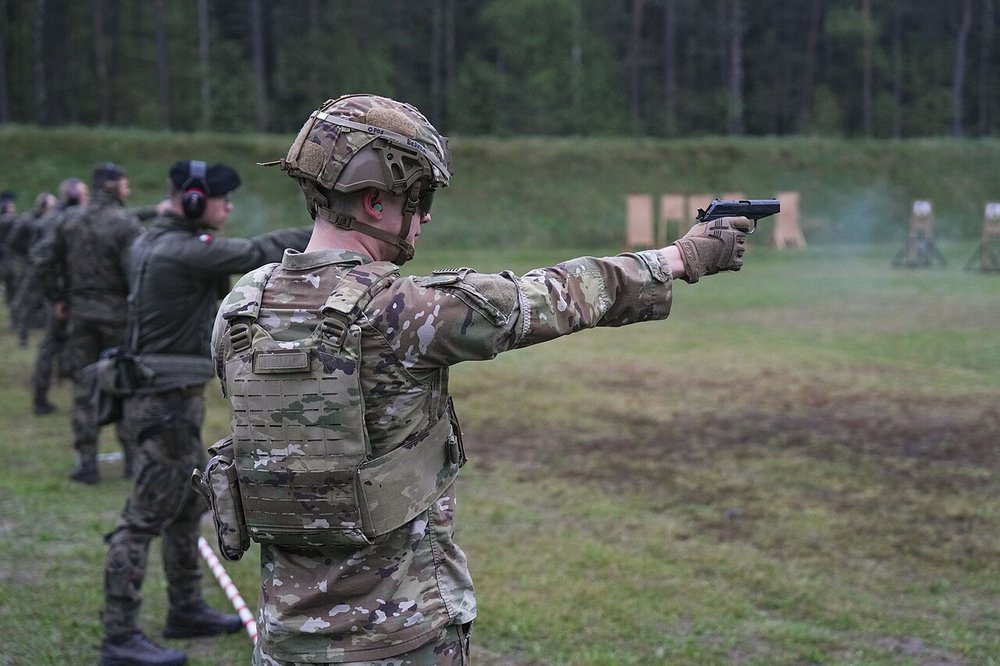
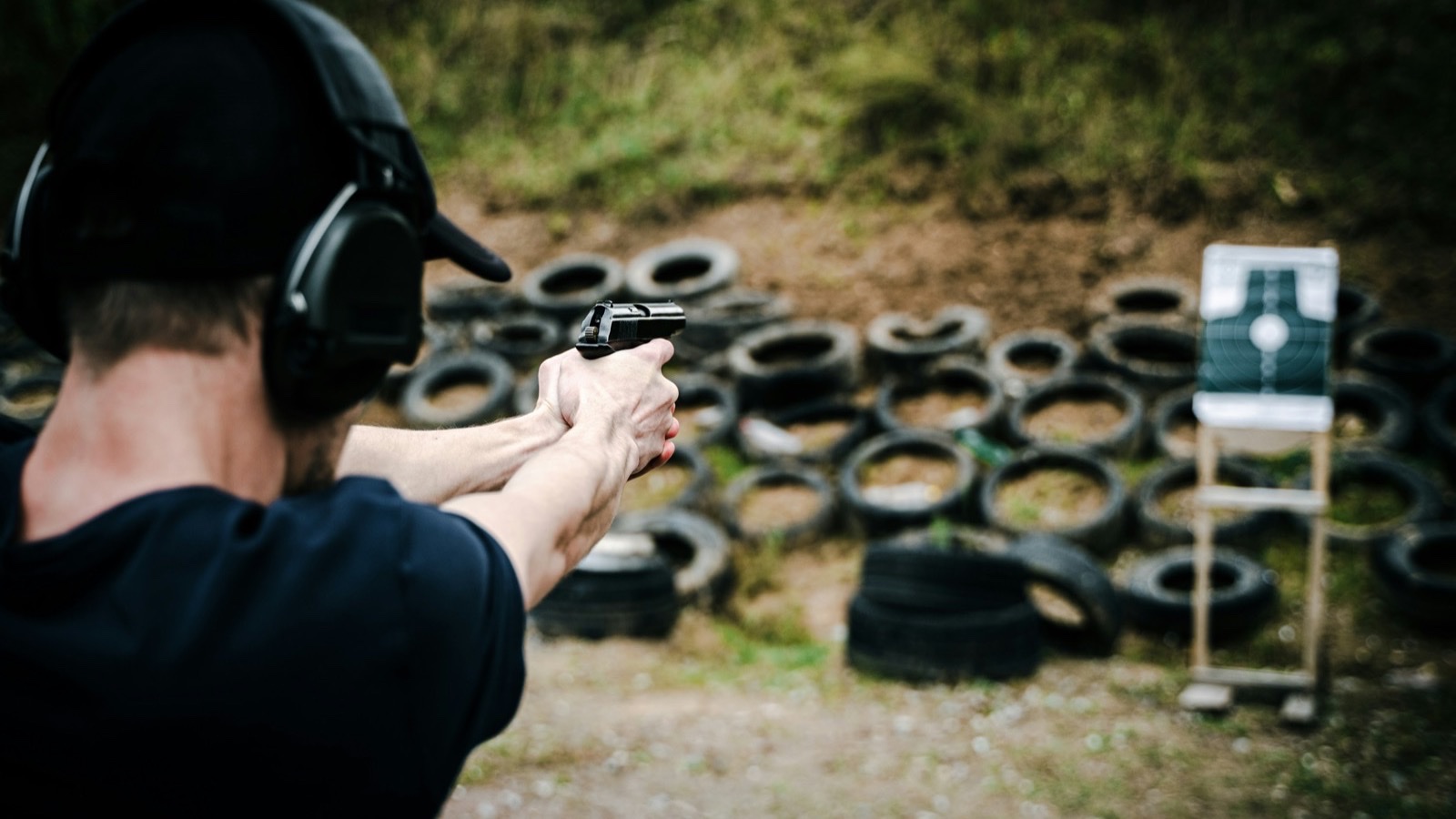
Image credits: cover — Artem Zhukov on Unsplash (Unsplash License); one-handed shooting — Sgt. 1st Class Keith Sanderson at the 2016 Rio Games, U.S. Army, CC BY 2.0; holster draw — U.S. Marine Corps photo by Cpl. Emmanuel Ramos, public domain; kneeling — U.S. Army photo by Spc. Hunter Carpenter, public domain. Photos show other courses and events, not the NRA qualification itself; cropped and resized to 16:9.


 Airsoft Shot Timer
Put a Shot Timer in Your Pocket
Automatic airsoft shot detection, split times, multiple PAR times and training records — no sign-up.


Related articles