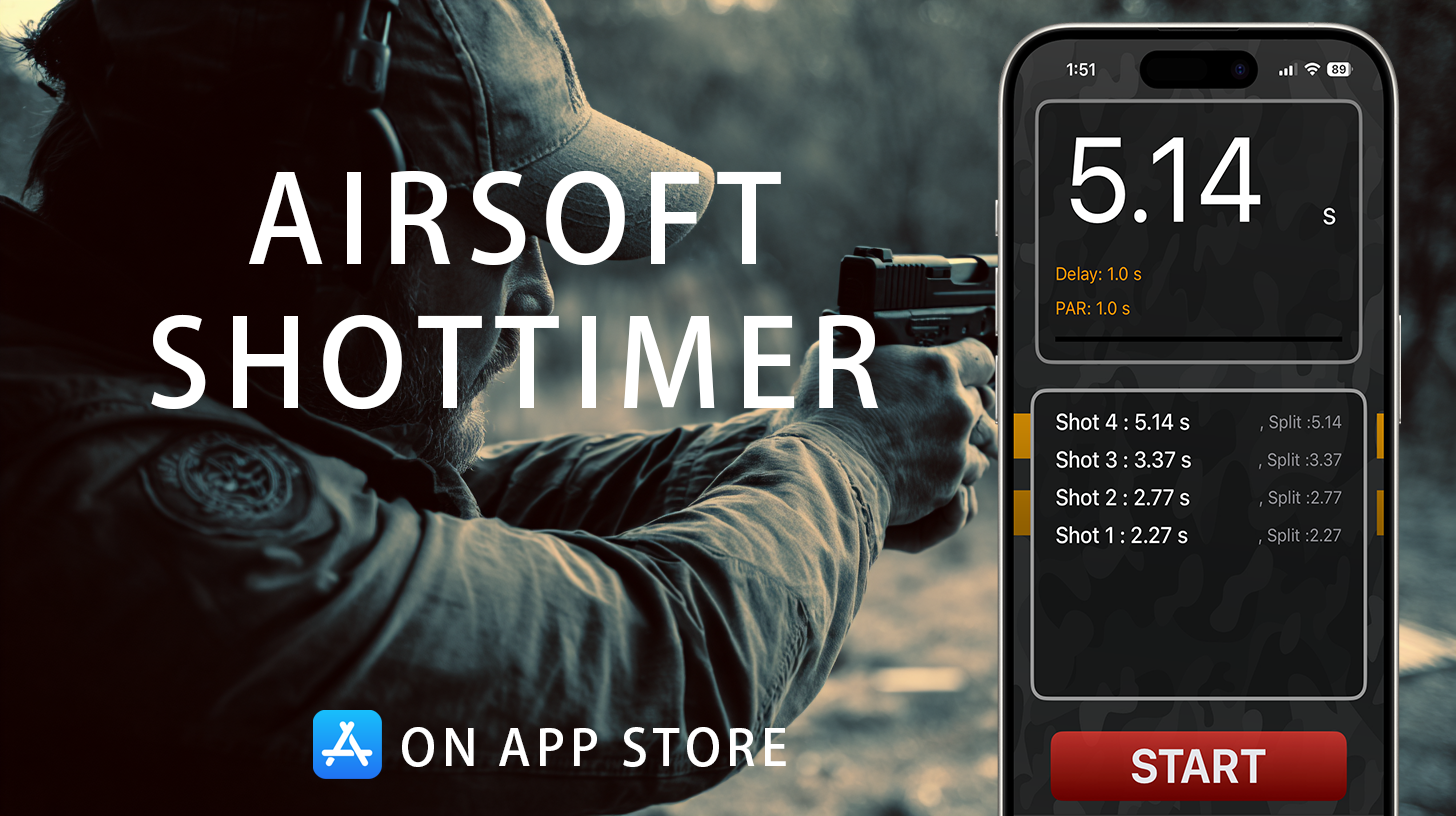
Airsoft Shot Timer is a free timer app built for airsoft players and Action Air shooters. Hardware shot timers often fail to pick up the low report of BB guns — this app is tuned specifically for gas blowback and AEG shot signatures, tracking everything from your draw to every split time. The blog below covers IPSC/IDPA training, airsoft gear, and tactics. Pair the drills with the app and watch your times drop.
The Free Shot Timer App Built for Airsoft
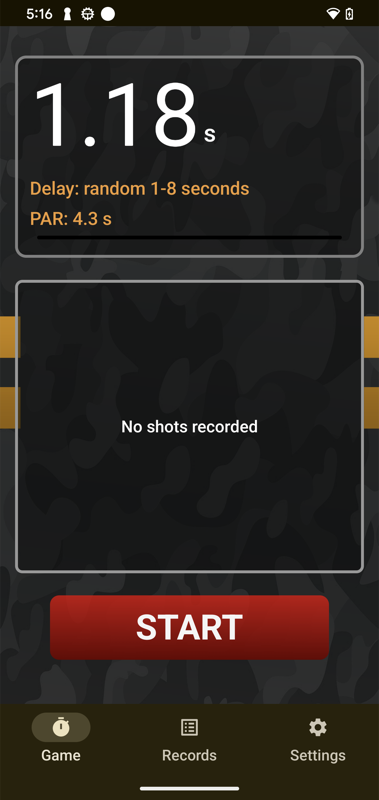
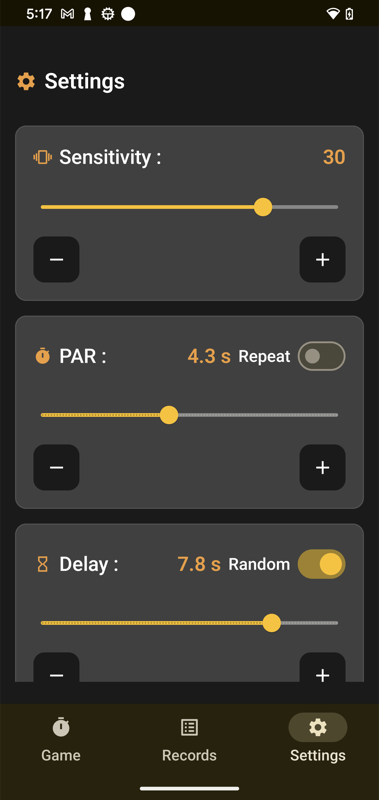
A shot timer tuned for airsoft acoustics — random start beep, automatic split times for every shot, and PAR time drills for your draw practice. Train for IPSC, IDPA, and Action Air without spending $150+ on a hardware timer. Your phone is all you need.

Bill Drill Time Standards 2026: Par Times for Pistol, Concealment & Rifle
The Bill Drill in 60 seconds (BLUF)
- What it is: Draw and fire six rounds into the A-zone of one target at seven yards, as fast as you can keep them all in. That’s the whole drill.
- Why it’s brutal: Six shots leaves nowhere to hide. A bad grip, a slow draw, or flinching all show up instantly in your hits and your times.
- What’s a good time? From an open holster: roughly 4.5s for a new shooter, sub-3s for a solid club shooter, sub-2s for someone who can genuinely shoot. From concealment, add roughly half a second to every one of those — a clean sub-2 from concealment is genuinely rare, not a weekend goal.
- How fast is the record? Around 1.1 seconds for six A-zone hits, with a draw near 0.40s. It’s a legitimate number and a terrible training target — see below for why.
- What do real people shoot? In a documented advanced handgun class, students ran it in 2.85–4.03 seconds raw. Sub-2 is an internet standard, not an average one.
- With a rifle? Same six rounds, same seven yards, but from low ready instead of the holster — which puts the whole score on your recoil control. Around 1.5 seconds is the working par; under a second is the real ceiling.
- Does the gun matter? Not to the course of fire — six rounds and no reload means a revolver, a 1911 or a 21-round double-stack all run it unmodified. It matters enormously to the number: a compact carry pistol typically costs you a few tenths against a full-size competition gun, so log the gun next to the time.
- The two levers: Your draw (first shot) and your splits (time between shots). A shot timer breaks both out for you so you know which one to fix.
- Train it anywhere: You don’t need live fire to build the pattern. An airsoft pistol or a dry-fire rep with a par time on a free Airsoft Shot Timer app trains the exact same draw-and-run mechanics.
If you’ve ever watched someone at the range draw and rip six shots into a single target in about two seconds, you’ve probably seen a Bill Drill without knowing its name. To a bystander it looks like a John Wick impression. To anyone who trains seriously, it’s one of the most revealing tests in shooting — because there is absolutely nothing to it, and that’s exactly why it’s so hard to fake.
IDPA 5x5 Classifier 2026: Full Times Chart by Division, Par Times & Every Way to Make Your Class
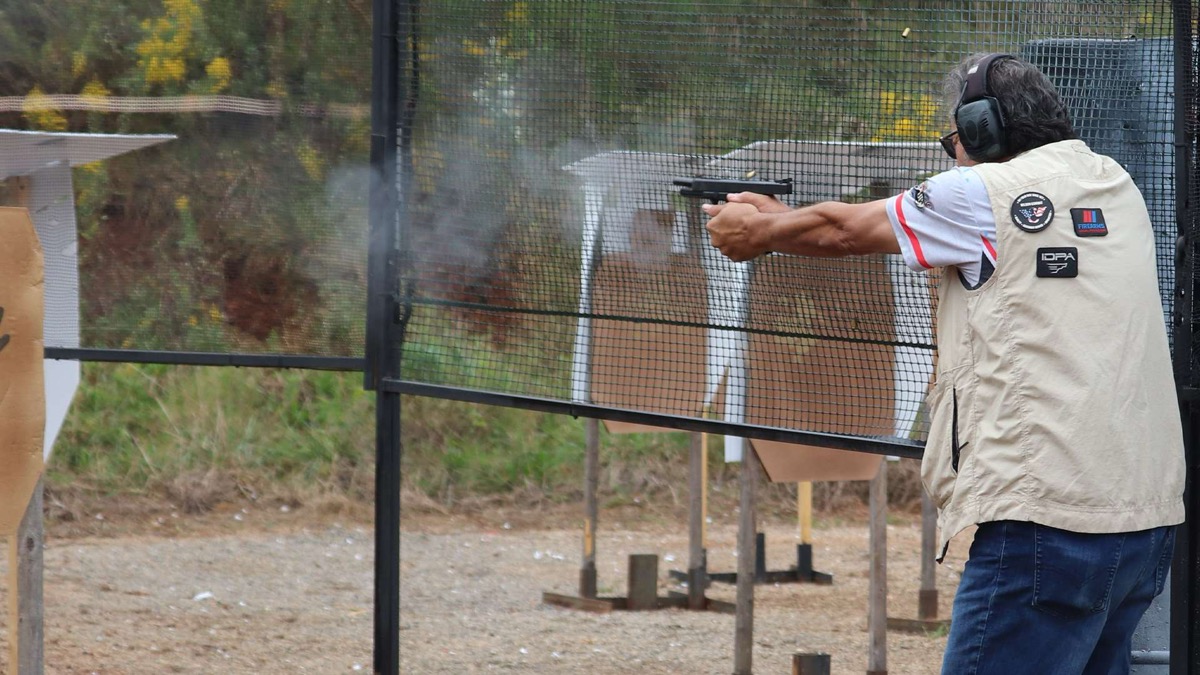
The IDPA classifier in 60 seconds (BLUF)
- What it is: A standardized skills test that sorts you into a class. Most clubs now use the 5x5 classifier — 25 rounds, four strings, one target at 10 yards, no concealment required.
- How it’s scored: Your final number is raw time + points down (1 second each) + penalties. Lower is better. Unlike USPSA’s hit factor, in IDPA your time is your score.
- The classes: Master (MA), Expert (EX), Sharpshooter (SS), Marksman (MM), Novice (NV) — set by hard time brackets that differ by division. Jump to the full times chart for all eight divisions ↓
- Three official methods: the abbreviated 5x5, the three-stage 72-round standard classifier, and a separate PCC classifier — plus a fourth route that isn’t a classifier at all, the match bump.
- You’re classified per division: you must shoot the classifier in a division to hold a class in it.
- The fastest way to move up: work out the four par times your target class actually requires, then drill the draw, the strong-hand string and the slide-lock reload against them with a free Airsoft Shot Timer app — every tenth you save is a tenth off your classifier.
There’s a particular kind of quiet that falls over a bay when the safety officer says “this is the classifier.” Everybody who was joking around two minutes ago suddenly gets serious, because this is the one stage of the day that follows you home. Your fun-stage hits stay at the club; your classifier time goes into the IDPA database and decides whether you’re a Sharpshooter or an Expert for the next year. This guide walks through exactly what that test is, how a stopwatch number turns into a class, what the current standards are, and — the part most people skip — how to actually train for it without burning a case of ammo.
USPSA Classifier Guide 2026: The New 26 Series, Hit Factor & Classes
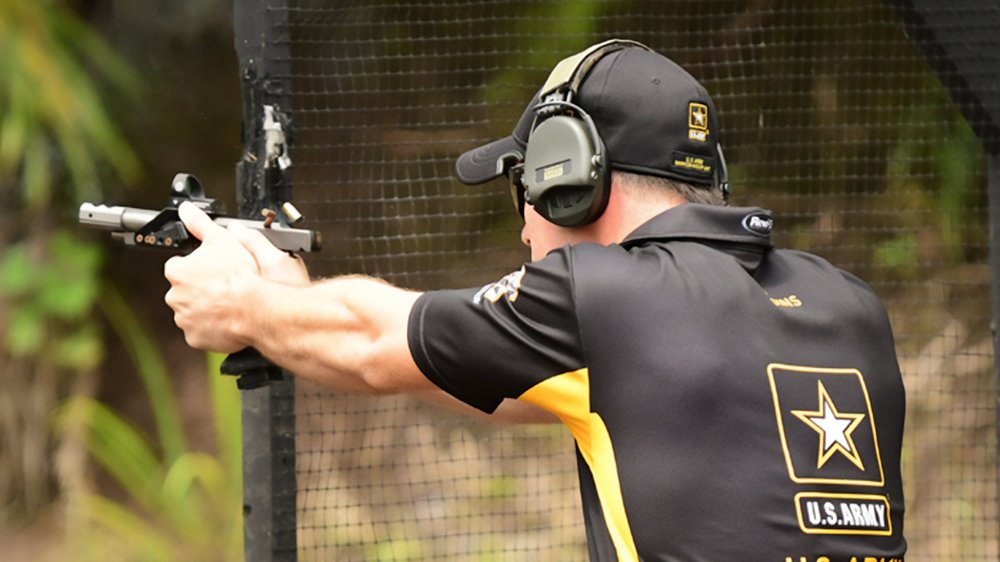
USPSA classifiers in 60 seconds (BLUF)
- What it is: A classifier is a short, standardized course of fire you shoot at a local match. Your raw score becomes a hit factor (points ÷ time), and that hit factor is compared against USPSA’s benchmark for that stage to produce a percentage.
- How you get classified: You need four valid scores from four different classifiers in a division. After that, your class is set by the best 6 of your most recent 8 unique classifier percentages.
- The classes: Grand Master (95%+), Master, A, B, C, D — each division is scored separately, so you can be A-class in Production and C-class in Open.
- What changed in 2025: USPSA removed the old B/C/D flags, started averaging same-day attempts, and released the new 25-Series classifier stages. More on that below.
- What’s new in 2026: the 26 Series — five provisional stages (King Crab, Darwinism, Mike Who?, Uprange? Seriously, Downrange? Obviously) that clubs began running in June. They don’t count toward your class yet, but they will retroactively if the stages get adopted. Jump to the 26 Series breakdown.
- Two things no other guide tabulates: a hit factor → class chart for any HHF, and the full anatomy of the classic CM 06-03 “Can You Count”.
- The fastest way to move up: practice the exact mechanics a classifier measures — draw, splits, reloads — with a free Airsoft Shot Timer app between matches.
If you’ve shot a couple of USPSA matches, you’ve already run into classifiers — those short, oddly specific stages where everyone suddenly gets quiet and serious. And if you’ve ever logged into uspsa.org and stared at a wall of percentages, division codes and three-digit stage numbers, you’ve probably also wondered what any of it actually means for you. This guide unpacks the whole system in plain language: what a classifier is, how a stopwatch number becomes a letter grade, what the 2025 overhaul changed, and how to nudge your percentage upward without gaming it.
2011 vs 1911: What's the Difference? Double-Stack vs Single-Stack (2026)
One Number Apart — How Different Can a 2011 and a 1911 Really Be?
The first time I saw a friend’s 2011 at the range, I stared at it for a good while. The side profile, the slide, the hammer, that familiar grip safety — it all looked like the century-old 1911 classic. Then I picked it up, and it was a completely different animal: the grip was noticeably chunkier, the magazine seated with a solid click and held 20 rounds, while my old 1911’s single-stack mag tops out at 8.
5 Fundamentals of Pistol Shooting 2026: How Stance, Grip, Sight Alignment, Trigger Control & Follow-Through Actually Work Together
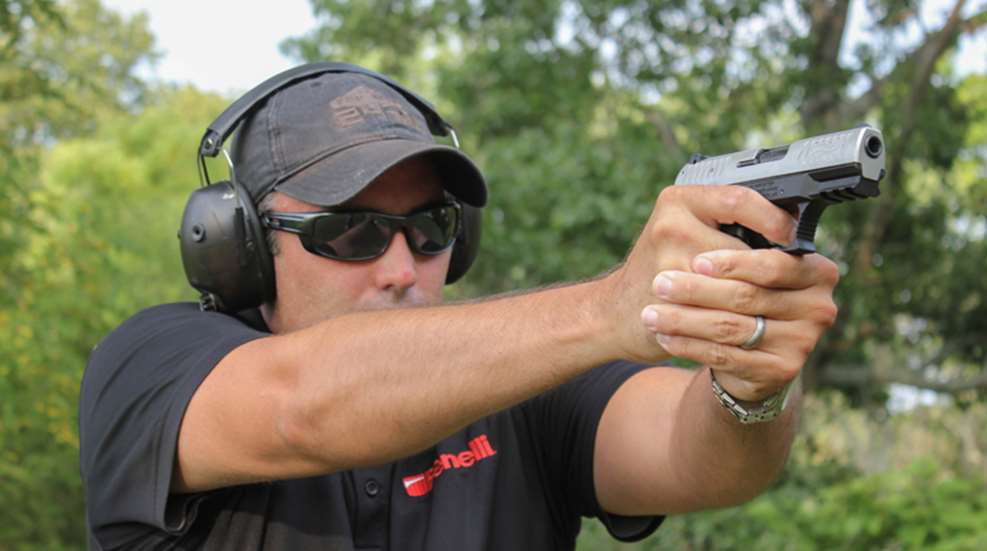
60-Second Quick Picks: Which Fundamental Is Actually Your Problem?
If you’ve already shot a few hundred rounds and your groups still drift, the issue is almost never “I need to practice more.” It’s that one specific fundamental is the weak link. Use this as a 30-second self-diagnosis before reading the long version below.
SpeedQB Complete Guide 2026: Rules, Equipment & How to Win Your First Tournament
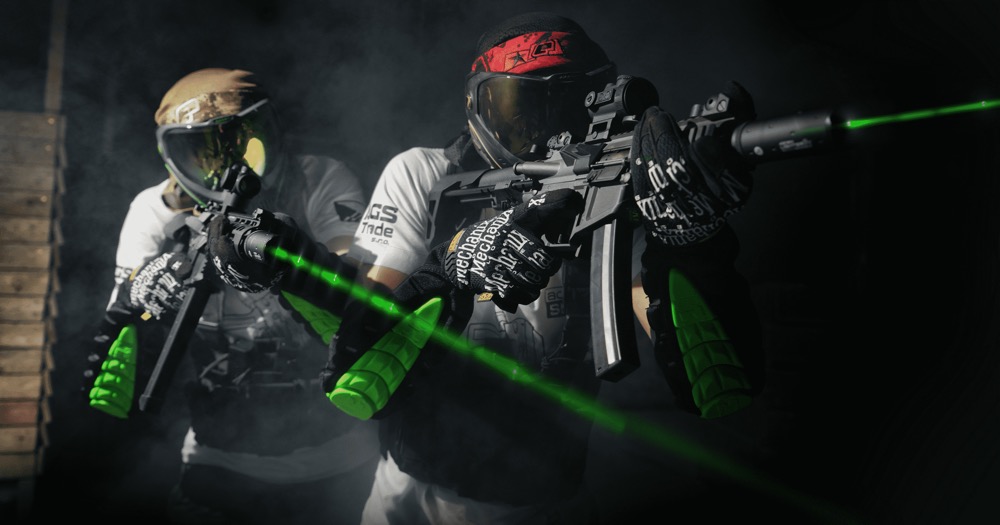
60-Second SpeedQB Quick Picks (2026)
If you’re already sure you want to jump in, here’s where most players actually start. Skim this and jump to the section you need:
IPSC Classification 2026: 6 Classes, 28 Classifier Stages & How to Rank Up
IPSC Classification Explained in 60 Seconds (BLUF)
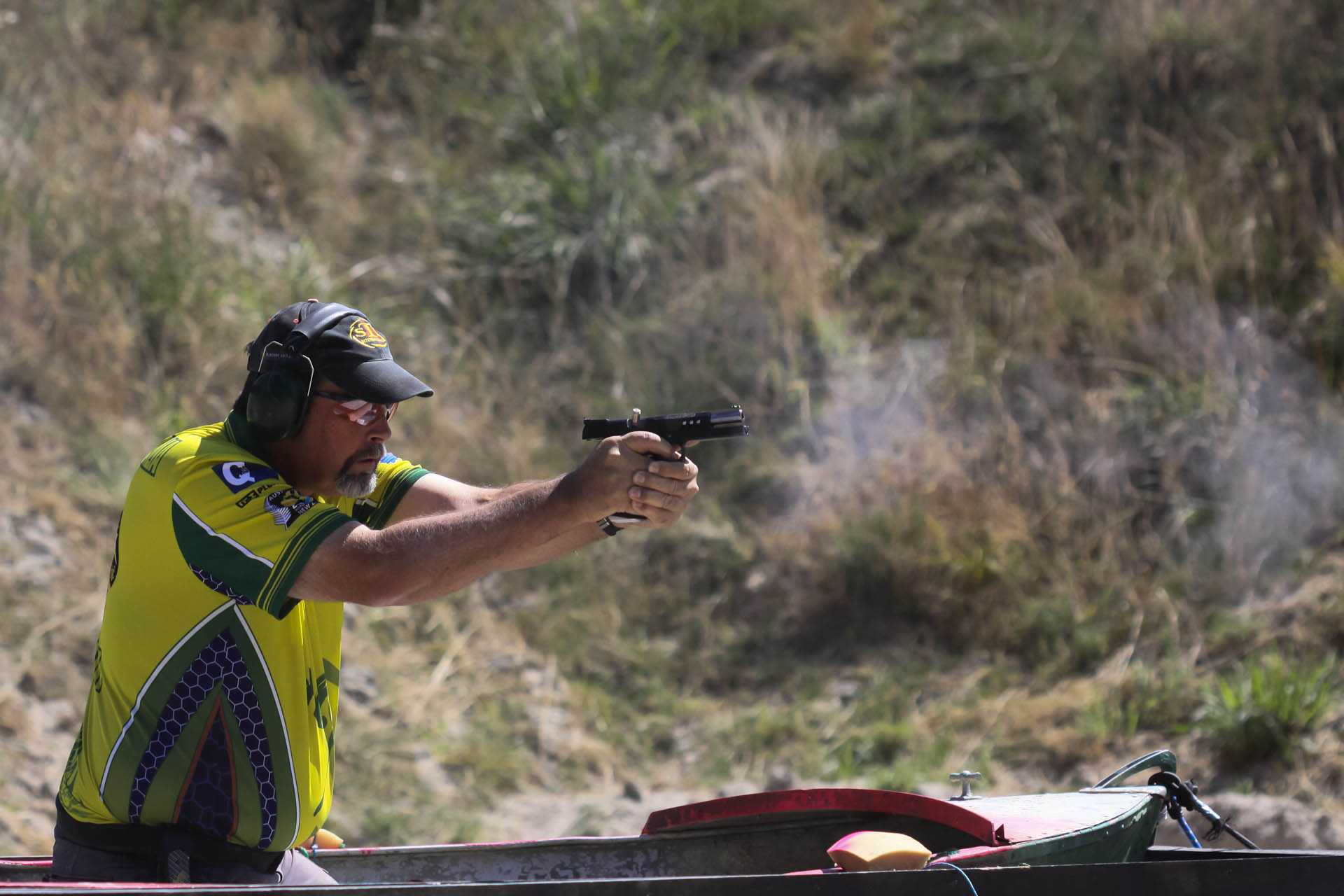
Short answer: IPSC ranks shooters into six classes — Grand Master (95%+), Master (85–94.9%), A (75–84.9%), B (60–74.9%), C (40–59.9%), and D (under 40%). The percentage is calculated against the highest hit factor ever recorded on a standardized Classifier Stage (CLS). You need a minimum of four CLS scores to get an initial class, and after that your classification is recalculated from the best 4 of your most recent 8 results. To keep your class active, you must shoot at least one classifier match or two CLS stages each calendar year, and your class is division-specific — being an A-class in Production doesn’t make you A-class in Open.
ProForce M17 vs M18 Airsoft 2026: Specs, Performance & Which to Buy
ProForce M17 vs M18 Airsoft: The Three-Second Answer
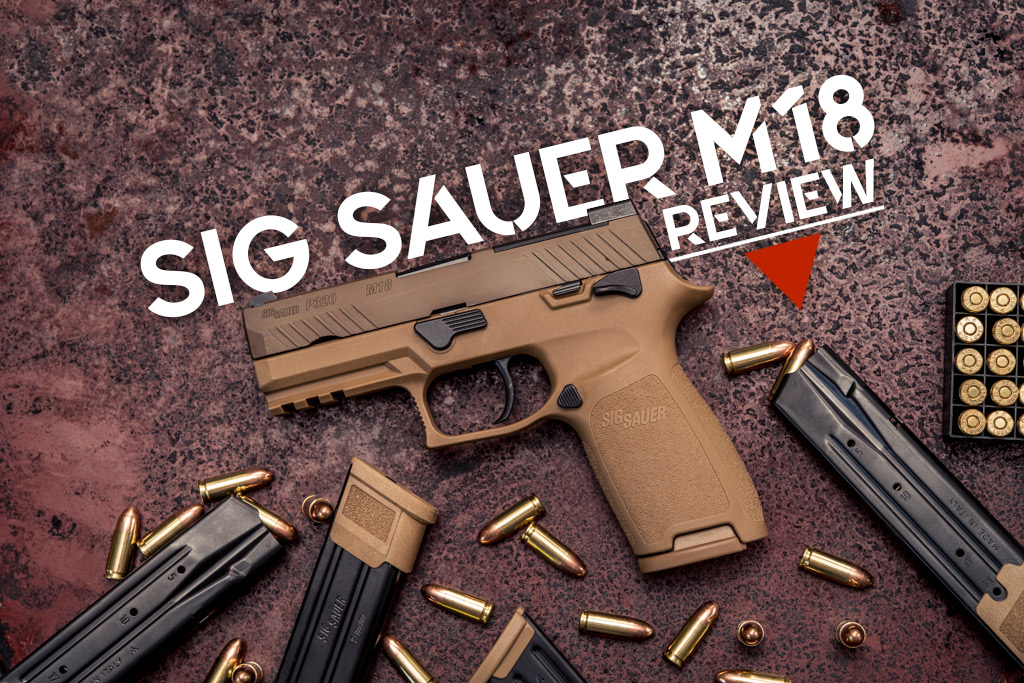
Short version: the ProForce M17 is the full-size airsoft replica of the U.S. Army’s M17 service pistol — 4.7" barrel, ~880 g loaded, Coyote Tan only, best for static-range work, IPSC Action Air practice, and anyone who actually shoots a real-steel M17. The ProForce M18 is the compact Marine Corps variant — 3.9" barrel, ~830 g loaded, Coyote Tan or Black, better suited for CQB, indoor draw drills, and shooters with smaller hands or concealed-carry training goals. Both are SIG-licensed and built by VFC, both run on green gas or CO2, and the 21-round magazines are fully cross-compatible.
Compact Carry Pistol IPSC 2026: There's No CCP Division — Here's What to Buy Instead
Quick Answer: IPSC Has No CCP — IDPA Does
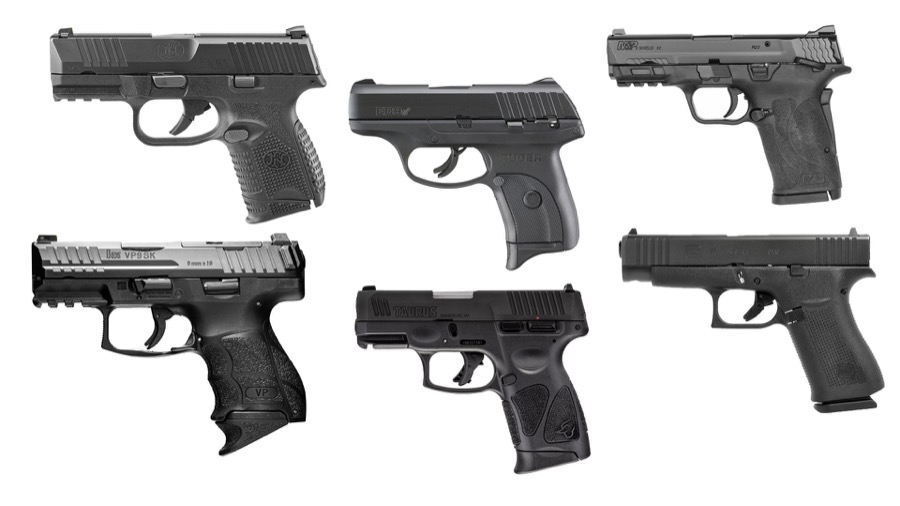
Read this first. If you searched for “compact carry pistol IPSC division,” you’ve stumbled into one of the most common naming mix-ups in practical shooting. IPSC does not have a CCP (Compact Carry Pistol) division. That label belongs exclusively to IDPA (International Defensive Pistol Association), which created CCP in March 2023 specifically for everyday carry-sized handguns. In IPSC, you shoot a compact pistol inside the existing Production, Production Optics, or Standard divisions — there’s no compact-only category.
IDPA Divisions Explained 2026: All 8 Rules, Quick Picker
IDPA Divisions Explained in 60 Seconds (BLUF)
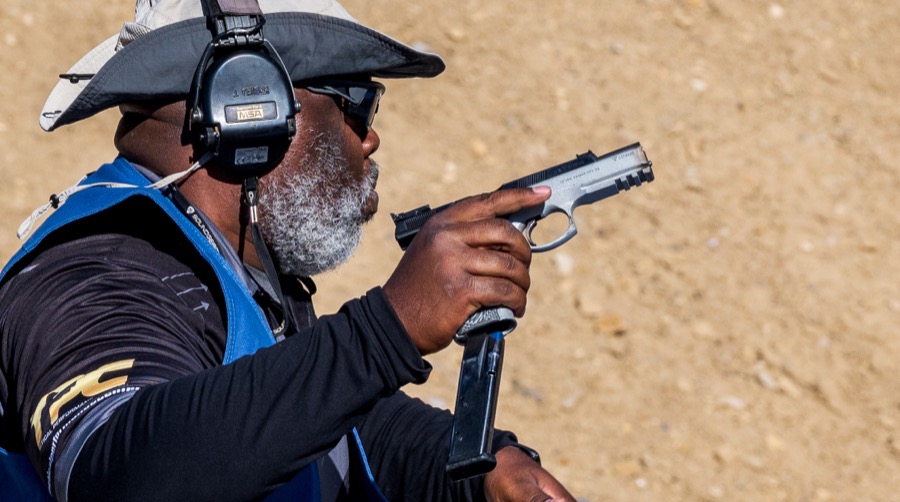
Short answer: IDPA has 8 divisions, and the right one depends on the gun already in your safe. Full-size 9mm like a Glock 17 or M&P 2.0 → SSP. Same gun with a red dot → CO. Compact carry like a Glock 19 or P365XL → CCP. CZ Shadow 2, 1911 in 9mm, or heavily modified Glock → ESP. 1911 in .45 → CDP. Revolver → REV. Pocket 9mm like a SIG P365 → BUG (now 8+1, .380 is out as of 2026). 9mm carbine with a 10"+ barrel → PCC. If you’re new and own one 9mm pistol, default to SSP, CO, or CCP — lowest cost, biggest beginner pool, easiest to learn in.