Complete Guide to Pistol Grip Technique: High Grip and Two-Handed Control Mastery
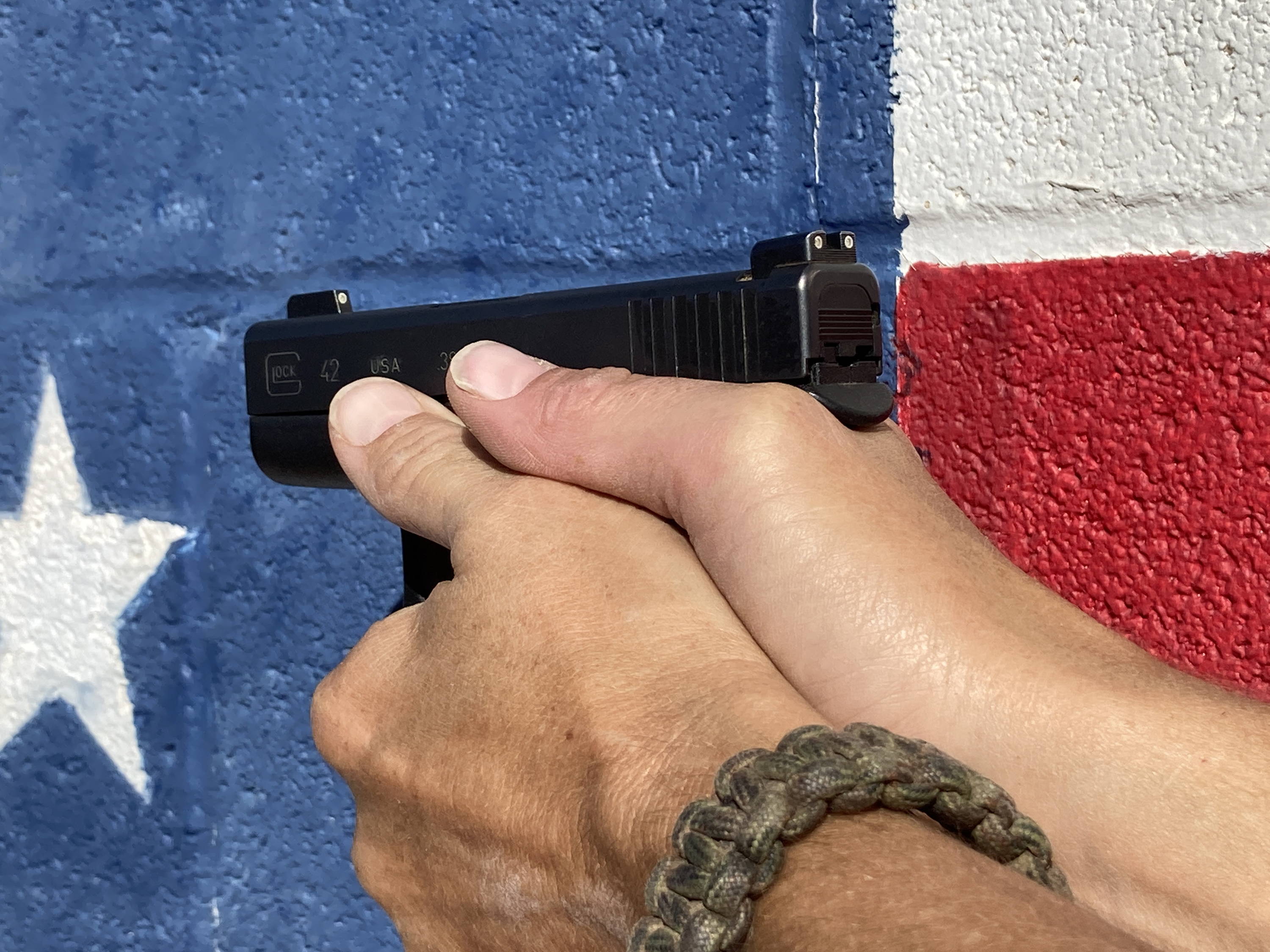
Why Grip is the Foundation of Shooting
Grip is the foundation of all shooting technique. The correct grip not only determines your control over the pistol but directly affects recoil management, sight stability, and speed of follow-up shots. Even with perfect stance, precise aim, and refined trigger control, an incorrect grip will undermine everything.
Unlike rifles, which use the stock against the shoulder and cheek for multiple contact points, pistols only have the grip as the contact surface. How to maximize control with both hands in this limited space is truly an art.
Three Core Objectives of Grip Technique
- Maximize contact area: Make the contact between your hands and the pistol as large as possible
- Counter recoil: Direct recoil force into your arm’s skeletal structure, reducing muzzle flip
- Maintain consistency: Build consistent grip mechanics to ensure reproducible control
“Grip is the first step in shooting, and the most important. Stance can be adjusted, aim can be corrected, but grip errors affect everything that follows.”
High Grip: The Key to Recoil Control
What is a High Grip?
High Grip means positioning the web of your shooting hand (dominant hand) as close as possible to the bore axis, gripping at the highest point of the grip. This is the standard technique in modern competitive and tactical shooting.
Why Grip High?
When a pistol fires, recoil travels rearward along the bore axis. Since the grip is below the barrel, recoil creates a lever action around the web of your hand, causing muzzle flip.
The closer your grip is to the bore axis, the smaller the lever arm, and the less muzzle flip.
Consider this:
- If you grip at the bottom of the grip, the long lever arm causes significant muzzle rise
- If you grip at the top (web tight against the slide), the lever arm shortens, dramatically reducing muzzle flip
How to Execute a High Grip
-
Web tight against the backstrap
- The web of your hand (between thumb and index finger) should press firmly against the highest point of the backstrap
- Push the web as high as possible, close to the slide
-
Backstrap seated in the web
- Feel the backstrap “seat” into the pocket of your web
- The palm should be flush against the grip with no gaps
-
Wrist aligned
- Keep your wrist and forearm in a straight line
- Think of the barrel as an extension of your forearm
- This directs recoil straight back into your arm structure
Common High Grip Mistakes
| Mistake | Problem | Fix |
|---|---|---|
| Gripping too low | Severe muzzle flip, slow follow-ups | Push web to highest position |
| Gap in web | Grip moves in hand, unstable control | Ensure web is fully seated |
| Bent wrist | Recoil doesn’t transfer to arm, wrist fatigue | Keep wrist aligned with forearm |
Primary Hand Grip: Building a Solid Foundation
Five Contact Points of the Primary Hand
Correct primary hand grip requires five solid contact points:
- Web: Tight against the highest point of the backstrap
- Middle finger: Wrapped around front of grip, second knuckle against trigger guard
- Ring and pinky fingers: Firmly gripping the lower grip for stability
- Palm: Fully flush against the grip side
- Thumb: Pointing forward along the slide
The Importance of the Pinky
You might think the pinky is the least important finger, but the pinky contributes approximately 50% of the hand’s gripping strength.
This is why shooting compact pistols with shortened grips (like Glock 26, S&W Shield) feels noticeably less stable—the pinky can’t fully contact the grip. If you use such compact pistols, consider adding magazine base extensions to increase pinky contact.
How Much Grip Pressure?
“Firm but not tense” is the most common advice.
Renowned instructor Massad Ayoob recommends a “crush grip”—gripping the pistol firmly from the start. His reasoning: under extreme stress, your grip will naturally tighten, so it’s better to train this way from the beginning.
Another school of thought suggests: about 60-70% grip pressure. Excessive gripping causes:
- Hand tremor
- Trigger control issues (sympathetic finger movement)
- Rapid fatigue
Recommendation: Beginners should start with enough force to “maintain stable control” and gradually find their optimal grip pressure with experience.
Two-Handed Grip: Fill Every Gap
Why Use Two Hands?
With a single-hand grip, large areas of the pistol grip remain uncovered. These gaps allow:
- Recoil to find “escape routes,” moving the gun in your hand
- Reduced grip stability
- Increased muzzle flip during rapid fire
The goal of a two-handed grip is to fill all gaps and create 360-degree control.
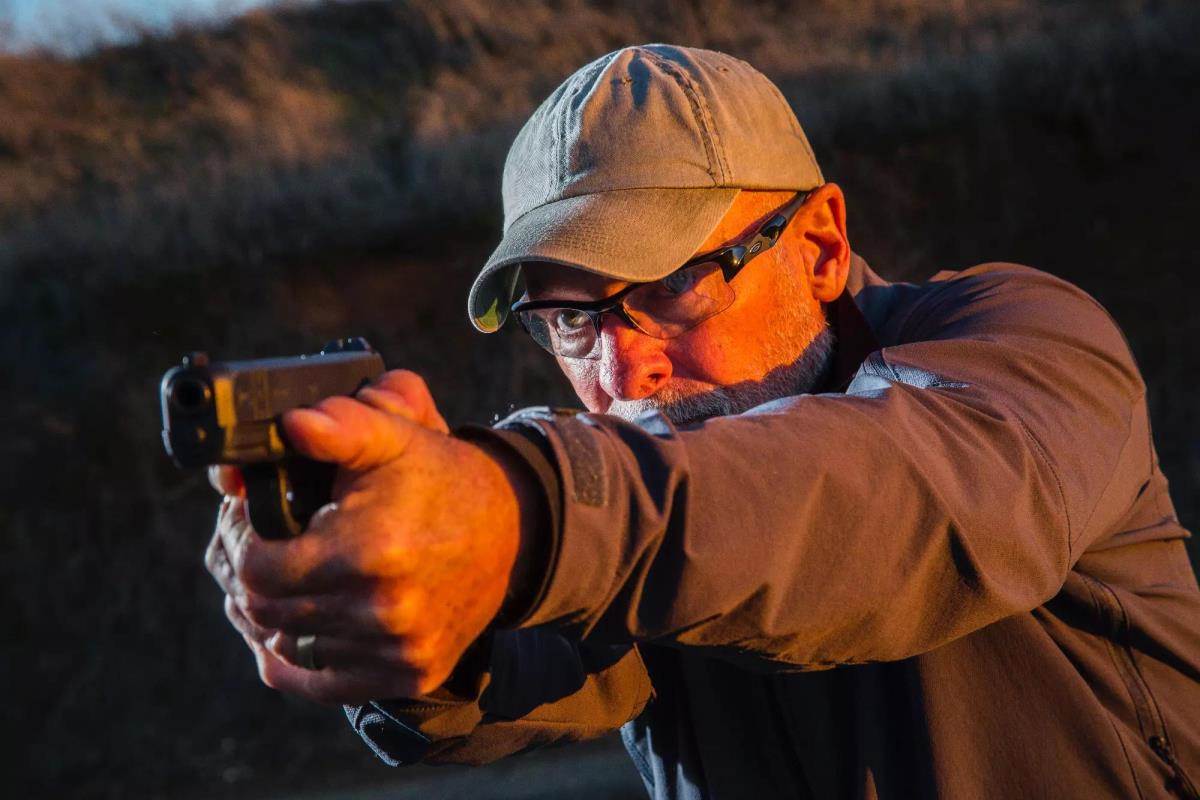
Correct Support Hand Position
-
Palm flush against grip side
- The heel of your support hand (non-dominant) presses against the left side of the grip (for right-handed shooters)
- Fill the area not covered by the primary hand
- Think of it as a “jigsaw puzzle”—both hands fitting perfectly with no gaps
-
Fingers wrapped over primary hand
- Support hand fingers wrap around primary hand fingers
- Grip firmly over the primary hand knuckles
- Index finger as high as possible under the trigger guard
-
Wrist locked forward
- Support hand wrist slightly bent forward
- Creates a “locked” position
- This angle helps control recoil
Thumbs Forward Technique
Thumbs Forward is the standard two-handed grip technique in modern competitive shooting.
How to Execute
-
Primary thumb points forward
- Extends straight along the slide
- Does not press down on support hand
-
Support thumb under primary thumb
- Also points forward
- Both thumbs parallel, like “two rails”
-
Thumb muscles against grip
- The large muscle at the base of the support thumb presses against the grip
- Fills area not covered by primary hand
Why Thumbs Forward Works
-
Increases contact area
- The large muscle at thumb base adds contact with the grip
- More contact = more control
-
Natural target pointing
- Thumbs pointing forward naturally point toward target
- Helps with rapid acquisition
-
Recoil control
- Both thumbs form a “stabilizer”
- Helps suppress side-to-side movement
Support Hand Force Distribution
IPSC World Champion Julie Golob recommends:
“The support hand should provide most of the grip force. This allows the trigger finger of the dominant hand to be more easily isolated, preventing grip pressure from affecting trigger control.”
Recommended force distribution:
- Primary hand: 40%
- Support hand: 60%
Or for more aggressive competitive shooting:
- Primary hand: 30%
- Support hand: 70%
Comparing Four Common Grip Techniques
Different shooting schools and eras have developed various grip techniques. Here are the four most common:
1. Thumbs Forward
Characteristics:
- Both thumbs side by side pointing forward
- Modern competitive shooting standard
- Best recoil control
Pros:
- Maximum contact area
- Excellent follow-up speed
- Natural target pointing
Cons:
- Not suitable for one-handed shooting (requires thumb adjustment)
- May accidentally engage slide release
Best for: IPSC, USPSA, IDPA competitive shooting, tactical shooting
2. Thumb Over Thumb
Characteristics:
- Primary thumb over support thumb
- Traditional Gunsite teaching method
- Standard technique from Jeff Cooper era
Pros:
- Intuitive, easy to learn
- Works well with revolvers
- Easy single-hand transition
Cons:
- Less contact area
- Less recoil control than thumbs forward
Best for: Revolvers, traditional shooting training
3. Thumbs Curled
Characteristics:
- Both thumbs curled down around grip
- Similar to making a fist
Pros:
- Very secure hold
- Won’t accidentally engage any controls
Cons:
- Reduced contact area
- Slower follow-up shots
- Not suitable for competition
Best for: Beginners, shooters with small hands
4. Flying Thumbs / Thumbs Up
Characteristics:
- Both thumbs raised up
- Away from slide and controls
Pros:
- Completely avoids accidental engagement
- Standard grip for certain pistols (like HK P7)
Cons:
- Loses stabilizing effect of thumbs
- Poorer recoil control
- Rare in modern competitive shooting
Best for: Specific pistol models, special situations
Common Grip Mistakes and Corrections
Mistake 1: Tea Cup Grip
Description: Support hand cups the bottom of the grip, like holding a teacup
Problems:
- Support hand provides almost no control
- Essentially single-hand shooting
- Common in movies, completely impractical
Correction: Support hand should wrap around grip side, not cup the bottom
Mistake 2: Crossed Thumbs
Description: Support thumb wraps behind grip, under primary thumb
Problems:
- Support thumb may be caught by slide
- Reduces contact area
- Interferes with slide operation
Correction: Both thumbs should be on same side of slide, pointing forward
Mistake 3: Limp Wrist
Description: Wrist not locked, too relaxed
Problems:
- Recoil doesn’t transfer to arm
- May cause short-cycle malfunctions in semi-autos
- Severe muzzle flip
Correction: Keep wrist straight and locked, forming one unit with forearm
Mistake 4: Inconsistent Grip Pressure
Description: Grip pressure fluctuates during shooting
Problems:
- Gun moves in hand
- Inconsistent control per shot
- Unpredictable point of impact
Correction: Establish consistent grip pressure from start, maintain throughout
Mistake 5: Too Many Gaps
Description: Visible gaps between hands or between hand and grip
Problems:
- Recoil “escapes” through gaps
- Gun rotates in hand
- Dramatically reduced control
Correction:
- Fit hands together like puzzle pieces
- Check and fill every gap
- Support hand heel fully flush against grip
Grip Adjustments for Different Pistol Types
Polymer-Frame Striker-Fired Pistols
Examples: Glock, SIG P320, S&W M&P, Springfield XD
Key Points:
- Standard high grip + thumbs forward
- Use grip texture for added friction
- Watch slide release position to avoid accidental engagement
Metal-Frame DA/SA Pistols
Examples: Beretta 92, CZ 75, SIG P226
Key Points:
- Wider frame requires support hand to work harder
- Safety/decocker position may affect thumb placement
- DA first shot requires more secure hold
1911 Single Action Pistols
Examples: Colt 1911, various 2011s
Key Points:
- Grip safety must be fully depressed
- Primary hand web must fully contact backstrap
- Consider thumb safety operation
Competition Pistols
Examples: CZ Shadow 2, Tanfoglio Stock III
Key Points:
- Usually larger grips, suitable for complete coverage
- Equipped with thumb rests for additional contact points
- Competition modifications (like Gas Pedal) further enhance control
Practicing Grip Stability with Shot Timer
Exercise 1: Split Time Test
Purpose: Evaluate grip effectiveness for recoil control
Method:
- Set AirsoftShotTimer to standard mode
- Distance 7 yards, aim at center area
- Fire 5 consecutive shots after beep
- Record split times
Target Split Times:
- Beginner: 0.35-0.40 seconds
- Intermediate: 0.25-0.30 seconds
- Advanced: Under 0.20 seconds
Analysis:
- Long split times → Severe muzzle flip, grip not high or firm enough
- Inconsistent splits → Inconsistent grip pressure, practice stability
Exercise 2: Bill Drill
Purpose: Test grip stability during rapid fire
Method:
- Distance 7 yards, facing standard IPSC target
- Start from ready position
- Fire 6 consecutive shots after beep, aim for A-zone
- Record total time and hit rate
Goals:
- Beginner: Under 3.0 seconds, 6 A-zone hits
- Intermediate: Under 2.5 seconds, 6 A-zone hits
- Advanced: Under 2.0 seconds, 6 A-zone hits
Exercise 3: Grip Consistency Test
Purpose: Ensure consistent control with each grip establishment
Method:
- Completely release pistol, hands at sides
- Regrip and present to target
- Fire 2 rounds
- Repeat 10 times
- Analyze shot group
Analysis:
- Scattered groups → Inconsistent grip position each time
- Tight groups → Stable grip procedure
Grip Technique Training Plan
Beginner (Weeks 1-4)
Daily training 15 minutes
| Exercise | Time | Focus |
|---|---|---|
| Grip procedure practice | 5 min | Build consistent grip action |
| High grip confirmation | 3 min | Ensure correct web position |
| Support hand wrap practice | 5 min | Eliminate all gaps |
| Grip pressure hold | 2 min | Maintain steady pressure 30 sec |
Weekly Goals:
- Week 1: Learn high grip, web tight to backstrap
- Week 2: Master correct support hand position
- Week 3: Practice thumbs forward technique
- Week 4: Build consistent grip procedure
Intermediate (Weeks 5-12)
Daily training 20 minutes
| Exercise | Time | Focus |
|---|---|---|
| Grip + presentation | 5 min | Smooth motion from rest to aim |
| Rapid fire control | 8 min | Use Shot Timer for split times |
| Distance adaptation | 5 min | Grip adjustment from 3 to 15 yards |
| One-handed practice | 2 min | Primary and support hand each |
Using AirsoftShotTimer:
- Track split time changes
- Goal: 5-shot split time standard deviation < 0.05 sec
Advanced (Week 13+)
Daily training 30 minutes
| Exercise | Time | Focus |
|---|---|---|
| Speed Bill Drill | 10 min | Goal under 2.0 seconds |
| Target transition | 10 min | Maintain grip through transitions |
| Stress training | 5 min | Maintain grip quality after exertion |
| Different pistol adaptation | 5 min | Switch grip between different pistols |
Frequently Asked Questions (FAQ)
Q1: My hands are small and can’t fill the grip. What should I do?
A: Several solutions:
-
Choose smaller grips
- Many pistols have interchangeable backstraps
- Select the smallest size option
-
Switch to smaller pistols
- Glock 19 has shorter grip than Glock 17
- Consider compact rather than full-size
-
Adjust grip technique
- Support hand grips more firmly
- Ensure pinky contacts the grip
-
Modifications
- Replace with thinner grip panels
- Add grip tape for friction
Q2: Will the slide catch my web with a high grip?
A: Not if gripped correctly.
- Web should be tight to backstrap but not above slide rails
- Modern pistols have “beaver tail” designs to prevent this
- If caught, web position is too high or at wrong angle
Q3: Will thumbs forward accidentally engage the slide release?
A: Possibly, depending on hand size and pistol model.
Solutions:
- Adjust thumb height, slightly away from release
- Choose low-profile slide release
- Practice natural thumb position
Q4: Should both hands use equal pressure?
A: Not necessarily. The mainstream recommendation for competitive shooting is:
- Support hand 60%, primary hand 40%
- This allows the primary hand to manipulate trigger more freely
- Support hand handles primary stability and recoil control
But this is advanced technique—beginners can start with “equal pressure.”
Q5: How to maintain grip with wet hands or gloves?
A:
-
Increase friction
- Grip tape (Talon Grips)
- Competition grip spray (Pro Grip)
- Stippling modifications
-
Choose appropriate materials
- Rubber-textured grip panels
- Aggressive grip textures
-
Glove selection
- Thin shooting gloves
- Anti-slip palm materials
Q6: Is grip different for left-handed shooters?
A: Technique is identical, just mirrored:
- Left hand becomes primary, right becomes support
- Thumbs forward applies the same way
- Pay attention to control positions (ambidextrous models are more convenient)
Conclusion
Grip is the foundation of shooting technique. Without a solid grip, stance, aim, and trigger control all suffer. Investing time in grip technique will dramatically improve your overall shooting ability.
Key Points Review
- High grip: Web tight to backstrap, reduces muzzle flip
- Thumbs forward: Modern competitive shooting standard
- Fill every gap: Hands fit together like puzzle pieces
- Steady pressure: 60/40 distribution, support hand dominant
- Avoid common mistakes: Tea cup grip, crossed thumbs, limp wrist
- Use AirsoftShotTimer to quantify split times and track progress
Next Steps
- Check your current grip for mistakes mentioned above
- Practice correct grip procedure 15 minutes daily
- Use Shot Timer to record split times
- Practice with other fundamental shooting techniques
Solid Grip + Correct Stance + Precise Aim + Trigger Control = Hits on Target!
Happy training!
Related Articles
Shooting Fundamentals Series
- Complete Guide to Shooting Stance - Foundation of stable shooting
- Complete Guide to Pistol Aiming - Precise target alignment
- Complete Guide to Trigger Control - The final mile of accurate shooting
- Complete Guide to Breathing Control - Mind and body stability
- Complete Guide to Shooting on the Move - Dynamic shooting technique
Training Tools
- Complete Guide to Shot Timer - Track progress with data
- Complete Guide to Dry Fire Training - Home practice for grip stability
- Complete Guide to Magazine Reload - Master reload techniques
Competitive Shooting
- IPSC Practical Shooting Training Guide - Core competitive techniques
- IDPA Defensive Shooting Training Guide - Tactical-oriented training
- IPSC Production Optics Beginner Guide - Red dot competitive shooting
Pistol Guides
- Glock 17 Training Guide - Classic striker-fired pistol
- SIG P320 Complete Guide - Modular pistol
- CZ Shadow 2 Complete Guide - Competition pistol of choice
- 1911 Complete Guide - Classic single-action pistol
Beginner Guides
- Complete Beginner’s Guide to Airsoft - Start your Airsoft journey
- Grip Technique
- High Grip
- Two-Handed Grip
- Shooting Training
- IPSC
- IDPA
- Pistol Training
- Recoil Control
- Thumbs Forward