Home Defense Pistol Guide: Choosing the Right Handgun & Training to Protect Your Family
Why Home Defense Preparation Matters More Than You Think
Most people buy their first handgun with range practice or competition shooting in mind. But over time, many gun owners start asking a serious question: if someone broke into my home in the middle of the night, am I truly prepared?
Home defense shooting is fundamentally different from range shooting or competitive shooting. At the range, you have plenty of light, a stable stance, and stationary paper targets. In a home defense scenario, you’ll likely be jolted awake in the dead of night, operating under extreme stress in tight, dimly lit spaces. Your family might be in the next room, and every round you fire must be carefully accounted for.
This is why home defense isn’t as simple as “buy a gun and keep it on the nightstand.” It requires the right equipment choices, thorough safety planning, and targeted training. This guide covers everything from firearm selection and accessory setup to safe storage and training methods, helping you build a complete home defense preparation system.
💡 Further Reading: Regardless of your firearm’s purpose, safety always comes first. Start with our Complete Guide to Shooting Safety Rules to build a solid safety foundation.
Choosing Your Home Defense Weapon: Pistol, Shotgun, or Rifle?
Before diving into specific pistol recommendations, let’s address the most common question: what type of firearm is best for home defense? Each of the three main options has distinct advantages and drawbacks, and the best answer depends on your living environment, family composition, and shooting experience.
The pistol is the most versatile home defense weapon. Its compact size allows single-handed operation, and it won’t get hung up navigating hallways and doorframes. You can hold a pistol in one hand while calling 911 or guiding a family member with the other. For anyone living in an apartment or smaller home, the pistol’s maneuverability advantage is unmatched. However, pistols are also the hardest of the three to shoot accurately—a shorter sight radius and greater perceived recoil mean you need more training to maintain accuracy under pressure.
The shotgun delivers devastating terminal effect. A single trigger pull sends seven to nine 9mm-sized buckshot pellets downrange, providing exceptional stopping power at close range. The entry price is also relatively low—a quality pump-action shotgun runs about $250 to $400. But shotgun recoil can overwhelm less experienced shooters, and the limited capacity of 3 to 9 shells means every shot counts. The shotgun’s length also creates challenges when navigating corners and doorways indoors.
The AR-15 platform offers the highest capacity (typically 30 rounds) and the lowest perceived recoil, with the fastest follow-up shot recovery of the three options. But its length is a clear disadvantage when moving through indoor spaces, and some states and localities impose legal restrictions. Additionally, 5.56mm rounds require careful consideration regarding over-penetration in residential settings.
For most households, a pistol is the most practical home defense weapon choice—especially if you also need to carry concealed daily. The rest of this guide will focus on selecting and training with a home defense pistol.
What to Look for in a Home Defense Pistol
The criteria for selecting a home defense pistol are completely different from choosing a competition handgun. Competition shooting prioritizes speed and accuracy with time to prepare before each run. But home defense situations are sudden and chaotic—your pistol must function reliably under the worst possible conditions.
Absolute reliability is the top priority. Your home defense pistol might sit in a safe for months or even years until the day you truly need it. It must fire the moment you pull it out, without hesitation. This is why most defensive shooting experts recommend proven, mainstream brands—Glock, Smith & Wesson M&P, SIG Sauer, FN, and Walther striker-fired pistols have accumulated millions of rounds of proven reliability records in military, law enforcement, and civilian use worldwide.
For caliber, 9mm is the most balanced choice for home defense. Its moderate recoil enables fast follow-up shots, magazine capacity is generous (typically 15-17+ rounds in full-size pistols), and modern 9mm defensive ammunition delivers excellent terminal performance. Equally important, 9mm’s lower training cost lets you invest more rounds in practice.
In terms of size, a mid-size to full-size pistol is ideal for home defense. Unlike concealed carry, you don’t need to worry about concealability. A full-size pistol provides a longer grip for better control, a longer sight radius for improved accuracy, and larger magazine capacity. If your pistol must also serve as a daily carry gun, a compact like the Glock 19 makes an excellent compromise.
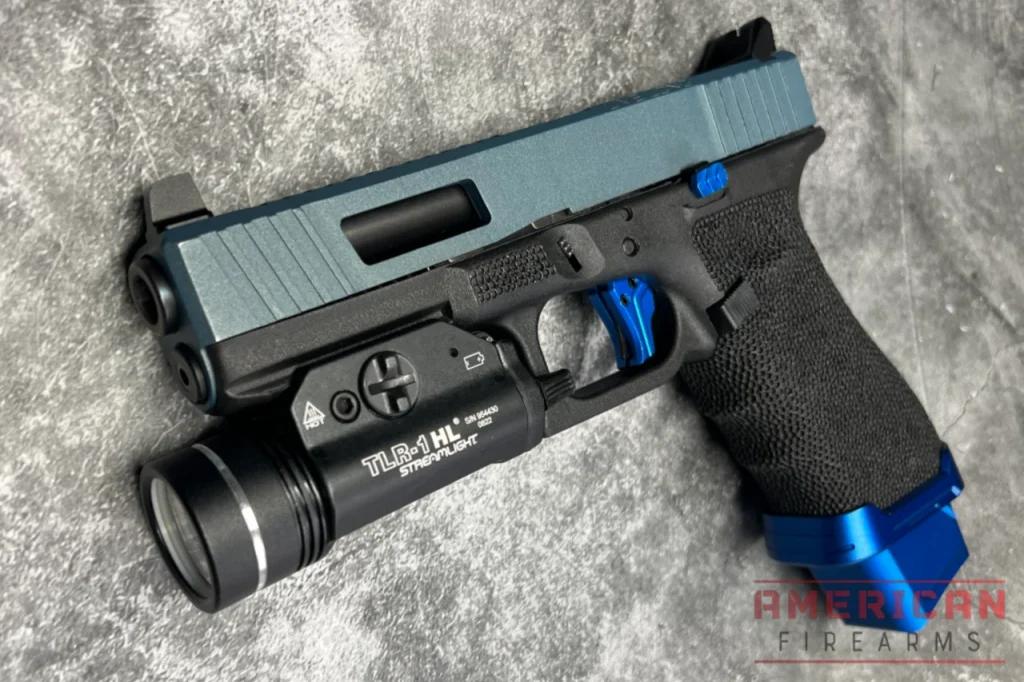
Finally, your home defense pistol must accept a weapon-mounted light (WML). In a home defense scenario, you’ll almost certainly be operating in low-light conditions. A light mounted on the pistol’s accessory rail helps you identify threats and aim in darkness. Choose a pistol model with a Picatinny rail or dedicated accessory rail.
Recommended Home Defense Pistols
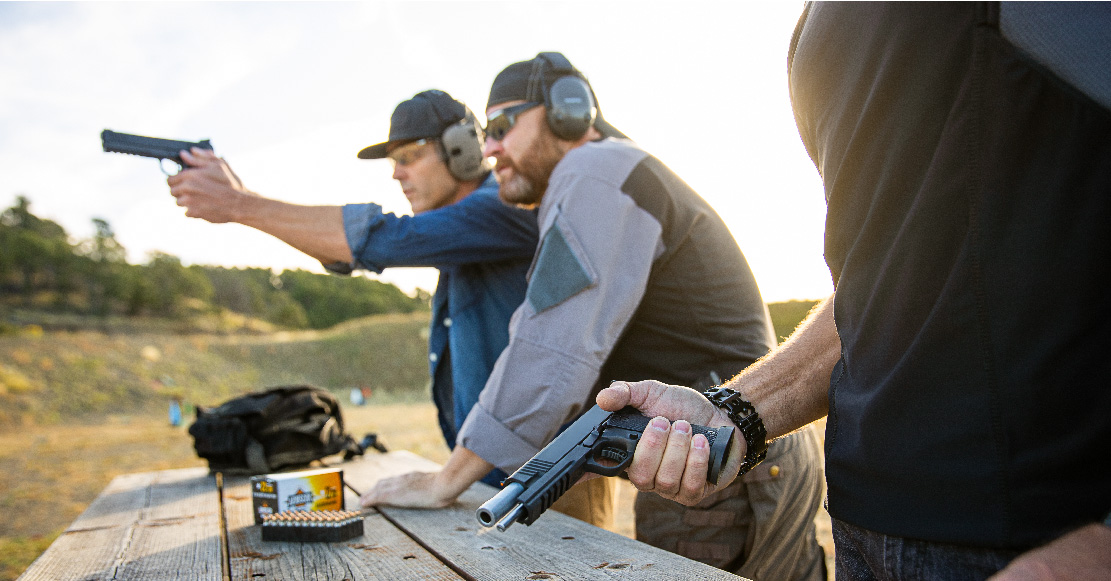
Here are several pistols that excel in the home defense role, all extensively proven for reliability in real-world use.
Glock 19 Gen 5 (~$550)
If you could only recommend one home defense pistol, the Glock 19 is the near-universal answer among defensive shooting experts. This compact 9mm combines enough size for good control while remaining maneuverable in tight spaces. The standard 15+1 capacity is more than adequate for home defense, and it accepts Glock 17’s 17-round magazines for extra capacity flexibility at home.
The Glock’s greatest advantage is its simplicity. No external safety, no decocker—pick it up, point at the target, press the trigger, and it fires. When you’re jolted awake at 3 AM with adrenaline surging, this operational simplicity could mean the difference between life and death. Extensive factory and aftermarket support means you can easily mount weapon lights and night sights.
Smith & Wesson M&P 2.0 Full Size (~$550)
If your pistol will primarily serve home defense without daily carry duty, the M&P 2.0 full-size is an exceptionally competitive option. It ships with four different grip texture palmswell inserts, letting you find the most comfortable fit. The 17+1 capacity and 4.25-inch barrel hit nearly the perfect balance for home defense use.
The M&P series trigger is among the best in its price range, with a smooth pull and clean break that helps maintain trigger control under pressure. The Optics Ready version accepts red dot sights directly, further improving aiming efficiency in low-light environments.
Walther PDP 5-Inch Full Size (~$650)
The Walther PDP has earned some of the highest praise in the defensive handgun market in recent years. The 5-inch full-size version with its 18-round magazine delivers maximum capacity and the lowest perceived recoil—crucial advantages in a home defense scenario. The PDP’s ergonomic grip design feels natural in most hands, requiring virtually no break-in period.
The PDP’s trigger is rated by many shooters as the best factory striker-fired trigger available, with a crisp break and short reset that make follow-up shots noticeably smoother. It ships optics-ready for easy red dot sight installation.
FN 509 Tactical (~$900)
If budget allows, the FN 509 Tactical is a professional-grade home defense choice. Built on FN’s Modular Handgun System submission to the U.S. Army, it ships with two 24-round extended magazines, a threaded barrel (suppressor-ready), and an optics mounting system. Suppressor-height night sights allow co-witness even with a mounted red dot.
The FN 509 Tactical’s threaded barrel deserves special mention. If your state permits suppressors, adding one for home defense dramatically reduces muzzle blast and flash, protecting your and your family’s hearing while reducing visual disruption in low-light conditions.
Essential Accessories: Weapon Lights and Sight Upgrades
Once you’ve selected your pistol, two accessories are nearly mandatory upgrades for home defense: a weapon-mounted light and night sights.
Weapon-Mounted Light (WML)
In a home defense scenario, your greatest enemy isn’t the intruder—it’s darkness. FBI statistics show that the majority of defensive shooting incidents occur in low-light conditions. If you can’t clearly see the target, you can’t confirm whether that noise is an intruder or your family member getting up for a glass of water—and the fourth rule of firearms safety demands that you identify your target and what’s beyond it before pulling the trigger.
A weapon-mounted light attaches directly to your pistol’s accessory rail, illuminating targets while you maintain a firing grip. The most popular home defense WMLs include the Streamlight TLR-7A ($125) and SureFire X300U ($300). The Streamlight TLR-7A delivers 500 lumens in a compact package suitable for most pistols, while the SureFire X300U provides a powerful 1,000-lumen output preferred by many law enforcement officers and defensive shooting professionals.
However, a weapon light doesn’t entirely replace a handheld flashlight. Before confirming a threat, you shouldn’t point your gun at anything you’re unsure about. The ideal approach is to keep a handheld flashlight at your bedside as well—use it for initial illumination and searching, and only bring your weapon on target once a threat is confirmed.
Night Sights and Red Dot Sights
Factory standard sights are virtually invisible in darkness. Upgrading to night sights is the most basic sight improvement for a home defense pistol. Tritium night sights (such as the Trijicon HD XR) glow independently in complete darkness, letting you quickly align on target.
If budget permits, mounting a red dot sight (RDS) is an even better option. A red dot lets your eyes focus simultaneously on the target and the aiming point—in a high-stress defensive scenario, this is more intuitive and faster than the traditional front sight/rear sight alignment system. The Holosun 507C and Trijicon RMR are currently the most popular pistol-mounted red dots.
💡 Further Reading: For an in-depth look at red dot sight selection and training, see our Complete Guide to Pistol Red Dot Sights.
Safe Storage: Choosing a Quick-Access Safe
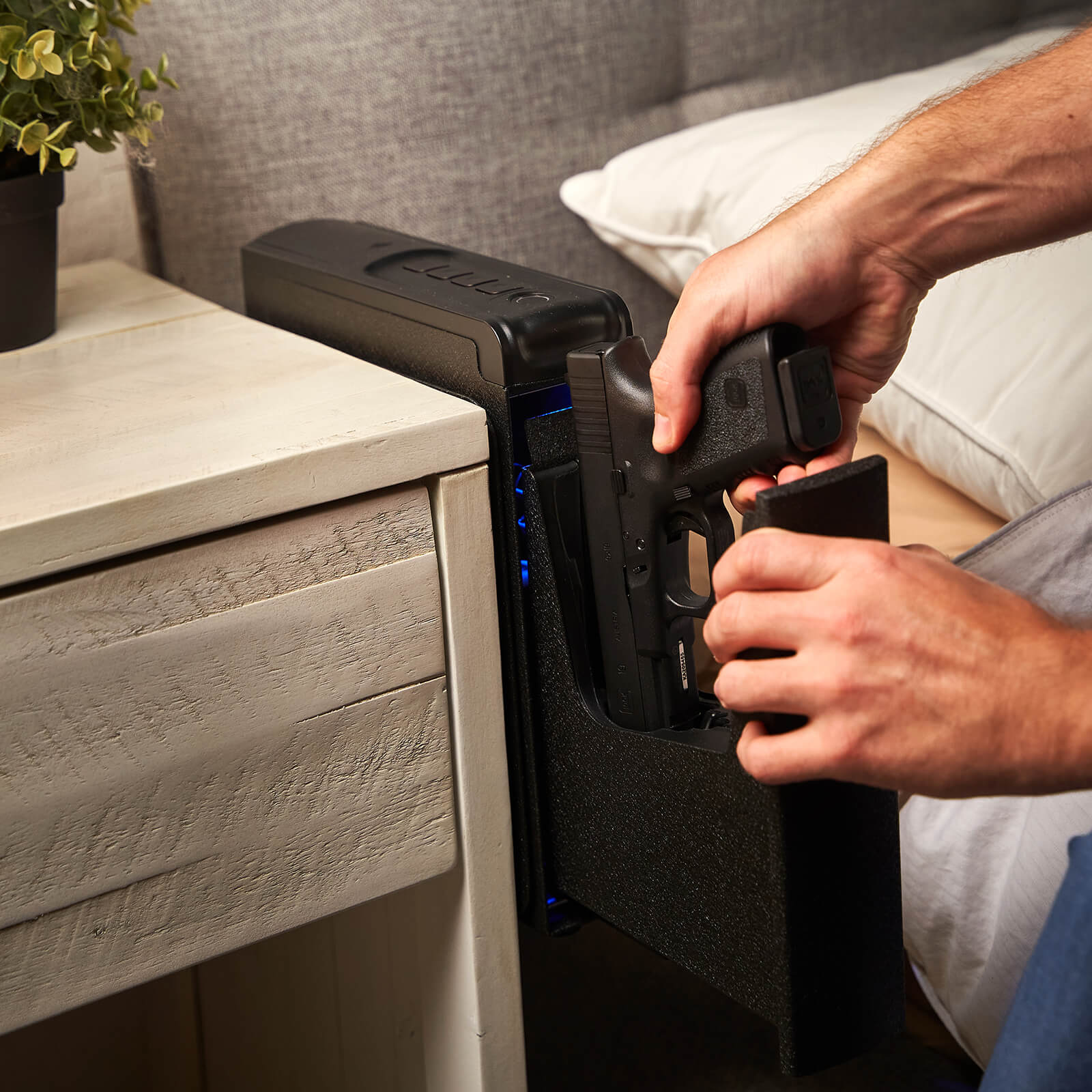
Owning a home defense pistol means simultaneously solving two seemingly contradictory needs: the gun must be accessible within seconds during an emergency while remaining securely stored away from unauthorized access—especially children. A quick-access safe is the answer to this dilemma.
Modern bedside quick-access safes typically offer three opening methods: biometric fingerprint scanning, electronic keypad, and backup key. Biometrics are fastest—under one second in ideal conditions—but wet or injured fingers can affect recognition rates. Mechanical combination locks (like Simplex push-button locks) require no batteries and offer the highest reliability, opening in under two seconds with practice.
When shopping for a quick-access safe, ensure it accommodates your pistol with the weapon light attached. Many safes claim to fit “full-size pistols” but can’t handle one with a mounted light. Measure your pistol-plus-light dimensions before purchasing. The safe should be mountable inside a nightstand drawer or on a wall to prevent the entire unit from being carried away.
Internal LED illumination is an important but often overlooked feature. When opening the safe in complete darkness, interior lighting helps you quickly confirm the pistol’s position and condition, preventing fumbling and delays.
Practice a “retrieval drill” once a week—time your complete process from bed to pistol in hand in a safe environment. Your target is 3 to 5 seconds for the entire sequence. Using the Shot Timer’s random delay buzzer function to simulate surprise events makes the drill more realistic.
Home Defense Scenario Training
Having the right gear is only step one. Without scenario-specific training, you’ll likely make poor decisions or struggle to operate effectively in a real emergency. Here are several training methods designed specifically for home defense situations.
Safe Retrieval Drill
This drill simulates being awakened by the sound of an intrusion. Using an unloaded pistol, start from a lying position in bed, open the safe, retrieve the pistol, confirm its status (simulate racking the slide with an empty gun), then move to a low-ready position. Use a Shot Timer to record each completion time, setting PAR time goals: beginner 8 seconds, intermediate 5 seconds, advanced 3 seconds.
The most important aspect of this drill is developing a consistent sequence. Every pistol retrieval should follow the exact same order—open safe, grip pistol, confirm status, grab flashlight, assume ready position. When this sequence becomes muscle memory, you’ll execute it smoothly even under extreme stress.
Mozambique Drill
The Mozambique Drill is one of the most classic home defense shooting exercises. At 7 yards, from low-ready or holster draw, fire two rapid shots to the torso zone, then one precise shot to the head zone. This “two to the body, one to the head” combination is the standard defensive response pattern—if the first two rounds don’t stop the threat, the precise headshot serves as your backup option.
Using a Shot Timer, the target time is 3 seconds for all three shots, with all hits in the A-zone. Beginners can start at 5 yards, building the sequence before gradually increasing distance and speed pressure.
Nightstand Drill
This is the training exercise closest to a real home defense scenario. Starting with the pistol on a table surface (simulating post-safe retrieval), upon hearing the buzzer, pick up the pistol, establish your grip, present to a target at 3 to 5 yards, and fire two rounds. The focus isn’t on raw speed but on the fluidity of transitioning from a static state to proper grip and aim.
Pay special attention during this drill: do not place your finger inside the trigger guard while picking up the pistol. Your finger must only enter the trigger position after the pistol is pointed at the target and you’ve made the conscious decision to shoot. This is the most commonly overlooked safety habit in home defense training.
Low-Light Training
Home defense training without low-light practice is incomplete. If your range permits, try shooting drills with lights off or in low-light conditions. Practice the complete sequence of activating your weapon light, identifying the target, then engaging.
If your range doesn’t allow low-light training, you can practice dry fire at home. In a dark room, practice bringing the weapon light on from low-ready, identifying a “target” (tape marked on the wall), and aligning on target. Mind your muzzle direction—even during dry fire, safety rules cannot be compromised.
Regarding flashlight techniques, several proven methods are worth learning. The Ayoob Technique involves holding the flashlight in your support hand and pressing the backs of both hands together for mutual support, providing stability while maintaining light control. The FBI Technique holds the flashlight away from the body, off to one side or above the head, so that if an intruder shoots toward the light, they won’t directly hit your torso.
💡 Further Reading: For more shooting drills and Shot Timer usage, see our Complete Guide to Classic Shooting Drills and Shot Timer App Complete Guide.
Developing a Home Defense Plan
Training is only part of home defense preparation. You need a comprehensive plan so that every family member knows what to do in an emergency.
First, discuss and designate a “safe room” with your family—usually the master bedroom or the most defensible room in the house. If you hear unusual sounds, the plan should be to gather all family members into the safe room, lock the door, call 911, and cover the doorway from a position of cover. In the vast majority of cases, you should not proactively “clear” your house searching for intruders—that’s a job for trained law enforcement professionals.
Learn your home’s layout. Know the wall materials (will bullets penetrate?), know where family members’ bedrooms are (is your line of fire safe?), and identify your main cover and concealment positions. Occasionally walk through your route from bedroom to safe room during daylight with an unloaded gun, noting blind corners and doors that need opening.
Selecting appropriate home defense ammunition is equally critical. Full metal jacket (FMJ) rounds have too much penetration for home defense, easily passing through walls and potentially harming bystanders. Choose quality jacketed hollow point (JHP) ammunition such as Federal HST, Hornady Critical Defense, or Speer Gold Dot. These rounds are designed to expand upon impact, reducing the risk of over-penetration. Store your practice FMJ and defensive JHP ammunition separately, and rotate the defensive ammunition in your safe every 6 to 12 months to ensure reliability.
Using a Shot Timer for Home Defense Training
The AirsoftShotTimer App is an excellent tool for home defense training, helping you quantify performance and track progress.
PAR Time Pressure Training: Set a target time (PAR Time) and complete the designated drill within that limit. Home defense PAR times should be more generous than competition training—because in home defense, accuracy and judgment matter far more than raw speed. Suggested starting PAR times: safe retrieval 5 seconds, Mozambique Drill 4 seconds, Nightstand Drill 3 seconds.
Random Delay Training: Use the Shot Timer’s random delay buzzer feature (set to 2–5 second random delay) to simulate the unpredictability of real events. This trains you to maintain focus during uncertain waiting while reacting instantly when the signal sounds.
Split Time Analysis: Record your split times for each training session and identify the slowest link in your sequence. Is the safe opening too slow? Is establishing your grip taking too long? Or is the transition from low-ready to aimed position not smooth enough? Targeting your weakest link with focused practice drives steady improvement in overall response time.
Dry Fire Training with Shot Timer: You don’t need to visit the range every time you train. Dry fire practice at home with an unloaded pistol, combined with the Shot Timer’s PAR time function, effectively trains retrieval, aiming, and trigger control. The Shot Timer App’s sensitivity can be turned down to detect the click of a dry trigger press for timing purposes.
💡 Further Reading: Dry fire is the best way to train at home. For detailed methods, see our Complete Guide to Dry Fire Training.
Frequently Asked Questions
Q1: Should I store my home defense pistol loaded or unloaded? This depends on your personal situation and security measures. If you use a secure quick-access safe and no untrained individuals in the household can access the firearm, many defensive experts recommend storing with a round chambered inside the safe. This allows immediate use upon retrieval. However, if children are present and you’re not fully confident in your security measures, storing unloaded with trained rapid-loading drills is a reasonable alternative.
Q2: How many rounds do I need? For home defense, a single fully loaded standard magazine (15–17 rounds) is typically sufficient. But keeping one spare magazine in the safe is recommended. Statistics show that the vast majority of civilian defensive shootings end within 3 to 5 rounds, but being more prepared is never a bad thing.
Q3: Should I put a suppressor on my home defense pistol? If legal in your state, using a suppressor for home defense offers clear benefits: protecting your and your family’s hearing (unsuppressed indoor gunfire can cause permanent hearing damage) and reducing muzzle flash (preserving more night vision in low light). Downsides include added length and weight, plus additional legal paperwork and cost.
Q4: How often should I practice home defense drills? Aim for at least one range session per month focused on defensive shooting drills, plus 2 to 3 at-home dry fire sessions per week (10–15 minutes each). Safe retrieval drills can be done weekly. The key isn’t volume but consistent, regular training habits.
Q5: Can I use the same pistol for home defense and competition? You can, but it’s not ideal. Home defense configuration (weapon light, night sights, defensive ammunition) differs from competition setup (match trigger, competition sights, match ammunition). If budget allows, dedicate one pistol to each role. If you can only have one, prioritize the home defense configuration and use it for IDPA competitions—IDPA equipment requirements closely mirror defensive carry setups.
Q6: Can airsoft help with home defense training? Airsoft does offer some home defense training benefits. It lets you practice decision-making under pressure, experience CQB spatial awareness, and learn basic concepts of cover and movement. But remember that airsoft shooting mechanics differ entirely from real firearms—don’t carry airsoft shooting habits into live-fire training.
Q7: I live in a firearms-restricted area. What are my alternatives? In areas with strict firearms restrictions, consider legal alternative options. Check your local laws to understand what’s permitted. Regardless of the tool, the core principles of home defense remain the same: know your environment, develop a plan, and practice executing it.
Q8: How do I communicate the home defense plan with family members unfamiliar with firearms? Open, pressure-free conversation is key. Approach from a “safety” angle rather than a “threat” angle. Help family members understand firearms safety rules and know what to do in an emergency (go to the safe room, call 911). Not every family member needs to know how to use a firearm, but everyone should know basic safety rules. For children, consider the NRA’s Eddie Eagle program teaching kids to “Stop, Don’t touch, Run away, Tell a grown-up” when encountering a firearm.
Conclusion
Home defense preparation is an ongoing process—it doesn’t end when you buy a gun. The right equipment choices, secure storage methods, targeted training, and an emergency plan that the entire family understands—every one of these elements is essential.
The best home defense scenario is one where you never need to use your gun. But if that day ever comes, your level of preparation will determine the outcome. Start developing your home defense plan and begin training today. You don’t need to get everything right at once, but you do need to keep progressing.
Related Articles
- Complete Guide to Shooting Safety Rules - The safety foundation for all shooting activities
- IDPA Beginner Pistol Guide - IDPA uses equipment similar to home defense setups
- Complete Guide to Pistol Red Dot Sights - Red dot sight selection and training
- Complete Guide to Dry Fire Training - The best way to train at home
- Complete Guide to Classic Shooting Drills - More classic training drills
- Handgun Ammunition & Caliber Selection Guide - Understanding ammunition
- Airsoft CQB Close Quarters Battle Guide - Practice close quarters tactics with airsoft
- Home Defense
- Pistol
- Self Defense
- Glock 19
- Weapon Light
- Low Light Shooting
- Quick Access Safe
- Defensive Training
- Shot Timer