What Is CQB? Meaning, Tactics & Room Clearing Guide (Airsoft 2026)
CQB — short for Close Quarters Battle — is the most intense and fast-paced game mode in airsoft. Locking eyes with an opponent in a narrow hallway, the split-second decision around a corner, the adrenaline rush of breaching through a doorway — these are what CQB delivers and nothing else in airsoft does.
But CQB isn’t about rushing into rooms and spraying BBs. Real CQB skill breaks down into three things: movement (how you cross hallways and rooms without giving up your silhouette), pieing (how you check corners with the smallest exposure), and clearing (how you get to cover within three seconds of crossing a threshold). These three together decide whether you survive past the second round in a pickup game or a MilSim push.
This guide walks you through each of the three in order — concept, mechanics, and a set of beginner mistakes to avoid. At the end you’ll get a home-training routine using a Shot Timer that lets you measure improvement without leaving your living room.
30-Second CQB Tactics Quick Picks
New to CQB and want a fast orientation before reading the full guide? Here are the shortest answers to the situations players most often ask about:
- First time at a CQB venue: Full-face mask + long sleeves/pants, rent a short-barrel AEG, and just remember “don’t stop in the doorway” — that alone wins half your fights.
- Don’t know how to move in hallways: Hug one side, never the centerline, plant on the ball of your foot — details in “CQB Movement: 6 Indoor Techniques.”
- Always getting tagged at corners: Learn “Slice the Pie” and stay two arm-lengths off the corner.
- Team coordination is messy: Start with three hand signals (stop/move/contact) and two callouts (Clear, Contact). Skip the rest.
- Loadout question: Short-barrel AEG or SMG + red dot + light chest rig + 3-4 mags. Full gear section here.
- Stuck clearing alone: Pie everything from outside the door, keep cleared space behind you, move slow — full breakdown in “Solo CQB.”
- Don’t know which tactic applies at a given door: Default to deliberate clearance over dynamic entry, stack on the handle side, and check whether the room is center-fed or corner-fed — see “Types of CQB.”
- Want to practice CQB at home: Use the free Shot Timer App random delay mode to drill draws — aim for sub-2.0s first.
What is CQB? From Military Concept to Airsoft
What is CQB, in one line? CQB (Close Quarters Battle) is combat inside enclosed, confined spaces — rooms, hallways, stairwells — where engagement distances are usually under 30 meters and you have to react, move, and shoot within a second or two. You may also see the term CQC (Close Quarters Combat); the two get used interchangeably, but CQB leans toward armed indoor engagements while CQC casts a wider net that includes hand-to-hand and edged-weapon fighting. In airsoft, what we’re almost always talking about is CQB.
CQB originates from military and law enforcement domains, referring to combat within buildings, rooms, hallways, and other enclosed spaces. In this environment, engagement distances are typically under 30 meters, and shooters need to react within extremely short timeframes. Unlike open terrain combat, the core challenge of CQB lies in limited sightlines, multiple threat directions, and virtually no room for retreat.
In the airsoft world, CQB preserves these core characteristics while transforming lethal real combat into a safe competitive experience. Indoor CQB venues are typically set up in converted warehouses or purpose-built facilities, filled with simulated rooms, corridors, stairways, and obstacles. FPS limits are stricter than outdoor fields, usually between 280-350 FPS, ensuring that close-range hits don’t cause serious injuries.

What makes CQB so appealing is how it condenses the best elements of airsoft into one package: fast reactions, precise shooting, and decisive decision-making. A single CQB round might only last five to ten minutes, but those minutes deliver more intensity and excitement than a half-hour outdoor firefight. For players looking to rapidly improve their shooting skills and reaction speed, CQB is the most efficient training ground.
The Three Principles of CQB: Speed, Surprise, and Violence of Action
A lot of players think CQB is just “look cool, move aggressive,” but military and law-enforcement doctrine boils the whole thing down to three principles: Speed, Surprise, and Violence of Action. Understand these three and you’ve grasped the logic behind every room-clearing technique — instead of memorizing a pile of moves without knowing why they work.
Speed doesn’t mean “sprint everywhere.” It means zero gap between decision and action. In a confined space, whoever sees first, judges first, and presses the trigger first survives; hesitate for half a second and your opponent has already finished slicing the corner. Surprise is about giving the opposition no time to react — picking an entry point they don’t expect, using sound or smoke to break their rhythm, never lingering in a doorway long enough to telegraph your intent. Violence of Action sounds harsh, but in airsoft it simply means committing fully once you’ve decided to move: enter the room and get to cover in one motion, slice a corner and clear the whole slice, and never leave yourself half-committed inside the Fatal Funnel.
Map these three onto the techniques we drill later and you’ll notice they’re really the same idea seen from different angles: movement preserves speed while cutting exposure, slicing the pie trades minimal risk for an information edge, and room clearing cashes in surprise and violence of action at once. Lock in “fast, unexpected, decisive” first, then break down each technical detail — it all comes together a lot quicker that way.
The 8 Key Principles of CQB (What Instructors Actually Teach)
If three principles are the philosophy, the eight key principles of CQB are the operating manual. Modern instructors — the people running force-on-force classes rather than quoting a 1980s field manual — generally teach some version of these eight: surprise, controlled speed, decisive action, 360-degree security, muzzle awareness, use of angles and cover, clear communication, and continuous information gathering. You’ll see the wording shuffled between schools, but every serious curriculum covers this ground, and the airsoft version maps onto it almost perfectly.
The first three you already know from the classic doctrine, with one important refinement: it’s controlled speed, not raw speed. One instructor I’ve watched teach this frames it with a shopping analogy that stuck with me — he calls it “Dorito speed.” If you have to go into a store you hate to grab one bag of chips, you don’t dawdle, because you don’t want to be in there long. But you don’t sprint through the aisles either, because that draws every eye in the building and you’ll blow right past the aisle you needed. You move at the pace where you can still read the signs. That’s exactly the CQB tempo: move at the speed you can actually process information, not the speed that looks good on Instagram. Almost every beginner who “rushes and dies” in a CQB venue is failing this one principle.
Principles four through six are the ones pickup players ignore and then wonder why they keep getting tagged from behind. 360-degree security means the room isn’t clear when the front is clear — someone has to be watching the door you just came through and the interior door nobody has opened yet. Muzzle awareness is both a safety rule and a tactical one: instructors teach keeping roughly a meter of separation between your muzzle and a teammate’s body, which is what makes overlapping fields of fire possible without flagging each other. And use of angles and cover is the principle that pays the biggest dividend in airsoft specifically, because BBs don’t penetrate walls — a wall you’re using as an angle is genuinely, permanently safe in a way it never is with live fire.
The last two are where a coordinated team pulls away from a group of individuals. Clear communication doesn’t mean radio discipline and a fifty-signal hand vocabulary; it means three signals and two callouts that everyone actually uses. Continuous information gathering is the mindset one instructor summarizes as “looking for work” — the moment you’ve cleared your sector, your job isn’t to stand there admiring it, it’s to find the next angle nobody is covering. In airsoft this is the single easiest habit to build and the one that most visibly separates the players who survive to the end of the round.
Slice the Pie: The Most Important Room Clearing Technique
If you could only learn one CQB technique, it would have to be Slice the Pie. The name comes from a visual metaphor—imagine standing at a doorway, with the room as a circular pie that you need to examine one thin slice at a time.
Specifically, Slice the Pie is a technique for gradually clearing blind spots from a doorway or corner. Instead of rushing straight into a room, you use the door frame or wall edge as a pivot point, slowly moving your body to expand your field of view one small section at a time, exposing minimal body surface area each time. Throughout this process, your muzzle stays trained on the newly revealed area, ready to engage any threat immediately.
There are several key points when practicing Slice the Pie. First is distance—you should maintain roughly two arm’s lengths from the door frame or wall corner, rather than hugging tight against it. The farther away you are, the smaller the angle you expose with each movement, and the more precise your visual sweep becomes. Second is body alignment—your toes, hips, and muzzle should always point in the same direction, forming a straight line. Finally, there’s speed control—too fast and you’ll miss details, too slow and you give opponents too much reaction time. It’s generally recommended to slow down during practice to nail the mechanics, then gradually increase speed as you become proficient.
In airsoft, Slice the Pie has incredibly wide applications. Whether you’re preparing to enter a room, navigating a T-intersection, or rounding a wall, this technique helps you gather maximum visual information while exposing minimum body surface area. Many beginners get eliminated at CQB venues simply because they walk straight to a doorway or corner, exposing their entire body to an unknown area all at once.
Breaching and Entry: Don’t Stop in the Doorway
If Slice the Pie is the technique for the outside of a room, then room entry is another critical skill. There’s a famous CQB saying: the doorway is the Fatal Funnel. The narrow channel formed by the door frame perfectly frames your body silhouette, making it easy for anyone inside the room to take aim. Therefore, the first rule of room entry is: don’t stop in the doorway.
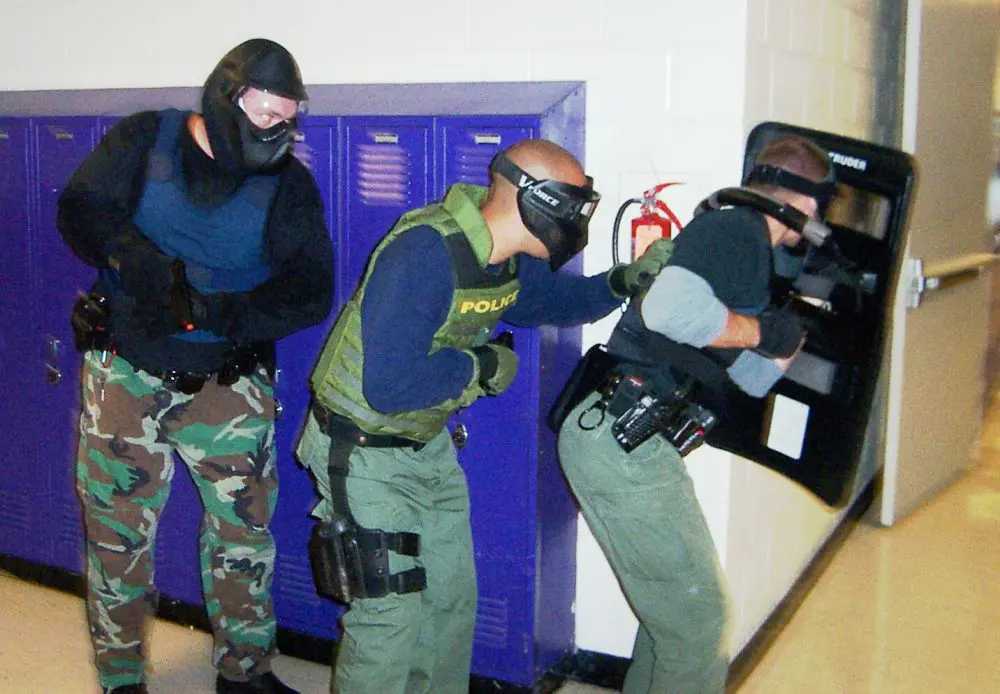
When clearing a room solo, you should first use Slice the Pie from outside to clear as many angles as possible. After confirming there are no immediate threats, move decisively and swiftly into the room, immediately relocating to the nearest corner or covered position. The entry motion should be seamless—there should be no hesitation or pause between crossing the threshold and reaching your cover position. Your muzzle should point toward areas of the room that haven’t been cleared yet, particularly dead zones that couldn’t be seen during the Slice the Pie phase.
Team room clearing follows similar principles but adds the concept of role division. Typically, the first two members enter the room nearly simultaneously—the first person moves to the left side, the second to the right (or vice versa)—each responsible for clearing threats on their respective side. Subsequent members handle pushing deeper into the room or confirming the safety of already-cleared areas. This kind of teamwork requires pre-established communication and mutual understanding—everyone must know where they’re going the moment they step through the door.
In airsoft scenarios, executing perfect room clearing every time is nearly impossible. Venue layouts vary, opponent positions are unpredictable, and in pickup games, teammates often haven’t coordinated beforehand. But even just mastering the two basic principles of “don’t stop in the doorway” and “find cover immediately after entry” will dramatically improve your survival rate.
Types of CQB: Deliberate vs Dynamic, Single vs Double Stack
“CQB tactics” isn’t one thing you either know or don’t — it’s a set of choices you make at every door, and knowing which type applies is most of the skill. There are three splits worth understanding, and once you can name them, a chaotic CQB venue starts looking a lot more like a series of solvable problems.
The first and most important split is deliberate clearance versus dynamic entry. Dynamic entry is what everyone copies from movies and Instagram: flood the room fast, dominate it with bodies and muzzles, sort it out inside. Deliberate clearance is the opposite philosophy — solve as much of the room as you can from outside the door, and only enter to handle what you genuinely couldn’t see. Instructors who run force-on-force classes overwhelmingly push newer students toward deliberate, and the reason is brutally simple: everything you resolve from outside the threshold costs you nothing, and everything you resolve inside the room costs you exposure. Dynamic entry only earns its keep when you have a trained stack, a reason to hurry (a hostage, a timer, a known threat), and utilities like flashbangs to buy the first second. In airsoft you rarely have any of those, which is why the players who look slow at a CQB venue are usually the ones still alive at the end.
Underneath deliberate clearance sits a technique split most airsoft players have never had named for them: panning versus slicing the pie. Slicing is the methodical version — stop, clear a slice, step, clear the next, at a pace where you actually process each one. Panning is the faster cousin: you move across the threshold gathering as much of the room’s layout as you can, then pull straight back out. Panning is for information, not engagement — you’re answering “where are the corners, doors and furniture in this room?” so that when you do commit, you’re not meeting the floor plan for the first time. There’s one mechanical detail that makes or breaks both, and it’s about your hips: angle them out and walk a small arc rather than stepping straight, because a straight step pushes your muzzle across the plane of the doorway before your eyes get there. Break that plane early and the person inside sees your barrel, processes it, and is aiming at the gap by the time your head arrives. That single habit is the difference between gathering information and donating it.
The second split is single stack versus double stack — where your team lines up before entry. Single stack means everyone on one side of the door, and there’s a rule that goes with it that almost nobody in pickup airsoft follows: stack on the handle side. Try opening a door from the hinge side and you’ll find you have to reach your whole body across the opening just to touch the handle, exposing yourself before you’re in any position to fight. It’s also usually better to let the second player open the door — the point man should be focused on the angle, not the doorknob — and for that second player to immediately step back once it’s open, leaving the point man room to work. Double stack splits the team two-and-two (or one-and-three) on both sides of the door, which gets more angle coverage from the outside, but requires the discipline that neither point man crosses the 90-degree line before entry, or you end up muzzling each other. Whoever entered has one non-negotiable job: turn immediately toward the side most likely to hold a threat. And when several players flow in, the rule that keeps everyone alive is left-right-left-right — if the player ahead of you went left, you go right, and the third fills the middle and looks for work.
The third split is about the room itself: center-fed versus corner-fed. A center-fed room has the door somewhere along a wall, so entering leaves you with unknown space on both sides. A corner-fed room has the door tucked into a corner, which means one side of the room is essentially a wall and nearly all the work is on the other side. This matters more than it sounds, because commercial buildings — the warehouses and offices most indoor airsoft venues are built into — are full of corner-fed doors for construction reasons. If you’ve only ever drilled center-fed entries, the first corner-fed door you meet will leave you standing in the Fatal Funnel wondering why the geometry feels wrong. Walk any new venue before the game starts and label the doors in your head: center-fed, corner-fed, which side has the handle. That two-minute habit does more for your survival rate than any gear upgrade.
One more type deserves naming because it’s what most airsoft players are actually doing most of the time — and it isn’t in any manual.
Solo CQB: Clearing Without a Team
Here’s the uncomfortable truth every military doctrine manual agrees on: clearing a structure alone is something you should never do — and here’s the airsoft reality: you’ll do it in almost every pickup game. Your squad gets whittled down, teammates wander off to another lane, and suddenly you’re the only one left holding a hallway. Solo CQB isn’t a doctrine; it’s damage control, and it has its own logic.
The first adjustment is that slicing the pie becomes your everything. With a team, dynamic entry works because four sets of eyes divide the room into sectors within a second of crossing the threshold. Alone, you have one set of eyes and one muzzle, so you clear as much of every room as possible from outside the door — patiently, slice by slice — and only enter to check the one or two dead corners that pieing can’t reach. If a room has two open interior doors, treat it as radioactive: even after you’re inside, you can’t watch both at once, so clear it fast and don’t camp there.
The second adjustment is route discipline. A team can flow through a building; a solo player picks routes that minimize the number of directions a threat can come from. Hug the walls that keep cleared space behind you, avoid center rooms with three or more entrances, and favor the perimeter hallway loop where threats can only appear ahead or behind. When you must cross an intersection, clear one direction with a pie slice, then commit across fast — you can’t cover both arms of a T-junction at once, so don’t pretend you can.
The third adjustment is pace. Solo CQB is slower than team CQB, full stop. There’s no one covering your six, so every few meters you buy back security by pausing, listening, and checking behind you. Footstep audio becomes your radar: in a quiet venue, a careless opponent announces their approach from thirty meters out, and the solo player who moves quietly and listens patiently routinely beats the pair who stomp around a corner. If you take away one thing: alone, information wins fights — speed just loses them faster.
CQB Movement: 6 Indoor Techniques You Can Drill
If you’ve searched for “CQB movement” or “indoor airsoft movement,” it’s probably because you step out of cover and get tagged, but then if you stay behind cover you can’t actually play the game. CQB movement isn’t a vibe — it’s six specific techniques that map to specific spaces, and you can drill each one in isolation.
One: Wall-Hug Single Side. In a hallway, walk close to one side wall rather than down the middle. This does three things: cuts the angles you’re exposed to in half, keeps the opposite wall as visual real estate to scan, and gives you something to brace against if you need to slice a doorway off your dominant side. Beginners almost always walk the centerline and pay for it the first time any door cracks open.
Two: Bounding. When you and a teammate need to cross a stretch with no cover, one of you moves to the next position while the other stays put and keeps their muzzle on the threat direction. Once the first person reaches cover, roles swap. Even at a pickup game where you don’t know your “teammate,” you can shortcut this by just saying “moving — cover me” to whoever is closest.
Three: Limited vs Deep Penetration. Once you enter a room, “limited penetration” means stepping just inside the doorway and sliding to the nearest corner; “deep penetration” means crossing the room toward the far diagonal corner. Limited is safer when you don’t know where the threats are; deep is faster when you have a stack of teammates following you in. As a default, beginners should run limited until they have a feel for the room.
Four: Buttonhook vs Crossover. When two players enter a room, the first one through has two choices: Buttonhook (turn 90° along the door frame into their own side, never crossing the partner’s line of fire) or Crossover (move diagonally to the opposite side). Buttonhook is safer but can cause a pileup at the threshold; Crossover flows better but requires that neither player crosses the other’s muzzle. For pickup play, default to Buttonhook — it’s harder to mess up.
Five: Pace Modulation. CQB speed isn’t “always fast” or “always slow.” The ideal pattern is fast across open ground, slow approaching doors and corners, then fast again once cleared. Beginners tend to commit to one mode — either sprinting and getting heard, or creeping through every meter and giving opponents free reaction time.
Six: Quiet Footwork. Land on the ball of your foot, not the heel. Tape down any metal buckles on your gear that clack while you move. Stuff loose mag pouches with foam so empty mags don’t rattle. In a quiet indoor environment, footsteps carry thirty meters — that’s enough to announce both your location and direction of travel to half the room before you’ve even reached your next corner.
Chain these six together in an actual game and you’ll notice the “I don’t know what to do” anxiety changes into “I know where I’m going and why.” That’s the whole point of practicing movement separately from the rest of CQB.
Corridor and Corner Movement
The most common spaces in a CQB venue aren’t rooms—they’re corridors and corners. These seemingly simple passages are actually death traps in disguise—long corridors offer no cover to use, and the other side of a corner might have someone waiting for you at any moment. Learning to move safely through these spaces is fundamental CQB skill.
When moving through corridors, avoid walking dead center. Staying close to one wall reduces your risk of being attacked from multiple directions simultaneously and gives you quicker access to door frames or protrusions as cover when needed. Movement speed should vary based on the situation: if the corridor appears clear, move quickly to minimize exposure time; if there are doors or corners ahead, slow down and prepare to handle potential threats.
Corner handling applies the same Slice the Pie principles, but pay attention to your positioning. A common mistake many players make is sticking their head directly around a corner to look—this essentially serves up your most vulnerable body part to the opponent. The correct approach is to maintain distance from the corner, allowing your body and weapon to appear in the opponent’s field of view simultaneously—this way you’re ready to fire the moment you spot them, rather than peeking your head out first and then scrambling to raise your gun.
Footstep noise is also significant in CQB. Walking heavily in combat boots on concrete floors is essentially broadcasting your position to everyone nearby. Try to keep your footsteps light, landing on the balls of your feet rather than your heels, and pay special attention to reducing noise when approaching danger zones. Of course, deliberately making noise can also be a tactical choice—such as using footsteps to bait opponents into revealing their positions.
Team Communication: Hand Signals, Callouts & Radios
The most underrated skill in CQB is communication. Even the best individual skills can be severely diminished in team engagements without effective coordination with teammates. The noisy, fast-paced CQB environment makes clear communication methods essential for team cohesion.
The three most commonly used communication methods each have their advantages and drawbacks. Hand signals are the quietest option, keeping your position concealed, but they require teammates to have direct line of sight to your hands, and both parties need to understand the same signal set. Basic hand signals include “stop” (raised fist), “move forward” (palm-forward wave), “enemy” (pointing in the direction with a shooting gesture), and using fingers to communicate numbers or directional information.
Radio communication excels when team members are spread across different positions without line-of-sight contact. However, indoor environments can cause radio reception to suffer from interference by walls and structural elements. When using radios, develop the habit of keeping transmissions brief and clear—state the recipient’s callsign before the message, and avoid lengthy descriptions.
Verbal communication is the most intuitive and easiest method, but it’s also the most likely to give away your position. In CQB environments, when you’ve already been spotted by opponents or the situation is urgent, calling out is the fastest option. Common callouts include “Clear” (area secured), “Contact” (enemy spotted), “Moving” (I’m about to reposition), and “Cover me” (provide covering fire).
In pickup CQB games, you typically won’t have trained, dedicated teammates. This is where simple verbal communication becomes especially important—telling the people near you what you’ve spotted and where you plan to move can dramatically reduce friendly fire incidents and redundant exposure.
CQB Loadout Essentials
CQB environments demand completely different gear than outdoor fields. In tight spaces, long barrels catch on walls and door frames, and heavy equipment makes you clumsy during rapid movement. The core principle of CQB gear is: short, lightweight, and fast.
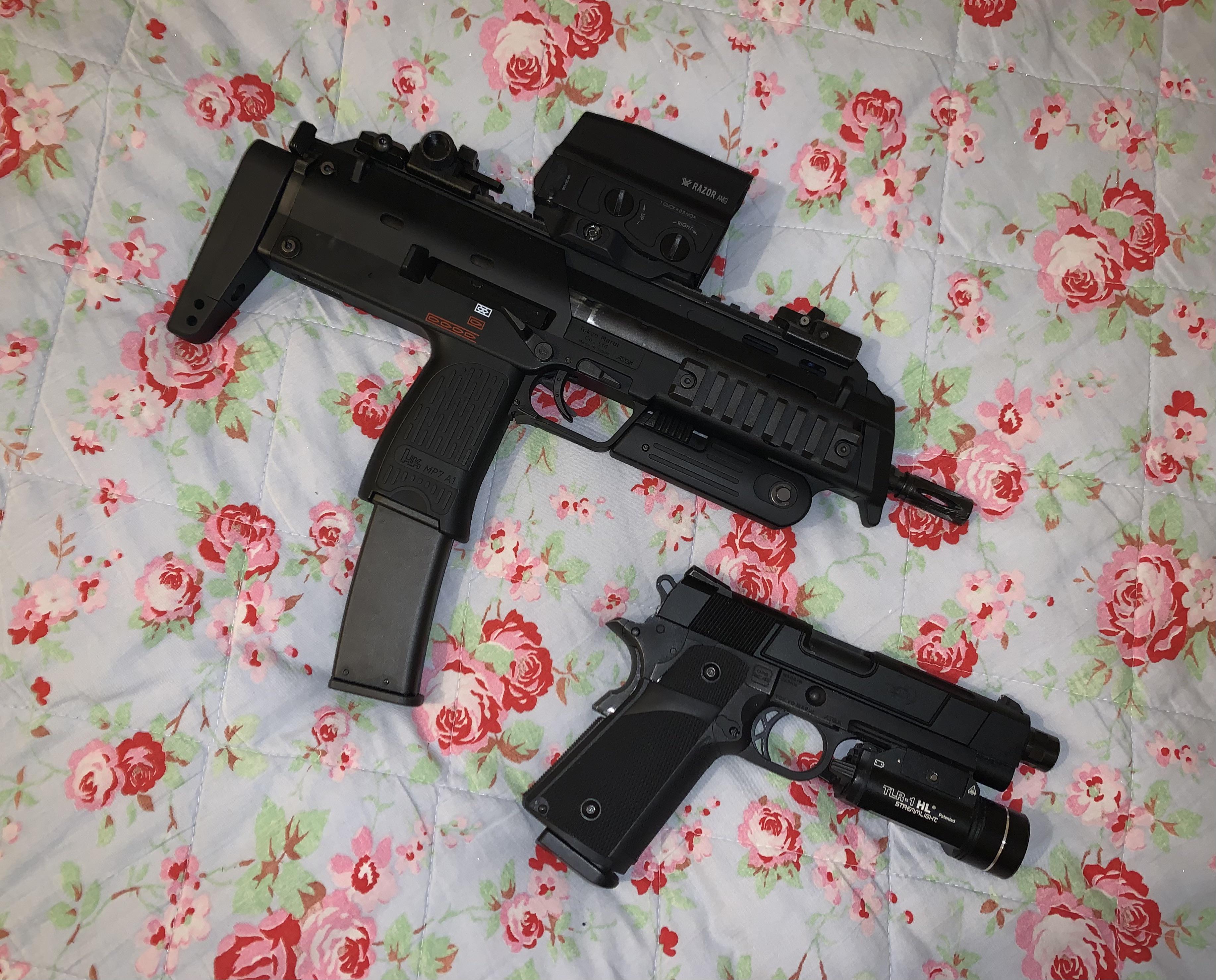
For weapon selection, SMGs (submachine guns) and short-barreled rifles are ideal choices for CQB. Compact AEGs like the MP5, MP7, and the G&G ARP9 offer short profiles that are easy to maneuver in tight spaces while maintaining adequate firepower and accuracy. Pistols are also excellent CQB weapons, especially around corners and in doorways where quick target acquisition is needed—pistol agility is unmatched by any rifle. If you prefer using a rifle, at minimum choose a CQB short-barrel variant or attach a foldable stock to reduce overall length.
For sighting systems, red dot optics are practically standard equipment for CQB. Indoor venues typically have worse lighting conditions than outdoor fields, and red dot sights let you quickly acquire targets even in low-light environments. Any magnified scope is a liability in CQB, as engagement distances are usually within 10-20 meters where magnification is completely unnecessary. A simple open red dot or holographic sight is more than sufficient for any indoor scenario.
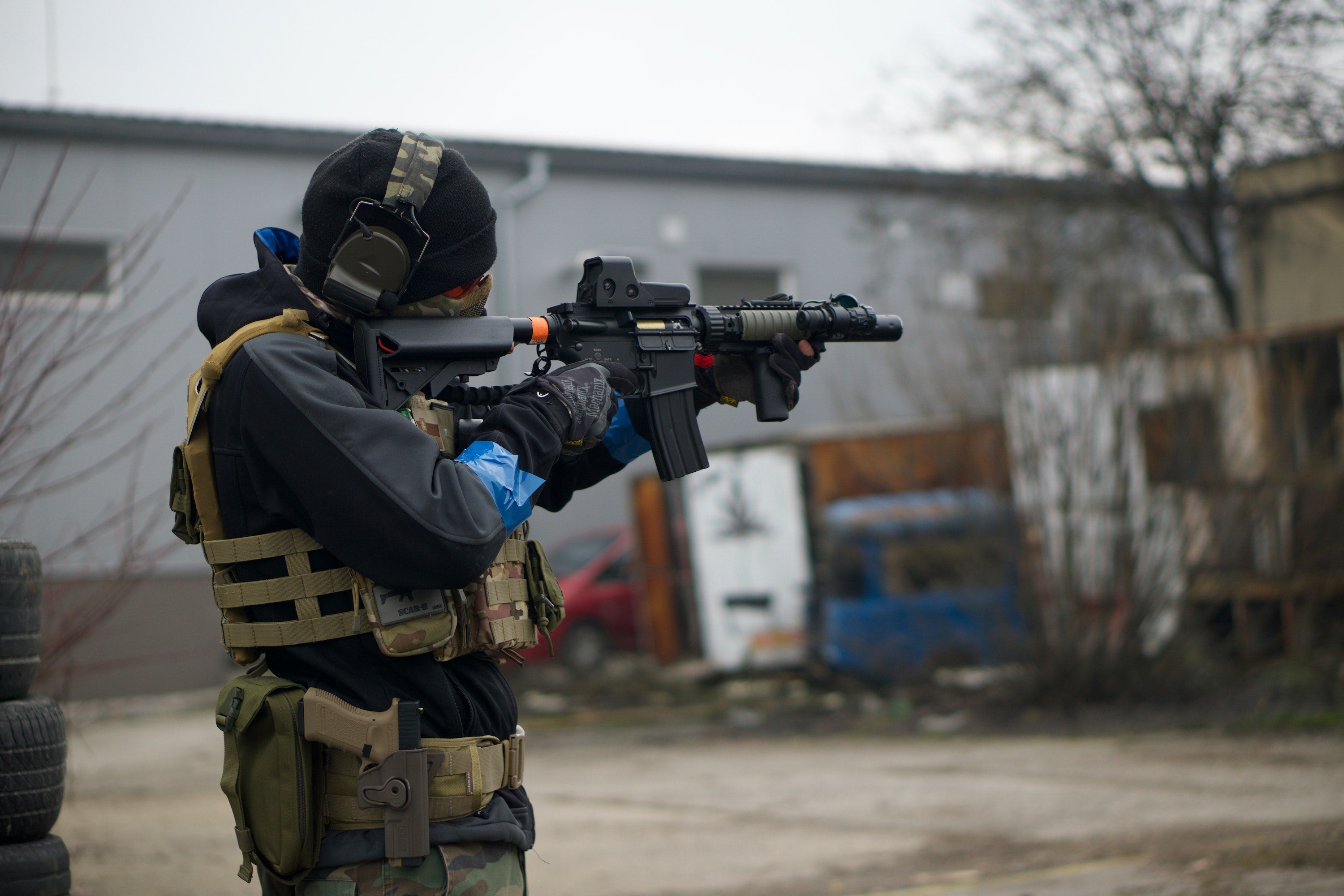
Tactical gear selection should follow the same lightweight principle. CQB doesn’t require a bulky plate carrier—a lightweight chest rig can carry enough magazines and essential equipment. Magazine count doesn’t need to be excessive either—CQB rounds are short, and three to four spare magazines are typically plenty. If using high-capacity magazines, you might only need one or two spares. Trading excess weight for better mobility is always a worthwhile exchange in CQB.
For protective gear, CQB’s close-range engagements mean harder BB impacts, making good protection particularly important. A full-face mask or at minimum a lower face guard is strongly recommended, as close-range BB strikes to the teeth are both common and painful. Gloves protect against collisions in tight spaces and BB hits to the fingers.
One more thing worth a dedicated slot on your rig: a grenade. Every clearing technique above assumes you have to expose yourself to buy information, and a sound grenade or BB grenade lets you break a room’s stalemate without paying that price. Which types your venue allows, how gas and pyrotechnic grenades differ, and how blast-radius calls are made are all covered in our complete airsoft grenade guide. If you’re eyeing an under-barrel 40mm launcher instead, think it through first: it can dump 120 BBs into a room around a corner, but it also makes your gun heavier and longer at the front — exactly the opposite of what CQB rewards.
Five Common CQB Mistakes Beginners Make
Even with knowledge of basic tactics, many players still make common mistakes in practice. Recognizing these mistakes helps you consciously avoid them.
The first mistake is over-relying on cover without observing. Many beginners find a covered position and refuse to move from behind it, thinking that staying hidden equals staying safe. The problem is that without continuous battlefield awareness, you can’t track enemy movement, and when opponents flank you from the side, you’re completely caught off guard. The correct approach is to periodically quick-peek from behind cover to maintain awareness of the changing situation around you.
The second mistake is leading with your barrel. Many players extend their barrel around corners before their eyes, essentially announcing where they’re about to appear. Your barrel should never be exposed before your line of sight—the ideal scenario is spotting the opponent at the same time your muzzle is already aimed at them.
The third mistake is standing still. In CQB, stationary targets are the easiest to hit. Even behind cover, you should alternate between different observation angles and firing positions. If you peek from the same spot every time, opponents will quickly predict your movements and pre-aim that location.
The fourth mistake is ignoring footstep noise. In quiet indoor environments, running sounds carry far. Many beginners habitually sprint through spaces, only to find they’ve been pre-aimed by opponents who heard their footsteps before they even arrived. Learn to slow down when necessary, using quiet movement to approach objectives.
The fifth mistake is going solo. CQB is a team sport, and even in pickup games you should try to coordinate with nearby teammates. Solo room clearing carries far more risk than two or three people working together. At minimum, tell the people around you what you intend to do, or follow experienced players’ lead. (That said, sometimes you have no choice — see the Solo CQB section above for how to manage it.)
5 CQB Mistakes Even Trained Players Make
The mistakes above are beginner tells. But there’s a second tier of mistakes that professional instructors see from people who’ve already had training — one law-enforcement CQB instructor who runs three to four thousand officers through his classes every year says he watches the same five errors show up week in and week out. They’re worth knowing because airsoft players who study CQB tend to graduate straight into them.
The first is open-door fixation. You enter a room, spot another open door inside it, and your eyes lock onto that scary dark rectangle — while the opponent standing in the corner of the room you’re actually in lights you up. The instructor’s rule: dominate the room you’re in first. Hit your critical corners, collapse your sector, and only then deal with the follow-on threat. The open door isn’t going anywhere; the guy in the corner will only wait as long as it takes to raise his gun.
The second is drifting off security. If your job is holding a door or watching a hallway, that is your entire job — not glancing over your shoulder to see what the team is doing, not asking what’s next. The instructor tells a story of a training run where the man holding the door got distracted for two seconds, a role player stepped out, and the instructor himself took the hit. In airsoft terms: when you tell a teammate “I’ve got this hallway,” mean it.
The third — and this is the one that should change how you train — is moving faster than you can process. Everyone has seen the movie-style speed run, and it looks fantastic right up until you blow past a target you never saw. His fix is brilliant because it’s measurable: your indoor movement speed should be the pace at which you can actually engage targets on a range while moving. Not slower, not faster. “Slow down” is useless coaching because it’s not a measurable metric — but “can you get hits at this pace?” is a yes-or-no question a timer answers. That’s exactly what the Shot Timer drills below are for: they turn “am I too fast?” from a feeling into a number.
The fourth is flagging teammates — sweeping your muzzle across a friendly because you’re transitioning between targets faster than your eyes can clear the space. The principle is eyes before gun: see it, identify it, then bring the muzzle. In airsoft nobody gets hurt by a flagged muzzle, but the habit marks you instantly as someone who learned CQB from montage videos, and it will get you benched from any MilSim team worth joining.
The fifth is having no plan. Real teams rehearse standard operating procedures until reactions are, in the instructor’s words, predictable and repeatable — if you jackrabbit through a door when your partner expects a buttonhook, you’ve just improvised your team into a crossfire. The airsoft version is cheap: before the round starts, agree with one teammate on entry order and default directions. And borrow his best training tip — video your runs. You will not believe what you actually do under pressure until you watch yourself do it.
Using a Shot Timer to Improve CQB Skills
🎯 Want to drill CQB reaction speed at home? Grab a timer first (it’s free)
Every CQB drill below — the draw, target transitions, corner presentations — comes down to one thing: reaction time. And reaction time only improves when something is objectively measuring it; “felt faster” isn’t data. The good news is you don’t need to drop $150+ on a CED7000 or PACT hardware timer. A free Airsoft Shot Timer App on your phone gives you random-delay buzzers, PAR target times, and split tracking. It’s tuned to pick up the low-decibel report of airsoft guns (GBB/AEG), so dry fire at home, indoor movement reps, and live range sessions all track the same progress curve. Install the app first, then work through each drill below — every time the steps mention “record your time,” that’s the tool they mean.
The core abilities in CQB—fast reactions, quick target acquisition, and accurate first shots—can all be systematically improved through timed training. The AirsoftShotTimer is the most practical tool for this purpose.
Draw-to-first-shot time is one of the most critical metrics in CQB. When encountering opponents around corners or in doorways, whoever can get their gun up faster gains the advantage. Using the Shot Timer’s PAR time mode, set a target time (beginners should aim for 2.0 seconds, experienced players can challenge sub-1.5 seconds), and practice the complete motion from ready position to raising and firing your weapon. Record your time each session and track your improvement curve.
Target transition speed is equally important. CQB environments frequently present multiple targets in quick succession, and your ability to quickly switch from one target to the next determines whether you can eliminate opponents before they react. Set up two to three virtual target points at home, and use the Shot Timer to record total time from first target engagement to last, along with split times for each transition.
Dry fire practice is also tremendously helpful for CQB skill development. Practicing quick weapon presentation at home, aiming at marked points on the wall, and simulating corner engagement motions all require zero BB consumption. The Shot Timer’s random delay feature can simulate sudden enemy encounters—you don’t know when the buzzer will sound and must complete the action as fast as possible after hearing it, closely mirroring the dynamic of CQB corner encounters.
Frequently Asked Questions (FAQ)
Q1: Is CQB more dangerous than outdoor airsoft?
CQB engagement distances are closer, so BB hits do sting a bit more than outdoors. However, proper CQB venues enforce stricter FPS limits (typically 280-350 FPS), and combined with mandatory protective gear requirements, overall safety is well-maintained. Wearing long sleeves, long pants, and full-face protection significantly reduces any discomfort.
Q2: Is CQB suitable for beginners?
Absolutely. CQB venues are typically smaller with simpler rules and shorter round times, allowing beginners to gain substantial combat experience in a very short period. CQB also doesn’t require high-end gear—an entry-level short-barrel AEG plus basic protection is all you need to get on the field.
Q3: What’s the best gun for CQB?
Short-barrel rifles, SMGs, and pistols are all excellent CQB choices. If you can only pick one, a compact AEG like the ARP9 or ARP556, MP5, or short-barrel M4 is recommended. On a tight budget, a reliable gas blowback pistol can also perform brilliantly in CQB.
Q4: Can I practice CQB techniques at home?
Yes. Many CQB techniques can be practiced at home through dry fire training. Corner engagement motions can be simulated using door frames, and draw and presentation speed can be timed with a Shot Timer. However, true spatial awareness and pressure response can only be experienced at an actual venue.
Q5: Is a pistol or rifle better in CQB?
Each has its advantages. Pistols are more agile, ideal for extremely tight spaces and quick cornering; rifles offer more firepower, longer range, and greater magazine capacity. Many experienced CQB players carry both a rifle and a pistol, using the rifle in open areas and switching to the pistol in confined spaces.
Q6: What do I need for my first CQB game?
At minimum: eye protection (ANSI Z87.1+ rated), full-face mask or lower face guard, long sleeves, long pants, and gloves. Most venues offer gun and magazine rentals. Bring extra water and a towel as well—CQB is more physically demanding than you might expect.
Q7: Is Slice the Pie or rushing into the room more effective?
In most situations, Slice the Pie is both safer and more effective. It lets you gather substantial information before entering a room, reducing the risk of ambush. However, in specific circumstances—such as under heavy time pressure or when you’re certain there are only one or two opponents at known positions—a dynamic entry may be the better choice.
Q8: How do I find a good CQB venue?
Google searching your city name plus “CQB” or “indoor airsoft” is the most direct approach. You can also ask for recommendations in local airsoft communities on Facebook or Discord. Good CQB venues should have clear safety rules, regularly maintained facilities, friendly staff, and reasonable FPS limits. For more venue selection advice, check out our Airsoft Field Guide.
Q9: What are the most important CQB movement principles?
Three rules and you’re ahead of most pickup players: first, don’t walk the centerline — hug one side wall in a hallway so you’re only exposed to threats from one direction at a time; second, never stop in the doorway — the door frame is the Fatal Funnel, so you commit through it and find cover within three seconds; third, quiet feet — land on the ball of your foot, not the heel, because in a silent indoor environment footsteps carry thirty meters. Nail these three before you worry about Buttonhook, Bounding, or any of the advanced techniques.
Q10: What are the most common CQB movement mistakes?
Five mistakes show up at every CQB venue: walking the centerline of a hallway (exposes both sides at once), muzzle-first cornering (telegraphs your entry direction), parking in the doorway after entry (Fatal Funnel in slow motion), camping behind one piece of cover without ever shifting (opponents pre-aim your peek position), and sprinting across open ground (your footsteps arrive before your body does). Fix these five and you go from “newbie who keeps dying” to “competent player teammates trust.”
Q11: What are the three principles of CQB?
The three principles of CQB are Speed, Surprise, and Violence of Action. Speed means no gap between decision and action — the player who sees and reacts first is the one who survives. Surprise means disrupting your opponent’s rhythm with timing and entry points they don’t expect. Violence of Action means committing fully once you’ve decided to move: get to cover in one motion, clear the whole slice, and never freeze inside the doorway’s Fatal Funnel. These apply just as much in airsoft as in the real thing — memorize “fast, unexpected, decisive” and the individual techniques make a lot more sense.
Q12: For drilling CQB reaction speed at home, is a free shot timer app enough — or do I need a hardware timer?
For the vast majority of airsoft and CQB players, a free phone app is plenty for life. The CQB skills you’re drilling — draw reaction, corner presentations, target transitions — all run on random-delay buzzers plus split timing, and the free Airsoft Shot Timer App has every one of those. It’s also tuned to pick up the low-decibel report of airsoft guns (GBB/AEG), something even some hardware timers (CED7000, PACT) struggle with — and those run $150+ plus another device to charge and keep track of. Build your daily dry-fire and movement habit on the free app first; if you ever shoot large live-fire matches where picking up shots in a noisy bay matters, you can upgrade to hardware then.
Q13: What are the four principles of CQB?
Different doctrines count differently. The classic formulation is three principles — Speed, Surprise, and Violence of Action — but many modern instructors teach four by adding Dominate the Space (also phrased as “360-degree security”): once you enter a room, you clear your critical corners and control the whole space before dealing with follow-on threats like interior doors. Some law-enforcement curricula phrase the fourth as Security or Decisive Action, but the substance is the same — entering fast and unexpectedly is worthless if you don’t finish taking control of the room you’re standing in. In airsoft this fourth principle is the one pickup players violate most, which is why “open-door fixation” tops the trained-player mistakes list above.
Q14: Can you do CQB alone? Is solo CQB practical in airsoft?
Real-world doctrine says never clear a structure alone — but in airsoft pickup games, ending up solo is routine, so it’s worth training for. The adjustments: rely almost entirely on slicing the pie from outside doorways instead of dynamic entry, pick perimeter routes that keep cleared space behind you, avoid rooms with multiple open interior doors, and move slower than you would with a team since nobody is covering your six. Quiet footwork and listening become your radar. See the full Solo CQB section for the complete breakdown.
Q15: What is a CQB weapon?
A CQB weapon is simply one short enough to swing through a doorway without snagging and light enough to hold up through a whole round indoors. In real-world terms that means SMGs, short-barreled rifles and PDWs; in airsoft it means a short-barrel AEG (M4 CQBR, MP5, MP7, Kriss Vector-style), an HPA-driven compact, or a GBB pistol as a genuine primary in tight venues. Barrel length matters more than model name — anything past about 14 inches turns every corner into a snag risk, and you’ll feel it the first time your muzzle taps a door frame and announces you. The other half of the answer is technique, not hardware: the gun is longer than the doorway is wide no matter what you buy, so instructors teach sliding the stock up over your shoulder as you cross the threshold, then dropping it back into the shoulder pocket once you’re through. What you should not do is the movie move of dipping the muzzle toward the floor to fit through — you arrive in the room with no sight picture and no ability to defend yourself in the exact second you’re most likely to need both. See the loadout section for the full gear breakdown.
Q16: Can civilians learn CQB?
Yes — and airsoft is the most realistic way to do it without a training budget or a live-fire shoot house. Civilian CQB courses exist and are worth taking if you have one nearby, but the thing that actually builds the skill is repetition against a thinking opponent, and that’s precisely what a CQB airsoft venue gives you every weekend for the price of a field fee. The mechanics transfer almost completely: slicing the pie, panning a threshold, muzzle discipline, limited penetration and left-right-left-right are the same techniques whether the projectile is a 6mm BB or not, and the feedback loop is honest — get the angle wrong and you get hit, immediately, every time. What airsoft won’t teach you is anything involving live ammunition or real breaching, and it lets you build some habits that only work because BBs are harmless. The part you can drill at home between games is your reaction speed, and the free Airsoft Shot Timer App turns that into an actual measurement instead of a feeling — random-delay buzzer, draw and first-shot splits, so you can see whether your corner presentation is genuinely getting faster or just feels that way.
Conclusion
CQB is the most technically demanding and most addictive game mode in airsoft. It concentrates shooting skills, tactical thinking, and team coordination into a high-pressure indoor environment, making every game a dense learning experience.
Master the fundamentals of Slice the Pie, understand the danger of the Fatal Funnel, learn basic team communication, and choose appropriate lightweight gear—do these things and you’ll already be better prepared than most players at any CQB venue. The rest is about getting to the field consistently and accumulating experience through each encounter.
Don’t be afraid to make mistakes—every CQB veteran started by getting eliminated. What matters is reflecting after each game on what you did well and where you can improve. If you want to systematically track your progress, use the AirsoftShotTimer App to record your draw speed and reaction times, letting the data show exactly how much you’ve improved.
Grab your compact gun, gear up with your protection, and step into that world of corridors and rooms. The CQB battlefield is waiting for you.
Related Articles
Airsoft Series
- Airsoft Beginner’s Complete Guide - Start your Airsoft journey from scratch
- Airsoft Field Selection Guide - Find the right battlefield for you
- Airsoft Gear Complete Guide - Full equipment selection guide
Shooting Techniques
- Pistol Draw Technique Complete Guide - Essential draw speed for CQB
- Shooting on the Move Complete Guide - Shoot while moving
- front sight focus vs target focus - Fast and accurate aiming
Training Tools
- Shot Timer App Complete Guide - Improve reaction speed with a timer
- pistol drill selector - Systematic training methods
- Dry Fire Training Complete Guide - Improve shooting skills at home
Put a Shot Timer in Your Pocket
Airsoft Shot Timer is a free shot timer app tuned for airsoft and Action Air — it picks up BB gun shots, tracks your split times, and saves you the cost of a $150+ hardware timer for IPSC/IDPA practice.

- Airsoft
- CQB
- What Is CQB
- CQB Meaning
- CQB Principles
- 8 Principles of CQB
- CQB Tactics
- Types of CQB Tactics
- CQB Movement
- Close Quarters Battle
- CQC
- Indoor Tactics
- Room Clearing
- Slice the Pie
- Pieing
- Panning
- Buttonhook
- Fatal Funnel
- Solo CQB
- CQB Mistakes
- CQB Callouts
- Points of Domination
- Deliberate Clearance
- Dynamic Entry
- Single Stack
- Double Stack
- Corner Fed Room
- CQB Weapon
- Limited Penetration
- Tactical Training
- Beginner Guide
- SMG
- 2026