GHK AK Review 2026: AKM V3 vs AK-105 V3, Gas & QC Fixes
Contents
The GHK AK to buy in 2026 is the AK-105 V3 (released July 2026, about $485-700 in the US, NT$15,800 in Taiwan). It fixed most of what went wrong with the 2023 AKM V3: a bigger and leak-resistant magazine, a CNC-machined bolt carrier, a gun that clicks instead of going dead when the magazine runs dry, and power that only fell from 1.57 J to 1.39 J across a magazine in testing. Buy the AKM V3 if you want the wood-furniture AKM look, but buy a 2025-2026 batch with the hammer-drop update and check it the day it arrives. Either way, a GHK AK is a warm-weather gun. Below about 15°C on green gas it struggles.
GHK is a Taiwanese company, founded in Zhongli in 2008, now in the Longtan industrial area of Taoyuan, and its first AK, an AKS-74U gas blowback, came out that same year. For more than a decade, if you wanted a gas AK, GHK was the main answer. Then the V3 AKM launched in late 2023 with the worst quality-control reputation the brand has had, Tokyo Marui and VFC both released their own gas AKs, and searching “GHK AK” now turns up a mix of glowing 2015 reviews, angry 2024 threads and store pages that copy the wrong specs. We went through GHK’s official pages, two long-form reviews from Explosive Enterprises (the 2023 AKM V3 and the 2026 AK-105 V3 preview), Taiwanese and US retailer listings and owner reports to sort out what’s true today.
The 30-second version
- AK-105 V3 (2026): the best GHK AK so far. New side-plate gas reservoir, about 120 shots per 30 g fill, 1.57→1.39 J on 0.32 g, clicks on empty. Struggles in freezing weather.
- AKM V3 (2023): steel receiver that takes a real dust cover, real wood, hard recoil. First batches had serious QC problems; GHK says it has since moved AK production to a dedicated factory.
- V2 (AKS-74U, AK74MN, AK74 and others): older system, mostly out of stock. V2 aftermarket parts don’t fit V3, but V2 magazines do.
- Power: GHK quotes 125 m/s for the AKM, which is 1.56 J on a 0.20 g BB. On heavy BBs it can run higher. Chrono with your game ammo.
- Alternatives: VFC’s AK74M/AK-105 shoots more per fill and works much better in the cold. Tokyo Marui’s AKM is the reliable, low-power choice.
The GHK AK Lineup in 2026
GHK’s own site lists three current AK models: the AKM (labeled V3), the AK74M and the AK-105. None is marked discontinued. The older V2 family (AKS-74U, AK74MN, AK74, AKS74M, AKMS, an earlier AK-105) still shows up at retailers, but at Red Wolf every one of them was out of stock in November 2026.
| Model | Length | Weight (with mag) | Capacity (official) | Velocity (GHK) | Energy on 0.20 g | Price (Nov 2026) |
|---|---|---|---|---|---|---|
| GHK AKM V3 | 900 mm | 3,320 g | 30 | 125 m/s (410 fps) | 1.56 J | $520-555 / NT$15,800 |
| GHK AK-105 V3 | 580-830 mm | 3,200 g | 30 | 110 m/s (361 fps) | 1.21 J | $485-735 / NT$15,800 |
| GHK AK74M | 950 mm | 3,400 g | 30 | 115 m/s (377 fps) | 1.32 J | not listed |
| Tokyo Marui AKM GBB | 890 mm | 3,550 g (empty mag) | 35+1 | not published | about 0.64 J measured | ¥79,800 ex. tax |
| VFC AK74M GBB | 705-943 mm | 3,307 g | 42 | 110 m/s (361 fps) | 1.21 J | NT$16,800 |
A few things in that table need a footnote. GHK doesn’t say what BB weight its velocity figures use; Taiwanese retailer Proact lists the same 125 m/s and 110 m/s figures on 0.20 g, so that’s the assumption here. GHK lists 30 rounds for every magazine, but reviewers loaded up to 40 BBs in the AKM V3 steel magazine and 32 in the AK-105 V3 magazine. And US retailer spec tables for the AK-105 V3 don’t agree with each other (one lists 900 mm, 40 rounds and 380 fps, which are AKM numbers), so trust GHK’s own page over a store listing. The Tokyo Marui energy figure is a review measurement of about 71.6 m/s on 0.25 g, because Marui doesn’t publish one.
Price spread for the AK-105 is wide because it’s new: Red Wolf had it at $519.99 ($483.59 on sale) and in stock, while Evike listed it at $699 and East Coast Airsoft at $699 pre-order. In Taiwan both V3 models sit at NT$15,800 at Proact, AOG and Rock Airsoft, with two-magazine bundles around NT$17,000.
V2 vs V3: What GHK Actually Changed
The V3 is a new system, not an update kit: new hop-up, new fire control, new nozzle, new barrel mounting and a receiver built to real dimensions. GHK’s AKM V3 page lists a 21 mm piston, a gas magazine about 20% lighter than before, a two-stage recoil spring, a “1:1” receiver that accepts a real-steel dust cover, a bakelite-style grip, short and long buffer options, a dual-lock barrel and steel bolt, barrel and fire-control parts.
Some of those are real improvements. The V2 used fragile AEG-type hop parts; the V3 takes standard GBB-spec buckings and barrels. The fire control group is now steel and patterned closely on a real AK, held by a real-style shepherd’s hook spring instead of clips. The two-stage recoil spring lets the carrier start moving against light spring force and then soaks up more energy at the end of the stroke. The two buffers give you about 3.5 in or 4 in of carrier travel (a real AK has about 5¼ in), so the old “half travel vs full travel” description isn’t right; it’s closer to two-thirds or three-quarters. The steel magazine also dropped from 678 g to 541 g.
What didn’t change is the part GHK owners argue about most: there’s still no nozzle return spring. The nozzle slides freely, and the system relies on the BB’s resistance in tight feed lips to push the nozzle back. Explosive Enterprises’ AKM V3 review explains why that matters: if the feed lips are loose, the nozzle is fouled or dry, or the magazine is cold or overfilled, you can get double feeds or a BB pushed partway down the barrel before you pull the trigger. The practical rule is simple: don’t file the feed lips looser (a common trick on GHK AR magazines), and keep the nozzle clean and lubricated.
The cost of all that change is that none of the V2 aftermarket fits the V3. If you already own a V2 with a steel carrier and an aftermarket hop, Explosive Enterprises’ blunt verdict in 2023 was that you already owned a better gun than the stock AKM V3, you’d just paid more to get there.
The AKM V3’s Rough Launch, and Whether It’s Fixed
The first AKM V3 batches (late 2023) had widespread build problems, and GHK has since changed its production. Recent batches are reported as fine, but nobody can promise yours is. The review sample Explosive Enterprises bought had a canted front sight, a loose gas block, a handguard routed off-center, a loose and canted rear sight, a front trunnion canted and rotated relative to the receiver, and a magazine that sat low and rocked in the magazine well. The receiver was twisted, and the reviewer straightened it by hand, which tells you the steel was too soft. At the time, all six members of the Heavy Recoil Club who’d bought one reported some kind of problem: loose trunnion rivets, sheared hop units, cracked nozzle stops, split furniture.
Function suffered too. At room temperature the AKM V3 started failing to cycle fully at around 80 shots from an 18 g fill, couldn’t clear two magazines in a row on fast semi-auto, and barely worked with the magazine chilled to freezing, which was worse than the stock V2. On 0.32 g BBs it went from about 1.8 J to 1.4 J across a magazine, a 22% drop.
What changed since: in December 2023 GHK announced a hammer-drop-on-empty update, free for initial V3 owners and fitted to later batches. The original V3 locked the hammer when the magazine was empty, so the trigger went completely dead, exactly like a feed failure. With the update, pulling the trigger on an empty magazine drops the hammer without firing. Proact notes it only works with V3 magazines. In 2026 GHK told Explosive Enterprises it had opened a factory just for AKs, revised its QC process and brought previously outsourced work in-house, and owner posts on r/GasBlowBack about 2025 AKMs are mostly positive. Proact describes its late-2026 AKM batch as “no design changes”, so the newer guns are the same design built better, not a V4.
So if you buy an AKM V3 today, buy from a shop that will take it back, and on day one check four things: the front sight and gas block are straight and tight, the rear sight leaf doesn’t wobble side to side, the magazine locks in without rocking, and the mag catch screws are thread-locked (on the review gun they backed out under recoil).
AK-105 V3: The GHK AK to Buy in 2026
The AK-105 V3 is GHK’s 2026 answer to the AKM’s problems, and in Explosive Enterprises’ preview it improved on the AKM in essentially every respect. It’s a short AK-74M carbine, the Russian replacement for the AKS-74U, so it’s handier indoors than an AKM but uses the same AK-100 family parts.
The biggest change is the magazine. Instead of the old dual-tube reservoir, it has one large internal reservoir behind a removable side plate with a big gasket. That holds about 30 g of propane, leaks less, and transfers heat better because there’s more surface area. The magazine weighs about 430 g empty and holds up to 32 BBs. It also has a simple stop-on-empty lever that locks against a lever in the gun, so the valve knocker misses the valve and the gun clicks on empty instead of going dead. The bolt carrier is now CNC-machined from billet rather than cast, at 325 g, and the nozzle comes apart with one screw and two pins, which means you can swap rocket valves at the field once GHK sells them separately. The hop chamber is thicker and wasn’t getting battered by the carrier the way the AKM’s was.
Performance on 30 g of propane: about 120 shots in one continuous string before it stops feeding, or about eight magazines of 32 if you let it warm up between magazines. In full auto, filled to 24 g to avoid liquid gas spitting, it got five to six magazines. On 0.32 g BBs at room temperature it went from 1.57 J to 1.39 J across a magazine, only an 11% drop, half the AKM’s. The weakness is still cold: chilled to freezing it couldn’t empty a magazine and muzzle energy was very low. GHK says it plans a softer recoil spring for cold weather.
The reviewer’s summary of GHK vs VFC is worth repeating because it’s fair to both. VFC gets more shots per fill and works much better in the cold. GHK has the better furniture, a simpler magazine, the better stop-on-empty and, to his taste, slightly sharper recoil. One caveat: that test was a pre-production sample, so read owner reports on production guns before you buy.
How a GHK AK Feels in a Game
It kicks hard, it’s heavy at the front, and it makes you do a real AK reload. At about 3.2-3.3 kg loaded, a GHK AK weighs about the same as a kitted-out AR carbine, but the steel puts more of that weight forward. After a long woodland game you notice it in your support arm. The short AK stock helps it feel compact, but taller players can find it hard to tuck the stock during reloads.
The recoil is the reason people buy one. On the AKM there’s a real sense of a heavy carrier slamming home; the AK-105 is a little lighter and quicker. The trigger is the weak point: Explosive Enterprises called the AKM V3’s a long, spongy pull that breaks at about 2.5 lb without warning. You get used to it, but it won’t feel like a tuned AEG.
Reloading is the classic rock-and-lock: hook the front of the magazine, rock it back. On a good gun it’s satisfying. On the early AKM V3, the loose magazine well made it easy to rock it back and have it not actually seat, which in a game means a dead gun at the worst moment. The other habit to unlearn on an early V3 without the update is reading a dead trigger as a jam when it really means “empty”.
Plan your gear around the magazines, too. AK magazines are big and sharply curved, so they don’t fit most M4 pouches. Open-top pouches or pouches made for longer .308 magazines work. If you’re setting up a rig, our chest rig guide covers pouch types. And add up the weight: five spare V2 steel magazines are about 3.4 kg, five AKM V3 steel magazines about 2.7 kg, five AK-105 V3 magazines about 2.2 kg, before gas and BBs.
Velocity and Gas: 1.56 J on Paper, More on Heavy BBs
GHK’s 125 m/s for the AKM works out to 410 fps and 1.56 J on a 0.20 g BB, which is already just over the common 400 fps / 1.49 J outdoor limit. On heavy BBs a gas gun can carry even more energy. That’s not a GHK flaw, it’s how gas blowback guns behave: a heavier BB stays in the barrel longer and picks up more of the gas push, so energy goes up with BB weight (an AEG usually goes the other way). Explosive Enterprises measured the AKM V3 at about 1.8 J on 0.32 g at the start of a magazine after break-in. That’s about 348 fps on a 0.32 g BB, a number that looks harmless if you only think in fps.
Here’s why that matters on a field. If your site chronos on 0.20 g and allows 400 fps, a GHK AKM on a warm day may pass or barely fail on 0.20 g, then carry more energy than the limit with the 0.30-0.32 g BBs you actually play with. Many sites now chrono with your game ammo for exactly this reason. Our chronograph guide explains the three-weight test that shows how much your gun creeps, and the joule calculator converts any reading on any BB weight. The AK-105 is the easier one to keep legal: GHK quotes 110 m/s (1.21 J on 0.20 g), but the measured 1.57 J on 0.32 g at the start of a magazine sits right on a 1.5 J limit, so a warm day or strong gas can still push it over. Check your own gun.
Temperature is the other half of the story. Green gas pressure falls fast as the magazine cools: our green gas vs CO2 chart shows it dropping from about 107 psi at 20°C to 78 psi at 10°C. GHK recommends “12 kg” gas, which is the stronger green-gas grade sold for full-metal GBBs (gas makers label 12 kg for about 15°C and up, and 14 kg for cold weather). Explosive Enterprises’ rule for the AKM V3 was that strong gas is necessary at or below 15°C, and that you should refill every magazine at every reload. CO2 magazines exist (Red Wolf lists a 40-round AKM CO2 magazine and a 50-round AKS-74U CO2 magazine), but CO2 hits harder on the parts and usually on the chrono, so check your field’s rules first.
For BB weight, the AK-105 hop worked well with 0.32 g and should suit heavier BBs; the AKM V3 hop had little room between over- and under-hop with 0.32 g. Our BB weight guide and hop-up guide cover how to choose and dial in.
Magazines: V2, V3, CO2 and What Fits
GHK says its older gas and CO2 magazines work in V3 rifles, and Red Wolf and Proact say the same. But one test found a V2 steel magazine damaged in a V3 AKM, so use V3 magazines or V2 polymer ones. In Explosive Enterprises’ AKM V3 testing, the V2 steel magazine’s gas router got chewed up quickly, likely because of the loose magazine well, and it gave higher power with bigger shot-to-shot swings. They recommend V3 steel magazines or V2 polymer magazines.
Remember the hammer-drop update only works with V3 magazines. GHK magazines are made for GHK rifles; Tokyo Marui’s AKM magazines fit Marui and Marui-pattern rifles, and we couldn’t find a reliable source showing GHK magazines working in Marui, LCT or E&L guns, so assume they don’t. On the AKM V3 magazine, the reservoir end caps sometimes leak; they’re easy to reseal. The AKM magazine is also hard to load because of its tight feed lips, so GHK’s speed loader is worth having.
GHK vs Tokyo Marui AKM vs VFC AK
Pick GHK for steel, realism and recoil in warm weather; VFC for performance and cold-weather reliability; Tokyo Marui for a low-power, low-maintenance AK. This isn’t a ranking, it’s a choice of compromises.
Tokyo Marui’s AKM GBB came out on 15 July 2021. It weighs 3,550 g with an empty magazine, holds 35+1 BBs, runs on HFC-134a and is priced at ¥79,800 before tax (it launched at ¥65,780). Its receiver is zinc die-cast with a pressed-steel cover, there’s no bolt stop, and like every Marui it’s built under Japan’s 0.98 J cap; a review measured about 71.6 m/s on 0.25 g, roughly 0.64 J. That’s fine indoors and soft outdoors. Marui doesn’t make an AK74 or AKS-74U gas blowback (its AKS74U is an electric gun), but it does sell the AKX GBB.
VFC released its AK74M GBB in September 2024 (42 rounds, 110 m/s on 0.20 g, NT$16,800 in Taiwan) and has since added the AKS-74U; an AK-105 with adjustable long/short carrier stroke is listed at European retailers. VFC showed an AKM at IWA in February 2026; owner groups report it’s due in 2027, but VFC hasn’t confirmed a date. VFC’s magazines are all-metal and shared across its AK74 family; its furniture is weaker than GHK’s.
If you want an AKM with wood and real steel today, GHK is still the main option. If you want a 5.45 carbine, it’s GHK AK-105 versus VFC AK-105, and where you play (temperature) should decide it.

How to Train With a GHK AK and a Shot Timer
A shot timer turns the two things that make a GBB AK hard to run, the recoil and the rock-and-lock reload, into numbers you can improve. You don’t need a hardware timer; a shot timer app on your phone can usually pick up gas blowback shots because they’re loud and sharp; outdoors in wind or next to other shooters, fire a few test shots first to make sure it’s hearing yours.
Start with recoil control. Stand 10 m from an A4 sheet and fire five aimed shots on semi as fast as you can keep them on paper. The split times show whether the heavy carrier is pulling your sights off target between shots. Run it five times, keep the average, and compare after you change your stance or grip.
Then time the reload. Fire two shots, rock out the magazine, rock in a fresh one, rack, and fire two more. The gap between shot two and shot three is your reload time. On a GHK the first runs often include a magazine that didn’t seat, which is exactly what you want to find at home, not in a game. Our magazine reload guide has drills and target times. If your rifle has the hammer-drop update, practise this too: load one BB, fire, pull the trigger again, feel the hammer drop on empty, and go straight into the reload.
One limitation: our app ignores any sound within 0.1 seconds of the last detected shot, so a full-auto string won’t be counted shot by shot. Use the timer for semi-auto splits and reloads, and a chronograph for power.
Frequently Asked Questions
Is the GHK AKM V3 good now?
The design is the same as in 2023, but GHK says it moved AK production to a dedicated factory and revised its QC, and owner reports on 2025-2026 batches are mostly positive. The early guns’ problems (canted sights and trunnion, soft receiver, loose magazine fit) were build problems, not design ones. Buy from a shop that accepts returns, and check sights, gas block, magazine fit and mag catch screws when it arrives.
What’s the difference between GHK AK V2 and V3?
V3 has a new hop-up that takes standard GBB parts, steel fire control and bolt, a two-stage recoil spring, two buffer lengths, a receiver built to real dimensions (it accepts a real dust cover) and a lighter magazine. It still has no nozzle return spring. V2 internal and aftermarket parts don’t fit V3, but V2 magazines do work.
Do GHK V2 magazines work in a V3?
Yes, GHK says its older gas and CO2 magazines are compatible with the V3. One review found a V2 steel magazine’s gas router damaged quickly in an AKM V3, so V3 magazines or V2 polymer magazines are the safer choice. The hammer-drop-on-empty feature only works with V3 magazines.
How many FPS does a GHK AK shoot?
GHK lists 125 m/s (410 fps) for the AKM, 115 m/s (377 fps) for the AK74M and 110 m/s (361 fps) for the AK-105, on 0.20 g BBs as listed by retailers. That’s 1.56 J, 1.32 J and 1.21 J. On heavier BBs a gas gun carries more energy: the AKM V3 measured about 1.8 J on 0.32 g at the start of a magazine. Real numbers depend on gas and temperature.
Does the GHK AK work in cold weather?
Not well on green gas. The AKM V3 needs strong gas at or below about 15°C, and both the AKM V3 and AK-105 V3 struggled to empty a magazine when chilled to freezing. If you play through winter, VFC’s AKs handle cold much better, or look at CO2 magazines if your field allows them.
Should I buy the GHK AKM or the AK-105?
Buy the AK-105 V3 if you want the better-performing GHK: more gas per fill, steadier power across a magazine, a lighter magazine and a gun that clicks on empty. Buy the AKM V3 if you want the classic wood-furniture AKM and accept more maintenance. For CQB the shorter AK-105 is easier to handle.
Is GHK a Taiwanese brand?
Yes. GHK was founded in Zhongli, Taiwan, in 2008 and later moved to the Longtan industrial area in Taoyuan. Its first AK gas blowback, an AKS-74U, came out the same year.
The Bottom Line
A GHK AK in 2026 is easier to recommend than it was in 2024. The AK-105 V3 is the one we’d buy: better magazine, steadier power, sensible stop-on-empty. The AKM V3 is for people who want the wood and the hardest recoil and will check the gun carefully. Both are warm-weather rifles, both can run hotter on heavy BBs than the box suggests, and both need V3 or polymer magazines. Chrono yours with your game BBs, refill every magazine, and time your reloads. A gas AK is fun because it’s demanding, so practise with it.
Image Credits
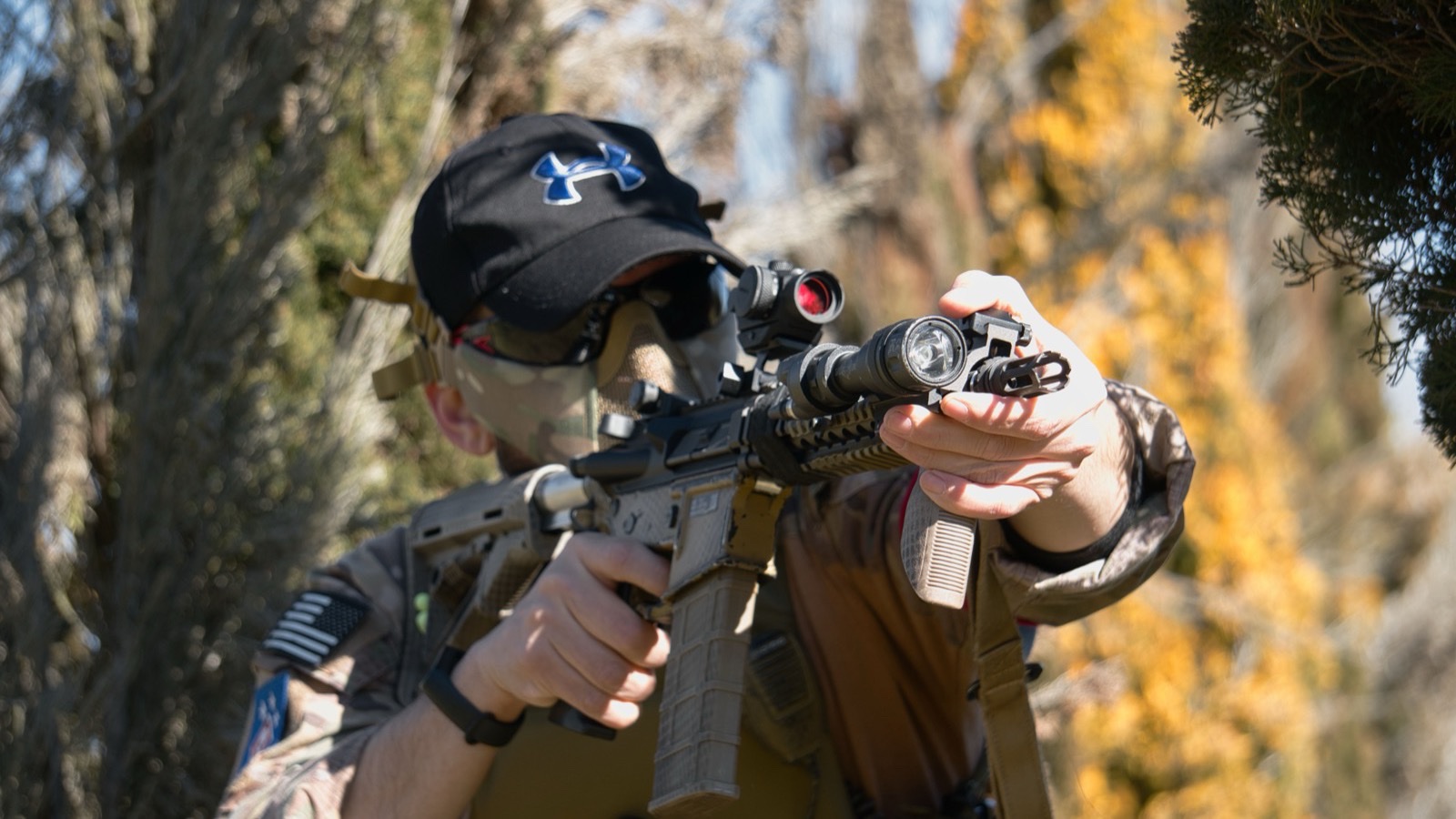
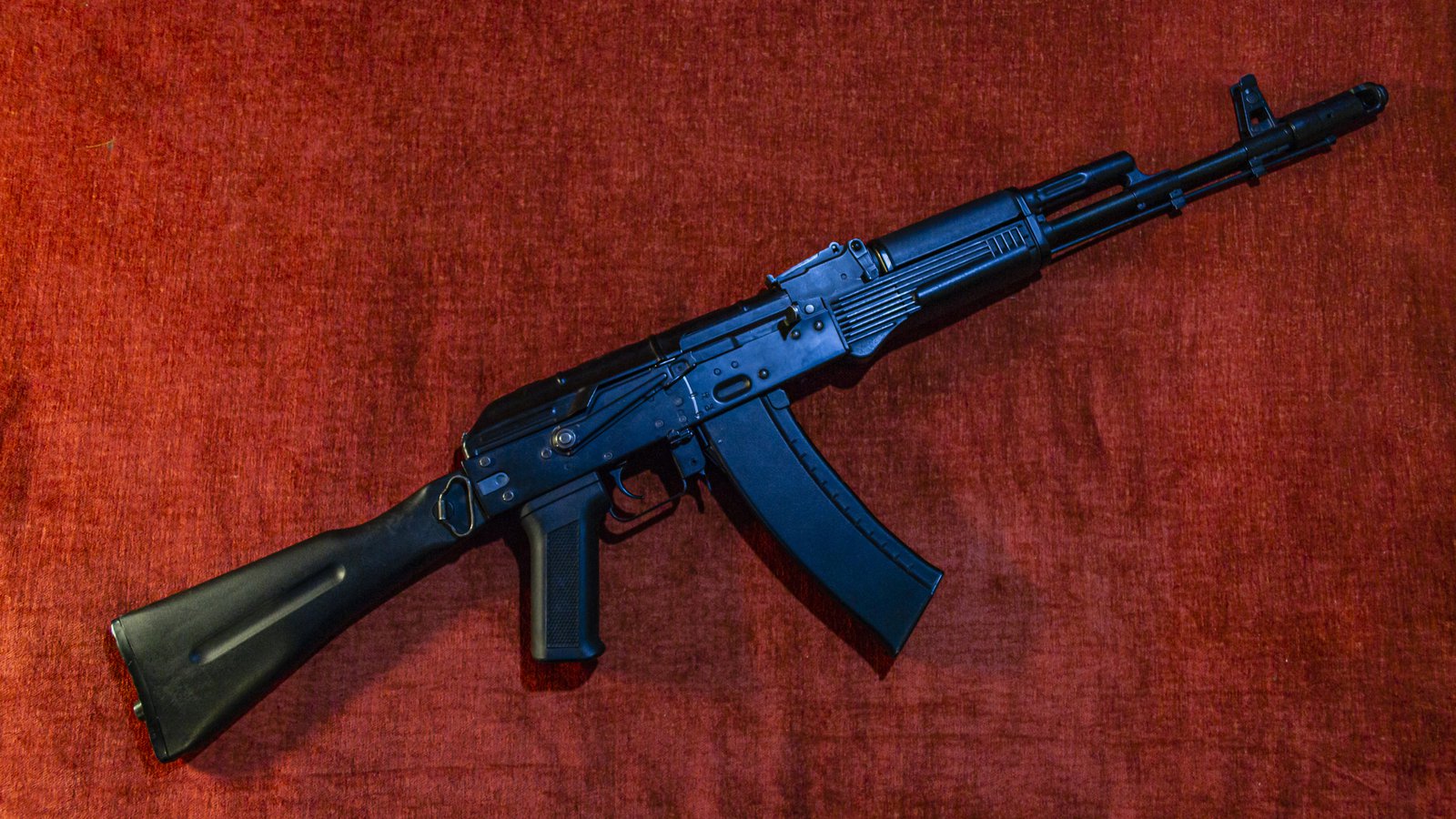
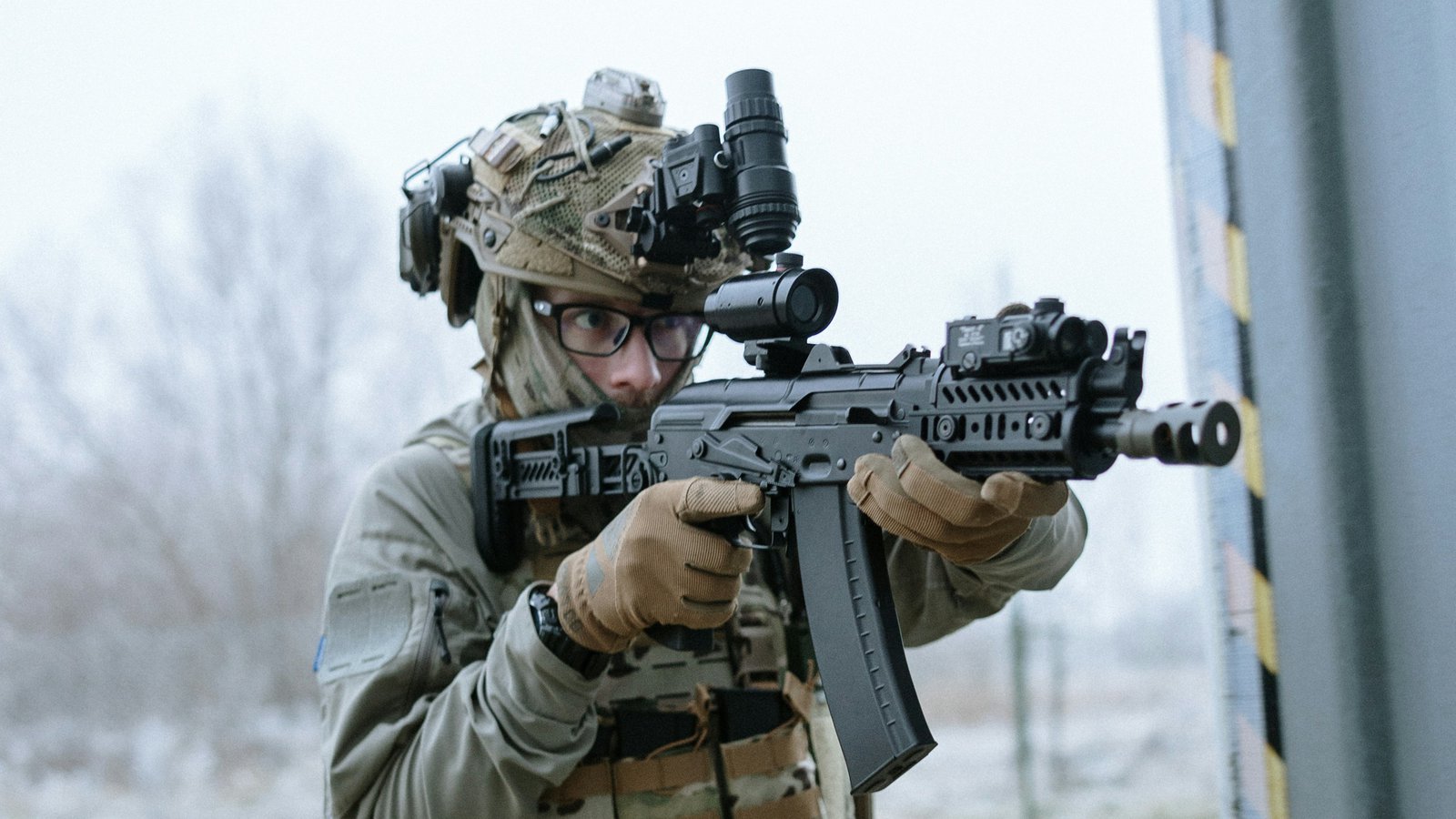
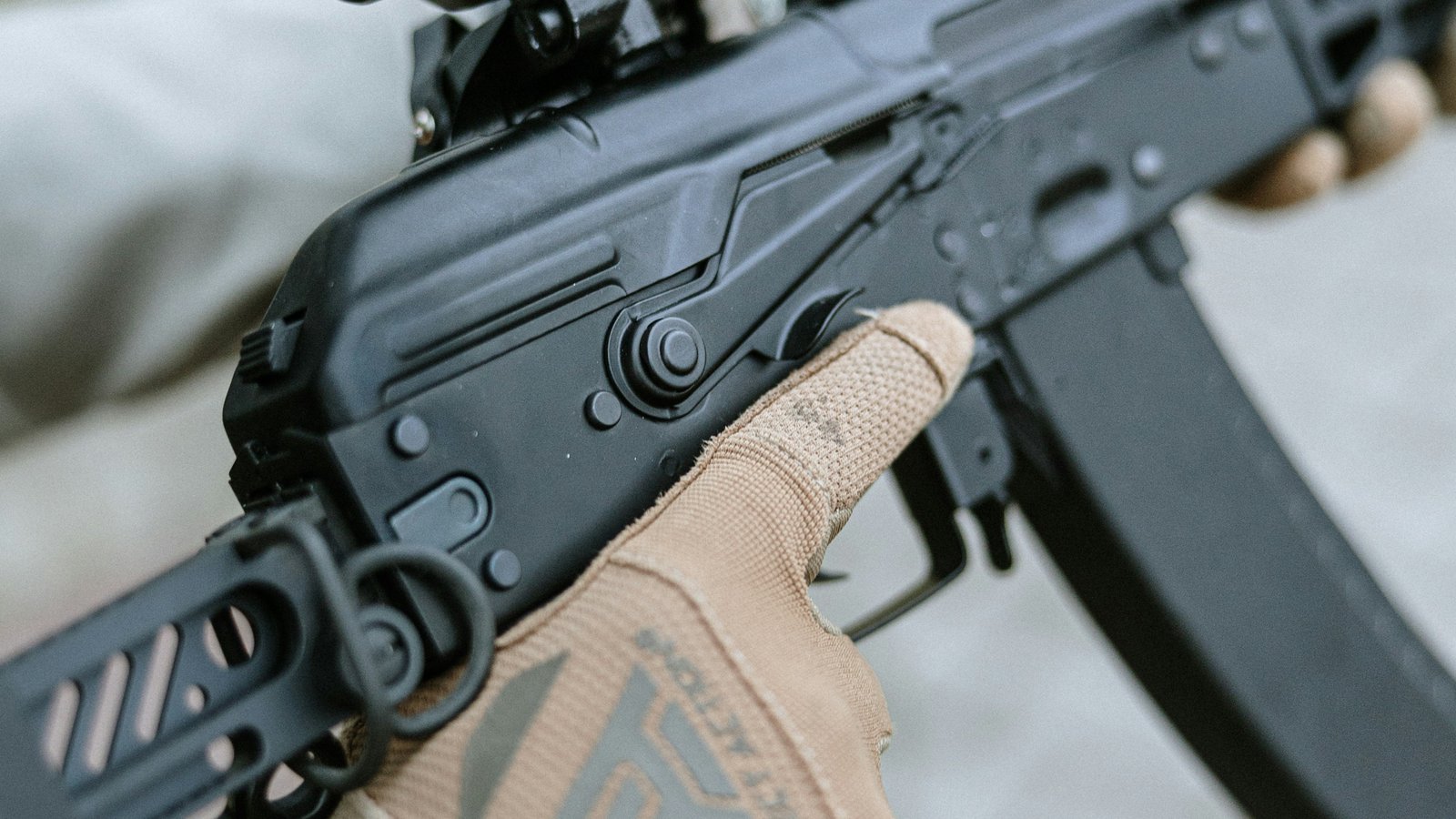
None of these photos shows a GHK rifle: we couldn’t find openly licensed photos of one. The cover is an airsoft AK-74M of unidentified brand; the other three show Cyma and Arcturus AK-style electric guns in games. Images were cropped and resized to 16:9 and not otherwise altered.
- Cover: AK-74M airsoft 04, Алексей Трефилов (Aleksey Trefilov), CC BY-SA 4.0 (resized)
- Airsoft player with a short AK (Cyma Platinum AK per the source), Taiwangun, Unsplash License
- AK receiver close-up (Cyma Platinum AK per the source), Taiwangun, Unsplash License
- Airsoft player in an abandoned building (Arcturus FE series per the source), Taiwangun, Unsplash License

Sources: GHK’s official AK series, AKM V3 and AK105 pages; Explosive Enterprises’ GHK AKM V3 review (2023) and GHK V3 AK-105 preview (March 2026, pre-production sample); GHK’s hammer-drop demo (December 2023); Proact, AOG, Red Wolf Airsoft and East Coast Airsoft listings; Tokyo Marui’s AKM GBB page and ArmsWeb; Proact’s VFC AK74M listing; owner discussion on r/GasBlowBack. Prices checked November 2026 and may change. Joules calculated with E = ½mv².
Related Articles
- Tokyo Marui M4 MWS GBB Guide
- Best GBB Airsoft Pistol 2026
- CO2 vs Green Gas: Pressure by Temperature
- Airsoft Chronograph: FPS and Joules
- Airsoft BB Weight Guide
- Magazine Reload Guide
- Airsoft Shot Timer App Guide

 Airsoft Shot Timer
Put a Shot Timer in Your Pocket
Automatic airsoft shot detection, split times, multiple PAR times and training records — no sign-up.


Related articles