Airsoft Joule Calculator: FPS to Joules, Limits & Creep
Contents
Type the velocity your chronograph shows and the BB weight that’s actually in your magazine. The joules appear as you type, along with m/s, J/cm² and a straight answer on whether you pass your field’s limit. Most airsoft FPS calculators stop at the conversion. This one also deals with the thing that gets people turned away at the chrono table: field limits are usually written as a reading on a 0.20g BB, and nobody plays on 0.20s. So it tells you the highest reading you can run on your weight, and if you chrono a second string on a heavier BB, it works out whether your gun creeps.
Use the weight actually in your magazine — not whatever the chrono menu was left on.
Fill any one box and the other two follow. Change the weight and the box you typed in last stays fixed.
Same energy on other BB weights (assuming no creep)
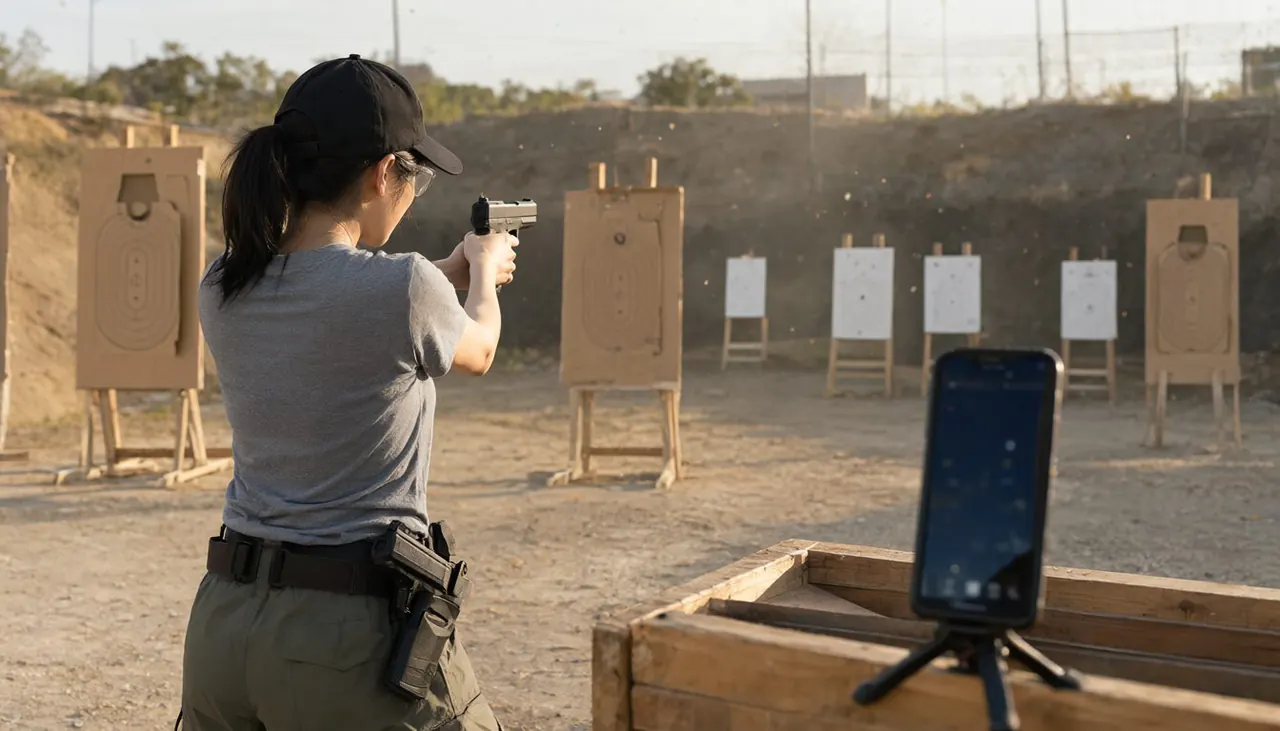
A chrono tells you how fast the gun is. The Airsoft Shot Timer app tells you how fast you are — it uses your phone's mic to catch every BB gun shot and times your draw, splits and reloads.


The 30-second version
- Joules = ½ × BB mass in kg × velocity in m/s, squared. 400 fps on a 0.20g BB is 1.49 J; 350 fps is 1.14 J.
- A “400 fps” rule is really a 1.49 J rule. On a 0.28g BB the same energy is only 338 fps. Turn up reading 345 fps on 0.28s and you’re 4% over a 400 fps limit.
- Joules to fps is the same formula run backwards. 1.5 J is 402 fps on 0.20g; 1.13 J is 349 fps; 2 J is 464 fps.
- Leave about 4% margin. The field’s chronograph is not your chronograph.
- A heavier BB doesn’t add energy unless the gun creeps. Chrono 0.20s and then your game weight; the creep check box turns the two numbers into one index.
How the calculator works
Every number on this page comes from one line of physics. Convert feet per second to metres per second by multiplying by 0.3048, convert grams to kilograms, and energy is half the mass times the velocity squared. A 0.20g BB at 400 fps is 121.9 m/s, which gives 1.49 joules. The calculator does that in whichever direction you need. Type fps and it fills in m/s and joules. Type joules and it tells you the velocity that energy means on your BB weight. Change the weight and the box you typed in last stays fixed while the other two move.
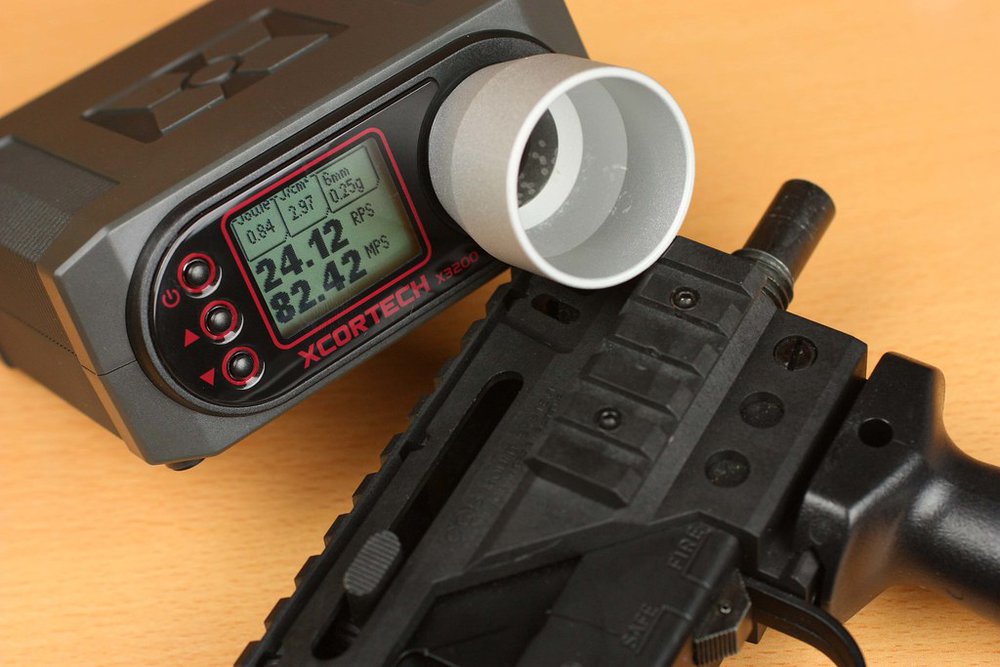
The weight box is the most important input, and the one people get wrong. Your chronograph can’t weigh a BB. It times a shadow between two sensors and reports velocity. Any joule figure it shows comes from the weight someone typed into its menu. If you got a reading from a field chrono or a friend’s unit, check what weight it was set to before you trust its joules. If you want the whole conversion as a printable grid, every common weight from 0.20g to 0.48g, it’s in our airsoft FPS to joules chart and chrono guide.
Why “400 fps” isn’t the number you think it is
Most American fields write limits in feet per second, but they mean a reading taken on a 0.20g BB. That turns the rule into an energy limit. 400 fps on 0.20g is 1.49 J, and 1.49 J on a 0.28g BB is only 338 fps. On 0.25g it’s 358 fps, on 0.30g it’s 327 fps, and on 0.32g it’s 316 fps.
This is where the calculator earns its place. Pick “400 fps on 0.20g” as your limit, set the weight to 0.28 and type 345 fps. That’s a perfectly ordinary-looking number, and the result is 1.55 J, about 4% over. A gun that reads 345 on 0.28s has the energy of a 408 fps gun on 0.20s. Players get caught out by this every weekend. They chrono at home on their game ammo, see a number well under 400, and assume they’re fine.
It cuts the other way at fields that chrono everyone on house 0.20s. If your gun doesn’t creep, the calculator shows what it should read on 0.20g, so you know your number before you join the queue. If your gun does creep, that 0.20g reading will understate what you’re actually shooting, which is what the creep box is for.
Checking a field limit, and how much margin to leave
The limit menu holds the common ones: 350, 400, 450 and 500 fps on 0.20g for American CQB, outdoor, DMR and bolt-action sniper classes; 1.13 J for UK AEGs; 1.00 J for many European CQB sites; 0.98 J, Japan’s legal maximum; and 2 J for public play in Taiwan. If your field uses something else, choose “Custom joules” and type it in. For the background to these numbers and how they vary by country, see what the limits are around the world.
You’ll see one of three answers. Pass means you’re under 96% of the limit. Only just means you’re between 96% and 100%: legal on your chrono, but close enough that a different unit, a warmer gas magazine or a freshly charged battery could put you over. Over tells you by how much. Under every answer you get the highest legal reading on your weight, plus the reading to build to if you want a 4% buffer. For a 400 fps rule on 0.28g, that’s 338 fps as the ceiling and about 331 as the target.
Why 4%? Match chronographs disagree with each other by a few percent, and gas guns drift with temperature. Building a few percent under the limit costs you nothing you’d notice on the field, and it means you never have to argue with a marshal.
The creep check: two strings, one number
If a gun put out the same energy whatever you fed it, a heavier BB would slow down by a predictable amount: the square root of the weight ratio. Some guns don’t behave like that. Over-volumed AEGs and high-pressure HPA setups have air to spare, and a heavier BB uses more of it, so the gun puts out more energy on heavy ammo than its 0.20g reading suggests. That’s joule creep.
To check your gun, chrono five or more shots on a light BB and put the average in the main box. Then chrono the same gun on your game weight and put that average in the creep box. The calculator works out the velocity a no-creep gun would show, divides your measured velocity by it, squares the result, and gives you the creep index. Between about 0.88 and 1.00 is a healthy, volume-matched gun. Between 1.00 and 1.10 is within measurement noise. Above 1.10 your gun creeps, and above 1.25 the 0.20g reading badly understates what it’s doing. If you’ve picked a limit, the heavier-BB energy is checked against it too, because that’s the energy the person you hit actually feels.
A documented example: an HPA rifle averaged 393.5 fps on 0.20g (1.44 J). With no creep it would have read about 321 fps on 0.30g. It read about 349, which gives an index of 1.18 and a real energy of 1.70 J. It sailed through a 400 fps rule while putting out more than a 1.49 J limit allows. The full write-up of that test and its opposite explains what to do about a high index.
m/s, J/cm² and the Taiwan numbers
Every result also shows m/s and J/cm². Fields and shops in Taiwan, mainland China and much of Asia quote velocity in metres per second, and some chronographs display energy per square centimetre. For a 6 mm BB the cross-section is 0.283 cm², so J/cm² is about joules × 3.54. Taiwan’s 2 J public-play limit is 141.4 m/s on 0.20g and 126.5 m/s on 0.25g. A 0.25g reading of 130 m/s is 2.11 J, just over. The legal lethality line, 20 J/cm², is about 5.65 J. No skirmish gun should come anywhere near it.
Where the shot timer comes in
A chronograph answers one question about your gun, and this calculator turns the answer into something you can act on. The other half of a good day at the field is how fast you are: how long your draw takes, how quickly you put a second BB on a target, how long a magazine change costs you. The same habit applies. You stop guessing and measure it.
That’s what the Airsoft Shot Timer app is for. It uses your phone’s microphone, it’s tuned for the quieter report of GBB pistols and AEGs, and it gives you split times that tell you whether that new trigger or MOSFET made you faster. If you’ve just spent money on an upgrade because the calculator said you had headroom, time five semi-auto shots before and after. If the splits don’t change, the upgrade didn’t help.
Frequently Asked Questions
How do I convert airsoft fps to joules?
Multiply the fps by 0.3048 to get metres per second, square it, multiply by the BB weight in kilograms (grams ÷ 1000), and halve the result. 400 fps on a 0.20g BB is 121.9 m/s, so 0.5 × 0.0002 × 121.9² = 1.49 J. The calculator above does the same thing and also handles the reverse.
How many fps is 1.5 joules?
It depends on the BB weight. On 0.20g, 1.5 J is 402 fps, which is why “400 fps or 1.5 J” rules are consistent with each other. On 0.25g it’s 359 fps, and on 0.28g it’s 340 fps.
How many joules is 350 fps with a 0.25g BB?
1.42 J. That’s well over a 350 fps rule written on 0.20g (1.14 J). The 0.25g equivalent of that limit is about 313 fps.
Do heavier BBs increase joules?
Only if the gun creeps. In a volume-matched gun a heavier BB slows down enough to keep the energy roughly the same, or slightly lower. In an over-volumed AEG or a high-pressure HPA setup, the energy goes up on heavier BBs. Run the creep check to find out which kind you have.
What fps should my gun read on 0.28g BBs for a 400 fps field?
No more than 338 fps, and about 331 fps if you want a 4% margin. For a 350 fps field the 0.28g ceiling is 296 fps.
Does this calculator work for HPA, GBB and spring guns?
The energy maths is the same for every power source. Gas guns read differently as the magazine warms and cools, so chrono near the temperature you’ll play in. HPA and over-volumed AEGs are the ones to run through the creep check.
Image Credits
- Cover: airsoft player with an S&T AR15-pattern AEG at a barricade, and the field photo of a player with an Arcturus AEG behind a ruined wall, both by Taiwangun on Unsplash (1, 2), used under the Unsplash License; cropped and resized to 16:9, not otherwise altered.
- Airsoft BB macro photo: Photo : Thomas Bresson, CC BY 3.0, via Wikimedia Commons; resized and lightly cropped to 16:9.

All energy figures on this page are calculated with E = ½mv² (1 fps = 0.3048 m/s); field limits follow the sources listed in our chronograph guide.
Related Articles
- Airsoft Chronograph & Joule Guide — the full FPS-to-joule chart, joule creep explained, and limits by country
- Airsoft Rules Guide — FPS limits and minimum engagement distances by field type
- Best AEG Airsoft Rifle 2026 — nine picks, with the 350 vs 400 fps version question answered
- Best Airsoft Sniper Rifle 2026 — the class where 500 fps and long MEDs apply
- Online PAR Timer — a browser par timer for dry fire and airsoft drills
- Shot Timer App Guide — measure draws, splits and reloads with your phone
 Airsoft Shot Timer
Put a Shot Timer in Your Pocket
Automatic airsoft shot detection, split times, multiple PAR times and training records — no sign-up.
Related articles