Complete Guide to Competition Holsters: IPSC, USPSA, IDPA Holster Comparison and Recommendations
Why Is the Holster a Critical Piece of Competition Gear?
In competitive shooting, the holster is the first interface connecting you to your handgun. A good competition holster isn’t just a container for your pistol—it determines your draw speed, draw angle, and the starting point of your entire shooting sequence.
Picture this: you’re standing at the start position in an IPSC match. The moment the buzzer sounds, everything begins with the holster. If the retention is too tight, you’ll waste precious fractions of a second; if the holster position is off, your draw stroke will be compromised; if the holster doesn’t meet competition rules, you could be disqualified outright.
Based on experience, a competition holster can affect draw time by 0.2-0.5 seconds. In top-level competition, this difference is enough to determine the winner.
This Guide Will Cover
- Key differences between IPSC/USPSA and IDPA holster rules
- Detailed comparison of major competition holster brands
- Holster recommendations for different divisions
- Complete introduction to competition belt systems
- Budget planning and recommended setups for beginners
💡 Further Reading: Learn complete draw stroke training methods in our Pistol Draw Technique Complete Guide
IPSC/USPSA vs IDPA Holster Rules Comparison
Before purchasing a holster, you must understand the rules of your target competition. IPSC/USPSA and IDPA have vastly different holster requirements.
IPSC/USPSA Holster Rules
IPSC and USPSA holster rules are relatively relaxed, focusing mainly on safety:
| Rule Item | Requirement |
|---|---|
| Position | Strong-side hip (3 o’clock or 9 o’clock position) |
| Retention Method | No restrictions (friction, magnetic, locking all allowed) |
| Material | No restrictions (Kydex, plastic, leather all allowed) |
| Drop/Offset | Restricted in Production/PO, unrestricted in Open/Limited |
| Angle Adjustment | Allowed |
Division-Specific Rules:
- Production/Production Optics: Holster must not have drop or offset design
- Limited/Open: Race Holsters allowed, including drop and offset designs
- Classic/Revolver: Varies by division rules
IDPA Holster Rules
IDPA simulates defensive shooting scenarios, so holster rules are stricter:
| Rule Item | Requirement |
|---|---|
| Position | Strong-side hip, AIWB allowed starting 2025 |
| Concealment | Must be completely covered by concealment garment |
| Muzzle Cant | Only neutral (vertical) or muzzle-rear cant allowed |
| Protrusion Limit | OWB holster must not extend more than 3" (7.62cm) from body |
| Mouth Design | Must have “stay-open mouth” design |
2025 IDPA Rule Updates:
- AIWB Carry: Appendix position carry now allowed
- Drop & Offset: Now allowed for both genders
- SSP/CCP Magazine Capacity: New capacity rules
⚠️ Important Note: IDPA requires holsters suitable for “all-day continuous wear,” which excludes pure competition Race Holsters.
Quick Reference Table
| Feature | IPSC/USPSA | IDPA |
|---|---|---|
| Race Holster | ✅ Allowed (some divisions) | ❌ Not allowed |
| Drop/Offset | ✅ Limited/Open | ⚠️ Allowed from 2025 |
| Concealment Required | ❌ No | ✅ Yes |
| AIWB | ✅ Allowed | ✅ Allowed from 2025 |
| Protrusion Limit | ❌ None | ✅ 3 inches |
Competition Holster Types Explained
Race Holster (Pure Competition Holster)
Race Holsters are designed purely for speed, typically featuring:
Characteristics:
- Ultra-low friction or magnetic retention
- Significant drop and offset design, positioning the grip closer to the hand’s natural position
- Highly adjustable (angle, height, distance)
- Not suitable for daily carry or concealment
Applicable Competitions:
- IPSC/USPSA Open Division
- IPSC/USPSA Limited Division
- 3-Gun Competition
Representative Products:
- Double-Alpha Academy (DAA) Alpha-X
- DAA Race Master
- Ghost Holsters The One EVO
- CR Speed WSM II
Competition Holster (Dual-Purpose)
Between pure competition and daily carry, meeting more division rules:
Characteristics:
- Kydex or high-strength plastic material
- Adjustable retention
- No or limited drop/offset
- May comply with IDPA rules
Applicable Competitions:
- IPSC/USPSA Production
- IPSC/USPSA Production Optics
- IDPA all divisions
Representative Products:
- Safariland 6354DO ALS
- Blade-Tech DOH Competition
- Comp-Tac International
- DAA MAX IDPA Holster
Concealment Holster
Designed specifically for IDPA and daily defensive use:
Characteristics:
- IWB (inside waistband) or slim OWB
- Low-profile appearance, easy to conceal
- Suitable for all-day carry
- Moderate retention
Applicable Competitions:
- IDPA all divisions
- USPSA Carry Optics (some venues)
Representative Products:
- Dara Holsters Action Sport
- Black Scorpion Gear IDPA Holster
- Blade-Tech Klipt
- CrossBreed SuperTuck
Detailed Comparison of Major Competition Holster Brands
Double-Alpha Academy (DAA)
Brand Background: Israeli brand founded by IPSC World Champion Saul Kirsch, focusing on competitive shooting equipment.
DAA Alpha-X ($224.90 USD)
This is DAA’s flagship Race Holster, an upgrade from the Race Master.
Pros:
- Adjustable rail height system
- New ball joint locking mechanism
- Detachable belt hanger
- Compatible with Race Master insert blocks
- Interchangeable colored logo inlays
Cons:
- Higher price
- Only suitable for Open/Limited divisions
For: IPSC/USPSA Open, Limited
DAA Race Master ($199 USD)
The classic Race Holster that has been a top choice for Limited and Open shooters for years.
Pros:
- Proven design
- Extensive accessory support
- Relatively reasonable price
- Highly adjustable
Cons:
- Partially superseded by Alpha-X
- Some features lag behind Alpha-X
DAA MAX IDPA Holster
Closed-body competition holster designed specifically for IDPA.
Pros:
- Fully IDPA compliant
- Legal for all USPSA divisions
- Adjustable retention
- Enclosed design protects the pistol
Cons:
- Slower than Race Holsters
- Higher price than typical IDPA holsters
Ghost Holsters
Brand Background: Italian brand known for innovative designs, very popular in European IPSC circles.
Ghost The One EVO
Ghost’s flagship Race Holster.
Pros:
- Quick release system, extremely fast draw
- Lightweight design
- Durable materials
- Highly adjustable
Cons:
- Accessories harder to find in North America
- High price
For: IPSC/USPSA Open, Limited
CR Speed
Brand Background: Swedish brand known for precision engineering.
CR Speed WSM II
Pros:
- Speed-oriented design
- Adjustable retention
- Robust and durable
Cons:
- Fewer accessories available
- Some models are thicker, compatibility issues with certain belts
Safariland
Brand Background: Major American law enforcement equipment manufacturer with a strong competition product line.
Safariland ELS System
Safariland’s Equipment Locking System (ELS) is a unique modular system.
Pros:
- Extremely high modularity
- Quick equipment configuration changes
- Highly compatible with other Safariland accessories
- Ideal for shooters needing multiple configurations
Cons:
- Overall system price is higher
- Belt is wider (1.75" vs standard 1.5")
- Compatibility issues with other brand accessories
Safariland 6354DO ALS
Competition holster with ALS (Automatic Locking System).
Pros:
- Automatic locking, high security
- Intuitive release
- Red dot optic compatible version available
- Usable for USPSA, IDPA, 3-Gun
Cons:
- Slower than pure Race Holsters
- Requires practice with ALS release
Blade-Tech
Brand Background: American brand known for high-quality Kydex holsters.
Blade-Tech DOH Competition
Drop and Offset Holster suitable for Production/PO divisions.
Pros:
- Precision Kydex molding
- Adjustable retention
- Reasonable price
- Suitable for multiple divisions
Cons:
- Check drop restrictions for Production division
- Not as fast as Race Holsters
Comp-Tac
Comp-Tac International
Pros:
- Extremely modular
- Multiple mounting options
- Suitable for USPSA and IDPA
- Reliable quality
Cons:
- Generic appearance
- Accessories sold separately
Competition Holster Comparison Table
| Brand/Model | Price (USD) | Type | IPSC Open | IPSC Production | IDPA | Features |
|---|---|---|---|---|---|---|
| DAA Alpha-X | $225 | Race | ✅ | ❌ | ❌ | Flagship Race Holster |
| DAA Race Master | $199 | Race | ✅ | ❌ | ❌ | Classic choice |
| DAA MAX IDPA | $150 | Competition | ✅ | ✅ | ✅ | IDPA specific |
| Ghost The One EVO | $220 | Race | ✅ | ❌ | ❌ | European favorite |
| CR Speed WSM II | $180 | Race | ✅ | ❌ | ❌ | Swedish precision |
| Safariland 6354DO | $180 | Competition | ✅ | ✅ | ⚠️ | ALS auto-lock |
| Blade-Tech DOH | $100 | Competition | ✅ | ✅ | ⚠️ | High value |
| Comp-Tac International | $90 | Competition | ✅ | ✅ | ⚠️ | Modular |
| Dara Action Sport | $80 | Concealment | ✅ | ✅ | ✅ | IDPA legal |
| Black Scorpion IDPA | $60 | Concealment | ❌ | ⚠️ | ✅ | Entry-level IDPA |
⚠️ indicates need to verify specific configuration meets rules
Competition Belt Systems Introduction
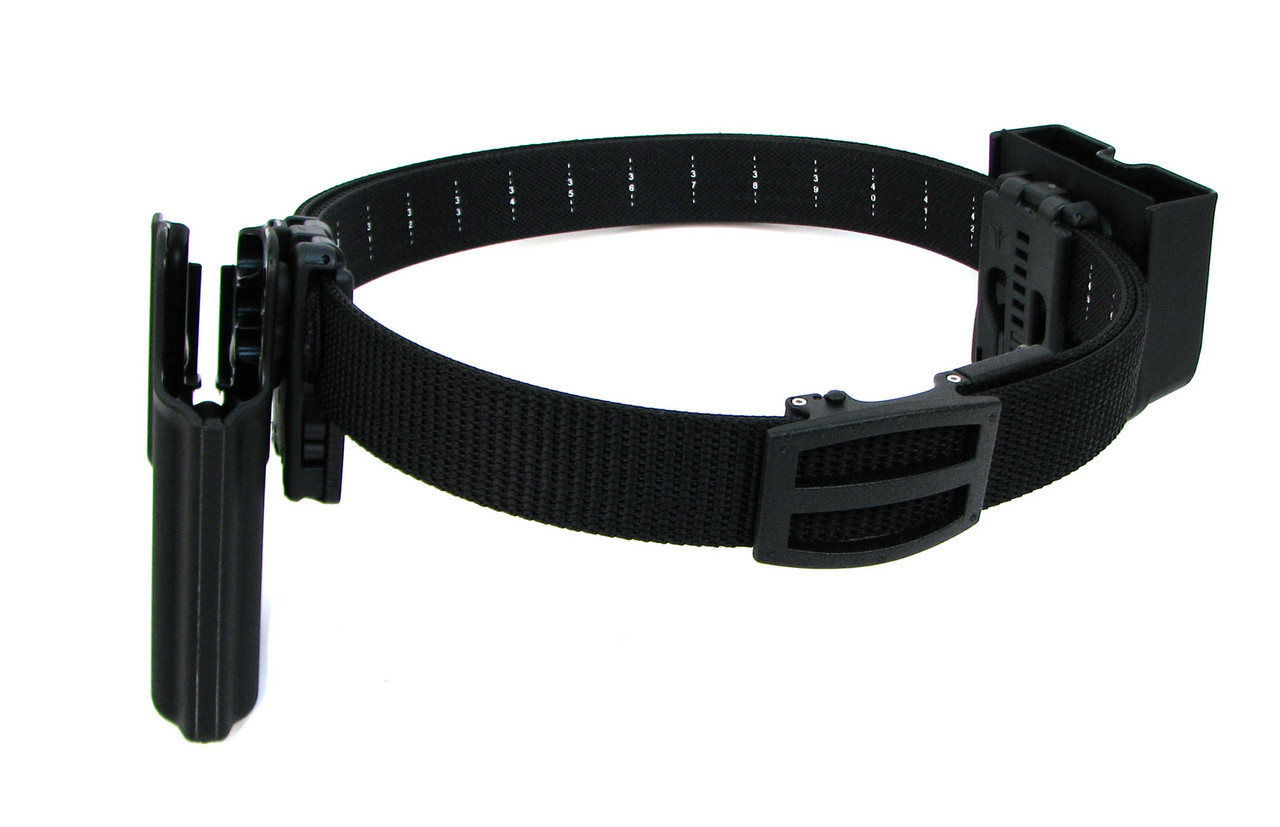
Holsters need to be paired with appropriate belts to perform optimally. Competition belts differ fundamentally from everyday belts.
Competition Belt vs Everyday Belt
| Feature | Competition Belt | Everyday Belt |
|---|---|---|
| Stiffness | Extremely rigid, no flex | Soft, comfort-oriented |
| Width | 1.5"-1.75" | 1"-1.5" |
| Structure | Inner/outer dual-layer design | Single layer |
| Fastening | Velcro | Belt buckle |
| IDPA Compliant | Mostly non-compliant | Compliant |
Major Competition Belt Brands
Double-Alpha Academy (DAA) Belt
Pros:
- Extremely rigid
- Inner/outer layer design is very stable
- Perfect compatibility with DAA accessories
Cons:
- Thicker, compatibility issues with some accessories
- Not IDPA compliant
CR Speed Belt
Pros:
- Moderate thickness
- Compatible with most accessories
- Adequate stiffness
Cons:
- Not fully compatible with DAA accessories (despite both being 1.5")
Safariland ELS Belt
Pros:
- Perfect pairing with ELS system
- Extremely modular
Cons:
- Wider (1.75"), compatibility issues with standard accessories
- Higher price
Ghost Belt
Pros:
- European quality
- Perfect compatibility with Ghost accessories
IDPA Compliant Belts
IDPA requires belts to be threaded through pant belt loops, so competition dual-layer belts are typically non-compliant.
Recommended IDPA Belts:
- Wilderness Instructor Belt
- 5.11 Tactical Belt
- Kore Essentials Gun Belt
- Blue Alpha Gear
Holster Recommendations by Division
IPSC/USPSA Open Division
Recommended Setup:
- Holster: DAA Alpha-X or Ghost The One EVO
- Belt: DAA or CR Speed dual-layer competition belt
- Budget: $300-400 (holster + belt)
Key Points:
- Speed priority
- Ensure compatibility with your handgun
- Consider red dot optic versions
IPSC/USPSA Limited Division
Recommended Setup:
- Holster: DAA Race Master or CR Speed WSM II
- Belt: DAA or CR Speed dual-layer competition belt
- Budget: $250-350
IPSC/USPSA Production / Production Optics
Recommended Setup:
- Holster: Blade-Tech DOH or Comp-Tac International
- Belt: DAA or CR Speed dual-layer competition belt
- Budget: $150-250
Note: Production division does not allow drop/offset, verify holster configuration.
IDPA All Divisions
Recommended Setup:
- Holster: DAA MAX IDPA or Dara Action Sport or Black Scorpion IDPA
- Belt: Wilderness Instructor Belt or Kore Essentials
- Budget: $100-200
Notes:
- Holster must be concealable
- Belt must thread through pant loops
- Consider AIWB configuration (allowed from 2025)
Competing in Both IPSC and IDPA
If you want one setup for both competitions:
Recommended Setup:
- Holster: DAA MAX IDPA (meets both rules)
- Belt: Wilderness Belt (IDPA compliant, usable for IPSC)
- Budget: $150-200
Trade-off: This setup won’t be the fastest in IPSC, but can be legally used in both competitions.
Beginner Budget Planning
Budget Setup ($100-150 USD)
Suitable for newcomers just starting competitive shooting.
| Item | Recommendation | Price |
|---|---|---|
| Holster | Dara Action Sport or Black Scorpion | $60-80 |
| Belt | Wilderness Instructor Belt | $40-50 |
| Total | $100-130 |
Suitable For: IDPA, IPSC Production (verify rules)
Mid-Range Setup ($200-300 USD)
Suitable for shooters seriously committed to competitive shooting.
| Item | Recommendation | Price |
|---|---|---|
| Holster | Blade-Tech DOH or DAA MAX IDPA | $100-150 |
| Belt | CR Speed or DAA competition belt | $80-120 |
| Total | $180-270 |
Suitable For: IPSC Production/PO, IDPA
Advanced Setup ($350+ USD)
Suitable for competitive shooters pursuing peak performance.
| Item | Recommendation | Price |
|---|---|---|
| Holster | DAA Alpha-X or Ghost The One EVO | $200-225 |
| Belt | DAA or Safariland ELS competition belt | $100-150 |
| Total | $300-375 |
Suitable For: IPSC Open/Limited
Holster Maintenance and Usage Tips
Daily Maintenance
-
Cleaning
- Regularly wipe inside and outside of holster with dry cloth
- Avoid cleaners that may soften plastic
- Check and remove dust and debris
-
Check Screws
- Regularly inspect all adjustment screws
- Use Loctite to prevent loosening
- Always check before matches
-
Retention Adjustment
- Find the retention level that works for you
- Too tight affects draw speed
- Too loose may cause pistol to fall out
Training Tips
-
Dry Fire Practice
- Spend 10-15 minutes daily practicing draws
- Use Shot Timer to track progress
- Focus on building muscle memory
-
Segmented Training
- First practice grip (without drawing)
- Then practice slow draws
- Finally add timing
-
Common Mistakes to Avoid
- Don’t “fish” during draw (hooking trigger guard with fingers)
- Ensure deep web grip
- Keep index finger straight until on target
💡 Further Reading: Want to dive deeper into draw training? See our Pistol Draw Technique Complete Guide
Frequently Asked Questions (FAQ)
Q1: What holster should beginners buy first?
A: We recommend starting with a Blade-Tech DOH or Dara Action Sport. These holsters are reasonably priced and meet most division rules, allowing you to avoid over-investing before determining your focus.
Q2: How much difference does a Race Holster make?
A: In draw speed, a Race Holster can be 0.2-0.5 seconds faster than a regular holster. However, for beginners, this difference is less important than fundamental technique. Upgrading after your technique stabilizes makes more sense.
Q3: Can I use the same holster for both IPSC and IDPA?
A: Yes, but you need to choose a holster that meets both rules. The DAA MAX IDPA or Dara Action Sport are good choices. However, this means you can’t use the speed advantage of a Race Holster in IPSC.
Q4: Is the belt really that important?
A: Very important. The rigidity of a competition belt ensures the holster and mag pouches stay in position, so each draw and reload can be consistent. A soft belt causes equipment to shift, affecting muscle memory development.
Q5: What’s the difference between Kydex and plastic holsters?
A: Kydex is a high-strength thermoplastic material that can be precisely molded to fit a pistol’s exterior. Regular plastic holsters (like Race Holsters) use injection molding, suitable for designs requiring special functions. Both have advantages; choice depends on use case.
Q6: How should I adjust the holster angle?
A: This depends on personal preference and body type. We generally recommend starting from a neutral position, then fine-tuning to the most natural draw angle. Use a Shot Timer to test different angles and find the fastest configuration.
Q7: How do I confirm my holster meets competition rules?
A:
- Read the official rulebook for that competition
- Check the holster manufacturer’s specifications
- Confirm with the Safety Officer before the match
- Ask for experience in relevant communities
Q8: What’s different about red dot optic versions of holsters?
A: Red dot optic versions have enlarged openings or cutouts to accommodate the red dot mounted on the slide. If your pistol has a red dot, make sure to choose a compatible holster model.
Summary
Choosing a competition holster is a decision that requires considering multiple factors. Here are the key points:
- Understand the rules first: Confirm the competition type and division you want to enter
- Start with basics: Beginners don’t need the most expensive gear; technique matters more than equipment
- Choose the right belt: Holster and belt are a system that need to work together
- Practice consistently: Even the best holster requires extensive practice to be effective
- Upgrade gradually: Upgrade equipment as your technique improves
Regardless of which holster you choose, the most important thing is investing time in practice. Use the Shot Timer App to track your draw times, set goals, and continuously improve.
Related Article Recommendations
- Pistol Draw Technique Complete Guide
- IPSC Beginner Pistol Selection Guide
- IDPA Beginner Pistol Selection Guide
- IPSC Practical Shooting Complete Training Guide
- IDPA Defensive Shooting Complete Training Guide
- Shot Timer App Complete Guide
- Holster
- Competition Holster
- Race Holster
- IPSC
- USPSA
- IDPA
- Safariland
- Double Alpha
- Ghost
- Shooting Gear