Airsoft vs Paintball: Which Hurts More? Pain, Cost & Range
Contents
The short answer (BLUF)
- Paintball hurts more. A standard .68 paintball (about 3 g at 280 fps) carries roughly 10.9 J at the muzzle; a 0.20g airsoft BB at 350-400 fps carries 1.1-1.5 J. That’s about 10x the energy and 12x the momentum.
- Up close, the sting per square centimetre is surprisingly similar (about 4-5 J/cm² for both), which is why a point-blank BB on bare skin feels sharp. The gap grows with distance: a paintball keeps its speed better, so at 20-30 m it’s carrying 17-25x what a BB has left.
- Does airsoft hurt? Yes, but briefly: a quick sting that usually leaves a small red dot. Bare knuckles, ears and the neck at close range are the exceptions. Paintball leaves welts and bruises that can last days.
- Airsoft is cheaper to shoot: about $3-7 per 1,000 BBs against $23-40 per 1,000 paintballs.
- Pick paintball for a fast, refereed, rental-friendly sport where hits are undeniable. Pick airsoft for realism, longer games, less pain and cheaper ammo — and a replica you can actually train with at home.
The question I get most from friends who have never played either is not “which is more fun”. It’s “which one hurts”. Usually they’ve seen a paintball welt on someone’s arm, or a video of someone flinching at an airsoft BB, and they want to know what they’re signing up for before they spend a Saturday and $60 on it.
Most answers online stop at “paintball hurts more because the ball is bigger”. That’s true, but it hides the interesting part. Measured per square centimetre, a BB fired from across a room hits about as hard as a paintball does. Further out, though, paintball pulls far ahead, because a heavy ball holds its speed much better than a tiny light one. Below are the actual energy numbers, what they mean for your skin, what each game costs per day, why airsoft BBs reach further, and how to decide.
Does Airsoft Hurt?
Yes, airsoft hurts, but for most hits it’s a short sting that fades in seconds. A 0.20g BB at a typical field limit of 350-400 fps lands with 1.1-1.5 joules, about the feeling of a rubber band snapped against your skin, sometimes leaving a small red dot or a raised bump for a day.
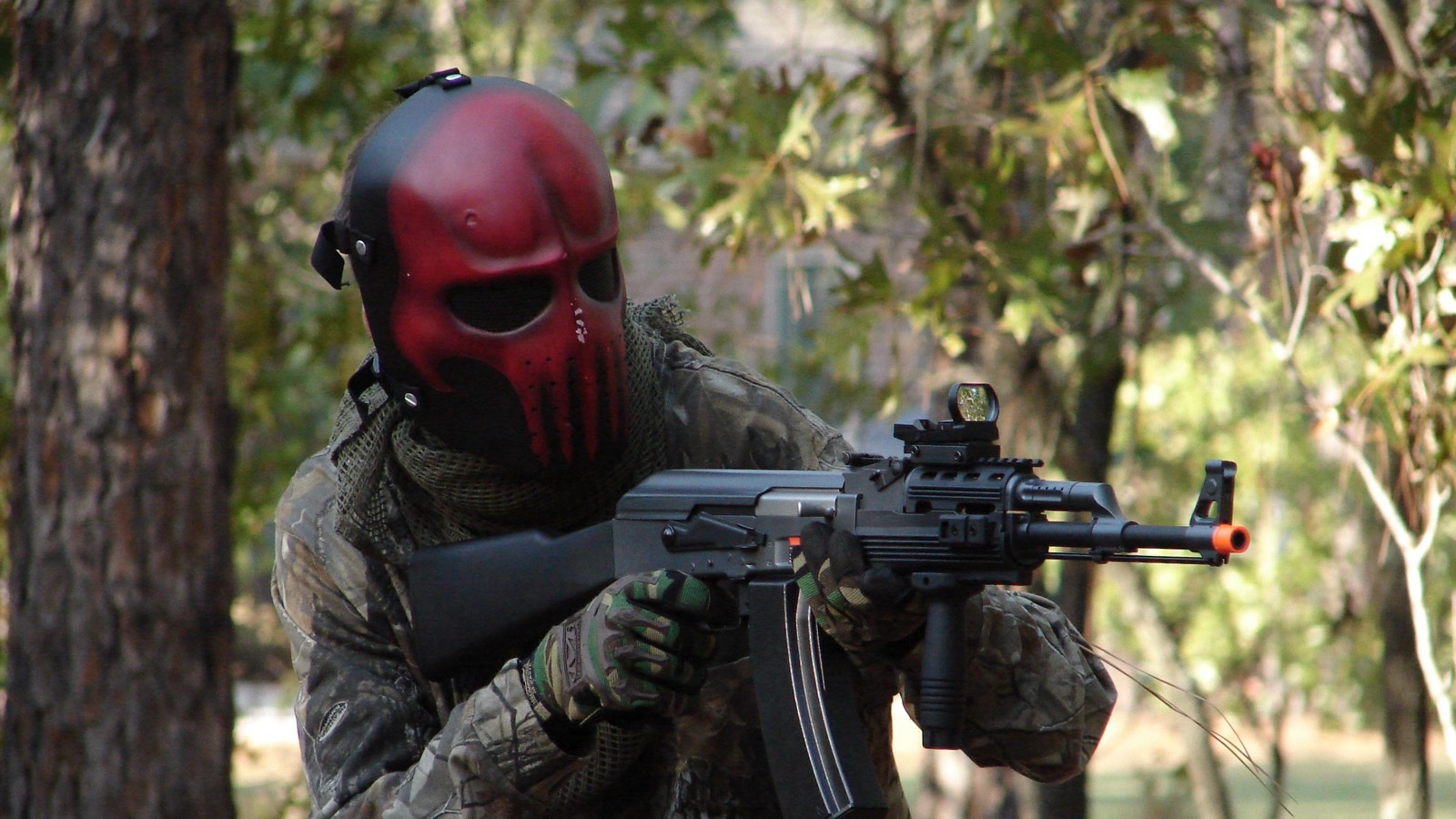
How much it hurts depends on three things more than on the gun. The first is what it lands on. Through a hoodie or a plate carrier you may not feel it at all, which is exactly why airsoft runs on honest hit calling. On bare skin, especially thin skin over bone — knuckles, the back of the hand, ears, the neck — a close hit stings sharply and can occasionally break the skin. That’s why most players wear gloves and why many fields require lower-face protection for younger players: teeth are the one place a BB can do real damage.
The second is distance. A BB loses speed fast. Using a simple drag model for a smooth 6 mm sphere, a 0.20g BB fired at 350 fps is down to roughly half its energy by 10 m and a quarter of it by 20 m. A hit from across a big outdoor field can feel like a flick; the same gun across a CQB hallway feels like a slap.
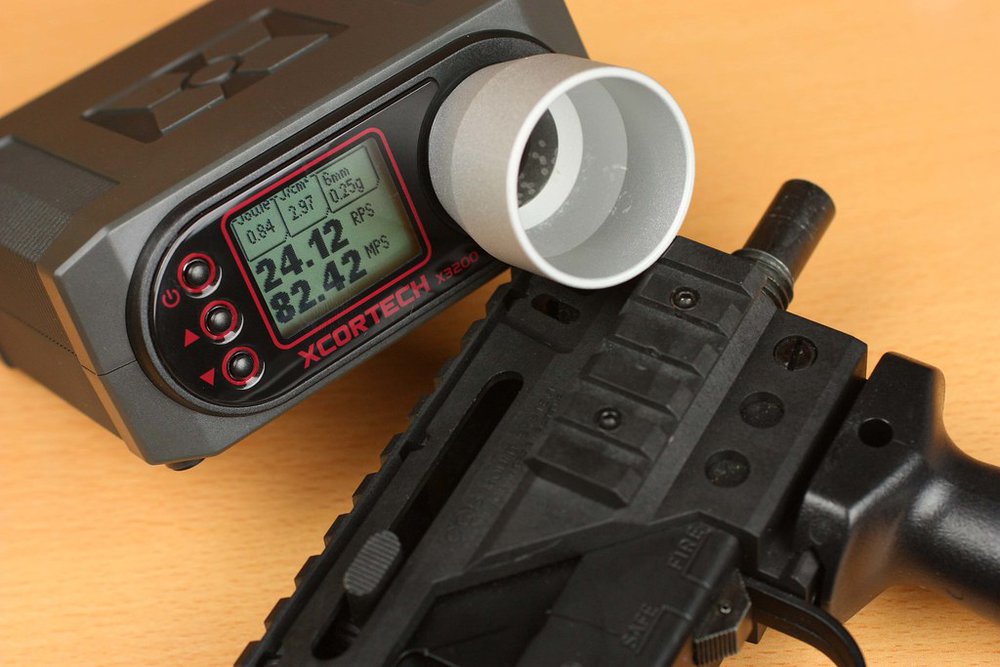
The third is the gun’s power class. Moving from 350 to 400 fps on the same 0.20g BB raises energy from 1.14 to 1.49 J, about 30% more. That’s the gap between a UK-style CQB site and a US outdoor field. Snipers and DMRs go higher still, which is why they come with minimum engagement distances. The airsoft rules guide covers those limits field by field, and the chronograph and joule guide shows how to convert your own gun’s reading.
Which Hurts More: The Energy Numbers
Paintball hurts more, and the numbers show by how much: about 10x the energy at the muzzle, 12x the momentum, and 17-25x the energy once both have travelled 20-30 m. Here is how the common projectiles compare. Muzzle values are straight ½mv²; the 20 m column uses a drag model (smooth sphere, drag coefficient 0.40-0.47, no spin), so treat it as an estimate rather than a measurement.
| Projectile | Muzzle energy | Per cm² at muzzle | Energy at 20 m | Per cm² at 20 m | Momentum vs BB |
|---|---|---|---|---|---|
| Airsoft 0.20g @ 350 fps | 1.14 J | 4.1 J/cm² | 0.24-0.30 J | 0.9-1.1 J/cm² | 1x |
| Airsoft 0.20g @ 400 fps | 1.49 J | 5.4 J/cm² | 0.31-0.39 J | 1.1-1.4 J/cm² | 1.1x |
| .50 low-impact paintball, 1.3 g @ 250 fps | 3.8 J | 3.0 J/cm² | 1.3-1.5 J | 1.0-1.2 J/cm² | 4.6x |
| .68 paintball, 3.0 g @ 280 fps | 10.9 J | 4.7 J/cm² | 4.5-5.2 J | 1.9-2.2 J/cm² | 12x |
| .68 paintball, 3.0 g @ 300 fps | 12.5 J | 5.3 J/cm² | 5.2-5.9 J | 2.2-2.5 J/cm² | 12.9x |
The paintball rows follow the real limits. ASTM’s specification for .68 paintballs puts the diameter at 17.3 mm and caps the weight at 3.5 g, and brands such as Dye describe a typical ball as about 3 g. Field velocity is capped at 300 fps across the industry, and most fields set 280 fps: Steel Town, Cousins Paintball Park and Yankee Paintball all publish 280.
Why the “per square centimetre” column matters
Look at the third column and something odd shows up: at the muzzle, a BB and a paintball land with nearly the same energy per square centimetre, 4.1 against 4.7 J/cm². Sharpness of sting tracks how concentrated the energy is, while bruising tracks how much total energy and momentum you absorb. So a close airsoft hit stings about as sharply as a paintball, but it’s a pinprick, not a fist. A paintball spreads ten times the energy over an area the size of a coin and pushes deeper into the muscle. That’s the welt.
Why paintball pulls ahead with distance
The 20 m column is where the two sports really separate. Air drag slows a projectile in proportion to its cross-section divided by its mass, and a BB has nearly twice as much frontal area per gram as a paintball. In the model, a 0.20g BB loses half its speed in about 18-21 m; a paintball takes 31-37 m. By 20 m the energy ratio has grown from 10x to about 17-19x, and by 30 m it’s around 25x. A long-range paintball hit can still leave a mark, while a long-range BB often goes unnoticed.
What about low-impact paintball?
.50-calibre “low impact” paintball sits in between. A 1.3 g ball at 250 fps carries about 3.8 J (Fort Myers Paintball lists 1.3 g, 250 fps, 3.77 J), roughly three times an airsoft BB, but spread over a 12.7 mm ball its per-area figure is actually lower than airsoft’s. It feels more like a thud than a sting, which is why it’s popular for kids’ parties and first-timers.
One thing we couldn’t find is a measured figure for how much energy a paintball loses when it bursts. Players commonly say a ball that bounces hurts more than one that breaks, and the physics agrees in direction — a bounce reverses momentum, so it delivers a bigger impulse — but nobody has published a reliable percentage, so don’t trust any page that quotes one.
Welts, Bruises and Real Injuries
A paintball hit typically leaves a red welt that swells for several hours and fades over a few days; an airsoft hit usually leaves a small dot that’s gone by the next day. Lone Wolf Paintball’s own guidance says paintball swelling usually goes down within about 12 hours and the mark disappears within a few days, while players on r/paintball describe bruises lasting about a week. Airsoft players report the opposite trade-off: less pain, but because the energy is concentrated, a close hit on bare skin can raise a small welt that lingers.
Neither sport is dangerous with eye protection on. Where things go wrong is eyes. A study of US emergency-department data published in Pediatrics in 2019 estimated 364,133 children treated for non-powder gun injuries from 1990 to 2016, with BB guns at 81%, pellet guns 16%, paintball 3% and airsoft under 1%. About 15% were eye injuries, and 22% of those needed hospital admission. A word of caution: the study has no count of how many children played each sport, so it can’t tell you airsoft is safer per game. What it shows is that the serious injuries happen without proper goggles, and mostly with BB guns that were never meant to be shot at people.
The protection standards are different but overlap. Paintball goggles and masks are certified to ASTM F1776; airsoft fields ask for ANSI Z87.1 full-seal goggles or ASTM F2879, the standard written specifically for airsoft eye protection. Many fields accept a paintball mask for airsoft — Summerlin Paintball’s rules, for example, accept “full-seal ANSI Z87.1+ or ASTM F1776 certified” goggles for airsoft — but check with the field, and never use mesh. The airsoft mask guide goes through the options.

Cost: Guns, Ammo and a Day at the Field
Airsoft costs about a tenth as much to shoot. Field paint runs $70-80 per case of 2,000 (TPA lists 2,000 field-paint-only for $70; Let’s Play Paintball $79.95), which works out to 3.5-4 cents a shot. Store paint is cheaper at roughly $45-60 a case, if your field allows outside paint. Airsoft BBs cost $16-25 per 5,000 online (Evike’s Elite Force 0.20g, for example), or 0.3-0.5 cents a shot, and even field-sold BBs at $7 per 1,000 come in under a cent.
At 1,000 rounds — a normal day for an active player in either sport — that’s about $35-40 of field paint against $3-7 of BBs. That single line explains most of the “paintball gets expensive” complaints you’ll read. The entry fees themselves are closer than people think: paintball parks often charge a small entry fee and sell air and paint separately ($5 entry plus $15 air at one park, or an $85 package with 2,000 balls at another), while airsoft walk-on days typically run $25-35.
Gear costs overlap more than ammo costs do: both sports have rental packages for first-timers and entry-level guns in a similar price range. The difference is that airsoft has a long tail of upgrades, batteries and gas, while paintball has a long tail of paint. The airsoft field guide breaks down a typical day’s costs in more detail.
Range, Accuracy and How the Games Play
Airsoft BBs reach further and fly straighter, even though they lose speed faster. A typical AEG rifle has an effective range of about 150-200 ft (45-60 m), while paintball markers are effective to about 40 yards (roughly 35 m); anything beyond that is “longballing”, as Tippmann’s parts site puts it.
That looks backwards after the drag numbers above, so here’s the reason. Airsoft guns have a hop-up, a rubber nub that puts backspin on the BB. The spin generates lift that holds the BB up against gravity and keeps it on a straighter line. A round paintball has no consistent spin, so it starts dropping and curving early. The paintball industry’s answer is fin-stabilised shaped rounds such as First Strike, which their maker claims fly over 50% further than standard paint. Treat that as a manufacturer claim; it isn’t independent testing.
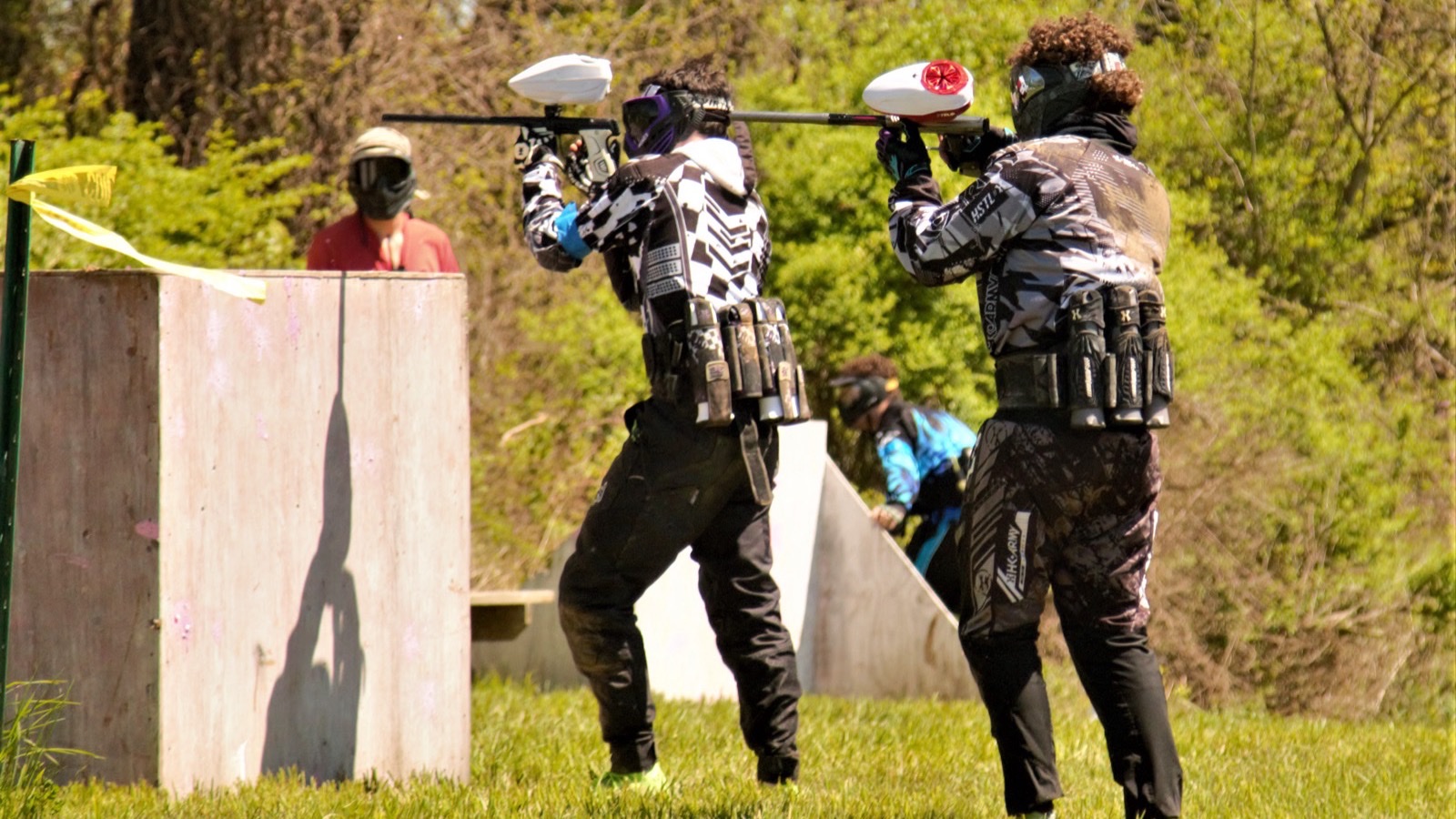
The games themselves feel very different. Paintball is a refereed sport: the paint mark is the proof of a hit, games are short, and tournament speedball is fast and loud. Airsoft depends on players calling their own hits, games run longer, and the replicas look and handle like real firearms, which pulls in people who enjoy military simulation, tactics and gear. Paintball parks are everywhere and very rental-friendly; airsoft is more often a bring-your-own-gear hobby with a smaller number of dedicated fields.
Which Should You Choose?
Choose paintball if you want a fast, sporty game you can turn up to with nothing, you like that a hit is undeniable, or you’re organising a group outing where nobody owns gear. Low-impact .50 calibre is a good middle ground for younger players.
Choose airsoft if pain is the main thing putting you off, you’d rather spend money on equipment than on consumables, you like realism and longer tactical games, or you’re interested in shooting skills beyond the game itself. Most first-timers who try both settle on the one that matches why they came: the adrenaline crowd sticks with paintball, the tinkerers and tacticians drift to airsoft. If you’re leaning airsoft, start with the airsoft beginner guide, and if speed is what draws you, have a look at speedsoft, airsoft’s answer to speedball.
The Training Difference Nobody Mentions
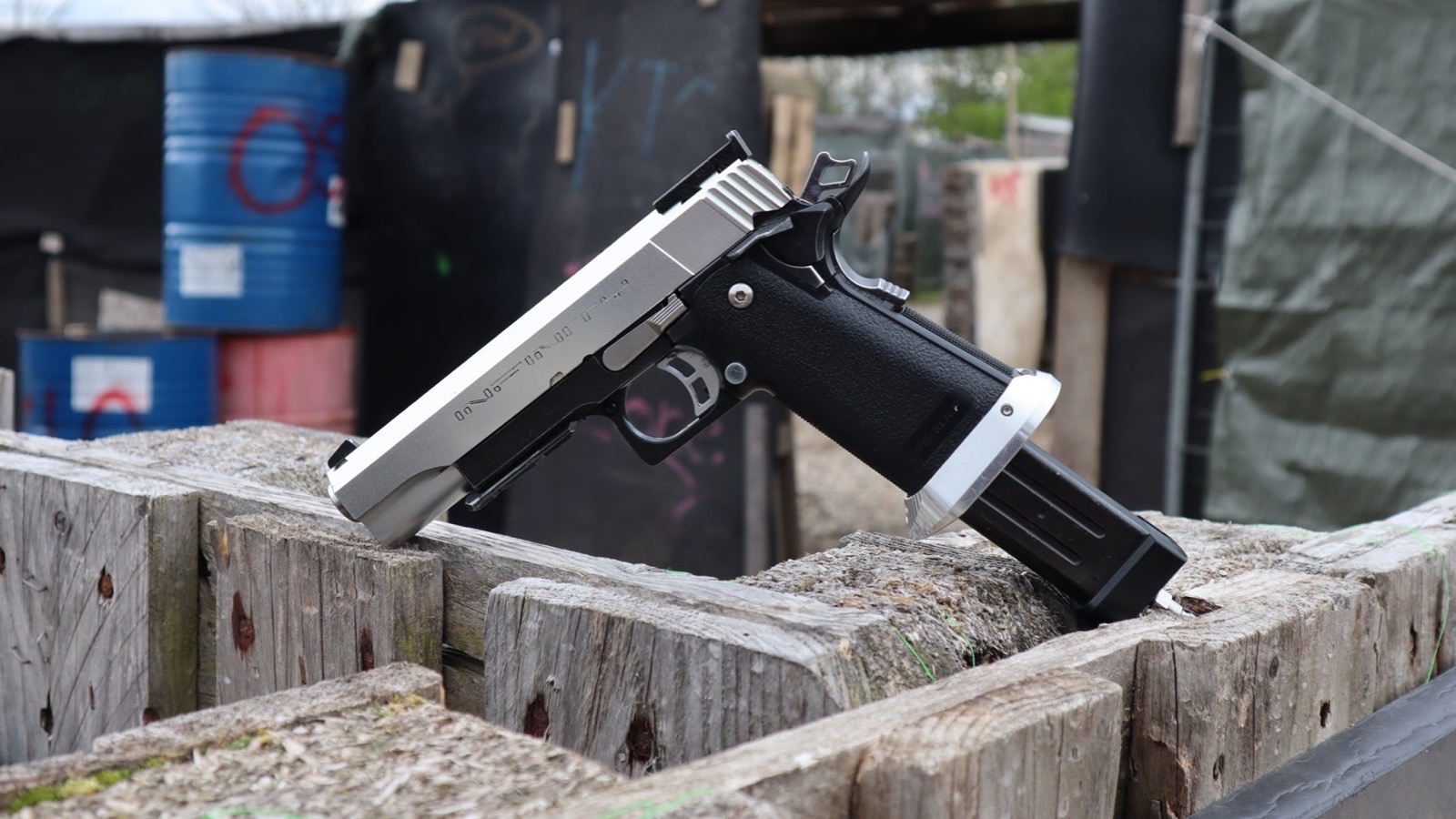
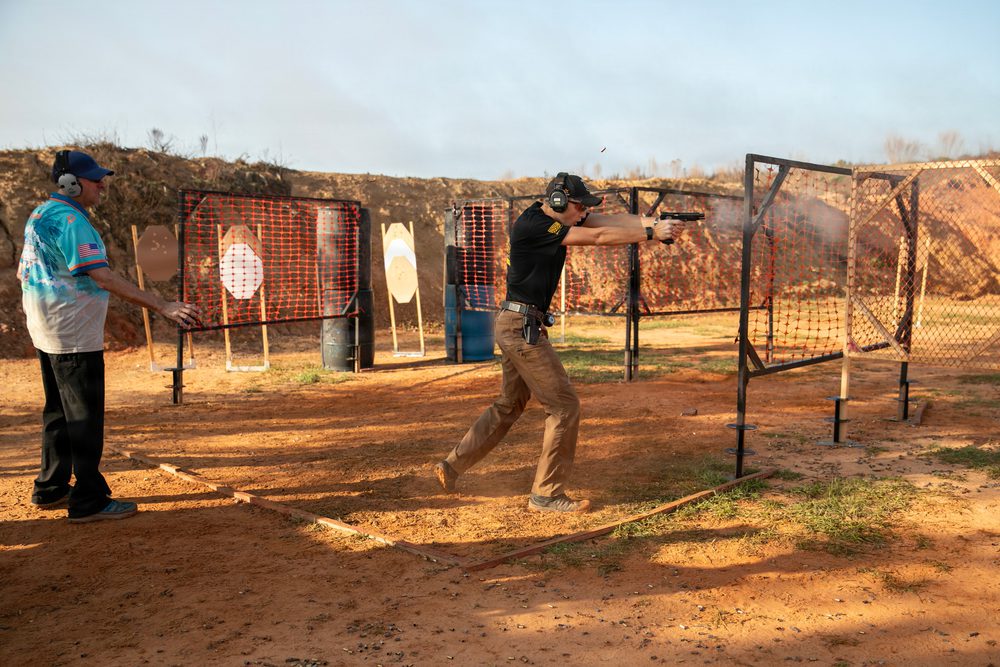
Airsoft gives you something paintball can’t: a replica that works like the real gun, so you can practise drawing, shooting and reloading at home. A gas blowback pistol has the same controls, holster and magazine changes as its firearm equivalent, which is why IPSC runs an official airsoft discipline, IPSC Action Air. There’s no paintball equivalent for that kind of precision practice.
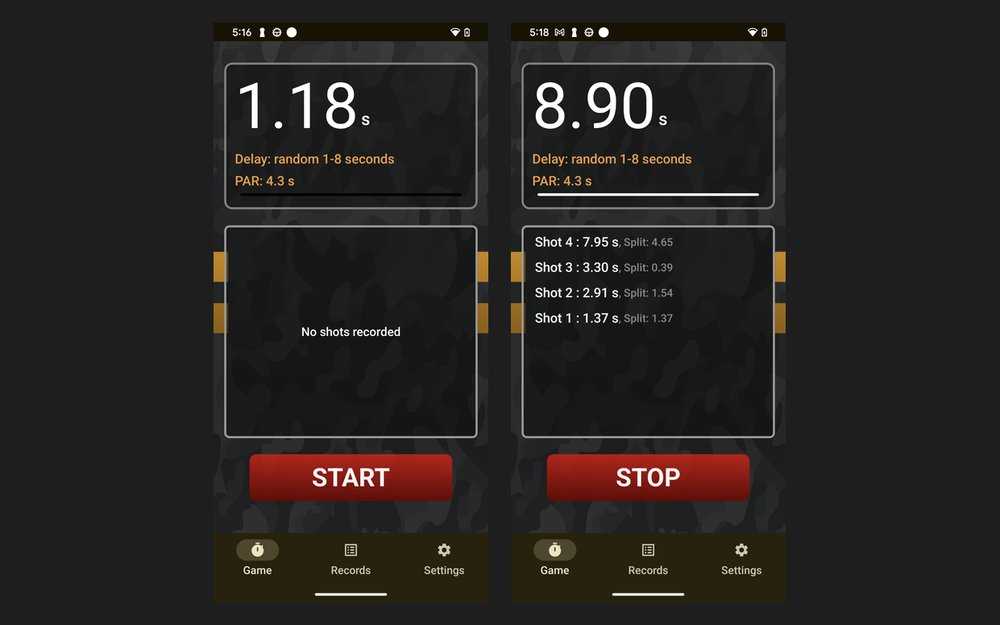
The problem is that GBB pistols are too quiet for most hardware shot timers. That’s the gap our Airsoft Shot Timer App was built for: it listens for the airsoft frequency range, so a GBB in your living room registers as clearly as a 9mm on a range. A good first session is ten draws to a single shot on an A4 sheet at 5 m, recording your time each rep. Beginners typically land around 2.5-3.0 seconds (see the pistol draw guide for benchmarks), and the same habits make you faster at your next airsoft game.
Frequently Asked Questions
Does airsoft hurt more than paintball?
No. A 0.20g BB at 350-400 fps carries 1.1-1.5 J, while a .68 paintball at 280 fps carries about 10.9 J, around ten times more. A close airsoft hit on bare skin stings sharply because the energy is concentrated on a 6 mm point, but it rarely leaves the multi-day welt a paintball does.
How bad does 400 fps airsoft hurt?
A 0.20g BB at 400 fps carries about 1.49 J, roughly 30% more than at 350 fps. Point-blank on bare skin it stings hard and can raise a welt or occasionally break thin skin, which is why fields pair 400 fps limits with minimum engagement distances. At 20 m it has lost about three-quarters of that energy.
Is airsoft cheaper than paintball?
Usually, yes. Per shot, BBs cost 0.3-0.7 cents and field paint 3.5-4 cents, so 1,000 rounds is about $3-7 in airsoft against $35-40 in paintball. Entry fees are similar ($25-35 for airsoft walk-on, while paintball parks often charge a small entry fee plus air and paint).
Can you use a paintball mask for airsoft?
Often, yes. Paintball masks are certified to ASTM F1776 and are full-seal, and many airsoft fields accept them alongside ANSI Z87.1 and ASTM F2879 goggles. Check your field’s rules first, and never use mesh goggles for either sport.
Is airsoft or paintball better for kids?
Both have youth programmes, and age minimums are set by each field. For a first try, .50 calibre low-impact paintball (about 3.8 J, spread over a larger ball) or low-power airsoft with full-face protection are the gentlest options. The biggest safety factor for either is keeping full-seal eye protection on at all times.
Does airsoft hurt without armor?
Through a T-shirt you’ll feel a clear sting; through a hoodie or jacket much less. You don’t need armour, but gloves and lower-face protection are worth wearing, because knuckles and teeth are the places a close hit actually does damage.
The Bottom Line
Paintball hurts more, by about ten times the energy at the muzzle and much more at range. Airsoft stings, sometimes sharply up close, but it’s over in seconds. Paintball costs more to shoot; airsoft costs more to tinker with. If the fear of pain has been keeping you from trying either one, airsoft with good goggles, gloves and a lower-face mask is the gentle way in.
And if you go the airsoft route, use the replica for more than game days. Download the Airsoft Shot Timer App and time ten draws at home this week — it’s the cheapest way to show up to your next game faster than you left the last one.
Related Articles
- Complete Airsoft Beginner Guide — Gear, guns and your first game
- Airsoft Rules — Hit calling, FPS limits and minimum engagement distance
- Airsoft Chronograph & Joule Guide — FPS-to-joule chart for every BB weight
- Airsoft Mask Guide — Eye and face protection that passes field rules
- Airsoft Field Guide — Field types, costs and finding a field near you
- Speedsoft Beginner Guide — Airsoft’s fast, speedball-style format
Sources: ASTM F1979 (paintball specification: 17.3 mm, max 3.5 g); Dye Paintball and Action Packed Paintball (ball weights); Fort Myers Paintball (.50 cal 1.3 g / 250 fps / 3.77 J); 300 fps industry limit per the ASTM field standards summarised in Ophthalmology Clinics; field rules of Steel Town Paintball, Cousins Paintball Park, Yankee Paintball and Summerlin Paintball; ASTM F1776 and ICS Labs (F1776 / F2879); Tippmann Parts (paintball range); Redwolf Airsoft (AEG range and hop-up); ANS Gear (First Strike claim); prices from TPA, Let’s Play Paintball, Fox Paintball, Evike, Xtreme Park and Crossfire Airsoft, checked November 2026; injury data from the Nationwide Children’s Hospital study in Pediatrics (2019). Energy figures calculated with E = ½mv²; the 20 m figures use a drag model for a smooth sphere without spin (Cd 0.40-0.47, air density 1.2 kg/m³) and are estimates.
Image credits: cover and field — Liberty Paintball 2023 Zombie Invasion Big Game 09 and 12 by Coldstreamer20, CC BY-SA 4.0; airsoft player — Airsoftmask.JPG by Jason Wolonick, public domain; paintballs — Paintballs.jpg by BraNewbs, CC BY-SA 2.0. Photos cropped to 16:9.


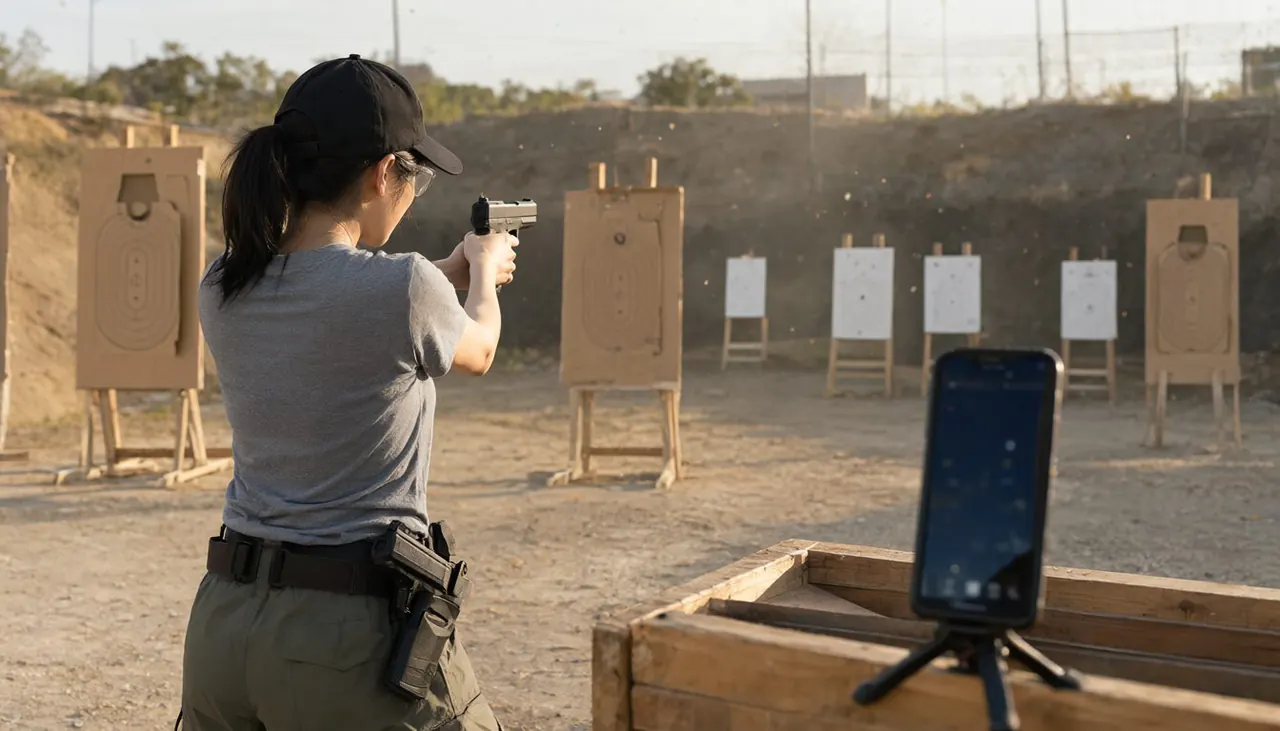
 Airsoft Shot Timer
Put a Shot Timer in Your Pocket
Automatic airsoft shot detection, split times, multiple PAR times and training records — no sign-up.


Related articles