Airsoft Grenade Complete Guide: Smoke Grenades, Sound Grenades & BB Grenades Explained
Why Grenades Change the Game
Picture this: you’re pinned down in a CQB arena, two or three opponents have locked down the room across the hallway, and anyone who peeks gets lit up immediately. Your whole squad is stuck in a stalemate, the game’s momentum completely frozen. Now imagine pulling a grenade from your belt, lobbing it through that doorway — a deafening bang or a wall of smoke — and suddenly the entire situation flips in your favor.
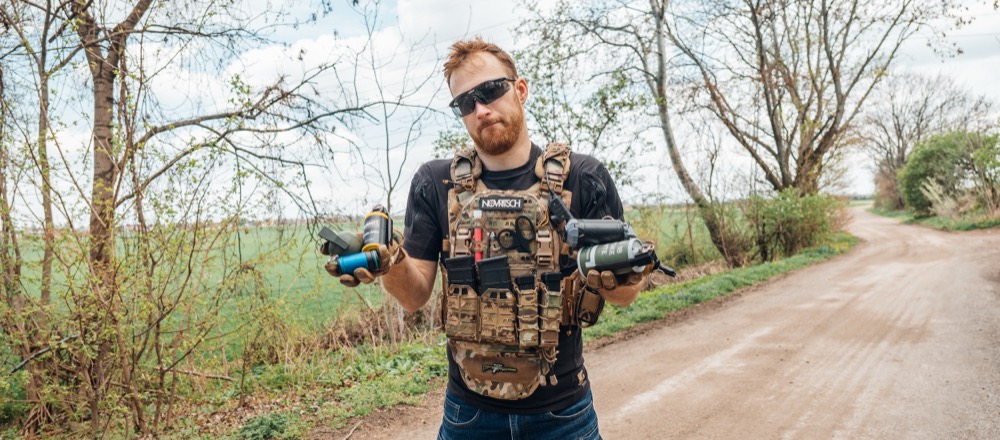
Grenades in airsoft aren’t just cool accessories. They’re legitimate tactical tools that can break stalemates, create movement opportunities, and clear rooms that would otherwise be impossible to take. Whether you’re using a smoke grenade to screen your squad’s advance, a sound grenade to shock defenders before a breach, or a BB grenade to eliminate everyone hiding in a closed room, grenades add an entirely new tactical dimension to the game.
The tricky part is that grenades come in wildly different types, from cheap single-use smoke canisters to reusable gas-powered BB grenades, and the price-to-performance ratio varies enormously. This guide walks you through every type, what they’re best at, and how to pick the right one for your play style.
The Four Types of Airsoft Grenades
Airsoft grenades fall into four main categories, each serving a fundamentally different purpose on the field. Understanding these differences means using the right grenade at the right moment.
Smoke Grenades — Visual Cover on Demand
Smoke grenades are probably the first type most players encounter. Pull the ignition mechanism and within seconds, thick colored or white smoke pours out, lasting anywhere from 30 seconds to 2 minutes. On large outdoor fields, a single smoke grenade creates enough visual cover for your squad to safely relocate from one position to another. In MilSim events, smoke grenades become essential tactical signals — red smoke marks enemy positions, green marks safe rally points, purple requests medical support.
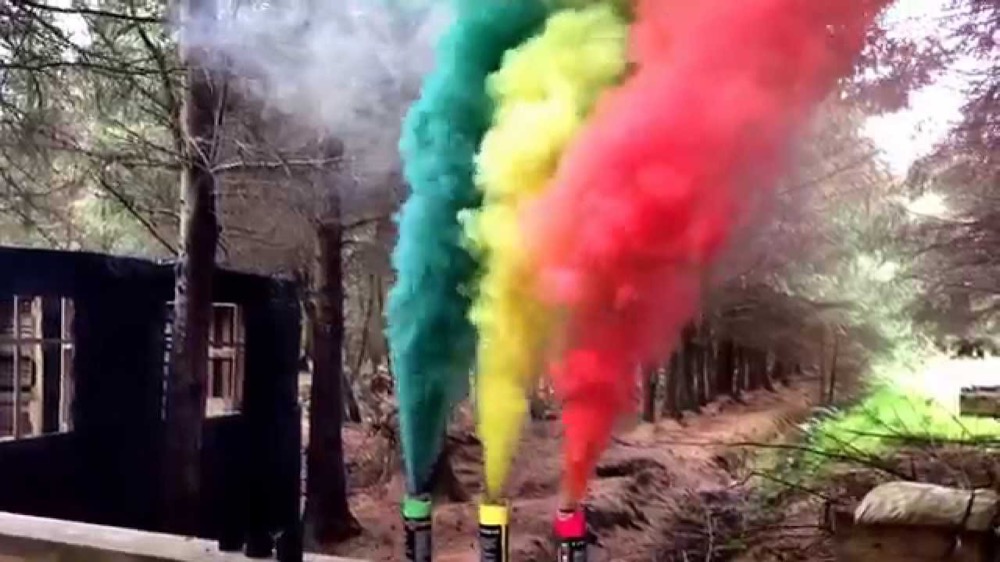
There are important restrictions to keep in mind. Nearly all indoor venues prohibit smoke grenades because the smoke can trigger fire alarms, reduce visibility to dangerous levels, and cause respiratory discomfort in poorly ventilated spaces. Smoke grenades are also single-use consumables — once spent, they’re trash. Over time, this adds up.
Enola Gaye dominates the smoke grenade market. Their Wire Pull series is dead simple to operate — pull the wire and it ignites, producing consistent smoke output. The EG18X is their large-format option with impressive smoke volume, ideal for outdoor fields. Pricing runs about $8-12 for standard Wire Pull grenades and $15-20 for the EG18X.
Sound Grenades — Psychological Warfare
Sound grenades exist for one purpose: to produce a massive bang that creates a moment of psychological shock and confusion. The most iconic is the Thunder B, which uses a 12g CO2 cartridge to generate roughly 130 decibels of explosive noise — about as loud as an actual gunshot. In an indoor CQB arena, that bang reverberating off concrete walls is enough to stun anyone nearby for a second or two, and those seconds are often all you need.
The Thunder B works through a clever mechanism. The core is a reusable metal body that holds the CO2 cartridge, covered by a disposable plastic shell. After pulling the safety pin, CO2 gradually expands until it bursts the plastic shell with a loud pop. The metal core runs about $15-20, and replacement shells cost $1-3 each, making it remarkably economical. The only real drawback is inconsistent detonation timing — sometimes it goes off in two seconds, sometimes five or six, which makes “cooking” the grenade unreliable.
BB Grenades — Actual Elimination Weapons
If smoke and sound grenades are support tools, BB grenades are offensive weapons that can directly eliminate opponents. When triggered, they spray BBs in all directions, simulating the fragmentation effect of a real grenade. Under most field rules, every player within the blast radius (typically 15-20 feet) is eliminated — only hard cover like walls or being in a different room provides protection.
The ASG Storm 360 is one of the most popular BB grenades on the market. Powered by green gas, it holds approximately 160 BBs and ejects them in a full 360-degree spread upon impact. You pull the pin, a button pops up on top, and when the grenade hits the ground and the button depresses, gas releases and BBs fly everywhere. The biggest advantage is that it’s fully reusable — refill the gas, reload the BBs, and it’s ready to go again. At roughly $30-50, the long-term cost is far lower than disposable alternatives.
Flashbangs — Light and Sound Combined
Flashbangs combine bright light with loud noise, simulating the effect of real stun grenades. They’re most effective in dark indoor environments where the flash component adds to the disorientation. However, for safety reasons, airsoft flashbangs have limited light intensity, so the actual “blinding” effect is far less dramatic than the real thing. Most fields treat flashbangs the same as sound grenades, relying primarily on the noise for psychological impact.
TAG Innovation’s FBG-6 represents the professional end of this category. TAGinn products are known for their extreme realism — they’re used not just in recreational airsoft but also in law enforcement and military training programs. The price reflects this quality, but performance is top-tier.
Choosing Grenades for Your Environment
Different game environments demand different grenade types. Using the wrong one doesn’t just waste money — it might violate field rules entirely.
In indoor CQB arenas, sound grenades and BB grenades are your best options. Tight spaces amplify the acoustic impact of a sound grenade dramatically, and a BB grenade’s 360-degree spray in a closed room leaves essentially nowhere to hide. The classic CQB tactic is to toss a sound grenade into a room, then rush in during the moment of confusion. Remember that smoke grenades are almost universally banned indoors.
Outdoor fields are where smoke grenades truly shine. When your squad needs to cross an open area with no cover, two or three smoke grenades can create a “smoke corridor” that lets you move while the enemy’s line of sight is blocked. Sound grenades lose much of their effectiveness outdoors because the noise dissipates quickly in open air.
MilSim events typically have the most comprehensive grenade rule systems. Major events like American Milsim specify exactly which grenade brands and models are approved, what the kill radius is, and what different smoke colors signify. If you’re planning to attend a MilSim event, always review the organizer’s rulebook beforehand.
Safety Rules
The fun grenades bring comes with safety responsibilities. Following these basic rules keeps everyone safe on the field.
Never throw a grenade directly at someone’s face or head. The correct technique is to throw toward the ground or floor of the target area and let the grenade bounce or roll into position. A 130-decibel sound grenade at close range can cause hearing discomfort, so maintaining reasonable throwing distance matters.
Don’t “cook” grenades. Some players want to hold the grenade until it’s about to detonate so opponents can’t react. But airsoft grenades don’t have the predictable timing of real ordnance — they might go off in your hand. Once activated, throw immediately. That’s the safest practice.
Always police your spent grenade debris. Plastic shell fragments and empty smoke canisters scattered across the field create tripping hazards and environmental waste. Many fields require players to clean up their grenade remnants, and it’s basic courtesy even when not required.
Tactical Applications
Knowing when and how to deploy a grenade multiplies its tactical value exponentially. Here are the most practical applications.
Smoke screening for movement is the classic smoke grenade play. When your squad is suppressed and can’t advance, throw smoke between your position and the enemy, wait for it to fully develop, then move. The key is to move through and past the smoke to new cover — if you stop inside the smoke cloud, the enemy can spray into it and still hit you. Once you’re on the other side with solid cover, you’ve gained a tactical advantage.
Room clearing is where sound and BB grenades truly excel. Position yourself beside the doorway, throw or roll the grenade into the room, and enter immediately after detonation. This is especially effective with team coordination — one person handles the grenade while teammates rush in within a second of the bang. For more detailed CQB techniques, check out our Airsoft CQB Close Quarters Battle Complete Guide.
Smoke-covered retreats are another critical skill. When your position is compromised and enemies are closing in, throw smoke between yourself and the threat, then use the visual cover to fall back to a safer position. This works especially well on outdoor fields where smoke has room to spread.
Training Grenade Throws with a Shot Timer
Grenade throwing looks simple, but smoothly executing the full sequence of “retrieve → pull pin → throw → return to fighting stance” under pressure requires practice. A Shot Timer helps you quantify and improve this process.
Set a PAR time and practice the complete cycle: from the buzzer, reach for the grenade on your vest or belt, pull the safety pin, throw to the target area, then re-establish your grip on your primary weapon and return to a shooting stance. Initially this might take 5-6 seconds, but with practice you can bring it down to 3-4 seconds. The goal isn’t extreme speed but smooth, safe execution — especially the ability to quickly resume shooting readiness after the throw.
You can also practice “shoot-then-throw” combination drills during dry fire training. Engage a target with a few shots, then imagine discovering a room that needs clearing, switch to retrieving and throwing a grenade, and return to shooting. This multi-task transition training builds the composure and fluency you need in actual games.
Budget Recommendations for Beginners
If you’re buying your first airsoft grenade, start with a Thunder B sound grenade. The metal core plus a few disposable shells totals about $25-30, giving you a taste of the tactical possibilities grenades offer. Once you know you enjoy using grenades, consider investing in a reusable BB grenade like the ASG Storm 360.
For smoke grenades, base your decision on where you play. If you’re mainly at indoor fields, you won’t need them. If you enjoy outdoor fields or MilSim events, grab a few Enola Gaye Wire Pulls to test the waters — at roughly $10 each, it’s not a painful experiment.
Don’t bulk-buy consumables before you’ve tried them. Start small, figure out which type and brand you prefer, then stock up. Plenty of players have excitedly purchased a pile of smoke grenades only to discover their regular field doesn’t allow them.
Conclusion
Grenades are one of the most underrated pieces of airsoft equipment. They’re not essential like your primary weapon, but once you learn to deploy the right grenade type at the right moment, the entire game experience transforms. From creating movement corridors with smoke to breaking stalemates with sound grenades to clearing rooms with BB grenades — grenades evolve you from a player who only knows how to shoot into a tactical operator who leverages multiple tools.
Start with an affordable Thunder B, feel the rush of lobbing it into a room and hearing that satisfying bang, then rushing in. You’ll never want to play without grenades again.
Related Articles
Airsoft Series
- Airsoft Beginner Complete Guide
- Airsoft Gear Selection Complete Guide
- Airsoft CQB Close Quarters Battle Complete Guide
- Airsoft Field Selection Guide
- Speedsoft Competitive Airsoft Beginner Guide
Training
- Airsoft and Firearms Cross-Training Guide
- IPSC Action Air Competition Guide
- Shot Timer App Complete Guide
Use AirsoftShotTimer to track your training progress!
- Airsoft Grenade
- Airsoft Smoke Grenade
- BB Grenade
- Sound Grenade
- Enola Gaye
- TAG Innovation
- ASG Storm 360
- Thunder B
- CQB
- MilSim
- Airsoft Gear