Below you will find pages that utilize the taxonomy term “Points Down”
Posts
read more
Mozambique Drill: Par Times, Scoring & the Exact Third-Shot Window
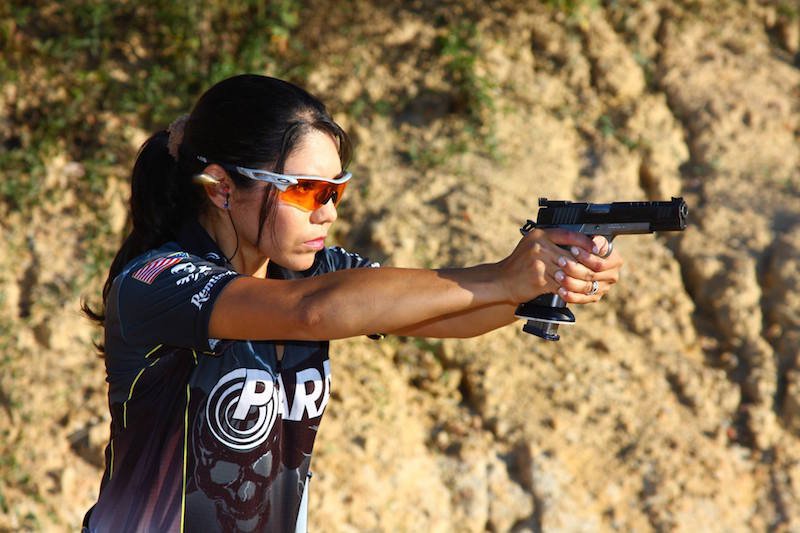
The Mozambique Drill in 60 seconds (BLUF)
- What it is: Draw and fire two rounds to the body, then one precise shot to the head, on a single target at seven yards. Also called the Failure Drill or Failure to Stop.
- Why it exists: It trains the moment your first response doesn’t work — two fast hits, no reaction, and now you need one slow, exact shot under pressure.
- What’s a good time? The classic par is 5 seconds from the holster at seven yards. Around 3 seconds you’re genuinely quick; world-class shooters have run it under one second up close.
- The hard part: The gear change. Your brain has to shift from “fast and loose” torso shots to a “small and exact” head shot mid-string — most people either rush the third shot and miss, or stall for half a second.
- Where exactly does shot three go? Not “the head” — the window between the eyebrows and the upper lip. Everywhere else on the skull is angled bone that can deflect a bullet.
- Three things almost nobody tells you: the 1974 shot that started it all landed in the neck, not the head; the LAPD renamed it the Failure Drill in 1980 over the name’s racial overtones; and most US police departments no longer teach the head shot at all.
- Train it anywhere: The 2+1 rhythm is a pattern skill. An airsoft pistol or a dry-fire rep against a par time on a free Airsoft Shot Timer app builds the same draw, cadence and transition without a single live round.
If you’ve seen John Wick clear a room — two quick shots to the chest, one to the head, next target — you’ve watched a Hollywood-polished Mozambique Drill. Keanu Reeves trained the pattern for the films, and Tom Cruise made an alley version of it famous in Collateral years earlier. But the drill wasn’t invented for the movies. It came out of a gunfight at an airport in 1974 — or at least out of a story about one, which turns out to be a distinction worth making — and it survives in competition warm-ups and training courses today because it tests something almost no other drill does: what you do when your first answer fails.
Posts
read more
IDPA Rules 2026: Scoring, Penalty Seconds & Power Factor by Division
IDPA Rules 2026 in 60 Seconds (BLUF)
Short answer: IDPA scores you on raw time plus penalty seconds — lowest total wins. Hits in the centre -0 zone add nothing, -1 adds one second each, -3 adds three, and a miss is five. The 2026 rulebook calls the two scoring methods Unlimited Scoring (best hits count, extra shots allowed) and Limited Scoring (extra shots get punished) — the old “Vickers Count” and “Limited Vickers” names are gone from the book, though everyone at the range still says them. You must use cover when offered, engage near-to-far (Tactical Priority), reload behind cover, and wear a concealment garment that hides your entire rig with arms outstretched. Procedural errors are 3 seconds, Flagrant Penalties 10 seconds, FTDR 20 seconds, hits on a non-threat 5 seconds, and safety violations (sweeping a muzzle, dropping a loaded gun, AD) are an immediate DQ.